
If you are a journalist who would like to report on this story, please provide a clickable link in your article. Thank you.
In April 2022, the Portuguese police conducted a series of raids on the W52-FC Porto cycling team, which was on a streak of six-consecutive victories at the Volta a Portugal, after obtaining evidence through wiretappings that the team was engaging in organised doping.
The near-undetectable drug AICAR was found by investigators in the homes and hotels of some cyclists, in a case which led to lengthy suspensions and prison sentences.
Over the previous three years, there had already been serious concerns that professional cyclists were taking AICAR in plain sight, in powder form in their water bottles, at the stages of major races.
This intelligence was provided by the Austrian cyclist Georg Preidler to the Movement for a Credible Cycling (MPCC), which subjects its member teams to additional anti-doping regulations, in 2019. A Tour de France team doctor told Ouest France that he had heard the drug could clear the system in as little as twenty minutes.
As part of a criminal investigation, Preidler was caught attempting to blood dope with the help of the German doping doctor Mark Schmidt, who also worked with skiers. He was consequently forthcoming with the contemporary techniques which athletes were using to evade the doping control system - including the use of powders.
“He [Preidler] told us he had strong suspicions about the use of powdered AICAR in the water bottles at the last minute, with a mafia-like system behind it all,” explained Roger Legeay, the former president of the MPCC.
On the day of the W52-FC Porto raids in 2022, not a single cyclist tested positive for banned drugs including AICAR. This was a demonstration of the deficiencies of the doping control system.
No athlete has ever tested positive for AICAR.
Honest Sport now reports that two scientists at the World Anti-Doping Agency (WADA) accredited laboratory at Ghent University, in Belgium, have developed a new technique to detect AICAR. This development opens the window to retroactively retest the samples of elite sportspeople who have consumed AICAR in the past – at the time with little fear of being caught.
But whether this will actually happen, only time will tell. An average of only ten samples a year have been analysed for AICAR since the first test was developed for the drug over a decade ago. No matter how effective a test, if it is not employed then doping will go undetected.
AICAR is a substance produced naturally by the body that stimulates AMP-activated protein kinase (AMPK), a protein that regulates metabolism. AMPK acts as an energy regulator and is activated during exercise. Once activated by AICAR, AMPK works to make energy more available. For example, it increases the usage of fat for energy and helps maintain energy availability during prolonged effort. It therefore increases endurance.
In 2008, studies on mice showed that AICAR improved endurance without any training; the drug increased the running time of these sedentary mice by 44% over four weeks in a study performed by researchers at the Salk Institute in California. The drug was investigated as a potential treatment for diabetes but was never approved because of safety concerns.
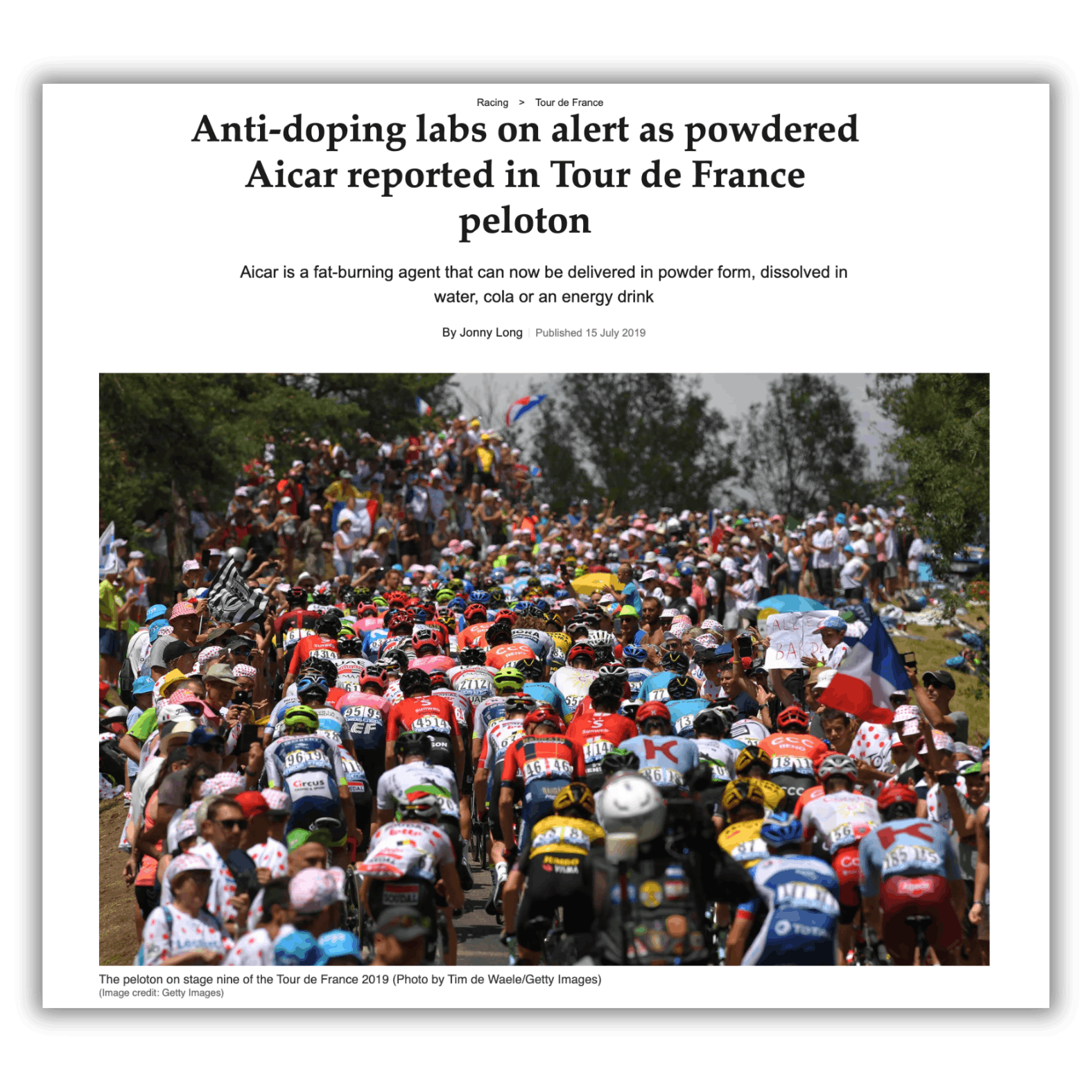
A test for the substance was developed by scientists at WADA-accredited laboratories in 2014 , but as evidenced by the absence of positive AICAR tests it has remained extremely difficult to detect.
Doping substances which are also naturally produced by the body such as AICAR, or testosterone, are more difficult to detect than foreign, artificial substances such as synthetic anabolic steroids. Therefore, an additional ‘confirmatory’ test, known as gas chromatography combustion isotope ratio mass spectrometry (GC-C-IRMS), is required to declare a positive drug test, after initial screening.
Now, the Belgian scientists Michael Polet and Professor Peter Van Eenoo have developed a new validated test for the drug. Their study states that it could allow for more samples, at less cost, to be tested more regularly for the drug. Importantly, this new method is more effective at distinguishing between the body’s naturally produced AICAR and synthetic AICAR, making it easier to declare a positive drug test for the substance.
“Because doping control laboratories are well aware that the confirmation method is onerous and expensive, the number of samples forwarded to IRMS for confirmation is very limited,” reads the study. “This easier, more accessible, and less expensive protocol was fully validated according to WADA IRMS requirements.”
The study describes AICAR as very polar, meaning it is ‘water-loving’ so to speak, making it difficult to analyse using a gas, rather than liquid, chromatography IRMS instrument. AICAR must be chemically modified, a process known as derivatization, before testing can be performed in this way. Testing for AICAR using this method is also more labour intensive and technically challenging than detecting substances like testosterone, making it a more expensive process.
Therefore, the new test adopts liquid rather than gas chromatography, because AICAR is ‘water-loving’, which requires less preparation and is less demanding on the instrument, therefore potentially cheaper.
The authors note that this new technique could be used to send more samples for confirmatory AICAR testing and to retest old samples - for example, those belonging to athletes suspected of using AICAR in powder form.
“An easier, more accessible, and less expensive protocol is needed, which then would also entice Anti-Doping Organizations to include AICAR analyses in their retesting program (for example, samples in long-term storage from 5 to 10 years ago),” reads the study.
When Honest Sport contacted the International Testing Agency, which operates the retesting programmes at every Olympics and on behalf of the International Cycling Union, official comment was not provided by the time of publication. However, the ITA has said previously, pertaining to its Rio 2016 retesting programme, that its officials periodically consider which new analytical techniques to adopt when reanalysing samples.
“As the development of analytical techniques is complex and in order to select the most advanced and efficient types of analysis, the expert group reviewed the current analytical capabilities and compared them with the original analysis situation in 2016,” reads the ITA website.
In relation to the cost of such a programme, while the new AICAR test itself is more cost-effective to run, the equipment required to conduct it, a liquid chromatography IRMS instrument, costs approximately £340,000 and has no other current applications in anti-doping testing. It is an investment in catching users of a single substance, therefore.
Whether anti-doping agencies, laboratories, and the governments and sports federations that fund both, across the world are willing to make that investment will determine whether AICAR remains, in practice, near undetectable.
The W52-FC Porto case demonstrated what happens when law enforcement fills the gap that testing leaves open. Without the Portuguese police’s intervention, the team’s possession of AICAR would have remained a secret.
Once again, all of the cyclists involved tested negative for the substance.
If you are a journalist who would like to report on this story, please provide a clickable link in your article. Thank you.
Please share this article by entering the original URL into this link generator as competing social media platforms, such as Twitter and Facebook, supress Substack URLs.


I have undertaken major doping investigations for British newspapers and international broadcasters. For discussions regarding potential doping investigations at your news organisation or broadcaster, please contact honestsport@substack.com.
Comments
Nothing yet. Say the first thing.
Sign in to join the conversation.