
When I was in my early twenties, I had a friend who read me poetry. He was convinced that if he read me enough poems that I would turn into a lover of poetry. I liked the way he would casually pick a book off his shelf, and flip through the pages and then say “this, this is what you need to hear.” I would stretch out on his floor, and he would sit cross-legged next to my head and read to me. I loved the closeness and intimacy of those moments more than the poems. I loved the way the candle light danced on the ceiling and the quiet and confident way the words flowed off his tongue.
During our teaching practicums we would have dinner together and discuss the highs and lows of trying to convince adolescents that we did know what we were doing. It was during one of those dinners that he suggested that I read Margaret Atwood’s poetry collections, since I had read everything she had written up until that point, but had avoided her poetry. I smiled, rolled my eyes, and the conversation moved on to other things.
However, a few weeks later when I was flipping through a poetry anthology assigned to my grade 10 students, I stumbled across her poem “This is a photograph of me” by Margaret Atwood. The narrator of the poem describes an idyllic lake scene with trees and a small house. Near the end of the poem, the reader discovers that the narrator has died in that lake the day before, and the person who has taken the photograph has no idea. Later that week, I triumphantly shared that I had found a poem that had grabbed me. This poem has stayed hooked in the corners of my mind for decades. It often felt like an apt metaphor for my life in my twenties and early thirties because often on the surface my life looked fine. Inside, there were moments in which I felt like I could see that actually I was dead inside. I was just below the surface of the life I was presenting to people. The phrase “this is a photograph of me” would rise in moments when I needed to be reminded of staying alive in my own life.
Later that year, the man I was dating suggested I read Stevie Smith’s poem, “Not Waving but Drowning.” It did not grab me in the same way, but the title would also would rise unbidden during times of turmoil. I spend most of my late thirties and much of my forties feeling like I was tumbling around in an ocean storm. I would be tossed around by the sea, get pummelled into the depths, and then just when I felt like I might run out of air, I would be thrust to the surface of life gasping for air, and fearing another wave gathering strength to crash down onto me.
Often in these moments, when I had made myself vulnerable and asked for help, I was met by suggestions that I give more of myself to other people, make myself small to be more pallatable, or I would suddenly be thrust in the role of caretaking someone else who had become so anxious by my situation that I needed to comfort them. “Not waving but drowning,” I would think for days afterwards. Couldn’t they see what I was asking for?
Unconsciously, I have withdrawn from any contact with water. In fact, I bought a bathing suit ten years ago that has never been wet. I have stated that I don’t like to get wet or cold, or that I am content to watch from the shore. I don’t know how to swim very well, so I know part of it stems from that. I wonder, though, if I have held these two poems too closely. I have become so familiar with feeling like I was drowning that I interpreted all bodies of water as unsafe.
In the last few months, I have been nudged and challenged to think of water in different ways. It is strange the way the universe has brought new people into my life over the last ten months who have all shared water metaphors for understanding life. This has been hard because none of them involve drowning or being tumbled around until I no longer know which way is up. I wanted to remain confident in my water means drowning metaphors.
Water I have been reminded is necessary for life, and while I was an early adopter of carrying around a water bottle, the reality of that has been more striking. As one new friend said, “humans are basically batteries, and water charges them.” It makes me smile now when I think about it.
I have learned to slow down and be present in washing dishes and cleaning the house because there is a meditative aspects to cleansing things with water. The swish and swirl of the bubbles in the sink. The back and forth of the mop on the floor. I have the power to make things new.
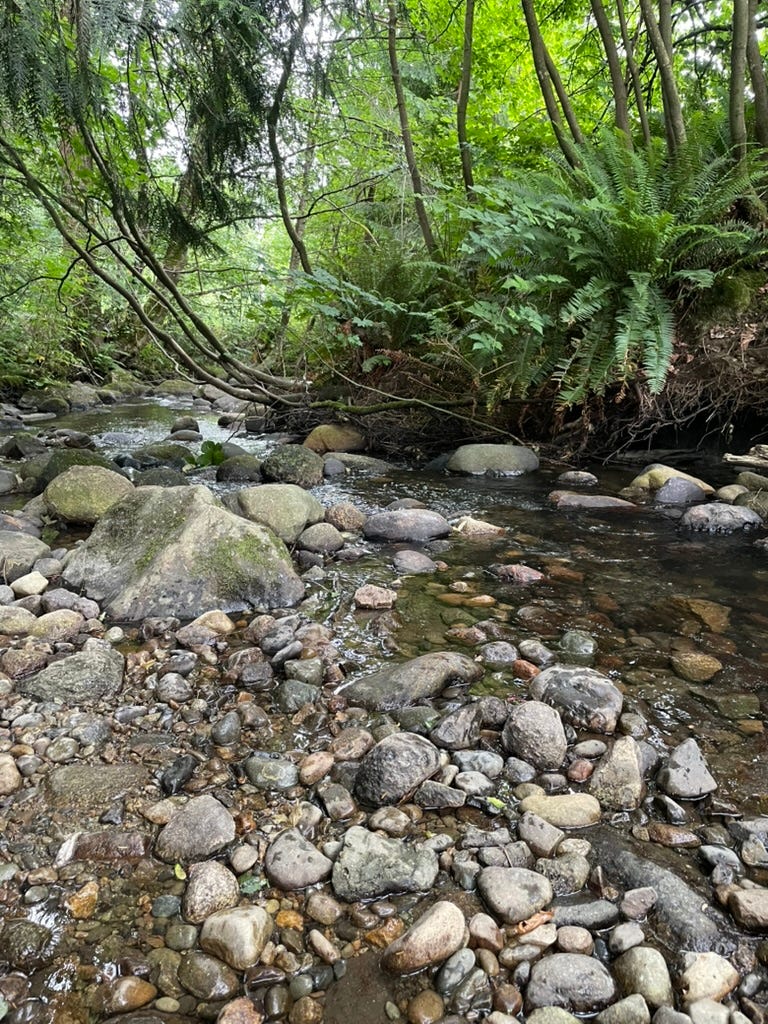
I have spent hours walking alongside the creek near my house thinking about the flow of water, noticing how the bank changes after a heavy rainfall, or what rocks appear as the water level drops. I have watched debris travel down sometimes slowly and other times with destructive force. I have watched the water move around rocks, and can see that overtime the rocks have smoothed out, and left long enough will break apart. This has become more mesmerizing that I would have imagined to look at the same creek day after day and see it as a metaphor for my life.
Rather than drowning, I have tried to imagine myself floating on the top of the ocean. Held up by the water below and with the sun warming me from above. Could I see myself as relaxed in water? This image is harder, but I think it is time to stop thinking about drowning.
I was thinking of Atwood’s poem last week, when I was at a lake with my two PhD writing partners. They are both swimmers and as I watched them gliding through the water away from the dock, I realized that it was the first time in a long time that I could see the idyllic without anything sinister below the surface. Sunlight on water shimmers just like candlelight on the ceiling. I exhaled in the company of good friends who allow me to just be, which was really the gift on the man who read me poetry in the first place.
Thanks for reading! This post is public so feel free to share it. This post was made without the use of AI.
No posts
Comments
Nothing yet. Say the first thing.
Sign in to join the conversation.