
The God of love is kneeling at our feet.
Though we betray Him, though it is the night.
He meets us here and loves us into light.
-from Maundy Thursday, Malcolm Guite
I remember it was several years back in a church that was trying out something new. The COVID-era self-serve melt-away paper wafers and cough syrup-like juice were thankfully a thing of the past. However, communion in a gym family-style was a new attempt to rethink the Eucharist in the church I was attending. Sitting at a table with several other adults while trying to wrangle my own 18 month old, I was passed a styrofoam cup of grape juice and a cracker. Celebrating the Lord’s Supper as a communal meal is by no means wrong. But in my heart that day, it felt so off. I gulped down the juice and left the gym before munching on the crackers (mostly due to the toddler’s deteriorating behavior) and spent the rest of the afternoon stomping with said toddler through rainy puddles behind our row house trying to discern why I felt so uncomfortable.
A few weeks later, on Maundy Thursday, I would join some friends and attend an Anglican Church. I had been to Episcopal services before, but this would be my first time in an Anglican high church setting. First up was the procession and acclamation. The ministers walked in behind a female celebrant carrying a cross. Once at the front, she led us in the Collect:
Almighty Father, whose most dear Son, on the night before he suffered, instituted the Sacrament of his Body and Blood: Mercifully grant that we may receive it in thankful remembrance of Jesus Christ our Savior, who in these holy mysteries gives us a pledge of eternal life; and who lives and reigns with you and the Holy Spirit, one God, for ever and ever. Amen.1
She then read the Old Testament passage for the day. I had never felt seen and known by God in the way I did in the pew that night seeing a female congregant, just like the rest of us, read Scripture out loud. But the most impactful part of the night was the observance of Communion. Towards the end of the service, the priest called us to come forward. We knelt, extended our hands, and received the bread and wine as he placed it in our mouths. He spoke over us, reminding us of God’s love and Christ’s sacrifice on our behalf, and prayed that we would receive the grace offered to us.
I knelt there holding back tears. The walking to the front, the posture of humility and utter need, the priest reminding us of what we already knew but needed to hear again- it all undid me in a way I hadn’t experienced before in an observance of the Lord’s Supper. I tasted and saw that atonement and grace was something I could only receive at my very weakest.
My whole life up until this point, had been spent in churches where church and faith were more about what I could bring to the table than what God could give me. Growing up in Baptist fundamentalism meant that I learned early on what kinds of acts of service would be most rewarded. As I grew older, even though I loved the Lord and loved the church, serving became a way to hide, to avoid scrutiny. If I was a quiet, obedient, teenager who accompanied the choir every week, who was to question my life outside the walls of the church building? While my fellow youth group friends skateboarded on church property and had public MySpace profiles, I too skateboarded and had a secret online life, but did it all on my own time. My worst nightmare would have been being found out or exposed and I did everything I could to divert others from looking too closely at my life outside of the three weekly church services.
For years, I was constantly torn between my earnest dedication to the Lord and my unwillingness to accept that I was unable to work or perform for grace. I was confronted with the wrath of God reserved for sinners every week, but figured if I kept it up long enough, the shame and guilt could be outweighed by acts of service and God would be placated. Atonement was something I knew Jesus had secured for me, and yet, it felt like something elusive. Something that could be lost if I wasn’t careful enough to cover my tracks.
The pinnacle of this performative faith was the monthly observance of Communion. It was the ultimate test of my worthiness to receive grace. The sacrament was never dared called a sacrament, but was merely a remembrance. But even the term remembrance doesn’t quite capture the event. What it was was a somber time of reflection and confession. We were to plumb the depths of our souls, leave no sin or errant deed unidentified. Only then would we be worthy of coming to the table. Judgement would fall on us if we held anything back. This was the way to find peace with God: my own efforts and spiritual pride that I had cleansed my heart and become worthy of receiving his sacrifice afresh.
It would take time and suffering for grace to finally break through. Abruptly moving away from this childhood church when I was 17 caused me to come to terms with my own frailty and inability to secure my standing with the Lord on my own. But somehow spiritual pride always has a way of coming back to the forefront. It wasn’t until that moment on a weekday evening in that Anglican church in Baltimore that atonement would finally make sense to me as something I could only receive at my lowest point.
And I was finally at my lowest point. The church we had been a part of planting for nearly eight years was drastically changing and everything I thought was sure up until then had come undone. My relationships with some church leaders were strained as pressure mounted and our differences became apparent. My efforts had failed and my preconceived notions about what God wanted from me had come up short. Like the woman who caught the hem of Jesus’s robe in the crowd as he passed by, this night in this church felt like a desperate attempt to grasp at spiritual straws. Would I come up short again? Or would I finally know rest and wholeness?
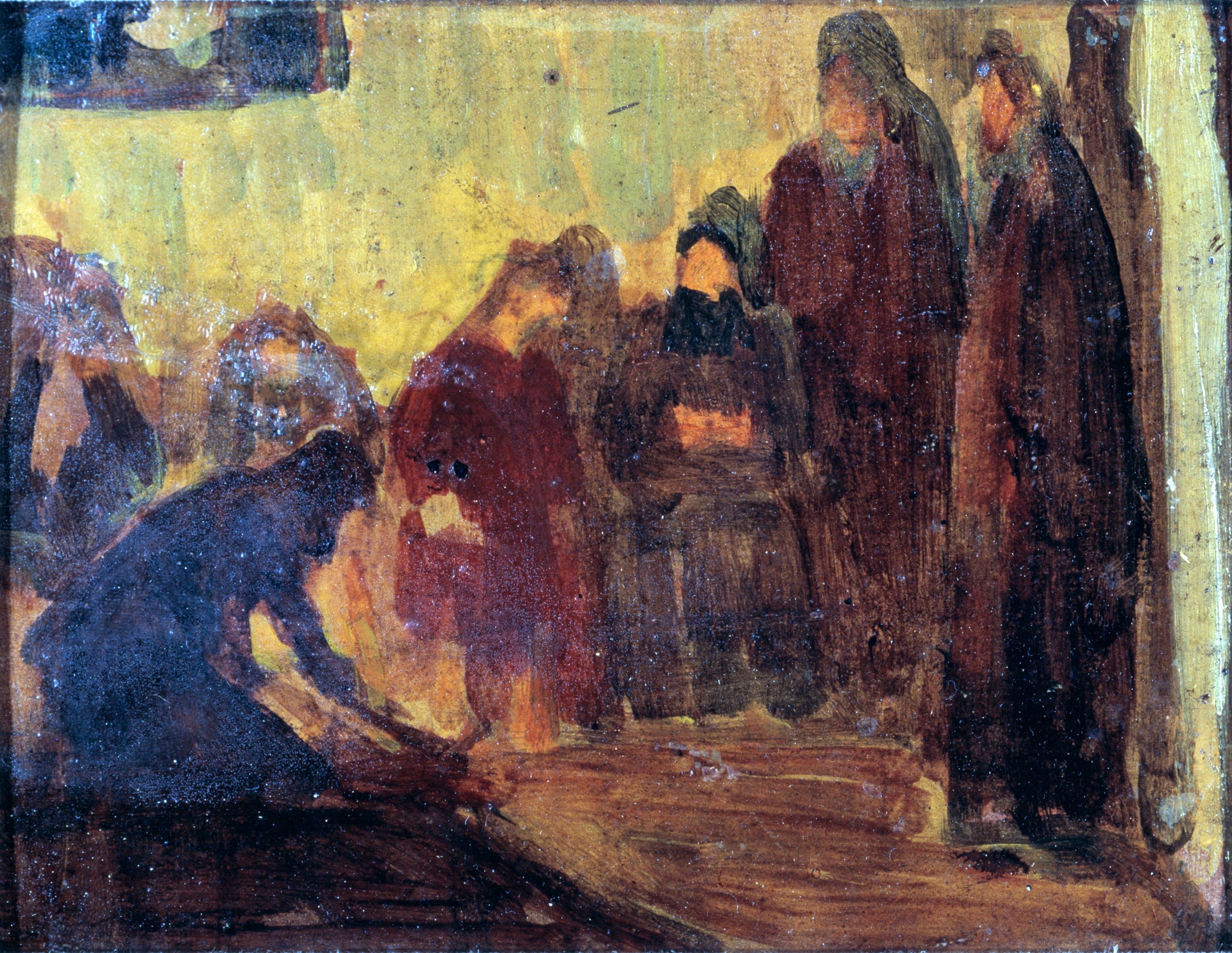
Sitting in the pew, the grace of God broke into my dismay. I saw Christ’s strength in weakness in the liturgy- a Savior who strips down to wash his hypocritical disciples’ feet as his last unexpected act of love before dying for them. My faith was battered but as I dragged myself to the altar that evening, knelt down on my knees and opened my hands, the priest placed the bread into my mouth like I was a helpless baby. All I could do was receive this sacrament of grace, and I wept at the picture of God meeting my faltering faith that this was. I finally understood atonement in a way I had never seen it before.
A state of humility and desperation is the very point at which God meets us and fills us. Atonement, being at one with God, isn’t something I could conjure up for myself. It was only in my utter need that I could receive what He has done for me on my behalf. My hiding was over and my soul had been laid bare. But there He was, faithfully ready to receive me. Shame and guilt are no match for this God who poured himself out and continues to give us himself again and again.
In Summary:
Batter my heart, three-person’d God, for you
As yet but knock, breathe, shine, and seek to mend;
That I may rise and stand, o’erthrow me, and bend
Your force to break, blow, burn, and make me new.
- from Holy Sonnet XIV, John Donne
*parts of this essay are adapted from a previous post.
Maundy Thursday, BCP https://www.episcopalchurch.org/lectionary/maundy-thursday-b/
No posts
Comments
Nothing yet. Say the first thing.
Sign in to join the conversation.