
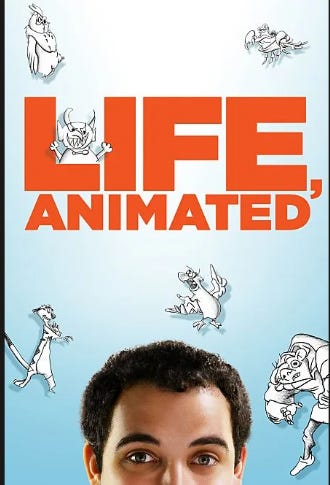
In a previous piece late spring, I wrote about scripting and how, in our own home, I came to better understand that repeated lines from movies, songs, and familiar dialogue were not meaningless words. They were communicating. Like many parents years ago, I did not yet have the vocabulary for autism, echolalia, or scripting when my daughter Sydney would answer with phrases drawn from the media. What I know now is that scripts often carry emotion, memory, safety, and intent. Once we understand that, we can begin to hear the person beneath the repetition. Few public stories illustrate that truth more powerfully than the journey of Ron Suskind and his son Owen Suskind.
I had the privilege of interviewing Ron Suskind on an older podcast I used to host, Converge Autism Radio, and one of the things that immediately stood out was how much we shared in common as families: the surprising role that The Walt Disney Company stories played in helping connection happen at home. During our conversation, Ron spoke of learning to enter Owen’s world rather than constantly trying to pull Owen into everyone else’s. He reflected that when families learn the language of a child’s passion, “you find there is much more there than you realized.” That truth resonated deeply with me. Many of us have discovered that movies, characters, songs, and repeated dialogue can become emotional shorthand, shared humor, and bridges to relationships. I sincerely hope Ron will one day join us on Holmes’ Cinema Clues, because Life, Animated is exactly the kind of meaningful cultural story we love to explore. If schedules do not align, I fully expect this film to be part of Season 2 or 3 in a Cinema Translator episode, because it offers one of the most compelling examples of how media can become not escapism, but connection.
In the book and later documentary Life, Animated, Ron shares how Owen, who had lost speech after regressive autism, immersed himself in The Walt Disney Company animated films. What others may have dismissed as fixation became, in time, a doorway.
Owen memorized scenes, songs, and dialogue from films such as The Little Mermaid, Aladdin, The Lion King, Peter Pan, and many others. Those stories gave him something powerful: emotional maps. In classic Disney narratives, characters face fear, friendship, loss, courage, belonging, injustice, and triumph. For a child trying to understand a confusing social world, these stories offered structure and recognizable patterns.
Ron described realizing that Owen’s repeated Disney dialogue was not random noise but meaningful language waiting to be understood. What sounded like disconnected phrases often came from specific scenes and carried emotional relevance. Suddenly, scripting was no longer something to extinguish; it was something to decode.
One of the most moving moments in Life, Animated involves the character Iago, the wisecracking parrot from Aladdin. Ron entered Owen’s room and began speaking in Iago’s voice. Rather than demanding typical conversation, he entered Owen’s world through a trusted character and familiar script. Owen responded. Through that playful doorway came real emotion and authentic communication. In that exchange, Owen was able to express painful truths about loneliness, friendship, and not understanding other people.
That moment matters deeply.
Too often, we measure communication only by spontaneity, originality, or neurotypical conversational style. Yet communication is broader than that. It is the successful transfer of inner experience to another person. By that measure, Owen was communicating long before others fully recognized it.
Ron later described their approach as “affinity therapy,” meeting a child inside a deep interest rather than dragging them away from it. I found this definition or description of “affinity therapy” that I will share: The affinity approach begins with the belief that a person’s deep interests are not obstacles to development but potential pathways into growth, relationship, and learning. Rather than trying to extinguish or redirect an intense interest because it appears narrow or repetitive, the approach asks how that interest can be used to build communication, trust, motivation, and emotional connection. For an autistic child, an affinity for The Walt Disney Company films, trains, maps, animals, numbers, or music may provide predictability, joy, competence, and a shared language. When parents, therapists, or educators enter that world respectfully, they often find increased engagement and opportunities for reciprocal interaction. In the story of Owen Suskind, Disney was not the barrier to communication—it became the bridge. The larger lesson is this: what we dismiss as fixation may actually be the front door to connection.
I appreciate that frame. Whether the affinity (or clinical language may define this as repetitive, restrictive interests) is Disney, trains, maps, animals, technology, numbers, music, rocks, or historical facts, the special or passionate interest is often not a prison but a pathway.
As a certified autism specialist and former clinician, I have often encouraged families to become curious before corrective. Ask: What is this script doing? Is it regulating anxiety? Requesting a connection? Expressing joy? Rehearsing language? Sharing identity? Opening a door?
Because sometimes the movie quote is not avoidable. Sometimes it is courage.
Sometimes the repeated line is not empty speech. Sometimes it is the safest available bridge from isolation to a relationship.
And sometimes, as the Suskind family discovered, when we step into another person’s language with patience and love, they begin to step into shared life with us.
Stay tuned, and Life Animated will be in Season 2 or 3, hopefully with Ron Suskind as a guest, but discussed as a cinema translation case at some point!
No posts
Comments
Nothing yet. Say the first thing.
Sign in to join the conversation.