
This is The Hero’s Journey—a reading project where we’re tackling the biggest fantasy books on our to-read lists, nerding out about intricate world-building, compelling characters, and exciting adventures. For the next six months we’re reading the Crescent City books by Sarah J. Maas.
Welcome to Book Two, Week Three of our read-along of Sarah J. Maas’s Crescent City trilogy! I’m thrilled that you’re here as we prepare for the newest ACOTAR books publishing this fall (since these series connect!). I’ve included an audio voiceover for this entire piece, which may play best within your Substack app.
If you’re not reading along, you can always turn off just these emails while continuing to receive The Town Crier, Side Quests, and my other newsletters. Customize your email preferences here.
Graphic by HollysLitMagic
Note that this newsletter will include spoilers for House of Sky and Breath pages 180 through 273, through the end of Part One.
Surprise! Cormac is Agent Silverbow, and his “engagement” to Bryce is mostly a cover for him to come to Lunathion and search for Sofie and Emile. He warns against Ophion commander Pippa Spetsos, explaining that there are no lines she won’t cross to accomplish her goals. Bryce becomes convinced that too many bad actors are after Sofie and Emile, seeking to use their powers for their own benefit: Ophion and Pippa; the River Queen; and of course the Hind and the Asteri. We also learn in this section that Celestina had been secretly friends with rebel leader Shahar, and has apparently been seeking to help Hunt ever since Shahar’s death.
What exactly was Danika up to? She had connections to Ophion but wasn’t working for them; she had her own agenda. Cormac was told by Sofie that “Danika suspected something about the Asteri, and needed someone to go in to confirm those suspicions. Sofie was that person.” Then, Ithan accidentally smashes a table at Bryce’s apartment and reveals piles of Danika’s hidden college papers “theorizing on the origin of worlds and what the Asteri even were,” plus blank papers marked “Dusk’s Truth”—just like the subject of Danika’s emails to Sofie.
Meanwhile, Cormac has another request: he wants Ruhn to use his telepathic powers to communicate with their most high-profile spy, Agent Daybright. I’m so curious to know who this is! Her appearance during their spy-talk is a female cloaked in flame. There seem to be hints that it’s someone we know, or that Ruhn knows. My top guesses are Queen Hypaxia (but we already had the medwitch-to-queen reveal last book, so that seems a bit repetitive) or Celestina (but again seems maybe too obvious). Let me know if you have any guesses in the comments.
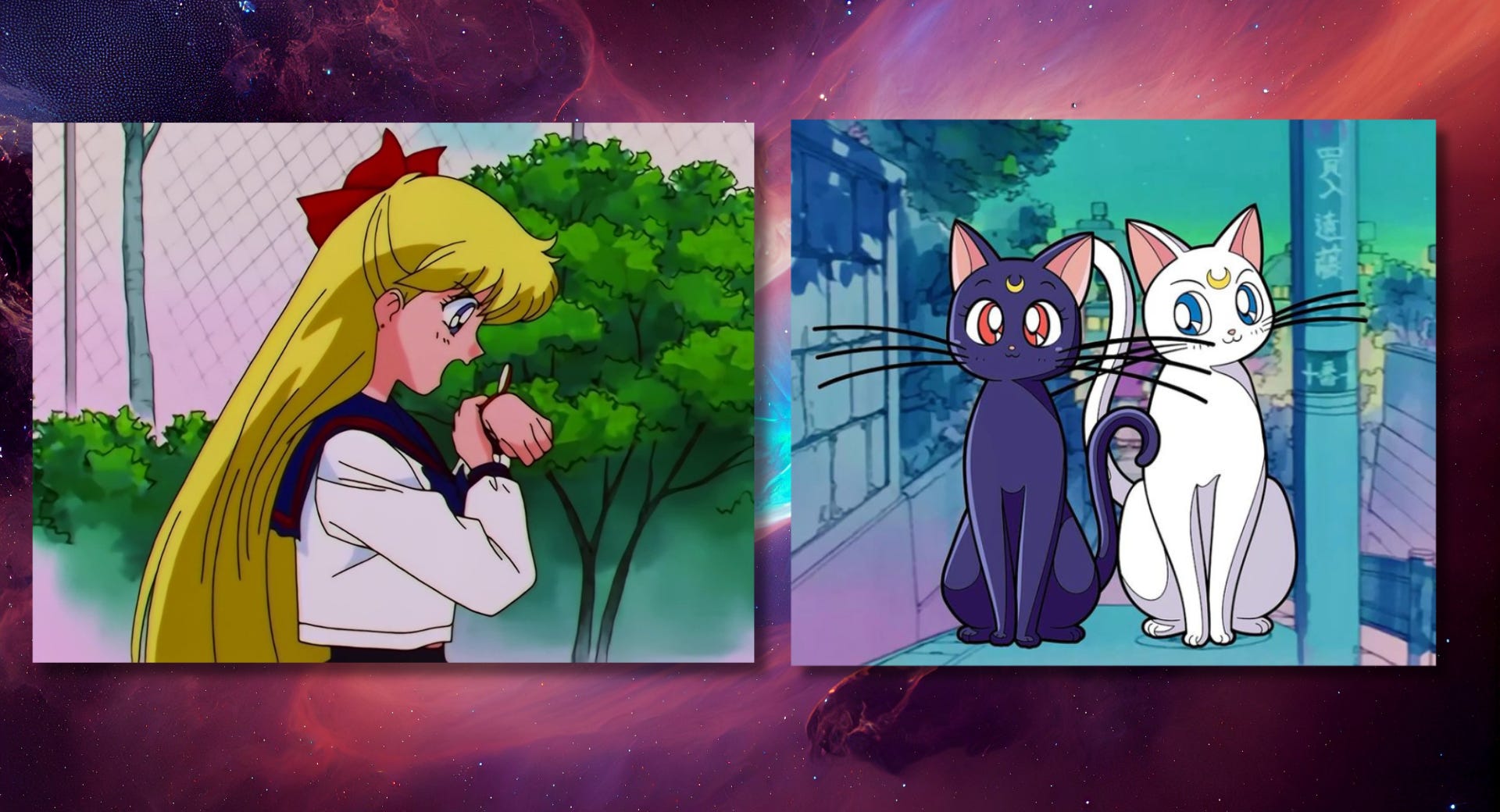
Under the influence: The way quartz serves as a communication channel, both through the quartz-fueled radios and comm-crystals the Ophion spies use as well as the quartz Gates across the city, is a direct inspiration from Sailor Moon. The Sailor Guardians use quartz crystal-based communicators to stay in contact, which were created by a talking cat named Luna—yes, Luna just like one of the Crescent City gods and yes, a talking cat just like Aidas. There are actually two cats in Sailor Moon: Luna, who is black, and Artemis, who is white.
What is up with Hunt being visited by Apollion, the Prince of the Pit? I find it kind of hysterical how helpful these terrible demon princes from Hel are. We have gotten a lot of hints that Hunt has more power than we are currently aware, stemming possibly from his mysterious father per the conversation between Aidas and Jesiba at the end of last book. Some highlights from this exchange:
I think his real name “Orion” could be some sort of hint to his identity, because I think only Aidas, the Oracle, and now the Prince of the Pit have used it.
A reminder that Apollion is known as the Star-Eater, said to have killed and eaten the seventh Asteri. This is also something I’m curious about better understanding what actually went down back then.
Apollion says his father “was the Void, the Being That Existed Before. Chaos was his bride and my dam.” Cool parentage.
Apollion accuses Hunt of wasting his gifts: “You don’t know a fraction of what you might do. You and the Starborn girl…Both of you would benefit from training. Your powers are more similar than you realize. Conduits, both of you. You have no idea how valuable you and the others like you are.” This phrasing—“the others like you”—makes me think it’s about more than just Hunt and Bryce?
The section ends with Ruhn being abducted by Reapers supposedly sent by the Prince of the Pit, bearing the message that he is “ready to strike.” They claim he “already hunts through the Bone Quarter’s mists to find the other one who might be his worthy opponent…or his greatest weapon.” Bryce assumes this means Emile and his thunderbird abilities—I personally think that’s a red herring. I think there is someone else this references. The fact that the Prince of the Pit reached out directly to Hunt to talk about his abilities…has me very intrigued.
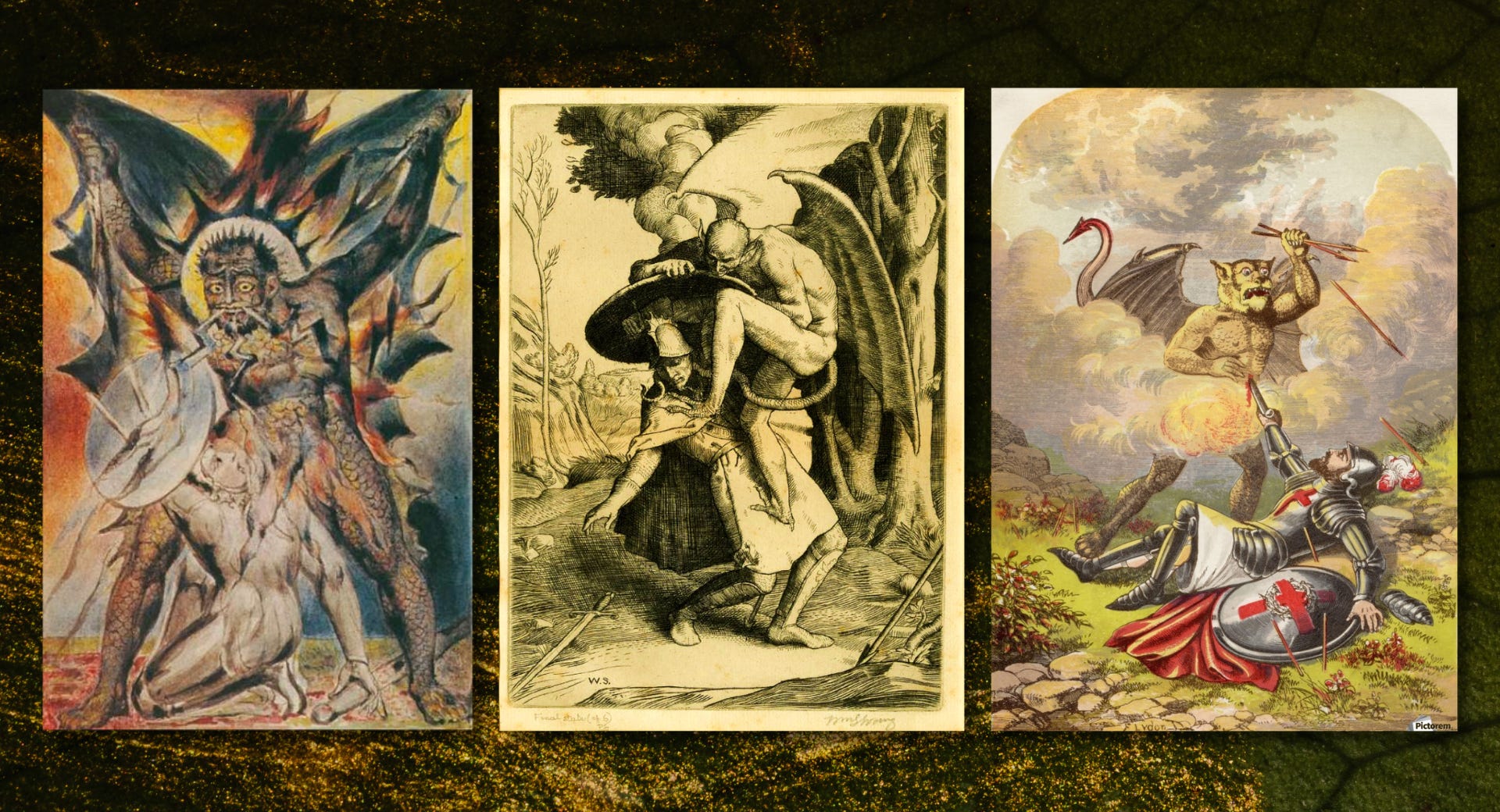
Artwork left Apollyon, the Fiend by William Blake; center Christian Fights Apollyon by William Strang, right Christian Fights with Apollyon by A.F. Lydon
Under the influence: Apollyon is the Greek version of the Hebrew name Abaddon, meaning the “Destroyer” and referencing the angel of the bottomless pit as depicted in the Bible’s book of Revelation. Essentially it is another representation of Satan. This figure also appears in The Pilgrim’s Progress by John Bunyan, a 1600s text that is essentially a long allegory detailing the spiritual journey of an everyman character named Christian, from sin through temptation to salvation. I was nerdy enough to read it as a teen because it’s referenced repeatedly in Louisa May Alcott’s Little Women.
Here are a few other things I’m taking note of and watching as we continue reading:
The Spine: I’m nervous about this hit Ophion is planning on the Spine, which is a north-south railway cutting Pangera in half and the main artery for supplies in the war. I’m not sure how much this will feature in the action ahead or if it’s just a reason for Ruhn to communicate with Agent Daybright.
Baxian, the Helhound: I believe that he’s actually good, or better than Hunt believes him to be—am I being too easily convinced? Do you believe him? Let me know in the comments!
Knife and Sword: Again, I’m continuing to pay close attention to these swords—this chapter, the Starsword really shows its unique magical abilities in destroying Reapers, thought to be indestructible. We’re also reminded of this Fae prophecy: “When knife and sword are reunited, so shall our people be.”
Death’s Day: We’re told this Autumnal Equinox holiday is coming up, “a day of balance between the light and dark, when the veil between the living and dead was thinnest. Cthona began her preparations for her upcoming slumber then, but in Lunathion, raging costume parties were held along the Istros River at the various Sailing points. The biggest party of all surrounded the Black Dock, where lanterns were sent across the water to the Bone Quarter, along with offerings of food and drink.”

Under the influence: Days of the Dead are common celebrations across cultures and religions at the end of October/early November, most notably “Die de los Muertos” in Mexico. Families gather to remember loved ones who have died; they set up altars, or “ofrendas,” offering their deceased loved ones’ favorite foods and drinks. Decorations include calaveras, or candy sugar skulls, marigold flowers, and colorful flags. Catholicism also celebrates the season of Allhallowtide, which includes All Saint’s Day, or Hallowmas, when people pray to the saints for the souls of their dead loved ones. Halloween evolved from All Hallow’s Eve, the night before All Saint’s Day. The timing of all of these celebrations coincides with the general belief that at this time of the year, the veil between the worlds of the living and the dead is thinnest, and the souls of the dead are able to cross over and visit.
I’m continuing to keep an eye out for possible connections, or even just similarities, to the worlds of ACOTAR and TOG.
“I can think of no better reason to yield my life.” Cormac utters these words and it immediately made me think of the witches in TOG and the Yielding. sobs
The Prince of the Pit: This is minor, and may mean nothing, but the description of “leathery wings” on the Prince of the Pit definitely made me think of the Illyrian Fae in ACOTAR.
Gods and other worlds: Again, we are reminded that there may be a bigger game afoot, reaching beyond this planet. “The demons worship different gods than we do, but what happens when the worlds overlap? When demons come here, do their gods come with them? And all of us, the Vanir…we all came from elsewhere. We were immigrants into Midgard. But what became of our home worlds? Our home gods?” This definitely makes me think of the situation faced by the gods in TOG.
I’d love to hear if there’s anything you feel I’ve missed! Let me know in the comments.
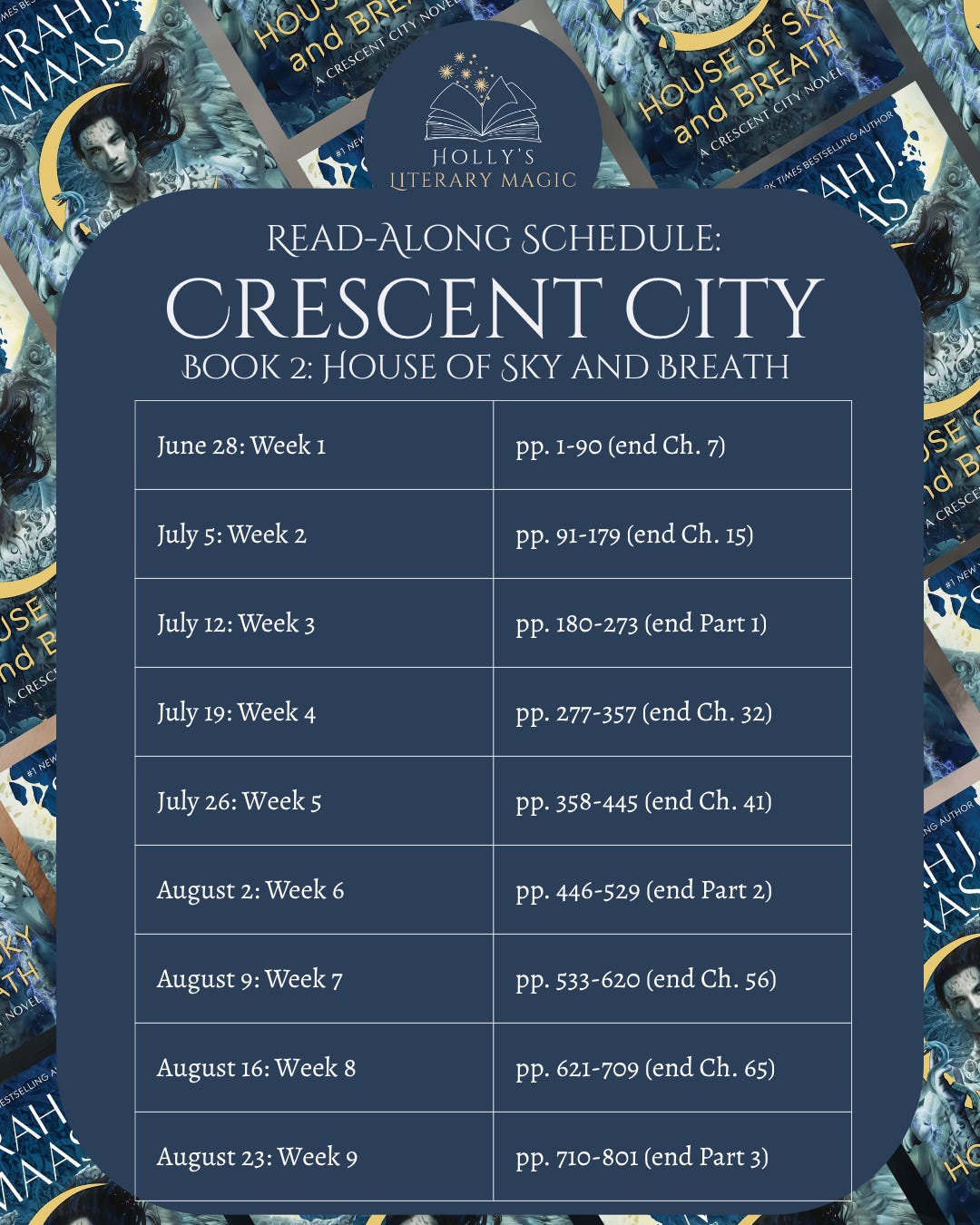
Next week we’ll read pages 277-357, through the end of Chapter 32.
Be sure to subscribe to receive future editions of this newsletter plus my other regular publications: “The Town Crier,” a monthly newsletter sharing my most-anticipated new releases and other book news; and “Side Quests,” where I share fun, seasonally relevant reading guides and thought-pieces in reaction to books I’ve read recently.
For day-to-day updates on my reading life, dynamic mood boards, reviews for everything I read, and bonus reading guides, follow me on Instagram @hollyslitmagic.
Crescent City Read-Along
·
Jul 25
This is The Hero’s Journey—a reading project where we’re tackling the biggest fantasy books on our to-read lists. Here, we nerd out about intricate world-building, compelling characters, and exciting adventures. We’re currently reading the Crescent City books by Sarah J. Maas.
Announcing: Crescent City Read-Along
·
Apr 25
This is The Hero’s Journey—a reading project where we’re tackling the biggest fantasy books on our to-read lists, with structure, context, and community. Follow along if you love to nerd out about intricate world-building, compelling characters, and magical adventures.
Comments
Nothing yet. Say the first thing.
Sign in to join the conversation.