
Julio Cesar Williams was my coworker for 5 years but I am only now seeing his paintings in person. In his studio in Bushwick, I stay withYearning for Eternity, a 6’x4’ raw canvas covered with semi-transparent washes. It is a profoundly slow read that asks me to meditate on unlimited subtleties.
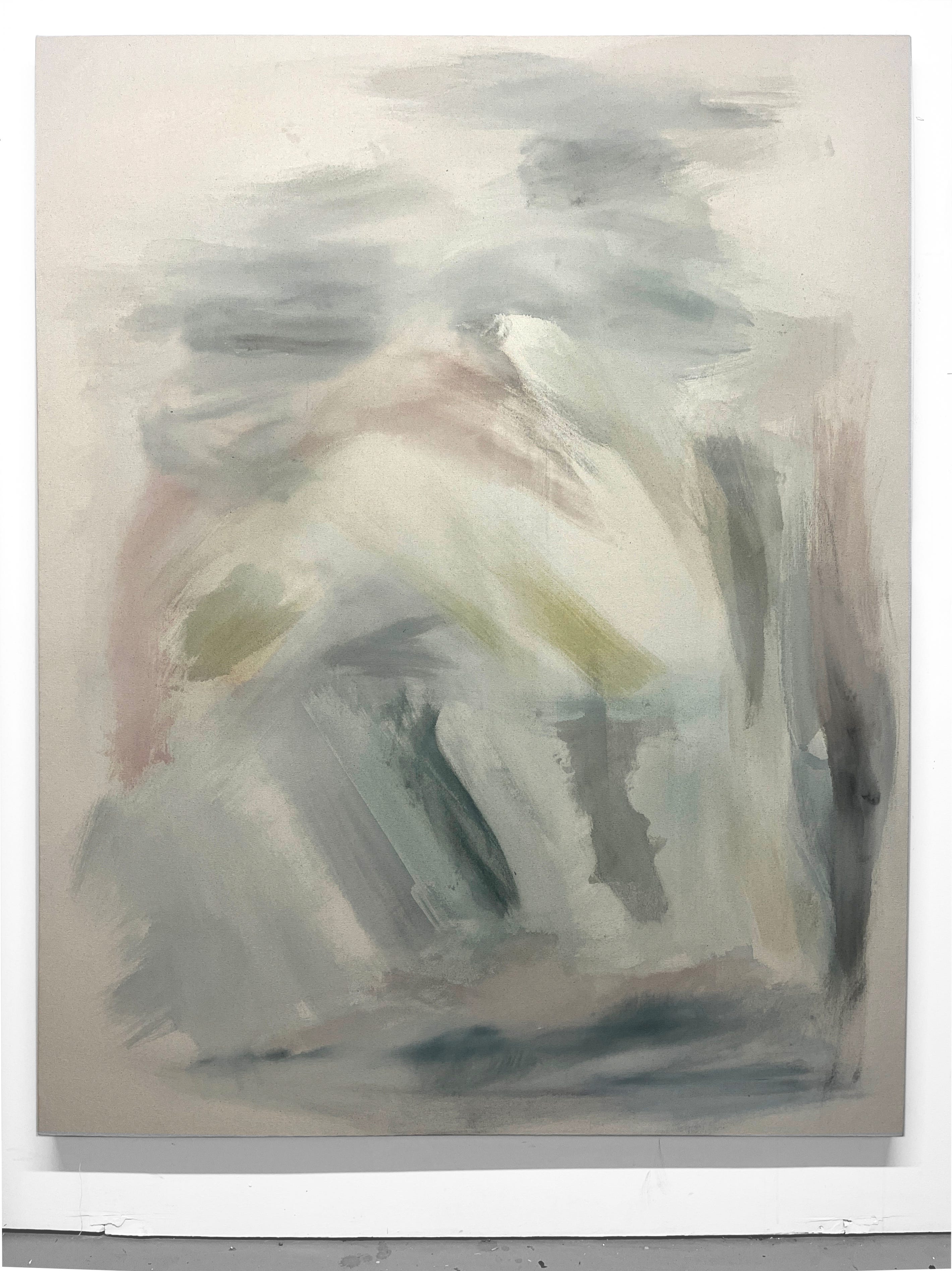
My entry point is the raw canvas. The visible weave creates a textured negative space; declaring substrate as visual information. It supports semi-transparent washes of closely valued grays, blues, pinks and yellow. They all hover above or sink into the surface, accumulating into one translucent mass.
All the washes intertwine by gradating absences of pigment. They evoke the “lifting” technique in watercolor when water is dabbed on the paper to remove paint. Julio explains his process of using pigment dispersions (a concentrated liquid containing finely ground colorants suspended in water or a solvent) that vary in density and fluidity. He first applies translucent layers of urethane binders, polyvinyl molding paste or heavy gel gloss. Already absorbed into canvas, they create unpredictability to how pigment reacts as it is drying.
He has to work quickly before the medium dries!
Applied with a wide 3” brush, the strokes sweep in a circular motion with no stopping point. Each brush mark makes contact with the canvas for a few inches to a few feet. When closely following one mark to the next, I discover occasional deviations like a sharply defined edge created by a calculated area of resistance, where the first layer of clear medium which the pigment could not penetrate, was applied. Another unexpected contrast is that once only once, and only for a few inches, is the pigment ever saturated enough to reach opacity. All at once I think of Rothko’s soft-edged color fields, the motion in Turner’s foggy seascapes, Cy Twombly’s rapid scribbles, and Agnes Martin’s minimal meditations of similar value.
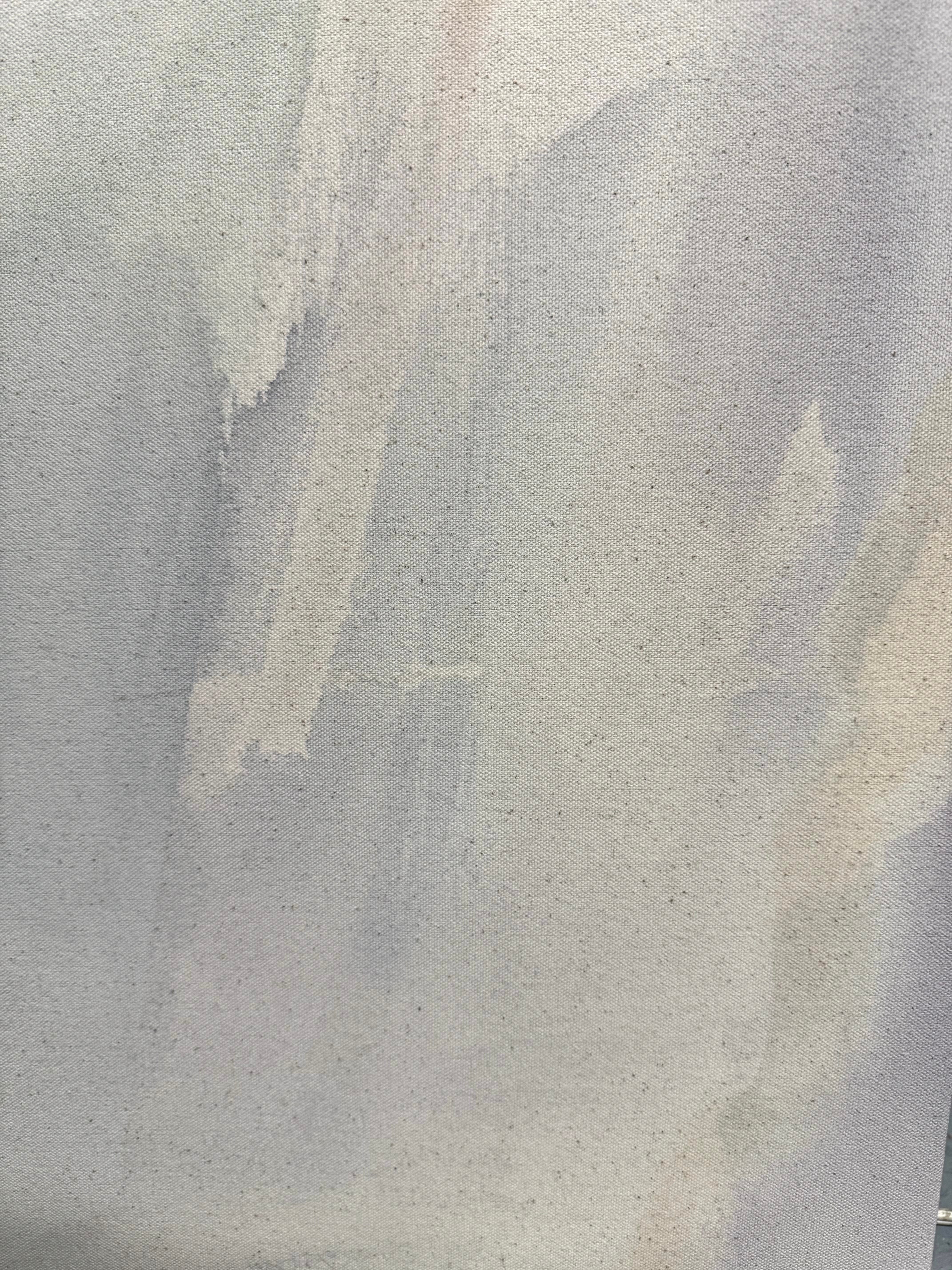
Like remnants of a dance, the brush strokes imply he reached above his head and kneeled on the floor to apply the rapid strokes. (I would love to see the path of Julio’s footsteps as he approaches and moves away from the canvas; contemplating and then acting on his next move. Maybe I will disperse a bag of chalk dust in next time.)
Like when looking up at the clouds, my brain wants to find recognizable shapes. The palette of the glowing washes triggers a memory from early childhood of the Sun shining through a striped cotton sheet hanging on the clothesline. I momentarily tap into a long dormant feeling that the world is fascinating, new, unknown, huge and mysterious.
In silent concentration, Julio organizes his paint swatches as I write my notes. We are both deep in thought, a co-working dynamic we’ve had one hundred times before. It is special to spend time with his work in the privacy of a studio rather than a public institution like where we work.
I muse without interruption on the empty fullness of Buddhism. I sense the potential in the invisible. Experiencing Yearning For Eternity forces me to slow down and find minute differences. I drift into a determined stance that painting figuratively and abstractly are the same, as long as you explore the potential for the substrate and material to be the image itself. It is paint, after all.
We leave the studio in the dark of night and walk in the same direction for a few blocks. He asks what I’ve been painting at school. “I’m excited about a limited palette of warm shadows and cool lights,” I reply. “Ah, I love making subtle light on things,” he says. “Subtle is hard for me,” I laugh. “It’s hard for everyone,” he smiles. Pleased to gain insight into the art practice of my co worker of five years, I recognize that like in his paintings, the subtleties are all I will ever know of Julio as a person, too.
No posts
Comments
Nothing yet. Say the first thing.
Sign in to join the conversation.