
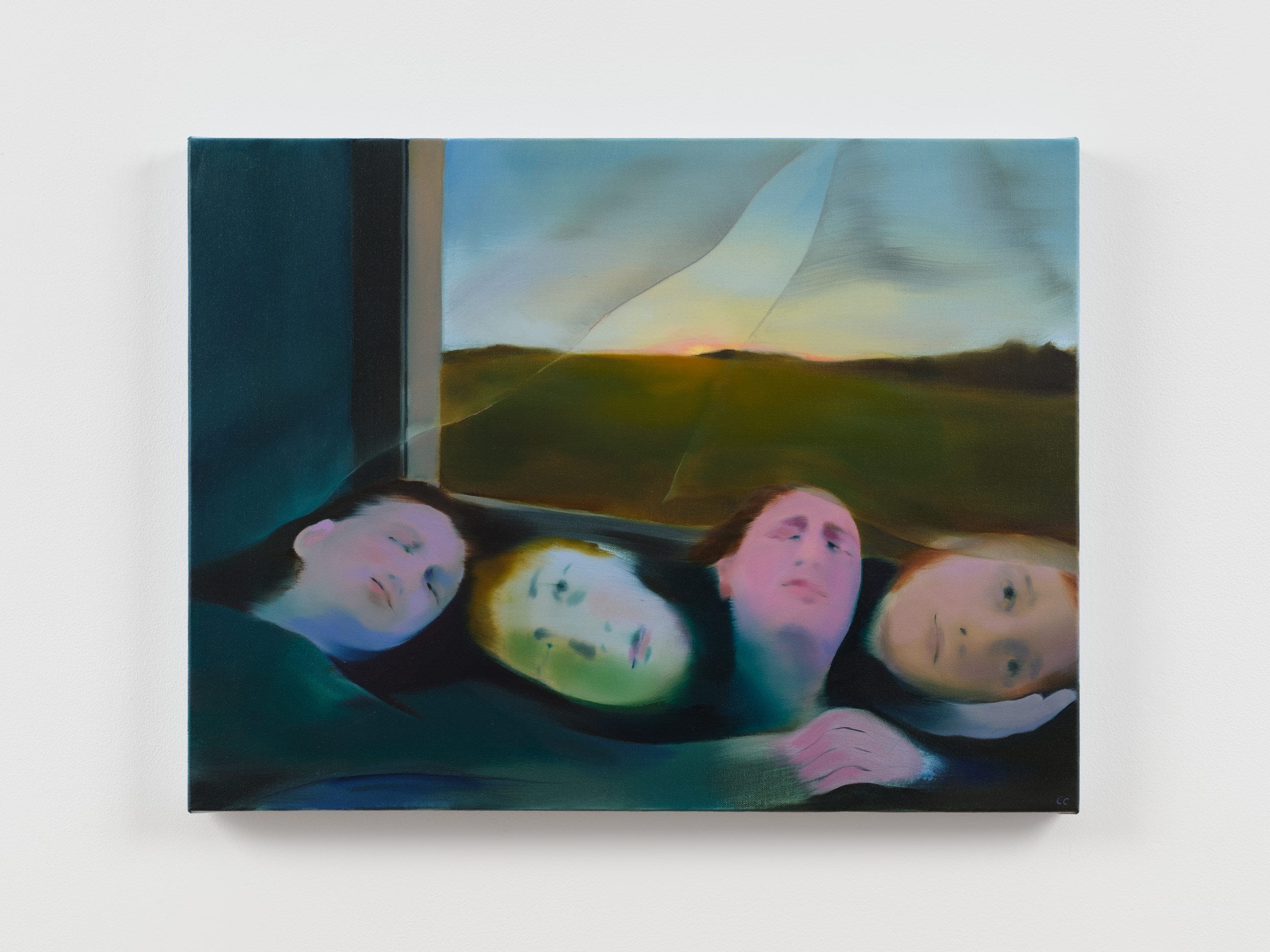
HO: How many children are you, really?
CC: Two children asleep and two children a-dream.
HO: The sunrise or sunset over the green field horizon harkens to a simpler way of life, almost Americana, but not with a cringe, nostalgic attitude… because something eerie is afoot. Disembodied heads are not read as dead, but, thinking deeply in another dimension. Both here with us, and beyond our material world.
CC: I find myself longing for real imagination, before you knew so many of the answers of what the world really is, how it functions, and who runs it. That sense of wonder you have as a child living in a rural place when the world beyond your daily life is unknown, can never be tapped into again, especially by an adult who moved to the big city…
HO: Maybe that is why I find your work so relatable. You may not consciously be tapping into that imagination inside your mind, but your canvases reveal the longing.
The transparent mist that is neither curtain nor glass acts as the secondary gesture to the main theme of the children. What is it?
CC: I am always painting wind-y outdoor scenes, and wanted to carry that movement from the outdoors to indoors.
HO: Director David Lynch was known to request from his actors, “more wind!”, when he wanted more mystery and ambiguity to their character in a specific scene. Do you think depicting wind does that for you?
CC: I do. A shudder at something lurking in the cold.
HO: Now that you mention it, this is the least cold-temperature feeling painting in your whole exhibition. There are many snow and winter scenes. This one is warm outside and cold inside, based on the palette. The winter is inside the house and the Spring is outside. What a switch!
CC: I was thinking about astral projection. Dreamers floating high where it is cold, up in the atmosphere. What sensations would your floating soul feel?
HO: And what colors would your floating soul turn into? Fluorescent green and pink? Glowing like distant balls of gas.
CC: I really am excited by fluorescents. They are so other-worldly, especially juxtaposed with earth tones. They are celestial and ethereal.
HO: Also create an ambiguous time of day or night.
I notice you framed the rectangle within the rectangle. It gives the viewer a place in the bed, a closeness to the figures.
CC: I think our dreams are not contained within our bodies. They like to explore and expand at night, and return at dawn.
HO: Painters of dreams like Leonora Carrington and Remedios Varo have little in common with your dreamers…
CC: Yeah, I’m not a huge surrealist fan. It becomes too fantastical for me. My paintings are still rooted in what could be in waking life. There is plenty of mystery behind that closet door, behind that tree, in that dog’s strange expression.
HO: You are reminding me of the book Portraits and Dreams by Wendy Ewald.
CC: I don’t know it, what is it?
HO: Wendy Ewald taught a film photography class to children in rural Appalachia in 1972 and published a book of their photos and descriptions. It is beautiful and haunting what fills the children’s imaginations. Back when the most important things in life were life, love, and death.
CC: Are they not still the most important things?
HO: Ha, true. I think your paintings are a reminder to slow down and really look. A novelty these days. But I do think the ability to hold focus on the quiet, cold paintings of your exhibition will resonate with anyone who visits them, for the rest of their day.
CC: That is the hope. I have a few Diane Arbus books in my studio that I flip through often.
HO: And it isn’t that the tone of your paintings are necessarily like gothic literature, nor are they particularly playful and naive. They are a liminal space. What painters are you looking at lately?
CC: I loved the Helene Schjerfbeck show. I have Munch print outs all over my studio walls. And I’ve been very excited by the projection mapping of Tony Oursler.
HO: I would have NEVER guessed him, but I totally see it now. What a bizarre way to cross mediums.
CC: Now you know all my secrets.
HO: My last question: What is your position on making beautiful things in a time when society is fraught with suppression and disillusion?
CC: Like we discussed before, I think the role of painting is unique in that it maintains its stance as a physical object in the digital age. Sure, you can look at it on the screen, but if I can get just one person a day to visit my show and let their focus land solely on the paintings for a few un-interrupted minutes, it re-sets the brain to not need constant stimulation from our phones. And that leads to a calm nervous system and good decision making. We all need more of that now. Patti Smith talks about the necessity to daydream and space out to give room for the bright ideas to come forth. If you are constantly searching and activated, there is no space for unexpectedness and unusualness to find YOU.
HO: Like the children in The Open Window, let us dream.
No posts
Comments
Nothing yet. Say the first thing.
Sign in to join the conversation.