
COMING SOON FOR PAID SUBSCRIBERS: I have an in-depth review of JD Vance’s new book about his return to Catholicism and a similarly in-depth review of Elliot Page’s book about her transition. These will be paywalled because I need to make some debt progress this summer to keep my momentum high. So if either of those interest you, today is a good day to sign up. Here’s a coupon to bring the price of an annual subscription under $50.
It’s taken me three days to figure out how to tell this story with something like an overarching point. I didn’t want to admit to the parts that make me look bad, and I didn’t want to acknowledge how completely, totally, fully, and utterly screwed our society might really be.
A couple of weeks ago I wrote about something I called digital entropy: the way companies quietly outsource cognitive labor to customers. We become the ones who remember which websites lie, which apps moved the button, and which warning messages can safely be ignored.
I thought I was writing about software. It turns out I wasn't.
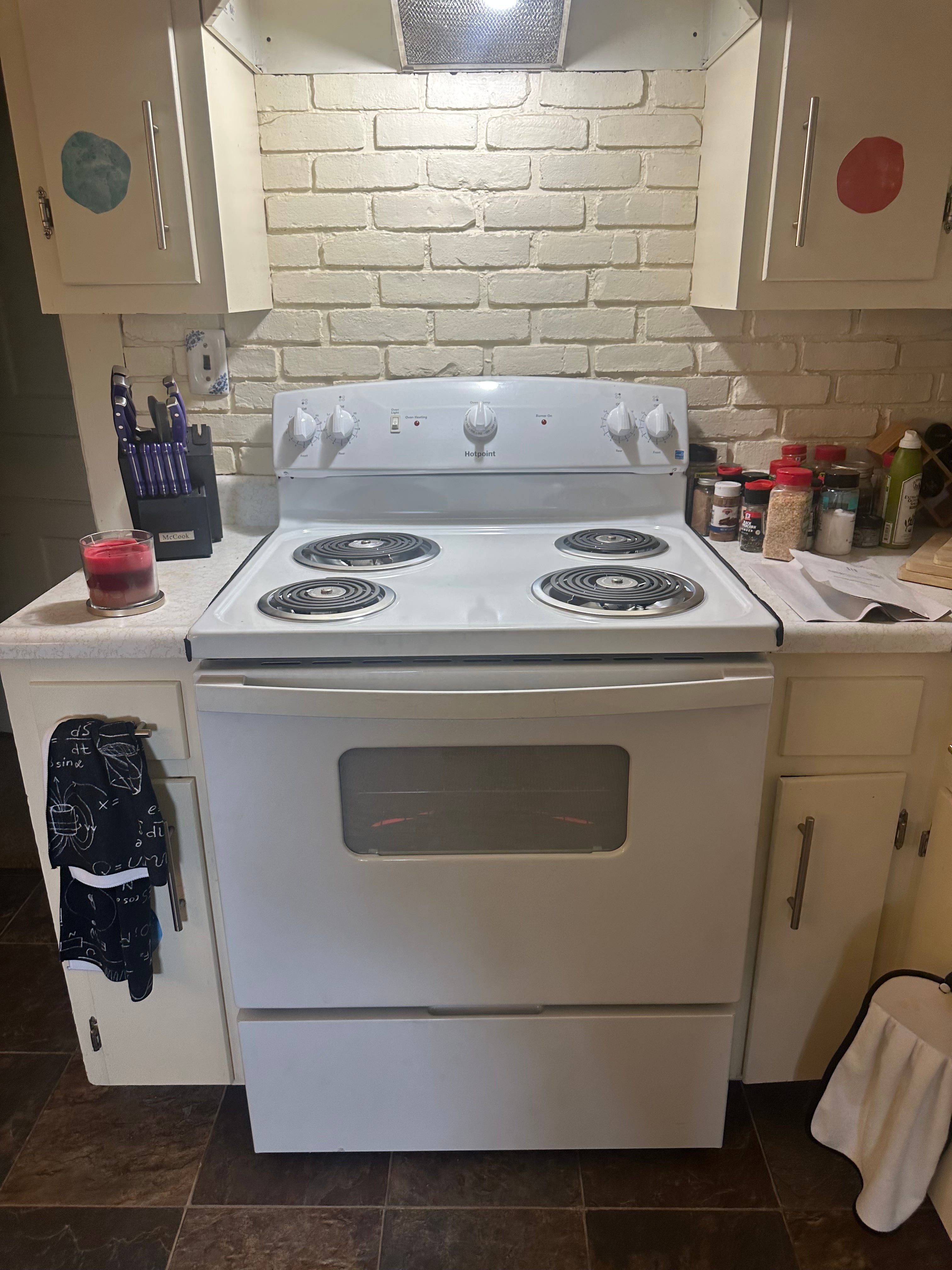
My new stove wouldn’t fit through the front door.
It has been almost a year of regular trouble with the electricity in my apartment. A certain breaker would trip, cutting power to about half the unit.
It didn’t happen every time I cooked, but every time it happened, I was cooking. An electrician came and assured me that there was no fire risk; these were “nuisance trips” that had something to do with living in a 200-year-old house that had been, in the modern era, segmented into three apartments.
In a three-hour bulk cooking session, it would happen twice. Then five times. Then nine times.
Then it got so bad that the tripping would happen every few seconds. I would be unable, quite literally, to fully turn around after resetting the breaker before it would trip again.
The property manager had the electrician come again. He checked everything again, reassured me there was no fire risk, and seemed mystified, but suggested a new stove might fix it.
Nobody thought to measure the stove or the doorway, which did not fill me with confidence about the diagnosis.
The two Lowe’s delivery workers were young black men. I’m not supposed to have noticed that, but I did, and what’s interesting about it is how it affected my reaction to what happened. We’ll get to that.
So the big day arrived, finally. The solution!
And the stove wouldn’t fit through the front door.
The young man from Lowe’s came in, and the first thing he did was — without asking, so there is no reason to believe any corporate policy about touching other people’s property was in play — remove my hook hanger from the door and take down my sketchbooks in covers, my backpacks, my scarf, and everything else.
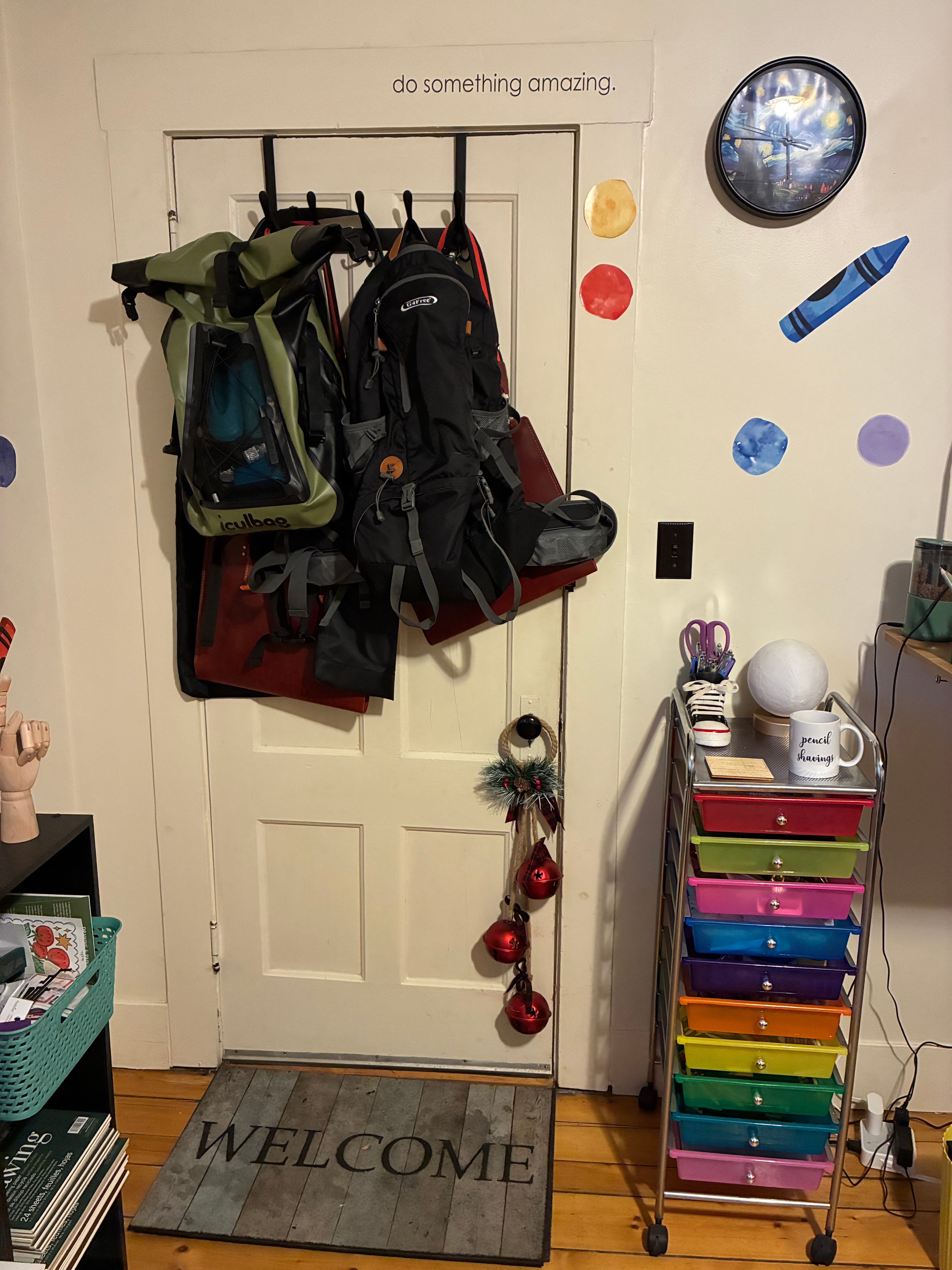
Then — again without asking or saying a thing to me — he used his tools to take the door off my apartment entirely.
It was obvious that the door itself was not the problem. The stove was not going to fit because the door had been moved.
It was equally obvious that he was executing a script, a prescribed set of steps to take in this situation, from which he was incapable of deviating.
That observation sounds harsher than I intend it. I don't think he was stupid. I think he had stopped believing, if indeed he had ever believed, that his own judgment was a remotely relevant factor in any situation.
When that failed, the second thing he did was approach this piece of furniture, which sits such that the door doesn’t quite open all the way. It was obvious that more room on the inside of a doorway that the stove won’t fit through would change nothing, but nobody cared what I thought. Or what was obvious.
I have circled the thing that matters most, the proximity of the windowsill:
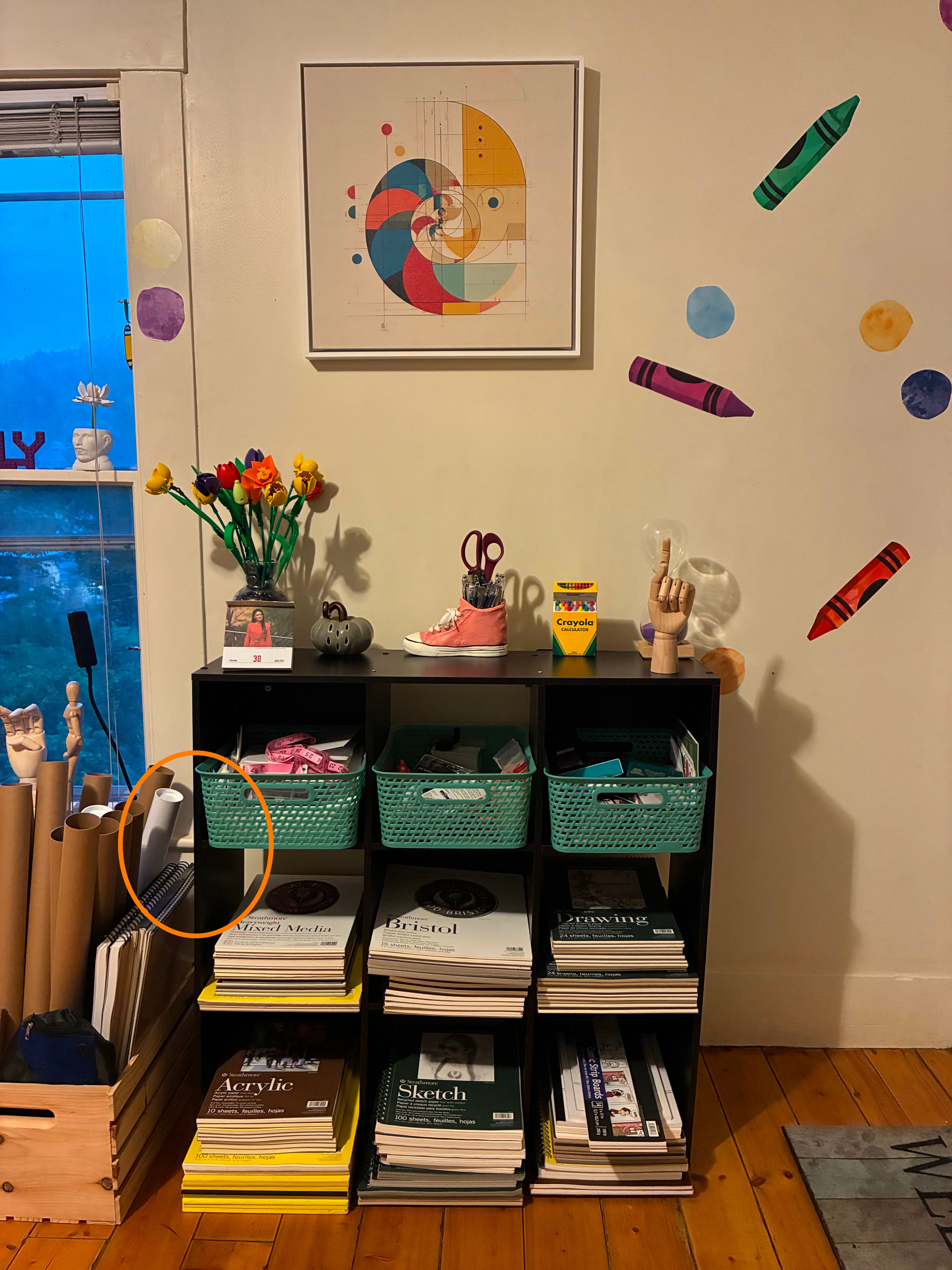
He braced his feet and put both hands on it, preparing to shove it into the items next to it (the crate filled with tubes for mailing drawings). This would have resulted in a very short stop when it hit the windowsill, a fact he completely failed to notice.
I said, “Stop! Please, don’t shove it. We need to empty it.”
Those were my exact words. Please. We.
He looked surprised, but not offended. If he was angry or thought I was a mean white lady bossing him around, that’s not the vibe he was giving off. He merely said, “Oh, sure,” and stepped back as I began to empty the top of it.
Notice what’s in, and on, this cube. We’re going to examine it thoroughly because it really matters for why I’m telling you this story.
On this cube are many things that are precious and also breakable.

The LEGO flowers in the vase would take hours to reassemble.
The gray potpourri pumpkin was a gift from my late friend Adam, making it both priceless and impossible to replace.
The ceramic Converse, which I’ve turned into a pen holder, is breakable.
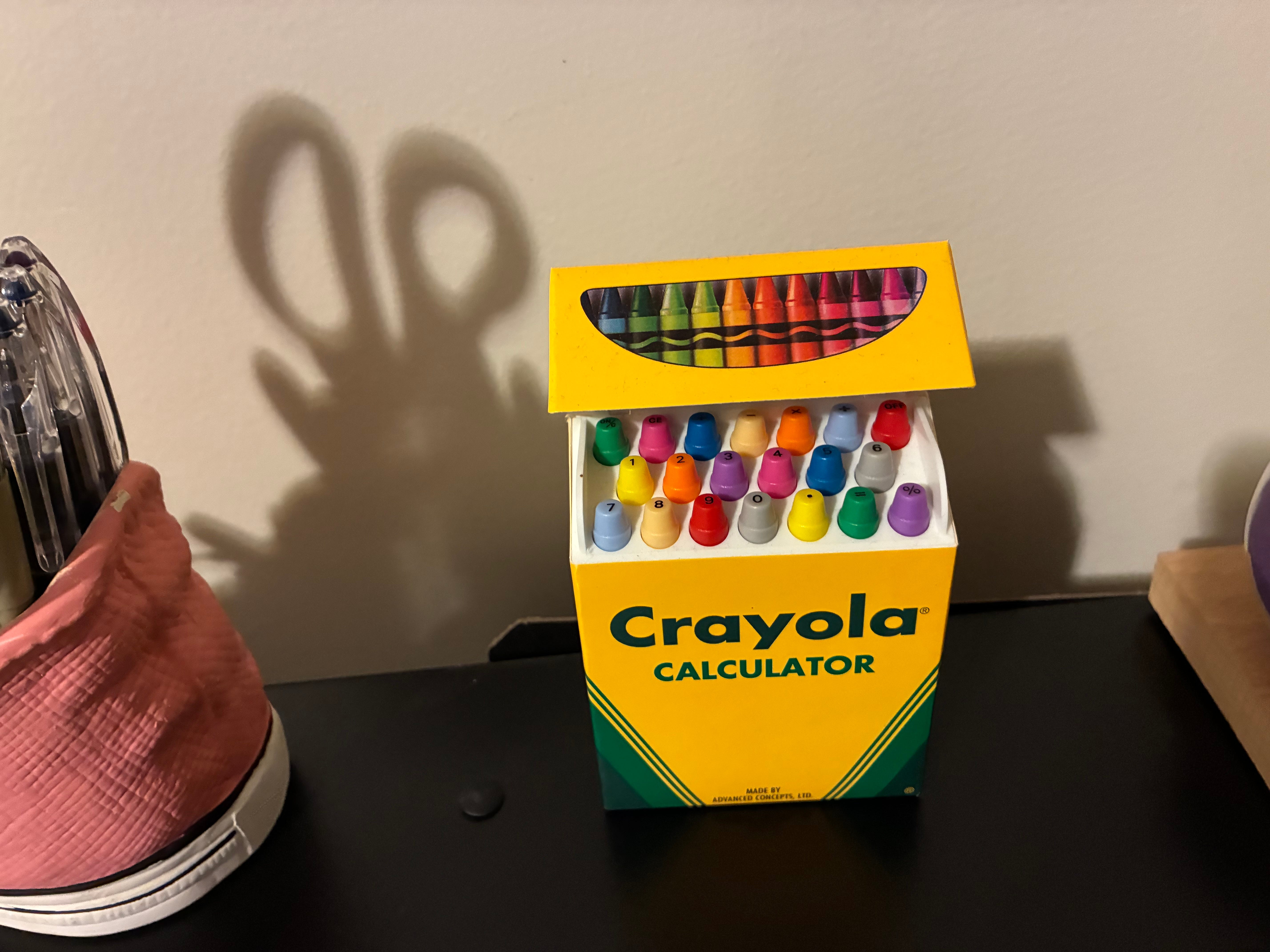
The working Crayola calculator is a 1994 original, the most perfect math-and-art hybrid item imaginable.
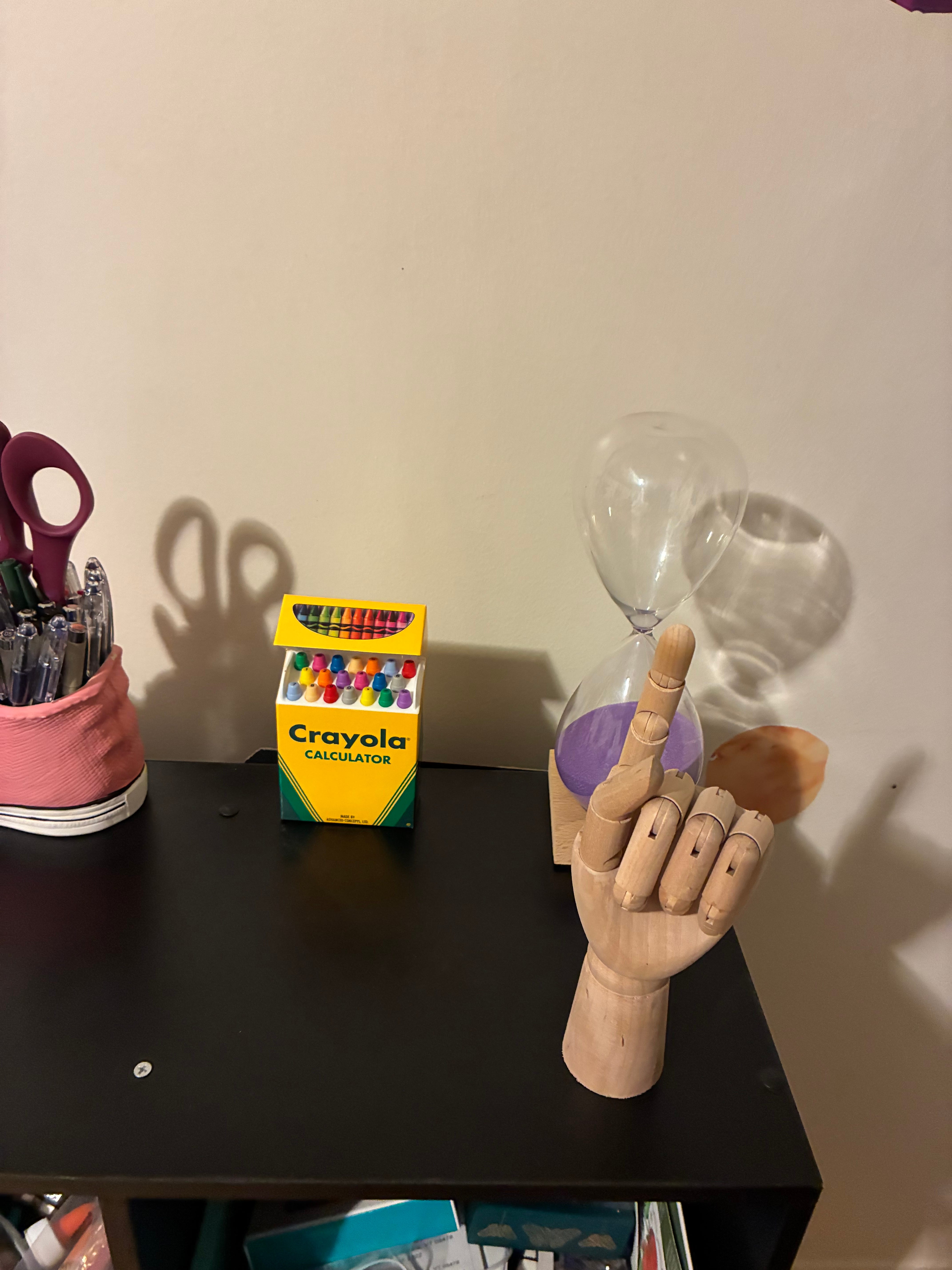
The hourglass, which I use for doing timed drawing sessions without a phone in sight, is as breakable as it looks. And the left hand model, used for anatomy practice, is not terribly fragile, but still will not benefit from a quick trip to the floor.
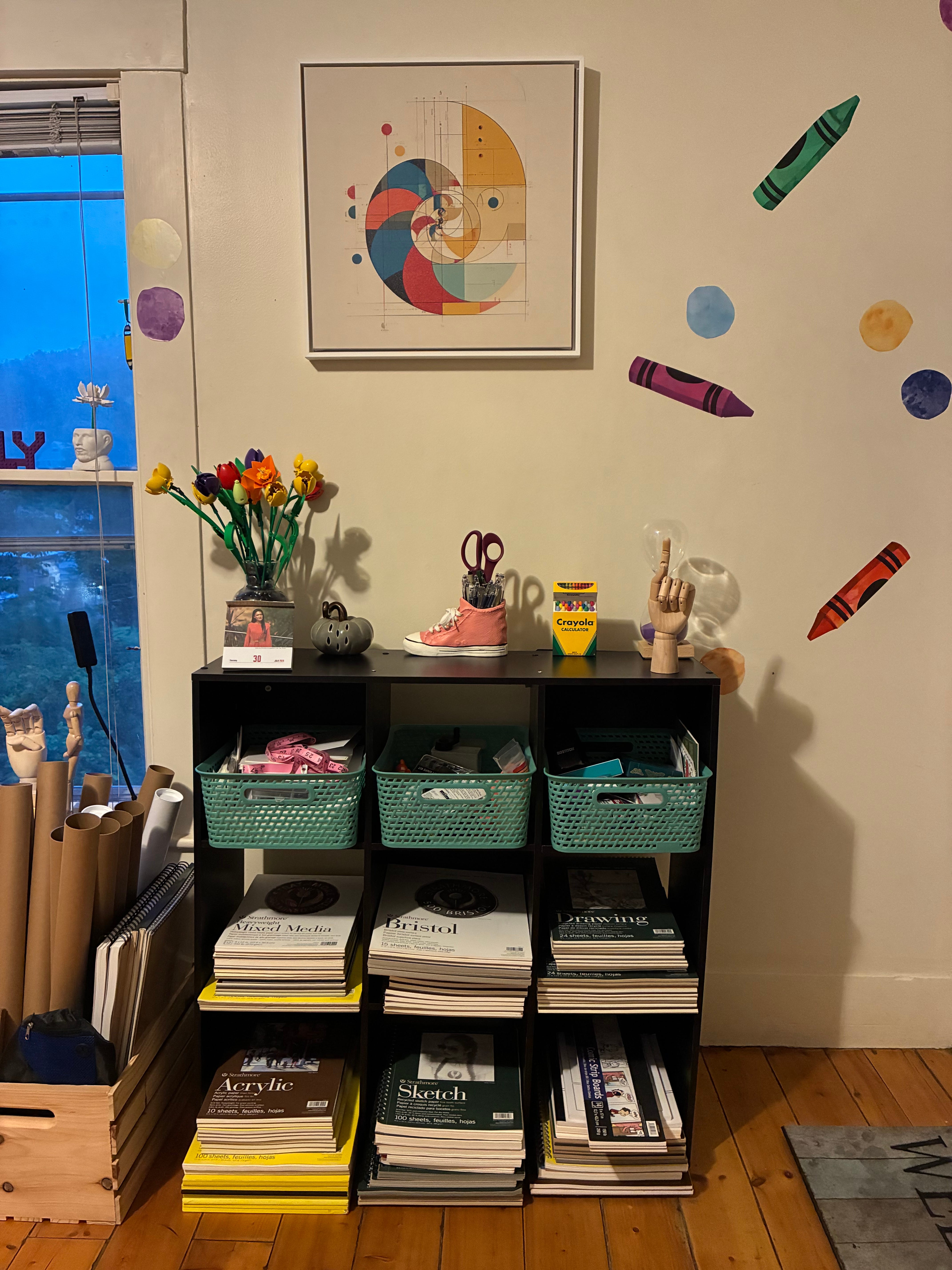
The top row has three baskets. Each holds a few random things that belong nowhere else. The living room is also my art studio, which is exceptionally well-organized, but there is no drawer for tape measures, for stamps, for the instructions that came with my tripod. These random odds and ends go in the baskets.
The other six cubes contain stacks of drawing paper. I have cheap sketch paper for screwing around (in white, toned gray, toned tan, and toned blue), expensive drawing paper for finished pieces (in white, toned gray, toned tan, and toned blue), the same divisions for mixed media paper, cheap and expensive in all four types; cheap bristol for screwing around with my comic strip, expensive bristol with panels for finished strips, and finally jaw-droppingly expensive, would-survive-nuclear-holocaust paper for the pet portraits and other drawings you fine folks sometimes commission from me.
First I moved the items on top of it. I did this quickly and with urgency, respecting that he was there to do a job and his time was valuable — and I did it with urgency even though it was obvious that this would change nothing.
Then I started emptying the cubes.
These stacks of paper are as heavy as they look. And since you probably don’t have a mangled right shoulder, they were almost certainly much heavier to me than they would have been to you.
I moved the first one, the whole stack at once, grunting a little.
I waited for him to follow my example and help.
He did not.
He wasn’t smirking or otherwise obviously enjoying watching me. He wasn’t giving off annoyance or anger.
He just…watched.
After the fourth one, I paused and squeezed my shoulder, which was really hurting, a few times with my left hand.
He said, “That looks heavy.”
I looked at him in genuine awe. He wasn’t trolling. He wasn’t, as far as I could tell, being an asshole with conscious intent. He was simply stating an observable fact.
After about five seconds of gaping at him, I said, “It is.”
What struck me wasn't cruelty. Cruelty would almost have made more sense. Cruel people still understand that another human being needs help and consciously decide not to provide it.
This felt stranger. It was as though he'd categorized what he was seeing as information rather than a problem.
Heavy object observed.
End of thought.
He just kept watching while I emptied the final cubes. Then, before I could stop him again, he shoved the now-empty cube into the windowsill. He looked surprised it only moved a few inches.
I picked up the cube and moved it out of the way.
Then the one who had been watching me called to his partner.
Unsurprisingly, moving things inside the apartment did not magically widen the door.
Their next attempt was to take the stove door off. They talked about it the way you’d talk about a ballgame, unhurried, from opposite sides of the porch. Then they had a friendly argument about who would do it, and it was without rancor of any kind. The one who did the work did not resent the other.
Their obvious operating principle was to continue with the next prescribed step until someone else took responsibility for changing the plan, while the least amount of work is required from the fewest number of people.
One of them got out a booklet to look up how to take the door off the stove.
The other scrolled his phone.
There was no urgency anywhere near my apartment, except mine.
They could not figure out how to remove the stove door, and the stove did not go through the apartment door.
I called the property manager while they were telling me they’d have to leave the stove on the porch for me to figure out.
She came a few minutes later with a carpenter in tow. They ultimately decided they needed to pry the door frames apart — both the front door of my apartment and the door between the studio and the kitchen.
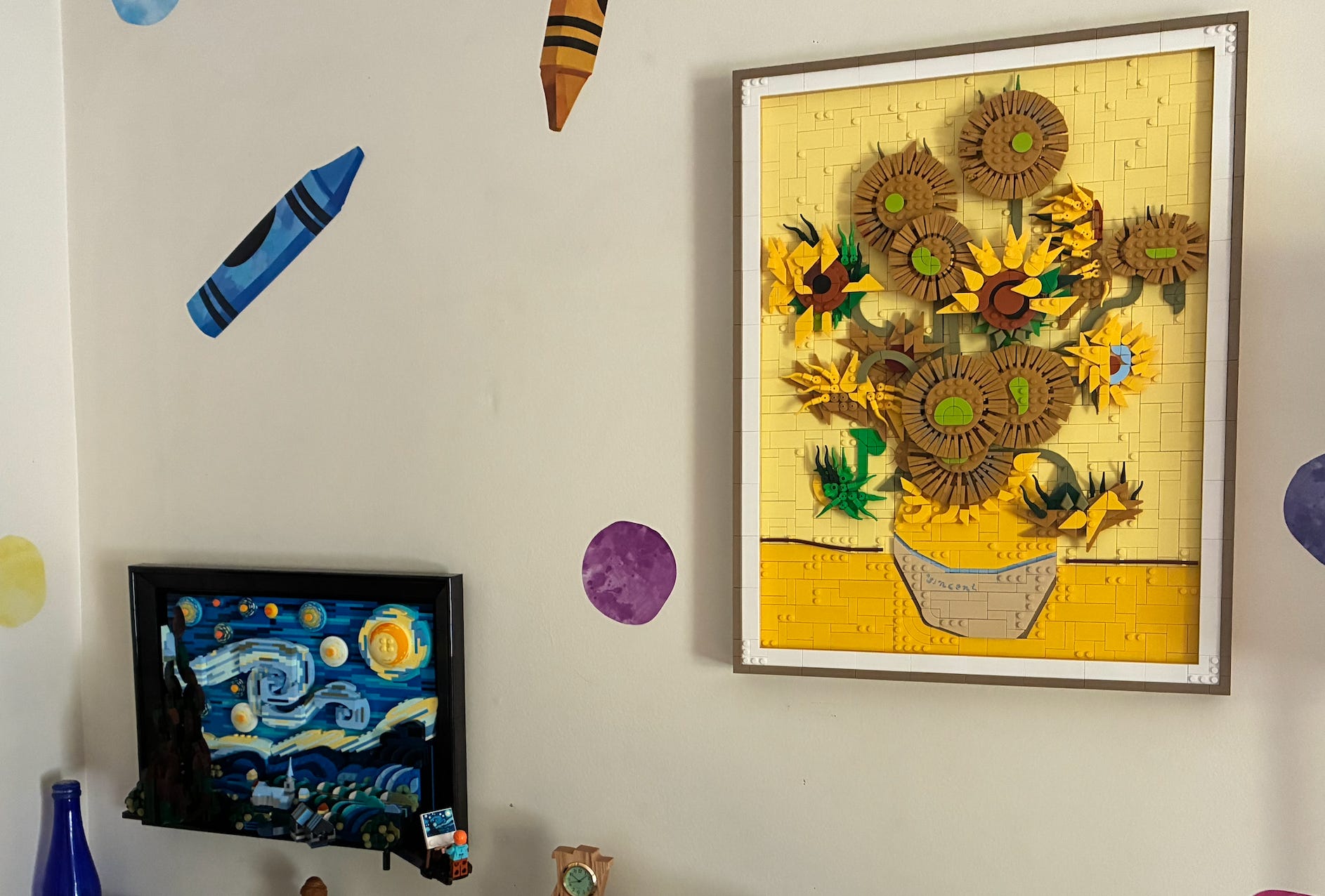
I quickly moved my LEGO Van Goghs to the bedroom and prepared to get the hell out of there as my cortisol spiked.

Josh Slocum came to rescue me as I took deep breaths and wondered how much of my art studio would survive this level of apathy and incompetence.
We went to lunch and discussed it.
I admitted to Josh — and I am admitting to you all now, despite how it makes me look and despite what it will likely do to my subscriber count — that I was angrier than I would have been if the Lowe’s delivery guys were white.
The enshittification of our society is not news to me. My experience — at restaurants, stores, in tutoring, in other situations — is that, with rare and quite noticeable exceptions, Gen Z simply has no work ethic and no urgency. I have both, mostly because I’ve been officially on my own since I was seventeen but functionally on my own since I was a toddler.
There was a two-year period when I avoided homelessness by working seven part-time jobs, and I worked every single day during that time. I broke a bone and was late once, but that’s it.
I went to work, because that’s what you do.
I was exposed to stereotypes about black Americans and work ethic as a kid when a white neighbor got a job with the city. I remember her coming over to confide in my mother, in private, that her supervisor and coworkers — all of whom were black, in those days, in Mississippi — hated it when she stayed busy. They had yelled at her for taking some down time to dust the copy room. “That’s not your job! That’s the janitor’s job!”
My mother and the neighbor spoke regularly about how much the neighbor hated having to be lazy to fit in and to avoid being yelled at by her coworkers for exercising too much agency and working too much and too hard.
So this idea was presented to me as fact, by adults, when I was very young. As I grew up and had my own jobs, I found it to be of mixed accuracy. I had plenty of lazy coworkers, of all races, and I had plenty of diligent coworkers, of all races.
So why, decades and thousands of miles away from that childhood programming, did I notice? And why did I care?
Josh listened quietly before saying something that immediately embarrassed me.
“Everything you just described is generational, not racial.”
My first reaction was defensiveness. Then I started replaying the morning in my head.
He hadn’t been lazy because he was black.
He hadn’t been standing there because he disliked me.
He wasn’t angry that I had stopped him from shoving the loaded bookshelf. Given his employer can’t possibly like damage claims, he was probably even a little grateful.
He hadn’t been trying to make me do the work.
He simply never seemed to regard himself as responsible for solving the problem.
And I think that’s why I initially reached for the easier explanation.
Because if a small segment of our population is lazy and incompetent to this degree, it’s unfortunate but not terrifying.
Josh was right, and that realization bothered me more than if he’d agreed with my first instinct.
If this had really been about black American culture, then it would have been a problem contained within one community, however regrettable.
I am literally a statistician; I already know that stereotypes are imperfect maps of reality. That explanation would have let me file the morning away as an unfortunate interaction with two particular people influenced by one particular American subculture.
But I don’t think that’s what happened.
What frightened me was that, throughout the entire episode, I never got the impression that anyone was trying to actually solve the problem.
They were executing procedures: remove the door. Try the furniture. Consult the manual. Consider removing the stove door.
At no point did anyone seem to step back and ask the question that would have occurred to me almost immediately: What is actually preventing this stove from getting inside?
Laziness has always existed. Incompetence has always existed. What unsettled me was the absence of ownership.
Nobody asked what in the room was valuable before moving it. Nobody noticed the windowsill that made shoving the bookshelf pointless. Nobody offered to help lift the paper once it became obvious it was heavy.
They weren’t hostile, and they weren’t malicious.
They simply didn’t seem to regard themselves as responsible for understanding the situation well enough to change course.
That’s what made me think back to the essay I wrote a couple of weeks ago. I thought I was describing software companies that quietly outsource cognitive labor to their customers. We become the ones who remember the workarounds, infer the missing information, and compensate for broken systems.
Standing in my apartment that morning, I realized the same pattern exists in the physical world. The people officially responsible for solving the problem increasingly execute scripts, while the customer becomes the one expected to notice reality, supply the judgment, and coordinate what happens next.
It was a real-life version of calling customer service and reaching someone who cannot take in new information and cannot independently problem-solve.
Not even when actual, physical reality is right there to interact with, and in ways as obvious as “moving furniture inside the apartment will not make the stove, outside the apartment, fit through the door to get into the apartment.”
Maybe I’m overgeneralizing from one memorable morning. I hope I am.
But if I’m not, then the problem isn’t that a younger generation is lazy. It’s that we’ve begun training people not to exercise judgment at all.
A society can survive its share of lazy workers. I’m much less certain it can thrive if people stop believing they’re expected to notice what’s in front of them, think independently about it, and take responsibility for changing course when the script no longer matches reality.
“That looks heavy” is an observation. Civilization depends on someone recognizing and owning the fact that it’s also a problem, and assuming responsibility for solving it.
The opposite of apathy isn’t passion. It’s ownership.
Comments
Nothing yet. Say the first thing.
Sign in to join the conversation.