
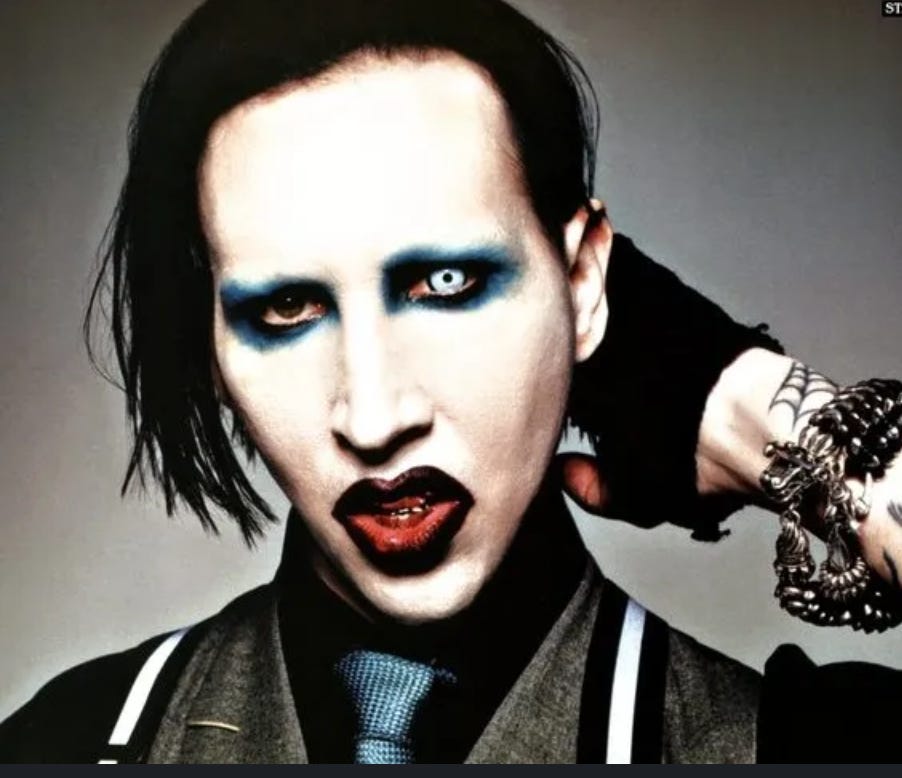
Marilyn Manson has released a new album, or so the algorithms tell me; YouTube and its brethren are pushing him at me quite aggressively.
I know little of his overall oeuvre and I know almost nothing about music. I am literally deaf; everything I know about music I learned from Josh Slocum in three or four conversations about the mathematics of octaves.
But I have made a study — a close reading, if you will — of Antichrist Superstar, the nearly 30-year-old album that made Marilyn Manson a star. Why?
Partly because I grew up in an apocalypse-obsessed Christianity wherein everything that happened in the world — and particularly in the Middle East — was evidence that Jesus would be coming back any minute and the Tribulation would begin shortly thereafter, so are you ready, kids? Are you ready?
Partly because I am deaf, and sampling a wide variety of music has been part of the fun of getting good hearing tech.
Partly because I am not yet a polymath, but I may be one day. The potential is there, and the work ethic, so I am fascinated by the kind of insight that becomes possible when someone knows enough about enough disparate things to start connecting them. And Manson, in my opinion, is a polymath.
And, finally, because I find him both admirable and appalling, appealing and abhorrent. That’s interesting.
What I have found in the album is an astonishingly prescient model of the trajectory American society would take over the next thirty years.
This will be a deep dive. Let’s begin.
Marilyn Manson was born Brian Hugh Warner in Canton, Ohio, in 1969, the only child of a nurse and a furniture salesman who had served as a helicopter mechanic in Vietnam.
He attended Heritage Christian School from first through tenth grade, where teachers explicitly warned students about forbidden music and taught the apocalyptic Christianity that would become enormously important to his later work. Warner has described being taught Revelation through fear of the Antichrist and the imminent end of the world — and becoming both terrified and fascinated by it.1
He eventually transferred to public school, graduated in 1987, and later studied journalism at Broward Community College in Florida, writing about music and interviewing musicians, including Trent Reznor, before becoming one himself.
His stage name was itself a thesis: Marilyn Monroe plus Charles Manson, pairing two American celebrities who represented seemingly opposite forms of fame, beauty and monstrosity. He formed Marilyn Manson and the Spooky Kids in Florida in 1989; the name was eventually shortened to Marilyn Manson, applying both to Warner and the band. By the time Antichrist Superstar arrived in 1996, Brian Warner had effectively turned everything his Christian school had taught him to fear into the raw material for an elaborate artistic persona.
What you probably think you know about Marilyn Manson is that he’s a Satan-worshipper who had one of his ribs removed so he could perform a sex act on himself. That was an extraordinarily early example of internet-age celebrity disinformation, and such a widespread one that he had to deny it publicly many times.
It is true that Anton LaVey gave him an honorary priesthood in the Church of Satan before LaVey’s death, but LaVeyan Satanists do not believe in the existence of an actual metaphysical being who serves as the opposite of Yahweh.
They are atheists with a philosophy built around radical individualism, self-interest, and personal sovereignty, using Satan as a symbol of rebellion rather than worshipping him as a supernatural being — plus a considerable edgelord streak and an obvious enjoyment of tweaking Christian noses and requiring their fellow Americans to live up to ideals of religious freedom. For everyone.
I say that not to defend LaVeyan Satanism, which I find silly, but for the sake of clarity and in the hopes that those of you who find it bewildering that I like this guy at all will keep reading.
Antichrist Superstar was Marilyn Manson’s second full-length studio album, following 1994’s Portrait of an American Family (with the 1995 EP Smells Like Children in between). It was released on October 8, 1996, through Nothing and Interscope Records, with Trent Reznor among its producers.
It debuted at number three on the Billboard 200, selling 132,000 copies in its first week — a remarkable leap for a band that had, until then, remained largely a cult phenomenon. Just over two months after its release, on December 11, the album was certified platinum by the RIAA, representing one million U.S. units; by 2010, Nielsen SoundScan put actual U.S. sales at nearly two million.
But numbers don’t entirely capture what happened. The album’s first single, “The Beautiful People,” arrived with Floria Sigismondi’s extraordinary music video, which premiered on MTV on September 22, 1996, before the album itself.
The video is a grotesque, industrial nightmare, and I absolutely love it. It is a piece of dark perfection. I see something new and thought-provoking in it almost every time I watch it. It’s in no way appropriate for kids.2 With that warning, here’s a YouTube link. He also performed it at the MTV Music Awards, which I think was something like the Emmys for music videos, in 1997. He starts off at a Presidential podium before stripping down and launching into the song. I chose a link that’s a VHS rip and of less than ideal quality because the host, Chris Rock, did an intro and reaction that were both hilarious. Again, completely inappropriate for kids. You were warned. Link.
Manson on stilts, medical appliances, marching crowds, fascist-rally imagery: the video gave the album a visual vocabulary before most listeners had even heard it. It received three MTV Video Music Award nominations the following year, for Best Rock Video, Best Special Effects, and Best Art Direction.
Antichrist Superstar was the record that transformed Marilyn Manson from an underground shock-rock band into a national cultural phenomenon and national moral panic. Its importance extends well beyond its sales: the album, its imagery, and particularly “The Beautiful People” became defining artifacts of 1990s alternative culture. Thirty years later, Sigismondi still identifies that video as a pivotal work in her own career. She says it was the first time she watched one of her drawings literally become a physical character in front of her camera.
I’ve not experienced that with any of my drawings, but I can imagine it would permanently change your understanding of what your art could become.
A triptych is a work of art divided into three distinct but interconnected panels. The form originated in visual art and if you have seen one, it was probably a Christian altarpiece. Artistically, it’s meant to be constructed such that the three images could stand independently while also forming a single larger composition. The middle panel was often-not-always dominant, but its meaning depended on what came before and beside it.
Antichrist Superstar explicitly adopts this structure. It is sixteen tracks long and they are grouped into three “cycles”.
Cycle I: The Heirophant
Cycle II: Inauguration of the Worm3
Cycle III: Disintegrator Rising.
The album booklet reinforces the division visually, and the cycles aren’t merely organizational labels. They describe a transformation.
The first panel of the triptych, the Heirophant, is about subjection. The protagonist exists inside systems of power created by other people: religion, beauty, celebrity, social hierarchy, authority. He is small, contemptible, and acted upon.
The first song, Irresponsible Hate Anthem, complicates the chronology by opening the album with a glimpse of what he will become. It serves the same purpose as a novel that has a short present-day chapter before telling you how the characters get there. We meet the monster first. Only afterward does Manson rewind the story and ask us to watch him being made.
The conceit is even more explicit in the album packaging: the song is presented as a live recording from February 14, 1997 — four months after the album was released. We are quite literally hearing from the future before the story begins.
In this first song, he violates a major social taboo by dropping an n-bomb. I am censoring it here only to keep this email out of your spam folder: “Everybody’s someone else’s n*gger. I know you are; so am I! I wasn’t born with enough middle fingers. I don’t need to choose a side!”
The second song, The Beautiful People, begins the narrative proper. In it, we encounter a world organized around domination: somebody is beautiful because somebody else is ugly; somebody is powerful because somebody else is weak. In Dried Up, Tied and Dead to the World we fully experience the suffering of the protagonist, who seems able to believe in himself only when high. By Tourniquet, the damage has become intimate. “Take your, take your, get up out of me/I don't believe in me/I never, ever believed in me/I am your tourniquet.”
This isn’t yet a story about a monster. It’s a story about the conditions capable of producing one.
The second panel of the triptych, Inauguration of the Worm, is about transformation. The despised thing acquires an identity: the Worm.
But this isn’t a conventional caterpillar-to-butterfly story in which metamorphosis reveals the beautiful creature that was latent all along. Manson corrupts that familiar metaphor. The Worm responds to humiliation by deciding that vulnerability itself is intolerable. And the Worm begins constructing something powerful enough that nobody can ever humiliate it again. Little Horn, Cryptorchid, Deformography, Wormboy and Mister Superstar progressively collapse the distinction between victimhood, celebrity, resentment and domination.
Mister Superstar is my favorite song from this cycle. It’s gritty and raw:
“Hey, Mister Super Hate, I just wanna love you
Hey, hey, hey, Mister Super Fuck, I wanna go down on you
Hey, Mister Super God, will you answer my prayers?”
But it ends by acknowledging, without flinching, the way American culture devours its celebrities wholesale, requiring them to provide our lives with meaning and turning on them when they cannot do for us what we can always and only do for ourselves.
The emotions are almost impossible to separate: worship, envy, sexual desire, identification, resentment, hatred. He wants the Superstar, wants to be the Superstar, and wants to destroy the Superstar for failing to fill the hole inside him. That matters, because the Worm is learning something profoundly dangerous: power is simultaneously the thing he resents and the thing he believes will save him.
“Hey, Mister Superstar (I'd like to see you dead, I wish I was dead)
I'll kill myself for you (I'd like to see you dead, I wish I was dead)
Hey, Mister Superstar (I'd like to see you dead, I wish I was dead)
I'll kill you (I'd like to see you dead, I wish I was dead), if I can't have you!”
The Worm isn’t escaping the value system that injured it. It is learning how to succeed within an inverted version of that system.
The third panel of the triptych, Disintegrator Rising, is about arrival and catastrophe.
By the end of the previous cycle, in Angel With the Scabbed Wings, we have already begun to see the creature the Worm is becoming. Then Antichrist Superstar opens the third cycle and enthrones him. The transformation succeeds. The Worm has become the Antichrist Superstar: charismatic, powerful, surrounded by followers and capable of imposing his own values on everyone else. By 1996 and The Reflecting God, rebellion has become annihilation.
The person who began by recognizing the cruelty of somebody else’s hierarchy has, at long last and inevitably, acquired enough power to construct his own. And I don't think he entirely wants to. That's important.
The transformation has acquired its own momentum: he wanted never to be helpless again, but becoming powerful enough to guarantee that has required becoming something he might never consciously have chosen at the beginning.
And then comes Man That You Fear.
This is my second favorite song on the album, after The Beautiful People.
That final song prevents the album from becoming a simple revenge fantasy. After all the noise, spectacle, power and apocalyptic self-creation, the gigantic Antichrist persona contracts again into something recognizably human.
Becoming terrifying and monstrous has solved one problem: the Worm is no longer helpless.
But it has not solved the original wound that made helplessness unbearable.
He sees exactly what he has done and what he has become, and rather than let the pain of it drive him to self-pity, he owns it while not shrinking away from the reality of it.
And that may be the final transformation. Not so much Worm into Antichrist, but Antichrist into a person capable of looking at the wreckage without saying, Look what you made me do.
The album has spent its entire narrative establishing that other people really did wound him. It does not therefore grant him absolution for what he chose to become in response.
“Pinch the head off, collapse me like a weed/Someone had to go this far/I was born into this, everything turns to shit/The boy that you loved is the man that you fear.”
The chorus, “You’ve poisoned all your children to camouflage your scars” is something I’ve thought about a thousand times on a thousand solitary walks outside.
The video was partly inspired by Shirley Jackson’s “The Lottery,” and also unmistakably evokes the story of Christ going to his death on the cross. I do not find it disrespectful of the latter; I find it an interesting artistic take on that story. It has, in fact, made me reflect on the story of Christ in a deeper way. But if you’re sensitive to that sort of depiction of the Christ, you might find it more blasphemous than interesting. Again, not appropriate for kids. Link.
That gives the three panels a remarkably simple underlying movement:
They have power over me.
I will acquire power.
Now I have power over them.
The crucial thing, though, is that this isn’t really a journey from one system to another. The Antichrist believes he has destroyed the world that produced the Worm, but he has absolutely and utterly retained its fundamental logic: there must be beautiful people and ugly people, strong people and weak people, rulers and ruled.
He has simply changed which side of every binary he occupies.
He has mistaken inversion for liberation.
He has not abolished the binary.
That distinction is where Antichrist Superstar becomes much more interesting than an album about Satan, Christianity, adolescent rebellion, or even fascism.
The Worm’s revolution is simultaneously successful and a complete failure.
He overthrows the people who defined him as worthless — and demonstrates how completely they still define him by becoming their mirror image.
The triptych therefore isn’t oppression → liberation → freedom.
It’s oppression → inversion → replication.
Manson understood the pathology of overcorrection.
And he understood the most dangerous thing about it:
At every intermediate stage, it feels like progress.
Consider the Worm. They define me becomes I will define myself. That is progress.
You have power over me becomes you will no longer have power over me. Also progress.
It is only when I will define myself becomes I will compel you to affirm my definition of myself, or you will no longer have power over me becomes I will have power over you, that liberation has become inversion.
The difficulty is that there is no flashing red light at the boundary.
Making substantial progress without overcorrecting — making a major change that is not simply a Borderline vacillation to the opposite extreme — requires discernment and balance. You have to identify precisely what was wrong with the old system while preserving whatever was true or necessary within it.
That means resisting the temptation to declare the entire old system flawed, unnecessary, or mistaken from the beginning — which is perhaps the most characteristically American mistake of all. Then you have to correct the actual error and do something surprisingly difficult for human beings:
I have a name for our national inability to do this: American Political Borderline Personality Disorder, or APBPD.
We don’t correct. We vacillate.
The War on Drugs becomes a country where in some places it is now easier to find a marijuana dispensary than a church.
The War on Terror and its sometimes hysterical, sometimes justified suspicion of Muslims gives way to a political culture in which self-described Islamic tribunals are conducting sharia-based religious arbitration on American soil. Meanwhile, the mayor of New York spent months refusing to condemn “globalize the intifada,” defended the slogan as an expression of a desire for Palestinian equality, and, even after protesters in his own city were literally chanting “we support Hamas here,” required nearly a day and a second statement before explicitly denouncing support for the terrorist organization.
Electorally, we went from Barack Obama to Donald Trump, then to Obama’s vice president, then back to Donald Trump.
These are not examples of America gradually incorporating new information into a more sophisticated understanding of itself — which is, after all, what growing up means.
We keep discovering something genuinely wrong with where we are and responding by flooring the accelerator in the opposite direction.
And we’ve done something creepily similar with identity.
For much of human history, other people had extraordinary power to tell you what you were and what that identity permitted you to do. Your race, sex, religion, sexuality, disability or social class could determine where you could live, whom you could marry, what work you could perform and whether you were entitled to participate fully in public life. America has an especially ugly history of making some of those classifications legally coercive.
The correction was one of the great moral achievements of liberalism:
You are entitled to define yourself, and other people are not entitled to persecute you for what you are.
But we didn’t stop.
Over time, you may not persecute me for my identity began, in some parts of our culture, to shade into you must affirm my account of my identity.
Disbelief itself could become a form of harm. And eventually another proposition entered the discourse: if someone’s identity is not sufficiently affirmed and that person dies by suicide, the people who failed to affirm it may bear some responsibility for the death.
This argument has become particularly familiar in discussions of transgender people. Whatever one believes about sex and gender — and that is not the argument I’m interested in having here — we have spent roughly the last decade becoming culturally familiar with a particular moral paradigm:
Believe people when they tell you who they are. Affirm them. Failure to do so may harm them. If that harm contributes to suicide, your refusal to affirm them makes you morally responsible for a death.
Once established, cultural paradigms don’t necessarily remain confined to the population around which we developed them.
Which brings me to Jason Arday. I will say what I have to say about suicide, including his, next month — September is Suicide Prevention Awareness Month — but for now, I’m simply noting that the paradigm’s a perfect fit.
Here is who I am.
You must believe me.
Your disbelief is harming me.
If I die, look what your disbelief did.
And suddenly I hear Mister Superstar again.
I’ll kill myself for you.
I’ll kill you if I can’t have you.
The particular psychology isn’t identical, and I’m not claiming that Manson somehow predicted Jason Arday. The resemblance is structural.
In Mister Superstar, another human being has been assigned responsibility for supplying something the protagonist cannot supply for himself.
Worship and resentment become inseparable because the Superstar is being asked to perform an impossible psychological function. When he inevitably fails, the person who needed him can turn the resulting anguish either inward or outward.
“We want to see you dead on TV.”
There is something frightening in a culture that simultaneously worships people and wants to destroy them, because those impulses are not nearly as contradictory as they appear. Even our language of sexual desire slips remarkably easily into the language of domination: nailing someone, getting nailed, railing someone, getting railed, fucking someone. The person we most intensely desire can become the person we want to possess, penetrate, conquer, consume.
Desire and domination aren't the same thing, obviously. But our language suggests that human beings have long understood how uncomfortably close together they can live.
Both begin by turning a human being into an object whose job is to satisfy our psychological needs.
And social media has democratized celebrity.
You no longer need to be Marilyn Manson to construct a public identity, acquire an audience and ask that audience to recognize the person you’ve constructed. Increasingly, all of us are simultaneously celebrities and fans, performers and audience, objects of judgment and people demanding recognition.
The liberal correction remains essential: you get to decide who you are.
But another person’s mind remains outside your jurisdiction.
They get to decide what they believe.
That boundary can be painful. It can be unfair. People can be cruel, prejudiced, ignorant or simply wrong about us.
But eliminating that boundary doesn’t eliminate power. It merely changes who gets to exercise it.
The Worm has changed sides of the binary again.
And because each step away from genuine oppression felt like progress, it can be extraordinarily difficult to notice the moment when progress ended and inversion began.
There is ample evidence that the American inversion is well underway.
Consider authority itself. There was a time when being an expert, holding an important institutional position, or possessing impressive credentials gave your opinion enormous — sometimes excessive — weight.
Thanks largely to a virus that emerged from China, we correctly discovered that experts can be wrong, institutions can become corrupt, credentials do not confer omniscience, and authorities have extremely fucking powerful incentives to protect their own authority.
So we corrected.
And then we kept going.
Today, in significant portions of American culture, an expert or authority simply doing his job, examining the evidence and announcing the conclusion he reached can be the least persuasive source of information available.
The CDC says it? Of course they do.
The intelligence agencies concluded it? That’s what the intelligence agencies want you to think.
The scientific consensus says it? Follow the money.
Tyler Robinson is on surveillance video at Utah Valley University, a university he did not attend and several hours’ drive from home, on the day Charlie Kirk was murdered. His DNA is on the murder weapon. He was identified by his own parents, who surely have no interest in seeing their son executed for a crime he did not commit. His own lawyers, whose personal financial interests are strongly in favor of proving someone else did it, are presently arguing about whether his shooting of Kirk satisfies Utah’s requirements for the death penalty. That is their question: Does the thing he did meet the legal requirements for execution? Not: Did he do the thing?
And significant portions of Americans are certain that the identity of the murderer of Charlie Kirk remains an open question.
Evidence provided by the accused killer’s own defense attorneys is apparently less persuasive than the fact that somebody on the internet has questions. Or claims to.
Conspiracy theories are ascendant partly because we have reached the extraordinary point where lack of conventional authority can itself confer authority.
Joe Rogan has never been elected to anything. He holds no government office, has no advanced degree and runs no major institution other than, arguably, his show. Ten days before the 2024 election, Donald Trump kept supporters waiting nearly three hours at a Michigan rally because he was recording an interview with Rogan. That tells you something about where political power now resides.
This isn’t because Americans have stopped looking for authorities. We abso-fucking-lutely haven’t.
And we aren’t less religious, either.
We’ve just found different priests.
The outsider became more trustworthy than the insider because he was outside. Suspicion became a credential. Anti-authority became authority.
The Worm has become the Beautiful Person.
There is another stage beyond inversion, however, and I think Antichrist Superstar sees it, too.
Eventually, after watching enough revolutions reproduce the structures they were intended to destroy, you can reach a darker conclusion: perhaps the structure cannot be destroyed.
Perhaps there will always be Beautiful People and the people they deem ugly.
Perhaps there will always be superstars and fans who want to see them dead on TV.
Perhaps every Worm that acquires enough power simply becomes another Antichrist.
Perhaps liberation is a story we tell ourselves while deciding who gets to stand on which side of the binary.
Perhaps there is no escape.
Only power.
This is the place where Antichrist Superstar becomes profoundly nihilistic, and where I part company with it.
Because once you believe there is only power, principles become little more than weapons.
Free speech becomes important when my speech is being censored and dangerous when yours is.
Institutional norms become sacred when they restrain my opponents and antiquated obstacles when they restrain me.
Democracy becomes legitimate when it produces legitimate outcomes — but I increasingly define legitimate outcomes as the ones that don’t permit the people I consider dangerous to acquire power.
The logic becomes seductive precisely when the threat is real.
After the 2020 election, TIME published an extraordinary article called “The Secret History of the Shadow Campaign That Saved the 2020 Election.” It described a coalition of business leaders, activists, election officials and others working behind the scenes to protect the election and ensure a peaceful transfer of power. The author explicitly rejected the idea that they were rigging the election; she called their efforts “fortifying” it.
But she was remarkably candid about what fortification involved: powerful private actors coordinating behind the scenes, influencing perceptions and information flows, pushing for changes to rules and laws, and pressuring social-media companies to take a more aggressive approach to election-related content.
The people involved believed, genuinely, democracy was in danger.
That’s what makes the example interesting.
When you become convinced that ordinary rules and institutions are inadequate to protect democracy from people who might destroy it, circumventing the norms surrounding those institutions can begin to feel not merely permissible but necessary to save democracy.
And the right has supplied its own version of exactly the same logic. It has become increasingly acceptable in some right-wing circles to question universal adult suffrage itself: whether women should vote, whether votes should effectively belong to households rather than individuals, whether parents should receive additional votes for their children. I have personally had men tell me that I should not be allowed to vote. (None have proposed that my taxes be returned.)
Notice the logic. Democracy has produced a political order they regard as dysfunctional, decadent or potentially catastrophic. Adults who pay taxes, obey the law and possess political opinions they dislike are using democracy to produce outcomes they regard as dangerous.
And therefore stripping fully functioning adult moral agents of any say in the laws they are nevertheless required to obey — while continuing to tax them, regulate them, punish them, and demand every obligation of citizenship from them — can begin to feel like defending democracy.
There is an old word for people who owe everything to a political order that owes them no voice: subjects. There are uglier words when the arrangement goes further.
The facts and conduct in these examples are not equivalent. The underlying temptation is:
The system has been corrupted.
The ordinary rules cannot save it.
Extraordinary action is therefore necessary.
We must violate the norms in order to preserve the thing those norms exist to protect.
At that point, the argument is no longer really about which rules are just.
It is about whose side gets to control the exceptions.
And that’s nihilism.
Manson understood the pathology of overcorrection. He also understood the most dangerous thing about it:
At every intermediate stage, it feels exactly like progress.
The Worm should stop allowing other people to define him. He should recognize that the Beautiful People constructed a hierarchy that benefits themselves. He should reject the idea that his position at the bottom of it proves that he belongs there.
Every step is defensible.
Until suddenly he is standing at the podium.
Making progress without overcorrection — making a major change that is not simply a Borderline vacillation to the opposite extreme — requires something rebellion does not: discernment and balance.
You have to determine exactly what was wrong with the thing you’re rebelling against. You have to change it without assuming that its opposite must therefore be right. You have to retain whatever was valuable in the old structure while discarding what was destructive. And, hardest of all, you have to recognize the moment when you’ve gone far enough.
Radicalism has a wonderfully simple instruction:
Keep going until everything is…..
Until everything is fixed. Normal again. Better. Perfect. Fair. The promised destination changes; the instruction does not.
Discernment has to keep asking:
What remains true?
What have we fixed?
What have we broken?
Is the next step still progress, or have we begun the journey toward the opposite extreme?
Manson’s answer, at least in Antichrist Superstar, is bleaker than mine. The album increasingly suggests that the structure itself may be inescapable. Screw or get screwed. Worship or be worshipped. Beautiful or ugly. Powerful or powerless. The only real choice is which side you’re going to occupy.
I don’t believe that.
I don’t believe that the world has to be divided into Beautiful People and Worms — with every Worm’s only hope being to invert the power structure and become one of the Beautiful People himself.
In fact, the entire idea of American Political Borderline Personality Disorder depends on my not believing it.
Calling overcorrection pathological implies that there is another possibility: not some mathematically perfect midpoint between two extremes, but a difficult, unstable, constantly renegotiated, constantly fluctuating place where correction does not become inversion.
Manson’s great insight was recognizing that the Worm can become the Antichrist without ever noticing the precise moment when liberation became domination.
His great mistake, I think, was believing that it was inevitable.
The pendulum swinging is not inescapable. We do not have to vacillate between extremes like adolescents. We are allowed to grow up.
It is simply much harder to escape than choosing a side.
Like Manson, I wasn’t born with enough middle fingers.
But I have exactly enough for a false binary.
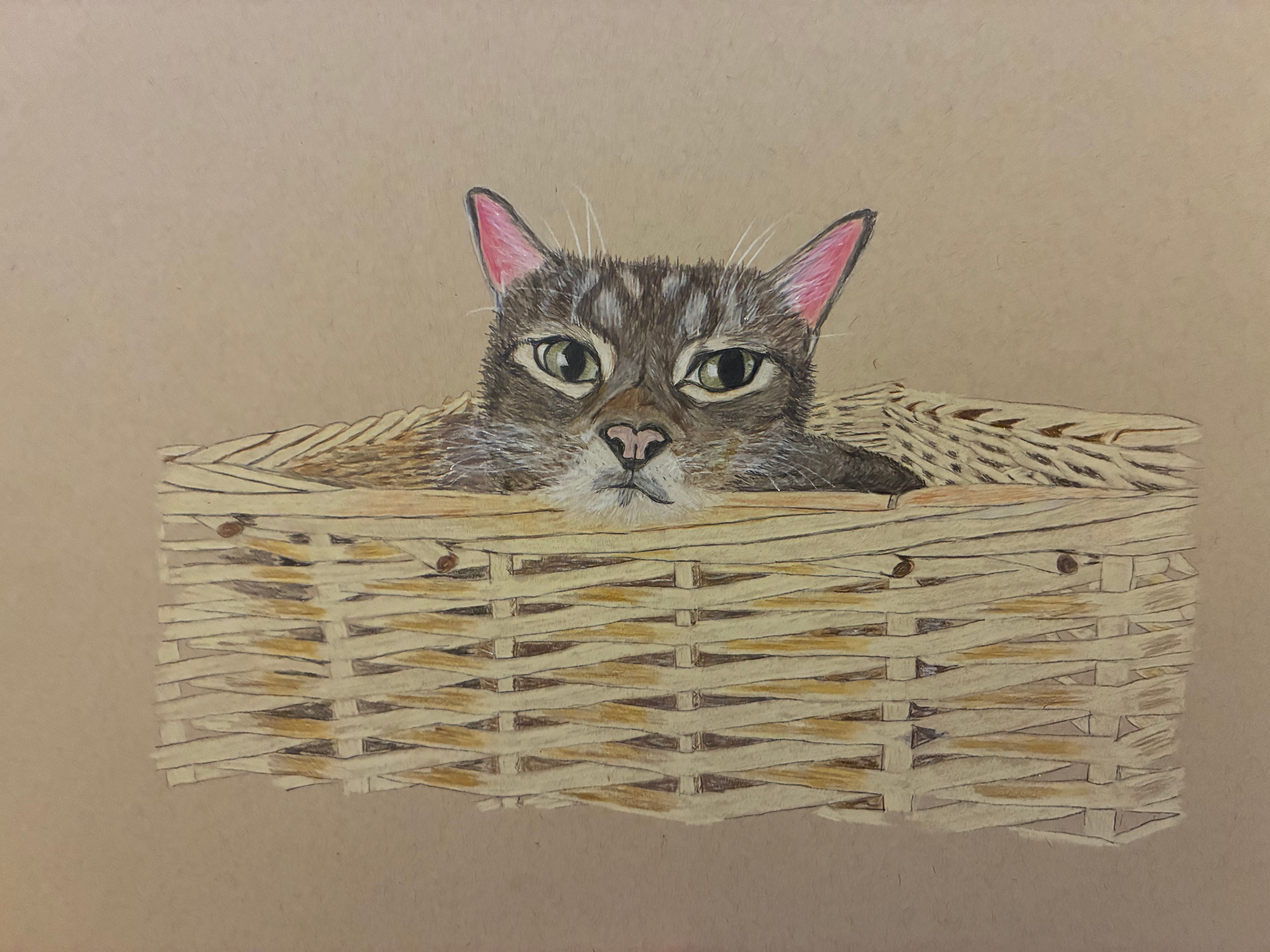
Email vtwriterartist at gmail dot com if you’d like me to draw your loved one. Portraits like this one, in graphite with the eyes in colored pencil, are my current artistic interest, but I’m also enjoying drawing pets, typically on toned paper for a nice contrast with the fur.

Having found my parents gone and thought I was left behind in the rapture more than once as a kid, your MathNerd relates. Oh Lord, does she relate.
If your kids watch YouTube on your account, log out before you watch this. The algorithm will start feeding “you” (i.e. your kids when they watch on your account) similar content, and you do not want that.
“Heirophant” is Manson’s deliberate spelling; the conventional word is hierophant, meaning a priest or interpreter of sacred mysteries. In the tarot, the Hierophant refers to legal and institutional structures.
Comments
Nothing yet. Say the first thing.
Sign in to join the conversation.