
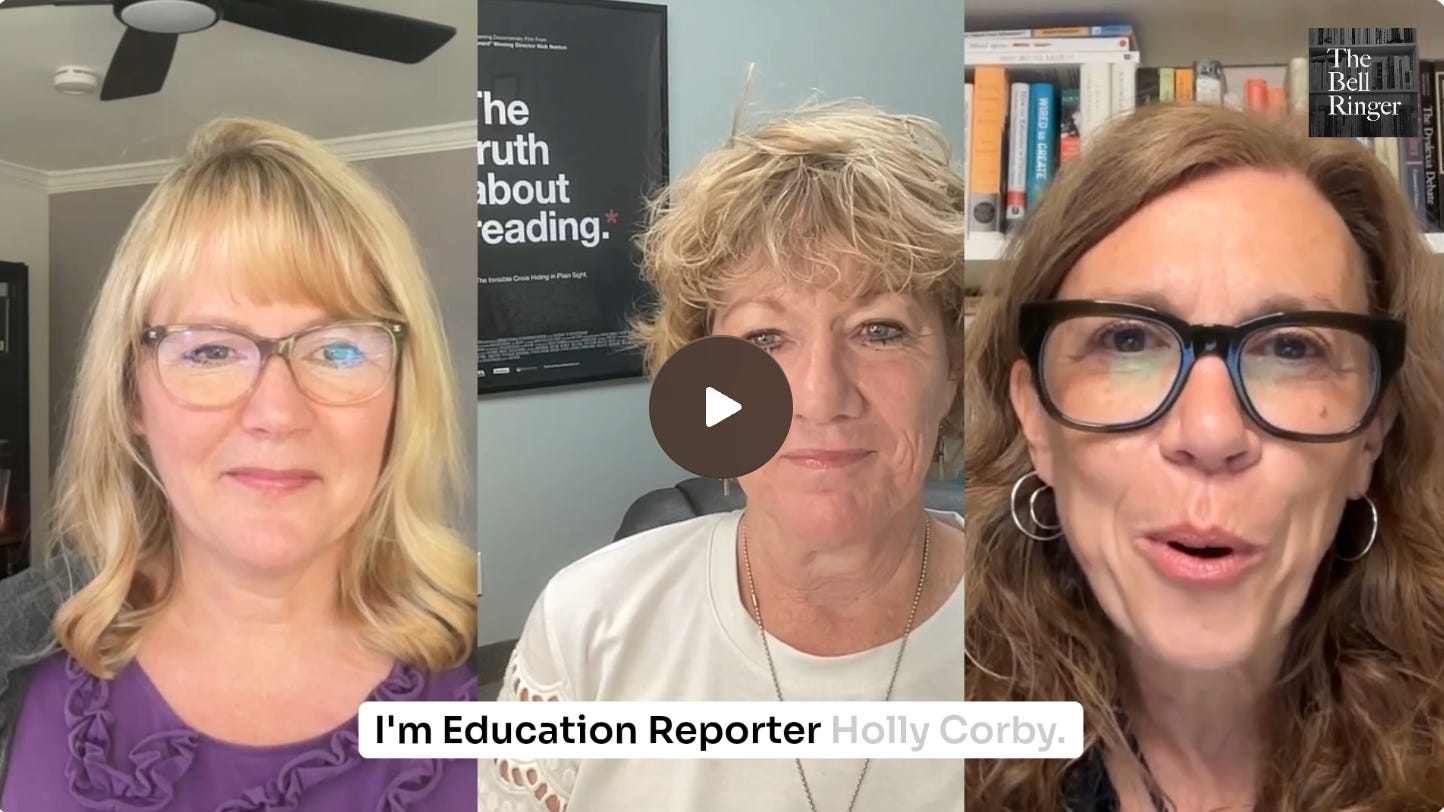
(Just an image; full video below)
This fascinating interview with two experts in literacy, Marnie Ginsberg of Reading Simplified and Nora Chahbazi of EBLI, is free today! If you like this kind of in-depth reporting and analysis about the science of learning that usually lives behind the paywall, consider joining Bell Ringer Pro.
One thing that’s become clear to me this summer in talking to reading teachers, interventionists and experts: there are a million and one ways the science of reading can go off the rails. And phonics might be driving that train.
All the new policies driving science-of-reading, evidence-based reading instruction mean many more children are going to get phonics instruction when they head back to school this fall. But can this focus on phonics be too much of a good thing? Some are beginning to worry—are classes over-teaching phonics? Are other crucial parts of the science of reading getting crowded out in our national love story with this one small slice of teaching kids to read?
I wanted to better understand what was happening with phonics, and the freakout, and what it means for kids headed back to school, so I asked Marnie Ginsberg, founder of Reading Simplified, and Nora Chahbazi, founder of Evidence-Based Reading Instruction, some hard questions about what’s next for the science of reading. Their answers might surprise you.
Is the obsession with phonics warranted? Should schools be moving on to other parts of reading?
What does the research say on the efficacy of different approaches?
How cognitive science principles like cognitive load theory and spaced and interleaved retrieval practice make stronger readers
What happens to young readers when they don’t ever get to the actual reading part?
Getting quickly past sounds and blending and into practice, iterations and feedback
A focus on student outcomes
Using Research and Reason in Education: How Teachers Can Use Scientifically Based Research to Make Curricular & Instructional Decisions, Paula and Keith Stanovich
Highly successful sixth grade reading intervention with SpEd and ELL students
The Bell Ringer: Hi there, welcome to the Bell Ringer, where we talk about the research on teaching and learning and how it plays out in real classrooms. I’m education reporter Holly Korbey. Most kids in most states head back to school this fall with some version of the science of reading in place. And the majority of that science of reading based instruction, those materials, like it or not, is focused on phonics. Which is a good thing.
Research has shown how crucial phonics is to word reading. And for many years, a lot of students weren’t getting systematic phonics in their classrooms. But can this focus on phonics be too much of a good thing? Some critics of science of reading policies are concerned mainly about two things. One, that the zeal for phonics might be leading to an over-teaching of really specific phonics skills and rules.
And two, that phonics might be crowding out the other just as crucial pieces of the science of reading research that carries kids into becoming fully literate. Both concerns, though, end up kind of having a similar result. Crowding out class time and energy spent on what is supposed to be the end goal of all this work: reading. Kids really getting a chance to read. So back in the spring, I reported a story.
On an emerging kind of phonics, what I would probably call phonics 2.0, that wants to address some of these challenges. And lately, awareness of this method is growing. In places like Education Week, linguistic phonics is what people are talking about. And it has a lot in common with structured literacy, which is what dominates state policy and reading lists at the moment. Linguistic phonics is systematic and explicit.
It’s research based. It’s focused on word reading. But it also has a few key features that appear to address some of these concerns, like spending too much time sounding out words and not enough time doing real reading. Linguistic phonics is also concerned about over teaching phonics to young students. And the lead players in this space say they want to have a bigger conversation about using cognitive science practices.
To get more students reading, actually reading, faster. So today we’re gonna talk to Nora Chabazi, who’s the founder of Evidence-based literacy instruction, which is also known as Ebly, and Marnie Ginsburg, founder of Reading Simplified. Both of these companies are helping teachers learn the linguistic phonics approach. So welcome to both of you, and thanks for being here.
Nora Chahbazi: Thank you, Holly, for having us.
Marnie Ginsberg: Yeah. Yeah. Thanks so much, Holly.
The Bell Ringer: I think it’s fair to say that phonics is going to show up in a lot of reading classrooms this fall. And yet I’ve seen some comments, I’ve heard some things, wondering whether literacy advocates, the the group, you know, a lot of them are very active and very vocal in online groups, are just making too much about these growing debates between structured literacy or linguistic phonics, like making too much out of what kind of phonics we’re using with students. There’s kind of this sense that the phonics piece has been solved. It’s time to move on to other pieces of the science of reading. And it’s basically like we made this huge leap. We’re following the evidence on decoding now. So you know, job done. Let’s move on. So my first question to you is, are a bunch of teachers and advocates worrying too much about phonics?
Nora Chahbazi: I’m going to say no. I think that it’s very important for us to look at the north star of what’s most important, and that is student outcomes.
Now, there’s a variety of different types of phonics. You have analytic phonics and synthetic phonics and structured literacy types of phonics, with, like you said, the OG focus and linguistic phonics. But the reason we need to be concerned about this is because we have a limited amount of time to teach children to get them to become readers where they read to learn instead of learning to read. And with instructional practices and phonics that are more accelerated and more effective to get them there faster so that they’re reading an authentic text and trade books and connected text is critical. So I think that instead of—we shouldn’t be worrying about it, in my opinion I feel that you know we should be talking more about it. You know, what are your thoughts, Marnie?
Marnie Ginsberg: Yeah, I agree with Nora. I know we have still a lot of challenges and I get why advocates want to move past the phonics question, but yeah, early word recognition is really foundational to all later school success, even math. If we don’t get it right from the beginning, we miss a huge opportunity. I think about recognizing to read words or recognizing print is kind of like a river, and learning vocabulary and world knowledge is like an ocean. And so learning to teach kids how to read words is much more doable for our school systems. Building you know a very knowledgeable citizenry is super important, but it’s going to be a lot harder lift.
When we know a child is learning to read well and she is then primed for learning to learn about the world. She can learn new vocabulary and new concepts because the best way you can do it is by being a good reader. And being a good reader starts with good decoding and good automaticity and fluency. And looking at the latest NAEP data, this recent SRI study that showed that limited practice was going on, there’s hints that we still haven’t gotten the implementation right. So I would love for us all to think of this as a both and situation instead of an either or situation.
The Bell Ringer: Absolutely. And I mean, you know, that’s kind of what I wanted to hear from you guys is, you know, the literacy advocacy group is big online. It’s big on Facebook. It’s big on Instagram. Right. So like there’s a lot of success in there. So I think that like what I see is a lot of these conversations are now playing out in public. And and a lot of education people are reading them and are are getting pulled in to kind of like these detailed arguments. But as Nora mentioned right before we started, these arguments have always been going on over what the best thing to do is for kids. So I kind of want to go over what linguistic phonics is and what it isn’t for listeners who might be new to it or readers who are new to it. Nora, can you describe its main features?
And how exactly it differs from the structured literacy approach that’s being used in a lot of classrooms currently. And could you also describe, are the differences big?
Nora Chahbazi: Yeah, and that’s a great question. So the differences are big, though nuanced, but big. So for you know, an overarching point is that linguistic phonics starts from speech. What in it—so it’s speech is natural. It’s what kids come to kindergarten. I have a grandson that just started kindergarten today, one last week. But kids come to school being able to talk to some degree, almost all of them. So we’re going to start from what is natural, which is speech. Now traditional phonics, other types of phonics are all basically pretty much all of them start from letters. Okay. And letters are man-made, not natural. So we’re gonna look at A-apple in speech in print to speech. They’re going to do that, where in linguistic phonics we’re gonna say, you guys say the word at, what’s the first sound in at? So we’re gonna go from the speech in the word, pull it apart to the components or sounds, right? And then match the spellings to them. All right. So that’s the basic difference. Instead of learning a bunch of sounds in isolation or letter names, both in isolation before you get a chance to put them together, which sometimes is months, even in kindergarten. So we’re going to get to rate what we need to do, which is you know, the whole words, splitting them apart.
Finding the, you know, the sound and then the symbol that or letter or letters that represent them. So that’s in general. And also the explicit instruction, we obviously you know, give explicit instruction on the code, but our instrument explicit instruction focus with linguistic phonics is on the logic of the English alphabetic code and the concepts that are a part of that. So let me explain what that means. So the four main concepts that you know
Diane McGuinness is the one who you know, the giant in my opinion, back in the nineties that both Marnie and I found out about this linguistic phonics stuff back then. And so what she talks about is these four concepts that are critical, for you know, a learner of any age or ability level to understand to be able to apply to the whole English alphabetic code. And the first one is, that the sounds that we say in words are represented with letters in print. Okay, that’s the first one. The second one is, in those sounds can be represented with one, two, three, or four letters. So for example, the word search. We have three sounds. S or ch but the s is spelled with one letter, S, Ur is spelled with three letters, E-A-R, and Sh is spelled with two letters, C-H. So even though that has three sounds and six letters, right, if you understand that concept that one, two, three, or four letters can spell a sound, this is no big deal. Okay, we don’t have to go for a bunch of rules and exceptions to rules and gyrations to try to kind of figure out what do we need to use when to figure out this word.
The third concept is in the English language, the same sound can be spelled in a lot of different ways. So if we go back to the s in search, for example, that s is spelled with one letter, S in search. And the word city, okay, it’s spelled with a C. And the word miss, two letters, and the word peace, right? C E is the spelling for s. So there’s whether it’s vowels or consonants, there’s a lot of ways to spell the same sound. And this is very you know, this is what makes the English alphabetic code more opaque, but it’s not a problem when you understand that concept and you learn or are taught, so you learn how to apply it.
The third concept is, the same exact spelling, letter or group of letters can represent more than one sound. So if we stick with that s in search, right, that can represent the sound as in search. But if you look at the word is, that same letter represents the sound z. If you look at the word sure, that letter now represents the sound sh.
So you need to be able to manage that logic of the English alphabetic code and in an integrated manner, which I think is important to point out with linguistic phonics instruction. We don’t teach phonemic awareness here, and phonics is there, and spelling is here, and reading is, you know, yeah, or vocabulary is somewhere else. It’s very integrated, which is part of what makes the instruction so accelerated. You know, there are many parts, but that is one part. And then we apply it, okay?
So it’s really important to have that application in that training, you know, so, you can transfer this to anything else, which is reading in connected text. The very beginning, little kindergartners will do some decodable, but mostly we’re doing trade books in authentic text and that type of thing. When we get them into reading, because they understand these concepts, it widens everything and accelerates their ability to acquire that information without having to have been taught explicitly every single spelling for every single sound, which is one of the things that happens a lot with traditional phonics. They want to have mastery in the sound or spelling before you can move on. Okay, and they also want to teach if they’re teaching different ways, probably to spell a, let’s say they may teach ai one week and the next week they teach ay, and then you know later on they teach another way to spell a.
So that integration is really, really critical. Also, there’s a very low cognitive load. There’s a lack of declarative knowledge. We don’t teach things that are not required for somebody to reach their highest potential in reading, that’s extra but not necessary—like terms like a fricative or a diphthong or those types of things, or syllable types, and how you I don’t know what they do because I I’ve not taught that way before, but breaking up syllables with marks and things or rules which is a real biggie and typically in phonics instruction where they have to have a rule but then the that complexity of the English alphabetic code makes it, so guess what? Now that rule only works 40% of the time. So there’s a lot of extraneous stuff that increases the workload for teachers, right? And how do you teach all of these things in isolation, right? There’s not time, so you have to choose. And just like you said, there’s very little reading going on because by the time you teach all these things in isolation, you don’t have an opportunity to get these kids actually reading in connected text. And it’s kind of like basketball. You know, if you’re learning the phonics, it’s like dribbling. If you’re just gonna dribble, dribble, dribble, dribble, and you get great at dribbling, but you never apply it to a basketball game. That you know, that’s not the same thing just because you can dribble. It’s an important component, but there’s a whole lot more to it.
The Bell Ringer: So what you’re saying is, and I’m just gonna try to clarify this for listeners who may be unfamiliar with this, is that when a kindergartner comes to class, you’re going to start with the sounds in words, sounds that of words they already know from their speech. You’re going to connect it to a printed word, and then you’re gonna have them go read that word in a text. Instead of spending weeks and weeks maybe on letters, letter names, and things like that. Is that right?
Nora Chahbazi: It is right. Mm-hmm.
The Bell Ringer: So has linguistic phonics just gone totally rogue? Or is this researched? So in one of the Education Week stories that came out last week, reading researcher Tim Shanahan urges caution around linguistic phonics, saying that it’s relatively new and there hasn’t been any research comparing it to other kinds of phonics instruction. So basically, it’s hard for schools and teachers to know which one is more effective. So, Marnie, I know you know a lot about the research. Can you talk a little bit about the available research on linguistic phonics and also maybe what’s still needed in the research arena.
Marnie Ginsberg: People do throw out at us that there is no research, but if you look across several different kinds of evidence, the case for linguistic phonics is fairly strong and it’s actually stronger than some mainstream programs that are in use. So there is a problem though, a little background like it’s hard to figure this out, pin it all down, because we have a naming problem.
If you search linguistic phonics in the research literature, you won’t find a tidy list of programs that identify that way. I know this very well because I led the development of the targeted reading intervention, which a professor at the University of North Carolina got federal funds for, and there’s lots of research articles on that approach, but we don’t identify it as linguistic phonics and we don’t actually include a lot of the historical roots in the journal articles. So that’s a little background. But I think if we look at a really influential and interesting pamphlet by Keith and Paula Stanovich called “Using Research and Reason in Education” to frame this question, we can get a clearer understanding. So they were talking about how it’s not that easy for practitioners to figure out what to take from the research. And they said, ‘Well, we need to look at three kinds of evidence. We need to look at what teachers in schools are seeing with their actual real real world data. We need to also look at direct evidence.’
Evidence from research programs on, you know, research studies on specific programs. That’s not the only way, but that is one of the ways. And then the third one is sort of again, reason from the title, using our reasoning based on what is in alignment with the science, where there is a consensus. And so if you look at a variety of linguistic phonics programs like Lindamood Lips, Phonographics, Nora’s EBLI, Sounds Right, the ones I know target reading intervention, Reading Simplified, and other programs that are descended from Diane McGuinness’s work, I think you’ll find that there’s some defense. So if we can just go through if that’s okay if I go through those three buckets.
So if you look at school and classroom data, a lot of people say, that’s anecdotal. But if you have a large collection of anecdotes from different schools, different states, and different countries, that’s where your evidence actually begins. That’s where I think that’s Stanovich’s point by including that as one of the buckets. And it’s actually how medicine works, too. So here’s a sampling: there’s a really well-known evaluation study in around 1996 of phonographics, and they looked at 87 struggling readers who gained about 14 standard score points in word identification and 19 in word attack after 12 hours or less of one-on-one instruction.
Now you may not know your audience may not know standard scores, but that is really, really high. And then Nora has a lot of great evidence from EBLI, too. One that I’ll share is that she’s recently had seven first grade classrooms with 114 students across four states. And their DIBELS end of year words correct per minute went from 109 for 114 students. And that’s how it that’s where it ended up. And it was 33 words higher per minute than the benchmark goal of 76 words per minute. So that is a great way to end the first grade school year.
The Bell Ringer: That’s a lot.
Marnie Ginsberg: Big gains. Sounds Right: they did a two-year evaluation of over sixteen hundred students in England and they finished with Year One students on average of nearly 11 months ahead of their chronological age. And I’m familiar with Reading Simplified—American Institutes for Research did an evaluation of two schools in a low-income community of 450 kindergarten through second-grade students, and they went from in one year 30% proficient on the DIBELS to 70% proficient on the DIBELS.
So these are different programs, different contexts, different countries, but still pretty significant gains pretty fast. So that’s the first bucket. The second bucket is actually direct research on these methods, and that exists as well. There are randomized controlled trials and brain imaging studies here. So let’s talk about Lindamood Lips. There are several randomized control trials with strong results. They’ve got a favorable What Works Clearinghouse rating. Look for the well-regarded Joe Torgeson’s reading paper for one of the most cited studies there. And then if you look at Phonographics and Lips, Semos, Fletcher and their colleagues, they studied just eight students with dyslexia, but they did brain scans and they also tested them in their reading and they were diverse ages, seven to seventeen, and they instructed them in neither phonographics or lips for eighty hours, and their brains moved from being like a dyslexic brain to a normal like brain, a typically developing normal reader in two months. And their reading went from mostly under the fifth percentile to above the forty-fifth percentile, again in two months, not normal kinds of things you find in the literature.
You can see some of this kind of outlier discussion in David Kilpatrick’s Chapter Eleven of his Essentials book. He particularly calls out Linda Mood and Phonographics, and then a marriage of the two discover reading as having unusually strong results. And then the targeted reading intervention has oodles of randomized control trials showing consistent effects for struggling K1 readers where their classroom teacher delivered the instruction in low-income rural communities. And it has one of the highest effect sizes on evidence for ESSA, despite only being less than five hours of instruction per kid. So those are some of the actual research on related programs. And then third, we could talk about what Nora was alluding to a little bit already, like the science undergirding this approach.
Are they based on a reason to use them based on a research consensus? And I think we have a growing, it’s still debated, but there is a pretty growing consensus that synthetic phonics is better. You can see Susan Brady’s article in the Reading League journal for that evidence, and that’s the foundation. But then there specifically be, you know, what makes us different from a another kind of synthetic phonics program would be things like some of things Nora mentioned, teaching from the known to the unknown, from language to print, lowering the cognitive load, practicing the skill in real words, interleaving. I could go on and on about those principles, but I think that there is a base there. So that’s just a glimpse across those three categories that the Stanoviches put forth. But I think you have a pretty good circumstantial case there and we should find it interesting to look more into it.
The Bell Ringer: Okay, so I have to have a follow-up here. So what do you think Shanahan was referring to? And I think what I heard is that there aren’t studies comparing these linguistic phonics approaches to maybe the structured literacy approaches, the Orton Gillinghams and the other ones. Is is that right?
Marnie Ginsberg: Yeah, as far as I know, there aren’t very many horse race studies, is what they call them. And researchers don’t like to do those because at the end of the day, all that you know when you’re done is potentially in that circumstance program A was better than program B, but you don’t know why. So it doesn’t really show you anything about principles and it’s very expensive. It could be done. But that’s definitely the case. But then I also think, like I said, nobody is actually writing in the lit research world about these as an umbrella category. You might find people that look at Linda Mood and refer back to it, but they don’t necessarily tie it to Phonographics.
The Bell Ringer: Okay. So what we’re going to do, readers and listeners, is we are going to ask Nora and Marnie for some of these research references that we have been talking about and I’m going to put them in the show notes for you. So like Marnie said, they’re hard to search for. So we’ll get those organized so everyone can look at the research themselves.
Nora Chahbazi: Yeah, I do want to say, Holly, as far as the comparison, just this past year at the request of the the executive director of a private dyslexia school, Hyde Park Day School in Chicago, they had found that EBLI, they had several kids who were OG non-responders with their Wilson for, you know, a year to four years. And then they had their teachers train at EBLI and taught EBLI to 53 of their 110 students. And you know, correct words per excuse me, per minute and fluency improved almost three times as much and in one fourth the time, the amount of instructional time. So that is a, you know, I mean it wasn’t like they were doing but it is we do have comparison, but that doesn’t go well for like Marnie said a variety of reasons and also if you have that as far as different programs, the program that doesn’t come out looking, you know, more effective and efficient is not real happy to, you know, have that kind of information out there too so there’s that.
The Bell Ringer: And The Bell Ringer reported on this study about the students at the dyslexia school. So I will also include that, listeners, in the show notes. So if you missed that story, you can read about it. It’s pretty impressive.
So the reason that I became interested in linguistic phonics is because—the reason that this newsletter exists, you know? It seemed to address not just the teaching of phonics, of course, research shows that to be valuable, but how it gets taught, and that some of its core principles are based in cognitive science principles of how we understand humans learn more generally. And linguistic phonics seems to be more aligned with that. So can we talk a little bit about what those principles are and then how they show up in this kind of teaching?
Nora Chahbazi: Yeah. I if I could start on that, because I actually literally just a couple of days ago wrote a blog and I’m having a webinar at the end of September on the science of reading and the science of learning, and combining those two, because that that is all baked into EBLI when it was created in 2003. Also, I have a background as a neonatal intensive care nurse. I did that for ten years and so I’m very enthralled with the plasticity of the brain and how we can basically grow the brain and how truly teaching reading you know, reading teachers are really kind of like neurosurgeons without a scalpel, because we can change the brains of these students and you can see that.
So as Marnie talked about, too, we talked about cognitive load and interleaving that integrated instruction, teaching more than one thing at a time. The, you know, dealing with attention and working memory and having all of that baked in underneath that’s not real obvious, you know, on the outside when you’re teaching, but our steps that we do with EBLI with all the five essential components of reading and spelling, writing and handwriting deal with all of these things, with the spaced practice and the retrieval practice, right? Retrieval practice, instead of giving the kids the answer, which is a whole lot easier said than done when you’re teaching, but pulling that out of their brain to help grow their brain. And productive struggle is another thing that’s really resisted because if we have our kids with EBLI not challenged and making some mistakes and having us help them move further, we’re gonna up the rigor of what we’re teaching, you know, the text we’re teaching, the words we’re teaching, that type of thing because that’s going to really grow their brain teaching to mastery, not a part of you know the science of learning, you know, that spaced practice and retrieval practice, all of those things. And a huge piece with the science of learning is transference. Are we teaching all of these things?
Are we just dribbling and never playing basketball? That doesn’t go well. We need to learn the things, but more importantly, the whole point of learning the things is to actually use the things for what they’re needed for, which is reading and writing. Both of those.
So yeah, I am really excited because I never heard anybody in education talk about the science of learning until the last few years. You know, it’s just like it’s just not even a thing. So that’s really, really thrilling. But it’s hard to imagine, which is why I’m doing this webinar and blog, because, you know, great, this isn’t more information, more cognitive load kind of for teachers. But what do we do? How do we meld that with, you know, the you know, the components that are part of the science of learning? That bridge to practice is always the challenge and with EBLI that’s really our greatest focus. Like, yes, here’s all this great data and research data and studies and all about the components, but this is what it looks like when you actually use them with teaching students.
The Bell Ringer: And one of the one of the things that I’ve heard about some of the some of the structured literacy approaches is that it has an increased cognitive load element to it because, and would correct me if I’m wrong here, there is a focus on memorizing rules and things to know when you approach words first. That students are being asked to memorize these rules in a way that that the linguistic phonics approach just avoids altogether. Am I right about that, Marnie?
Marnie Ginsberg: Yeah, a hundred percent. Most mainstream phonics programs are kind of built on paradigms that are a hundred years old, and that does as Nora said earlier, include a lot of declarative knowledge, which so if you imagine trying to read that word like a word like, I don’t know, hope. And the student then has to think, is this an open syllable or closed syllable? Then they have to think, is that a long vowel or a short vowel? or whatever. They might not know what the question is that they have to think about what rule to retrieve. And I want them to just look at the letters and put them together and then see if that connects to a meaningful word. They need to blend the sounds, and then if they come up with something that doesn’t make sense, like they well, they try hoppy and it doesn’t fit the sound.
Maybe they play around with the sounds and figure out it’s hope, or maybe their teacher points to that tricky spelling that’s separated and says, try O, and then they blend it. So they’re either blending it and getting feedback, or they’re blending it and flexing it. So that’s where our time is. It’s on the actual decoding. I think that we have gotten suckered into thinking that the research findings on explicit systematic phonics means everything has to be explicitly taught and by everything, we mean everything.
Yeah, what a linguist might know. But the major finding of the National Reading Panel was that we were supposed to teach it systematically.
And we definitely do teach it explicitly, but what do we have to teach explicitly? I think we have to teach the letter sounds. We have to teach a structure. We have to teach the letter sounds, and we have to teach the concept of the alphabetic principle that our written language is a code for sound. And then we have to teach a few strategies, just a few, how to blend those sounds, and then how to blend syllables, and then how to flex when we hit something that doesn’t line up. And that is the stuff that we do, and then we need to have a lot of time for practice and feedback, practice and feedback, practice and feedback. That’s where any skill is gained, just like Nora’s basketball analogy. We want kids playing the game as much as possible and not doing a passing drill and doing a dribbling drill and only having one minute or less for game time.
The Bell Ringer: Okay, so it’s so what I’m hearing is like when you do it this way and you start with sounds, you apply them quickly to several different kinds of words, then you can kind of get on with it. The kids then go straight into reading words, even if they make mistakes, their cognitive load has been lowered, if I’m under hearing you correctly, so they can immediately go into reading the actual sounds that are that are inside the words without having to worry about all the rules and “Am I thinking of the right rule? Am I applying this in the right way?”
Marnie Ginsberg: A hundred percent.
The Bell Ringer: There are, you know, a million and one ways that the science of reading can go off the rails, and probably no one knows this more than you all. But one of the biggest and perhaps the most consequential ways is when students spend all their time learning sounds and blends and rules for syllables, and they don’t spend any time with actual text and with books. And to me, this is like one of the biggest fears of the balanced literacy advocates, right? Like come to fruition.
A recent analysis from SRI looked at early reading classrooms and they found that a majority of students working on these foundational reading skills were actually spending a very little time actually reading text. So what happens to early readers when they don’t get to the real reading part?
Marnie Ginsberg: Well, it’s, yeah—that’s it. End of story.
Nora Chahbazi: They don’t read well. I mean in a nutshell, that’s kind of it.
The Bell Ringer: Okay, next question. [Laughs] I think that what Marnie, what you were talking about, is kind of like the getting past the sounds into the practice and feedback, like the iterations, is really what needs to be happening, but it’s not. What’s what’s going on?
Marnie Ginsberg: Yeah. It’s pretty discouraging. When I saw that report, but I actually wasn’t really surprised because I’ve been hearing this from teachers. And actually when I look at lesson plans from mainstream programs, I study them a lot. And you know, the last thing is a little reading connected text. If you can get through ten items as a teacher and you still have time for that, you’re a miracle worker. I mean classrooms are busy. We need to put those front and center and lot of what we’ve kind of been implying is like subtract, subtract, subtract. So there is time for reading because reading is a skill and like any skill, you only get good at it if you do the practice with feedback. And so kids that don’t practice reading, they don’t learn to read well and then they probably aren’t gonna identify as readers. And then they’re gonna probably not identify as good students. They’re gonna read less, become less and less interested in books and less and less interested in school. And we know exactly…
The Bell Ringer: Yeah, the Matthew effect, right? It’s the Matthew effect. the more you can read, the more you will read.
Marnie Ginsberg: Most likely. You’re certainly much more likely to read more and then learn more if you have the underlying skills. And a sad fact about our school system, is it a rule of thumb more or less is like if you’re finishing first grade and you’re not reading well, nine out of ten times you won’t be reading well later. And so we’ve got this very precious window based on the way the schools are working anyway in K and One where we want to hook kids into learning to read. And that means that they need to be successful pretty early on. We’ve got this siren song of screens that’s tempting them away from reading. So we gotta get them to believe that they’re good at it and that they can do it and read it so widely that they identify as a reader and they’re gonna be thrilled with that as an activity at school so that the school teachers from then on can build off of that s robust foundation.
The Bell Ringer: And Nora, so I’ve been reading a lot about arguments over decodables. And so where do decodables fit into this real reading part, and what’s happening in real classrooms with the decodables?
Nora Chahbazi: What I see, and we, you know, train teachers all over the country in classrooms, and is that these decodables are lasting a very long—sometimes in the third grade. Okay. And the mindset is, if you haven’t explicitly been taught what sound goes with this spelling, you can’t read it in text. Okay? So that forces you to be in decodables for a very, very, very long time. We use decodables in our kindergarten classroom instruction. It through I mean
The one letter spellings that those are done well before Christmas time and moving them into, I mean, it still may be kind of decodable, a bunch of words with a sound E or O or whatever to practice that. But really, we’re gonna move into Dr. Seuss and Frog and Toad and in real books, because you’re gonna be exposed to all of those. And if you’re giving that feedback and that you know, correction and support, then again that moves them further faster. So the decodables, what I see is it’s really keeping kids away from reading what they want to read, which is real books. And there’s some beautiful decodables out there that, you know, they, you know, that’s changed a lot since the science of reading movement for sure. But, you know, I think another point that’s really important that to kind of riff off what Marnie was saying is that, and to point out is that we want these kids reading, but not just reading like, I’m gonna, like my daughter used to perfectly fine read a story that had none of the words, none of the words in the book were in her story that she was saying out of her mouth, right? We don’t want that and we don’t want guessing.
What we need is accurate automatic reading that moves, you know, that is happening in connected text. So we’re gonna start that with very little sentence, right? When you’re a kindergartner. But we’re going to move that very quickly so that you’re getting more and more practice in the game, as Marnie says. We need you in the game and we’re gonna be sure you’re accurate and automatic. Those are top priority. So we don’t just say go wing it and read you know, do some independent reading of things that you don’t you know we’re going to move them further and faster. And we have a lot of ways to do that too in linguistic phonics.
But it’s not just about the decoding and encoding. It’s about you know the vocabulary and the fluency and of course the comprehension which is the only point, and the writing which is the only point of you know a way to communicate with others when you’re not with them, so and you’ve got to be able to spell accurately, too, which is another huge point and with linguistic phonics we teach spelling to teach reading. You know, and you increase spelling, you’re going to increase reading even more so all of those things, it’s you know, there’s a lot of nuances and there’s a lot of, you know, the integration piece is very different, it’s a very huge paradigm change from what we’ve thought with kind of the silo instruction, or even you may combine phonemic or phonics. That’s been a big discussion the last few years too. But okay, good, but we needed all of it, you know, not the pieces. So it’s really exciting though that we can, you know, we can like—I think about the Wright brothers, right? Raise your hand if you’re happy about the Wright Brothers, you know, creating the airplane. Yeah, me, big time, right? However, when I fly to Colorado next week, do I want to fly on a Wright Brothers plane? No, thank you. I do not want to.
So this evolution and advancing all the time and being open to instead of, you know, kind of holding on to this, is the way I know and this is what I want, and it’s challenging because it’s a paradigm shift for sure.
The Bell Ringer: Absolutely. You know, I’ve heard teachers say, a lot of teachers tell me that a lot of the materials and even high quality instructional materials, the way that they’re structured to teach early reading, that the lessons are doing too much and that they’re too long. And by the way, the same thing happens in early math curriculum too, that the lessons are too long. And I’ve done reporting on this. And by the time students get to the part where they actually need to practice and solidify into long-term memory this thing they just learned, there’s no time for it. So is there a way—I kind of want to talk about how you all talk to teachers. Is there a way for teachers to still use these high quality instructional materials, but to adjust the lessons to make room for more actual reading?
Marnie Ginsberg: Yeah, I get that question a lot. And it can be challenging depending on the level of oversight. Some admins are really breathing down teachers’ backs like you have to be demonstrating fidelity to the curriculum. So then, I kind of, depending on that level of scrutiny, I would suggest this tweak or that tweak if possible. But just broad brush strokes, you know, if one thing that would be good is if all of us teachers who are teaching reading could do a little self-study clock, how much reading our kids are actually doing on a typical day. And if it’s not 10 minutes or more, you probably want to subtract some things from whatever curriculum. Nothing else is really as important. You know, keep the kids safe and then keep them reading. That’s the next most important lever, in my opinion. So there’s a lot of things you can consider taking away. Like if you’re spending several months on the letter names before building and manipulating, reading and writing real words, you can drop that, push that off to later. The kids can pick up letter names once they’ve already internalized sound-based decoding, which relies much more on letter sounds. As we’ve alluded to, the phonics rules, teachers feel as if they’re learning through that. And maybe, of course, some kids do, but by and large, the science indicates that we learn to read through pattern recognition, which is subconscious.
So we need to give kids a lot of data, meaning a lot of reading practice, so that they can pick up that information subconsciously through lots of writing and reading experiences. Some programs have this big wind-up to reading, to attacking a word, lots of markings. Or I know one program in kindergarten that has the class count the number—I’m sorry count how many letters, then say the letter names, and then maybe say the letter sounds and then try to blend it. Just cut that out, go straight into blending.
Phonological awareness at the global level. We know from research and certainly my clinical experiences that it’s the phoneme that unlocks the code, not global phonological awareness like rhyme, syllables, recognizing words. One program that’s on that SRI list has recognizing sounds like in your environment. That’s not related to reading. Oral-only phonological awareness is much more challenging than showing the print with letters. That’s why we build, manipulate, read and write words, always in the context of almost always in the context of real words. Something that Nora alluded to earlier is know kind of random phonics. One day it’s OA, another day it’s ER and AI. You know, we are gonna show kids the sound all at once. So if you have a program that just says say OA, well okay, do that and accelerate your kids by showing them well, we’re gonna learn several spellings for the sound O, we’re gonna learn the O in go and boat and home and show and toe, and we’re gonna sort the words by that so we can build a schema or a mental framework that is in alignment with the science of learning. The random is not. And then the strictly decodable text for especially doing it for too long, as Nora said, is a really big problem. The reading research does not suggest that. We can list some, but Freddie Hebert has some good studies on that, but also we know that you can’t do statistical learning and separate variability, which is a fancy researcher term meaning flexing around with the sounds in a word that’s unknown. You can’t do them as well as if you’re always living in a little bubble of what you’ve been exactly taught in the last two weeks. So we throw things at kids that they haven’t seen, and that’s how they develop that strategy of trying something, if it doesn’t work, fixing it.
That is the work of what it makes for a good reader. And that’s what we are still doing as adults when we come across an unusual medical term or something from another language. We’re going to attack it from left to right, building syllables left to right, and playing around with the vowel. It’s usually the vowel that trips us up.
The Bell Ringer: It’s almost like we’ve gone from, you know, and we do this in education, and no surprises to anyone. We’ve gone from like guessing at words, we’ve swung all the way over to the other opposite end of like we’re going to we’re going to take every little tiny step for every single word. And are you all concerned?
Nora Chahbazi: Yeah.
The Bell Ringer: You know, the media is obsessed with phonics in a way. The state policies are obsessed with phonics. And it is actually, is all this obsession going to crowd out the other attention that should be paid? And I mean Emily Hanford has brought this up herself. Hey, phonics isn’t the only thing about reading. We’ve got background knowledge, we’ve got vocabulary, we’ve got morphology, we’ve got writing. Are you worried that the conversation, that phonics is sucking all the air out of the room?
Nora Chahbazi: Yes. I wanna go back and say too about your question about all of the, you know, the things on the state list or the you know, your tier one instruction. I think it’s important to point out that linguistic phonics is a methodology. It’s not like this is the thing you teach and there you go. It’s a methodology that can be used with anything that’s reading, writing, and spelling. So what I tell teachers is and it’s also foundational instruction.
With EBLI, we’re to teach the foundational instruction, the five essential components of reading and handwriting, spelling, and writing. So we’ve got that foundational instruction. You can use your stories, you can use the vocabulary ou can use the vocabulary, but use the methodology that you learned with teaching these EBLI and these activities and these skills and processes. Use that with any word. So what happens a lot with schools is they will use EBLI as their foundational instruction for all literacy things, and then they will use a knowledge-building curriculum like EL or CKLA or you know, Wit and Wisdom, that type of thing. But you can still do that with anything that re you can do it with your science curriculum, you can do it with math words, you know.
Because you have story pounds. So it doesn’t matter what, but you are going to take away, you’re not going to teach EBLI that with your spelling words and your vocabulary and all, and then teach also teach that foundational stuff from a print-to-speech perspective in the program. And we’ve been doing this for almost 30 years. with four, I was training phonographics before EBLI, but in schools they have been, you know, matching and they can do that, right? And then we ideally say this is how, and then we talk to them and that shift is not nearly as challenging as you know as you would think.
The Bell Ringer: And listeners, I mean, what she’s saying here is really important to some other reporting I’ve been doing about the decoding threshold. That this is also a set of principles and foundations that work for students in middle school, that work for students in upper elementary, that work for students in high school who are having difficulty reading. That this is not a curriculum, this is more like a way of seeing, a way of seeing how to teach literacy to all students.
Nora Chahbazi: You know, Holly, you just touched on something that’s important too, is that decoding threshold, what that is, is kids when taught phonics, this is actually another huge distinction, typically that phonics instruction that’s going through third grade is not gonna get you past two syllable words, right? You get one-syllable word with tons and tons and tons and tons of practice and a lot in isolation, and then two-syllable words, but very rarely is it past that. Now, even if you look at Frog and Toad, you have tomorrow and yesterday and all kinds of three-plus syllable words.
With EBLI in the first week of you know, in even first grade, I think, but definitely second grade and above, you’re gonna be reading and spelling three-plus syllable words because if we don’t have that, it’s why a lot of you know schools will see our scores in third grade are great. Look, we get to the older grades and it’s like mmm and this is what it is. They they are not accurately and automatically able to manage read and spell three, four, five syllable words and, you know, unprepared. Okay, un means not. D means in the past. Prepare means ready. You weren’t ready yesterday, right? So those kinds of things were that integration, but adding that multi, it’s almost completely—wouldn’t you agree, Marnie—missing what I see and and you know instruction of all grades, really. With explicit instruction, not just they give the words, but not can you read these words, can you spell these words? Can you use these words? All of that.
The Bell Ringer: Great. great. So okay, last question, and then I’m gonna let you go. What’s next? You know, what’s needed for the science of reading next? You know, and I’m also thinking about like, is there any kind of special research that’s needed that could help schools make better decisions?
Marnie Ginsberg: Well, I’ll try. I mean it’s a complex question, but you know, I think we actually know so much already. I love research. I that’s how I got into this. But really a lot of this knowledge is for the practitioner or for even literacy leaders, a lot of it’s trapped in isolated pockets. So I think we need more consensus documents, like the old document by Snow and her colleagues from 1998, I believe, Preventing Reading Difficulties in Young Children. That type of book was designed to explain how research and theories work conceptually and like make it more of a model that teachers can apply to their classroom. It’s more meaningful than just like a finding like unsystematic phonics.
So the National Reading Panel had a tremendous influence and we really needed it to break the dogma of three-queuing and that was a massive problem. But it really wasn’t designed to build a mental model of how a reader develops, and plus we’ve actually learned a ton more since the the the National Reading Panel was released in 2000. And like the Literacy Canon that you were introduced me to written by Paige Pullen is an example of this type of let me look at the arc of things and give you how the pieces fit together. because teachers have been with the Balanced Literacy debacle. We have been so misled and confused. And so I think we need researchers to weave the literature together to show how reading develops.
Now we know, like I mentioned a little bit earlier, we know that we have to teach the structure explicitly, the sounds and the alphabetic principle. We have to teach the strategies explicitly. But—and this is the part that people don’t listen to when Mark Seidenberg says most of the words are learned through statistical learning. And that’s David Scherer’s self-teaching theory from 1995. This has been around for a while but it’s hard if you’ve been indoctrinated into everything has to be taught explicitly it’s hard to really wrap your mind around that, and that would be just one example of of a big picture that teachers need to understand so that they could process the curriculum that they have through that lens instead of just trying to have a cherry-picked research item here or there that doesn’t really build a conceptual whole.
And then another little bonus, if I can take one more second or two, I would love researchers and literacy leaders to not worry about their if i if their friends program has some weakness in it and and and not worry about speaking up. Because some programs, for instance, are still teaching a segmenting-first approach to blending. It’s good that they’re teaching phonics, but that approach has several studies and including a very strong study by Linnea Airy and her colleague that shows it’s very inefficient and and less effective. And so we should call that out. And I know it’s very hard, but a professional field should be able to debate important ideas like that or like we’re doing here and not devolve into us versus them factions. We should just keep having a conversation like professionals and nd help the field move forward as Nora’s Wright brothers example pointed out.
Nora Chahbazi: You know, I wonder too, like, about declarative knowledge for teachers, thinking of all the extraneous stuff that they have and know, like, okay, I know about this research from phonemic awareness, I know about from vocabulary, and this about handwritten, this about spelling, this is about so pulling all of those when really what is needed is what…
Marnie Ginsberg: Good point.
Nora Chahbazi: What is that bridge to practice with my children in my classroom? Right? All of these different—it’s kind of like teaching phonics here and you spell you know, all these all these siloed things, but they’re not shown how to put it together. And I think that these linguistic phonics systems very much show them to me, I mean Marnie could she can rattle off that research it blows my mind every single time. I’m like if I need research stuff it’s she’s my girl. I I and it’s it blow it’s really amazing that you know so much, Marnie.
For me, what I obsess about all the time and spend a lot of my time thinking is how do I make teachers’ lives easy to deliver this instruction? Because I feel like the instruction or I know the instruction is really solid. If you teach it, you’re gonna be golden to move your kids far and fast, right? But the teachers who are, you know, juggling, you know, they’re doing a ten ball juggling act, and then some, and try you know, what do I actually do in this classroom with 25 kids? And how am I supposed to do that? Because I’m thinking about they said this and they said that, and then I read this here, or you go on social media and ask a question, you get 40 different answers, and they’re all different than each other. Eeny meeny, do I throw a dart? Right? Poor teachers, right? Poor teachers. So I think that, you know, looking at the research moving to looking at student outcomes, why don’t we do that? Why don’t we talk about student outcomes?
Why don’t we look at these schools that are doing spectacularly phenomenal things, which you wrote about actually, and do what they’re doing. Why don’t we do that? Why don’t I mean at all we don’t we don’t even talk about student outcomes. Even in the, you know, social media groups and all, student outcomes are kind of like way back there in the back, you know, 40, buried. And it should be right here top, number one. So to me, that’s what I’d like to see.
The Bell Ringer: True.
Marnie Ginsberg: Yeah, when when I—that’s really powerful, Nora. I mean, Emily Hanford brought that incredible story of Steubenville, Ohio, and people debated like fussy things about it and then it’s gone. And why isn’t it—I don’t mean, I don’t know, but I’m assuming I have flocks of people aren’t going there to try to mimic what they’re doing. And it’s there’s not an endless circuit of reporters hounding them like they would hound a celebrity. They should be hounding them.
The Bell Ringer: Yeah, I’ve written a series of essays on this because this actually really bothers me, too. Why aren’t we studying schools that are getting great outcomes for students and they’re very consistent? We should all be looking to them and figuring out what is happening. This has been and say more. Say more. Yeah.
Nora Chahbazi: No, I do wanna say one thing about I do think that there is, you know, like you’re saying celebrities, Marnie, and edu celebrities and people are well, they’re doing it, so I think now, okay, they’re doing it and look at their outcomes, great, but they’re just because they’re doing it, we’re gonna or because it’s free from something, we’re gonna the not good reasons to make a choice that impacts, you know, thousands and millions of kids’ lives. Not a good thing. But they’re doing it and look at those gains. Or I’ve noticed, I just today looked at where all of our people who register for EBLI training come from. And over sixty percent, maybe seventy percent of all the choices were word of mouth. Okay. So people are talking about what’s working and telling each other, We don’t have any sales and we don’t really market and you know, if you want it, we got it. And I think Marnie, you’re pretty much the same. You know, it’s like we don’t go out and try to, you know beg people or convince them to use this, but if you want it, we are here and we’re good. But that word of mouth is picking up and I think that I’m noticing that it is more widespread, which is exciting too. Instead of word of mouth like I like this or my friend said this was good, so you should have it for your district.
The Bell Ringer: Really anxious to see where this goes. As you all know, my one mission for starting The Bell Ringer is that I believe that school leaders and educators and parents and the public deserve to know the cognitive science on how our brains work. And when we use that lens, that school leaders and teachers can use it to make better decisions for kids and not everyone is gonna choose the same phonics approach, but if you can use that understanding on human learning, you can make better decisions for kids that end up with higher literacy rates and and higher math achievement and all those things that that we want for kids. So I really appreciate you all being here.
Listeners, I want to hear from you. Do you feel in your schools, do you see what’s happening and should we be having more conversations about phonics? I want to hear from you, answer in the comments section, send me a message if you want. Marnie, Nora, thank you so much for your time today.
Nora Chahbazi: Thank you, Holly. Very much.
Marnie Ginsberg: Thank you, Holly. Awesome.
The Bell Ringer: Great. All right. Until next time, Bell Ringers. The conversation continues. See you soon.
Comments
Nothing yet. Say the first thing.
Sign in to join the conversation.