
Happy Friday, Bell Ringers. I’m sending you into the weekend with a bang—a hilarious, moving, must-read guest essay by the English teacher-turned-administrator-turned-essayist Cafeteria Duty, also known as Patrick Hunt.
After paying for the pleasure of attaining a master’s degree in education from a prestigious university, Hunt writes in the following essay that he had to figure out how to do the actual teaching of writing to a bunch of rambunctious, disadvantaged high schoolers on his own.
Much of his “training” on how to teach writing consisted of nothing more than philosophical dissection—the social and political conditions responsible for his students’ biggest challenges—while remaining very light on the nuts and bolts. With no framework to follow, no research to refer to, Hunt says he was left to a kind of lonely and often humiliating trial and error that seemed to be an integral part of becoming an English teacher.
And perhaps most importantly, it left students without the skills they needed. Did it have to be this way?
“Ask ten different English teachers how they teach writing and you’ll get fifteen different answers,” Hunt writes. “Why is writing instruction rooted more in professional lore and legacy habits than a coherent body of research-informed principles and techniques?”
Part examination of the literacy crisis, part failures-of-higher-ed critique, and part call for better teacher training rooted in evidence, settle down for a Friday long read worth your time.
“The problem was my near-ignorance of even the most basic aspects of writing instruction, and my misbegotten ideas about how students learn—both the consequence of my teacher’s preparation program.”
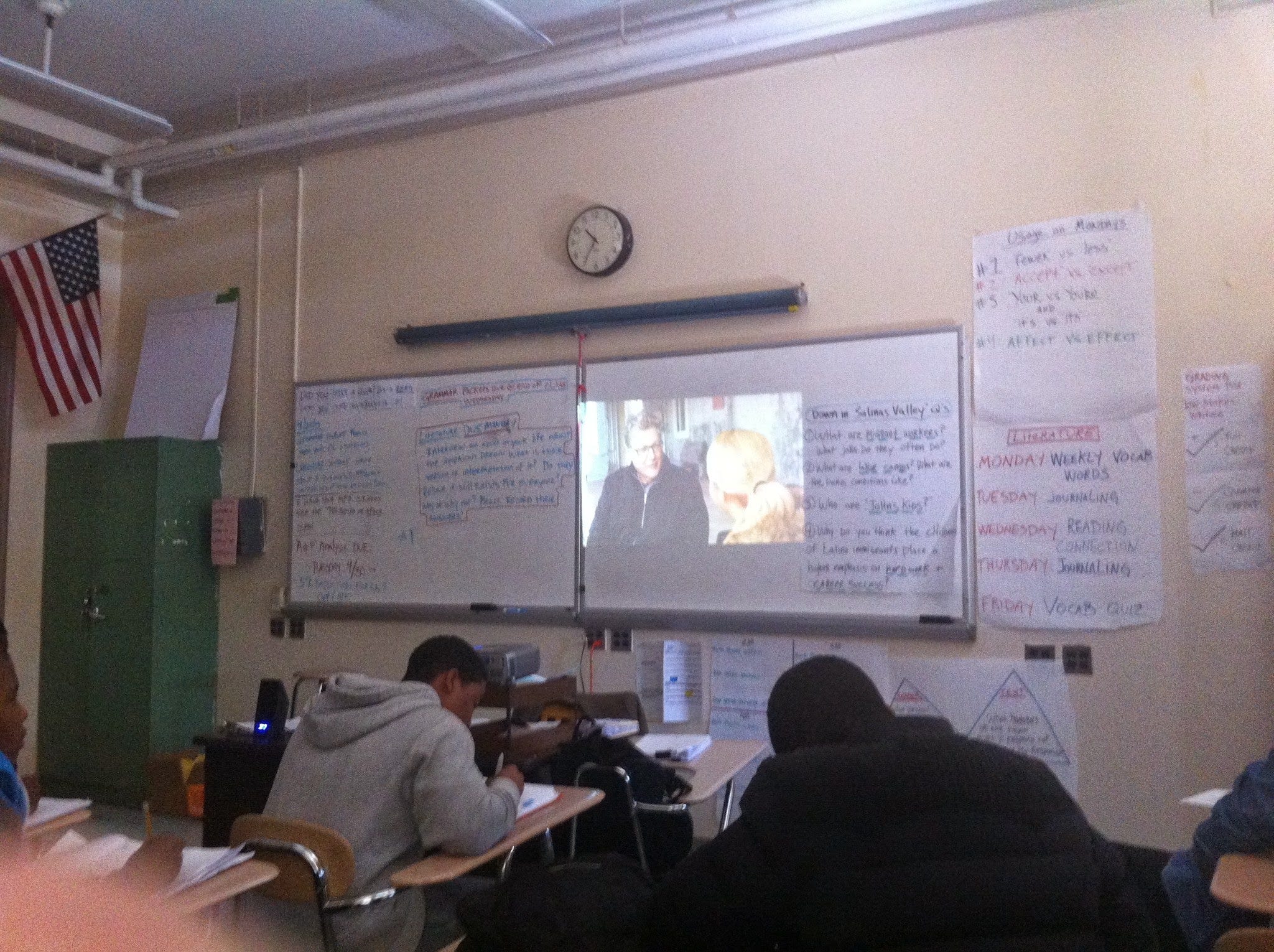
(Patrick Hunt’s high school English classroom in the early years. Photo courtesy of the author.)
Last winter I met an English teacher who had been teaching for almost 25 years at one of the most academically prestigious high schools in New York City. I was curious how he was handling AI, especially with his particular students. He told me it hadn’t changed much for him: he still required they write essays longhand and he still provided extensive comments on every single one. “Takes me about thirty hours to grade them,” he said, loftily.
I was used to this sort of thing. English teachers are the great martyrs of education and will busy-brag about the thankless drudgery of grading essays to anyone who will listen. Even so, thirty hours? Seemed excessive.
But what did I know? I hadn’t taught English for half as long as this guy, and certainly not to gifted students. I had also hated grading essays with such intensity that in order to avoid it I had employed some pretty goofy gambits over the years. Maybe he knew something I didn’t. I asked my friend, also an English teacher who had taught for many years,
“That’s insane,” he said.
Ask ten different English teachers how they teach writing and you’ll get fifteen different answers, none of them dispassionate. The five paragraph essay is either a harmless convention or an abattoir of the soul. Conferences either turn classrooms into the DMV or enrich the feedback process. The traditional “research” paper is a farce, and interminable besides—no, it’s a tidy skill builder. One teacher’s sacrament is another’s anathema, and you have not seen a fierce debate until you have witnessed an English department try to agree on a common rubric.
The disagreement extends to the quality of student work, too. Essay norming tends to be as uncomfortable as couples therapy, so departments avoid it. Hence the tenth grader who gets As from Mr. Petrone is shocked to discover she can’t score higher than a B in Ms. Rowe’s 11th grade class. The volume of writing and the genres students write vary dramatically across schools, and even what an “essay” is has become open to interpretation, with lots of teachers accepting Google Slides presentations in lieu of a proper argument essay. Even most teacher’s own methodology changes from year to year; I swore by peer review until, suddenly, I felt it was a total waste of time.
This system-wide lack of consensus on writing instruction and quality is partly understandable, perhaps unavoidable, too. Writing is messy, it is painful, and it is as much a science as it is an art. Identifying why, exactly, a particular sentence or paragraph is better than another is hard, and it is harder still to explain that to a classroom of children in terms they understand, to say nothing, then, of getting them to do “that” in their own writing. It is not just Herculean— much of the time it feels as if it is in total vain.
But how much of this disagreement and incoherence is actually inherent to the discipline? Why does it span grade levels? (Go talk to a bunch of first grade teachers about spelling or cursive.) Why is writing instruction rooted more in professional lore and legacy habits than a coherent body of research-informed principles and techniques? After all, it’s not as if this doesn’t exist. It does. Very much so.
Why don’t more teachers—all teachers, not only English teachers—know this Science of Writing? The chief reason is that too many education preparation programs refuse to teach it. A 2016 study found that few “rarely offer stand-alone writing instruction methods courses” while another 2016 study found equally poor preparation among pre-service teachers. A 2010 study revealed that teachers received “little preparation to teach writing” in their courses, and a 2017 New York Times’ article titled “Why Kids Can’t Write” reported that “a scan of course syllabuses from 2,400 teacher preparation programs turned up little evidence that the teaching of writing was being covered in a widespread or systematic way.” Granted, these studies are not super-recent, but there’s no evidence that programs have improved their writing pedagogy the way many have overhauled their reading pedagogy since the Sold A Story reckoning.
My own teacher preparation program provided almost zero effective writing instruction. Though the specifics of my own experience surely differ from other teachers’—I still remember my professor talking about the “trauma” of red ink, encouraging us to choose other colors for grading instead—I have little doubt that the contours are the same: out-of-touch professors; progressivism as orthodoxy; a disdain for explicit instruction; an indifference to cognitive science; a lack of rigor; and an undue emphasis on social justice politics. What I learned about teaching writing, I learned on the job or cobbled together from a variety of disparate sources. Thus, my first few years in the classroom were marked by missteps and wasted classtime. Over a decade later, I still feel remorse about the poor instruction I subjected my students to, most of whom were poor black boys.
Beneath that remorse lies an anger towards my program for leaving me so unprepared.
But make no mistake. What follows is not a belated grievance. I am not grinding my axe. The collateral damage from sending unprepared teachers into classrooms is the students. I hope the postmortem here makes that clear.
*****************
My first few months teaching were not great. I found a job teaching 9th grade English at a large, poor high school in a blighted neighborhood near LaGuardia airport in New York City. The students were mostly black or Hispanic, and, for a variety of reasons, overwhelmingly male.
The school wasn’t dangerous, but there was a wildness in the air that was as much a product of that concentration of testosterone as it was an indifferent staff consumed by petty feuds, and an administration that had abdicated its responsibility to lead.
A culture of isolationism prevailed. Teachers kept their doors closed and students put their heads down. The hallways were dreary. Department meetings were perfunctory, if they happened at all. The assistant principal who oversaw the English department was a tall, regal woman who dispensed with a crisp “Good morning,” when she passed me in the hall, but aside from that, she rarely spoke to me and only visited my classroom for my two required observations. At the beginning of the year, she gave me a list of required texts and told me to choose whatever I wanted. I was expected to write my curriculum myself.
I was lucky to have a few scattered years of tutoring under my belt and, despite my middling record as a student, a knack for teaching. But not much can prepare you for the demands of teaching full-time in a low-performing, high-poverty high school riven with conflict and apathy.
I felt overwhelmed. Every day, wave after wave of rambunctious boys poured into my classroom. I could not calm them down. I could not recall their names fast enough. Someone always had to use the bathroom. Someone always needed a pen. The lesson plans I spent hours writing collapsed immediately because I mis-paced activities, or the activities themselves suddenly made no sense. The simplest administrative tasks—giving directions, taking attendance—derailed the class. I had selected Of Mice and Men from the department’s list but didn’t know what to do with it. Each day after the final bell rang, I sat stunned at my desk. The floor was littered with candy wrappers and worksheets. If my students learned anything, I could not tell you what it was and so most days I walked into my classroom with a pit in my stomach, and most days I left consumed by an overpowering sense of guilt.
By early winter, I had brought my classes mostly under control. Learning and correctly pronouncing my students’ names established a baseline of trust I could not have predicted. Simple routines—scrap paper near the door for warm ups, vocab quiz every Friday—were game-changers. I ditched worksheets for composition notebooks. Lesson planning became easier once I learned how to write clear learning goals and agendas. The better my lessons got, the more of my classroom management problems disappeared. I mastered taming my rowdiest boys with just a look and will never forget the stray bit of advice I got from Mr. Esposito, an old codger who’d been working in the school’s auto shop for 35 years, and which I still use to this day: “Never talk over ‘em.”
Still, I struggled with teaching writing. The problem was not just that my students could not write. They could not; not by any measure. The problem was my near-ignorance of even the most basic aspects of writing instruction, and my misbegotten ideas about how students learn—both the consequence of my teacher’s preparation program.
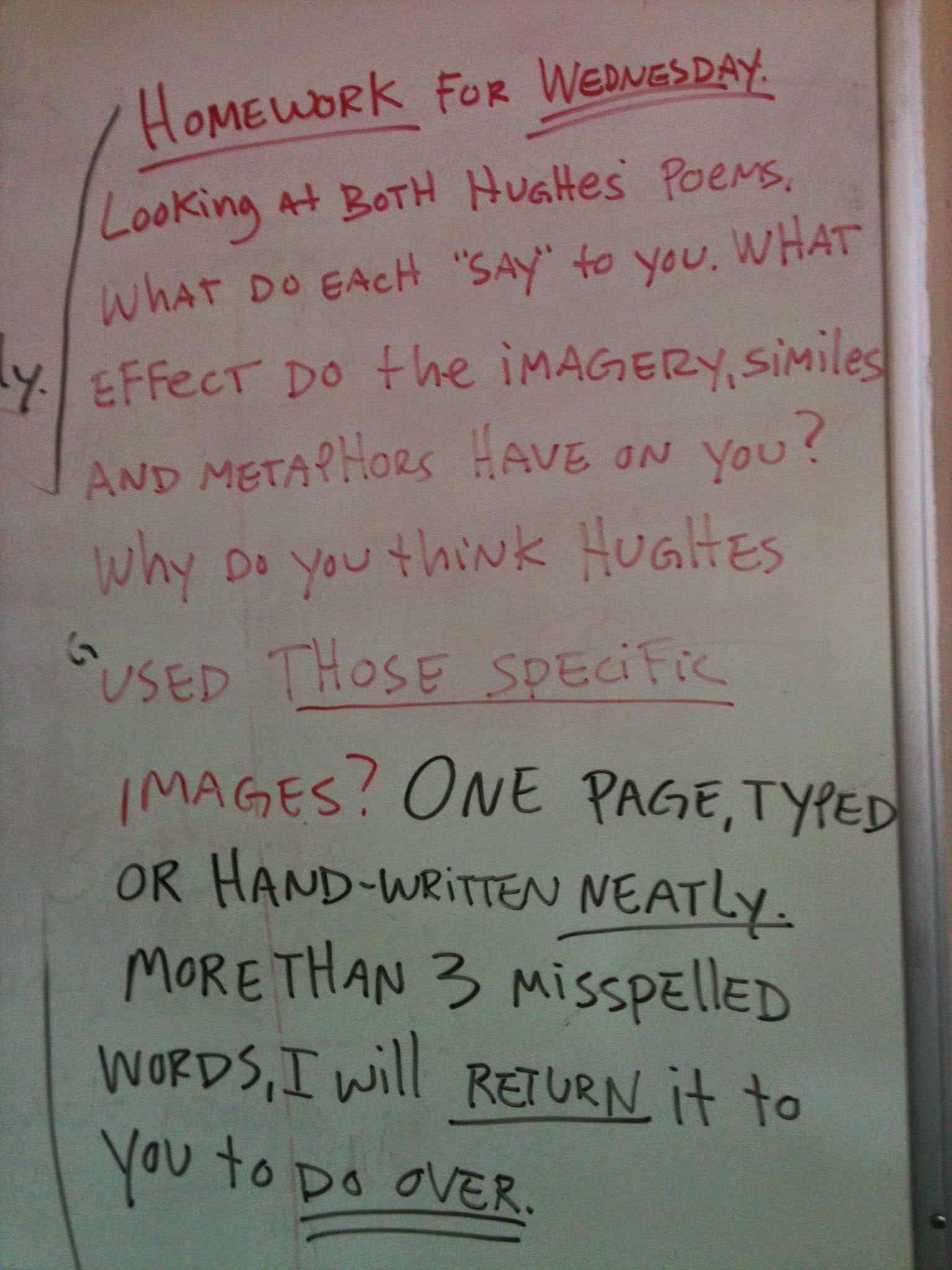
(A homework assignment for Patrick Hunt’s high school students in his first year teaching. Photo courtesy of the author.)
Consider an actual prompt I gave to my students in December of that year:
Discuss the meaning of Robert Hayden’s “Those Winter Sundays,” and how it relates to your life.
Beyond its awful vagueness, the problems began with my rationale for selecting this poem, which was to make my classroom “culturally relevant.” The professors in my program had assured me that the achievement gaps (at that time, hotly debated) were due in no small part to the exclusion of poor black and brown students’ “lived experiences.” “Honoring” those experiences in my curriculum would increase their engagement and, as day follows night, lead to higher attendance, higher grades and higher graduation rates.
What culturally relevant pedagogy actually looked like from day to day was unclear to me at the time (it still is), but the possibility of ending the cycle of poverty and eradicating racism was simply too impossible to resist, especially if it began with me selecting the right poem for my 9th grade classroom. Hayden was black. My students were black. The poem was about a poor family. My students were poor. Plus it was winter! Q.E.D. (Years later, this patronizing oversimplification still makes me want to crawl into a corner.)
The problems continued as I hewed closely to my program’s philosophy. I was intentional about designing “student-centered” activities that, not incidentally, favored engagement over understanding. Direct instruction (aka “chalk and talk,” “drill and kill,” or being a “sage on the stage”) was heretical. Thus, my students did lots of proprioceptive writing (a kooky type of freewriting), participated in discussions that quickly strayed far from the poem, and collaborated on a poster project that involved lots of drawing (and bickering over markers). One moment that I still remember is when I approached a group and pointed to a picture of a building they had drawn in the middle of an empty street.
“What is that?” I asked. “‘Lonely offices,’ one of the boys responded, a funny if not telling misinterpretation of the last two lines of the poem: What did I know, what did I know/of love’s austere and lonely offices?
At the time, I remember how proud I felt about how engaged my students seemed. I remember going home and bragging to my girlfriend about how much better my classes were going. I remember thinking: Finally. I’m getting it.
Imagine my bewilderment, then, when I received my students’ essays. I got everything from a single paragraph to Woolfian streams of consciousness. Few had any semblance of organization or coherence, or grasp of the harsh, sorrowful mood of Hayden’s poem. I planned a peer review—students learn best from each other was another of my program’s mantras—but few of the essays came back improved.
I spent an entire miserable weekend grading, marking up each paper with proofreader’s symbols I’d never bothered to teach my students, and writing extensive comments whose opacity was due both to a desire to spare my students’ feelings and an inability to provide clear, actionable feedback. I made a ceremony of passing the essays back. Most were shoved into backpacks without a second look, or left on desks. The next day was Winter Break.
The whole wretched affair had consumed three full weeks of class time.
The Teaching of Writing class I had enrolled in for the spring term, then, could not have come soon enough. It was taught by a charismatic professor with a million-watt smile known for her brilliance and devotion to her students. I was at first caught off guard by this—she started class by greeting each student at length and ended class by giving each student a long, bosomy hug—but found myself beguiled. She quoted scholarship with ease and told funny, moving stories. It was not uncommon in those first few weeks, after someone confessed that one of their lessons had tanked, for her to abandon her syllabus and transform the class into a freewheeling bull session. I remember leaving her class feeling hopeful. Elated, even. I could not wait for us to get to the nitty-gritty of writing instruction.
We never did. We started off by composing “literacy autobiographies,” and teachers began giving lengthy “inquiry presentations” about any aspect of writing that interested them. My professor belabored the necessity for us to include “multimodalities” in our classrooms. Every class discussion found its way to the subjects of power and identity. Someone was always name-dropping Paulo Freire or John Dewey or bell hooks or Alfie Kohn. I kept waiting for the readings on writing instruction—essay genres, what effective feedback is—but they never came. I’d flip ahead in the syllabus only to discover that the next week’s topic was “Writing As Social Action.” Assigned readings: “Podcasting on Young Adult Novels 2.0” and “Ghetto Lady to Critical Linguist.”
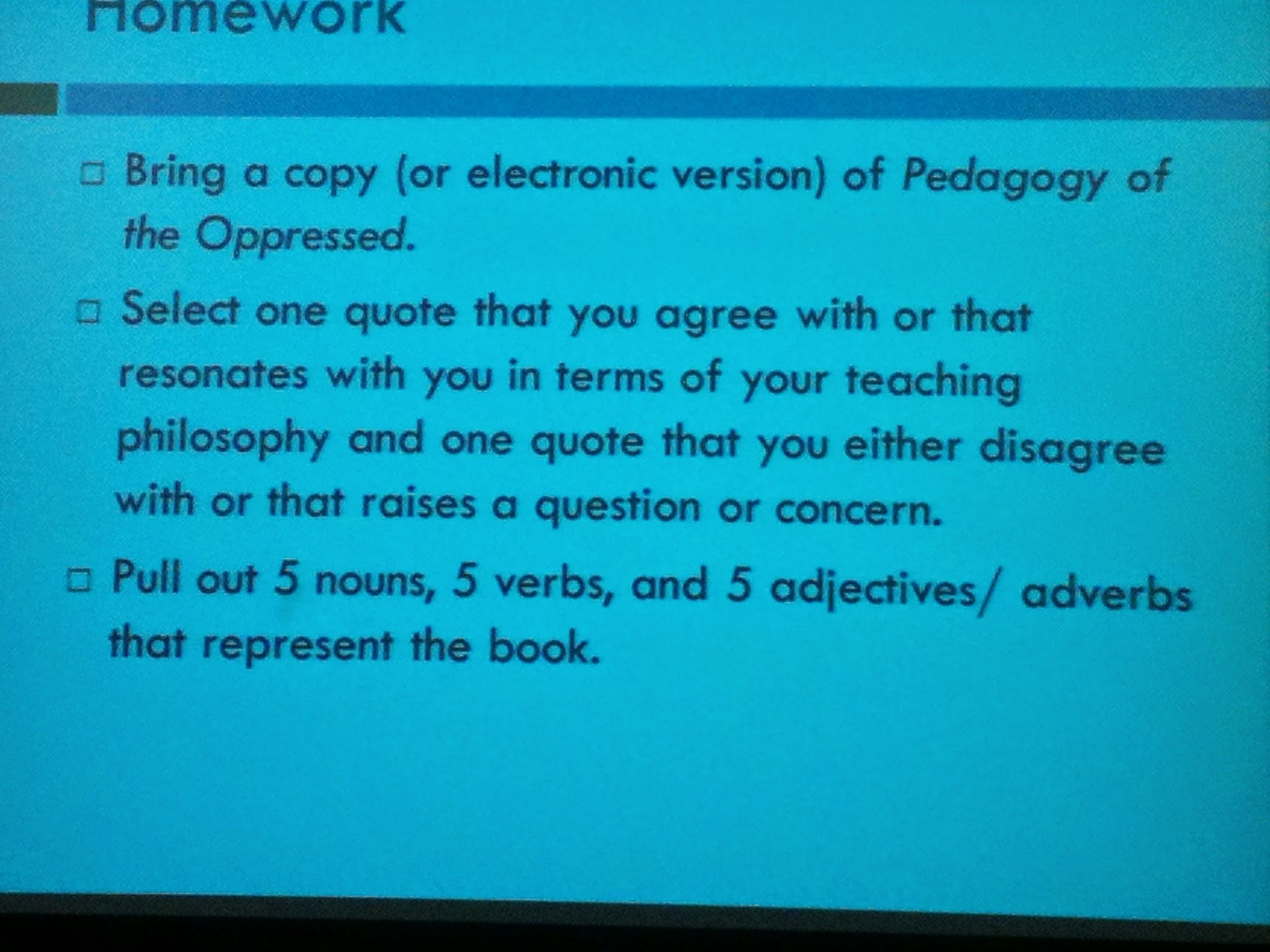
(Homework assignment from Patrick Hunt’s Teaching of Writing class. Photo courtesy of the author.)
My disappointment, it seemed, grew from a number of misconceptions I had about literacy that my professor would kindly disabuse me of. The first was that literacy was no longer understood to mean the ability to read and write well. No, it was more of a general skill that could be bolted onto any domain or concept. Hence, there was now digital literacy, critical literacy, media literacy, and something we talked about ad nauseum called racial literacy.
In fact, that traditional idea of literacy was not only fusty, it was oppressive to anyone who did not speak and write standard English. That teaching students to write in standard English was no longer considered the least bit controversial went completely unacknowledged. As did the fact that, according to the then-nascent Common Core Standards, it was explicitly our job.
As such, I was to learn, the usual tools and techniques English teachers employed to teach writing—graphic organizers, rubrics—were actually bludgeons used against disadvantaged students. The English teacher who considered himself an authority on writing was creating an oppressive teacher-centered classroom (there was nothing worse) and, by extension, was nothing more than a willing agent of the “system” which was racist, homophobic, sexist, classist, colonialist, and ableist. Any student who questioned this dogma, or even asked for specifics (we were a tiny minority) always elicited from my professor a cheery reminder to “unpack that invisible knapsack of yours!” The metaphorical “knapsack” contained your various privileges.
One class period, the discussion found its way to the five-paragraph essay. At this point in the term, my professor’s education philosophy was clear, as was most of my peer’s unquestioning acceptance of it. Still, I was surprised at the degree of scorn directed at what I had naively assumed was a harmless convention of high school English classrooms, maybe even a necessary rite of passage. No. Most of the class agreed it was formulaic and inauthentic. One savvy student called it “Eurocentric.” Another called it “carceral.”
“But maybe its rigid structure actually helps struggling writers?” I offered.
There was an awkward silence. A subtle rolling of eyes. By this point in the term, the class had grown tired of my contrarianism.
I pressed on, talking about my own students, and my own ongoing struggles helping them become better writers. I briefly talked about my “Those Winter Sundays” catastrophe.
“The final essays I got were kind of a jumbled mess. I made a lot of mistakes, but a five-paragraph essay would have at least helped their essays take shape.”
“Shaped into what?” someone asked.
“Coherence.”
“Whose idea of coherence?” my professor asked.
This threw me for a loop. “Coherence is . . . coherence. Topic sentences. Supporting details. Transitions. Shouldn’t our students learn how to do all this?”
A stony silence.
My professor smiled wanly and addressed the class. “The biggest challenge we face as teachers is not teaching students how to write according to a particular rubric. There is not one way to write, after all. The challenge is to question our deficit mindsets, especially about particular populations of students, and to think deeply about how that informs how we teach writing.”
This was followed by a flurry of finger snapping.
“Wait. What does that mean?” I asked defensively. My professor’s usual response to my skepticism had always been a faux graciousness for bringing an “alternate” perspective to class. This felt personal.
“Well.” Another smile. “Based on some things you’ve shared, I do wonder how you see the children in your classroom.”
I was stunned. I didn’t need her to elaborate. It was one thing for her to imply that I was engaging in a form of prejudice simply by acknowledging my students’ writing deficits—I could withstand a personal attack, however oblique.
But the suggestion that what my students needed in order to escape their impoverished lives was not sound writing instruction from a competent teacher but one, instead, who could eloquently critique the socio-political conditions that had caused that impoverishment was educational neglect masquerading as social justice. Worse, that my professor and so many of my peers were willing to deprive the neediest students of the basic writing skills they themselves possessed and had built upon to succeed in school (and, at least in one case, to secure a lucrative tenure at a prestigious university) was hypocrisy of the worst order. For me, but not for thee.
To be fair, the brazen disregard for research-based pedagogy extended well beyond my Teaching of Writing class. This was, after all, the very university that had employed the woman responsible for the stunting of more American children than lead.
In class after class, I encountered ideas that flattered the adult’s sensibilities or appealed to their own grievances over what was best for students. One of the course goals for my Adolescents and Literature class was to “queer classrooms to disrupt discourses that are essentialist or (hetero)normative.” (Italics and parentheticals not mine.) In Teaching Methods, we planned a Waiting for Godot unit using an experiential, arts-based pedagogy which I have no doubt would have been appropriate at the experimental school my professor had spent her career at, but which was almost hilariously ill-suited to the needs of the students I was teaching then and the thousands I have taught since.
I hoped, in my Teaching of Reading class, to learn how to help students reading years below grade comprehend grade-level texts, but the instructor was a veteran teacher of New Canaan schools—one of the wealthiest districts in one of the wealthiest U.S. states—and had no experience with the problem. My Teaching of Special Education class spent 3 weeks watching Geraldo Rivera’s landmark expose about Willowbrook, a state facility for children with intellectual disabilities. It’s 28 minutes long.
Another caveat: this was also 2012. The ideological extremism that would soon deform our politics and culture was incubating online and on college campuses. The world of education, too, at the time was roiling with acrimonious debates over charter schools, teacher quality, and high-stakes testing, among other things. The Tea Party was protesting “Obamacore” at town halls and school board meetings.
My professors, despite their sophistication and Ms. Frizzle vibes, often taught with a siege mentality, warning us darkly about administrators, rote learning, and mandates. The achievement gaps surfaced by No Child Left Behind had validated their beliefs in social justice education, and the “strict” accountability that had beset schools had redoubled their commitment to progressivism, for which my program was the axis mundi. “At the end of the day,” professors would assure us conspiratorially, “you can always close your classroom door.”
I was persona non grata in my Teaching of Writing class for the rest of the term. When it was my turn to give an “inquiry presentation,” I chose, not undefiantly, E.D. Hirsch, whose The Schools We Need I had discovered in my desperate search for a competing theory of education that would help me become a better teacher. He was my life raft. My professor, ever devoted to her students, thanked me warmly for my “alternative” perspective and ended class early that evening.
As for how, in the end, I actually learned to teach writing, I picked it up the way I would guess most other English teachers do: slowly; through a lot of trial and error; from the rare, effective PD; and by stealing from other teachers. Am I an effective teacher of writing, though? Even with almost 15 years of teaching and supervising under my belt, I’m not confident I am. How many other English teachers feel the same? If I had to guess, I’d say quite a lot.
It does not have to be this way. In June, the National Council on Teacher Quality reported that almost 50% of teacher preparation programs are still not teaching the science of reading. The negligence is shocking. Following this report, the NCTQ’s president, Heather Peske, wrote an unsparing commentary calling out teacher preparation programs on their stubborn breach of ethics, suggesting that, at this point, reading advocates may want to consider suing them for consumer fraud.
“When teacher prep programs include methods of teaching that run counter to the evidence and research, they are selling aspiring teachers a faulty product. When teacher prep faculty lack the knowledge and skills to teach reading aligned to the robust evidence base [. . .] or when they refuse on philosophical grounds, they are complicit in misrepresenting what aspiring teachers need to know about reading instruction,” she wrote.
Peske concedes consumer fraud is provocative but draws a useful analogy: “If a medical school knowingly taught future physicians treatments that had been disproven decades ago, we would not call it academic freedom. We would call it malpractice.”
She’s referring mostly to reading instruction, but the same could be said for math instruction, classroom management, the science of learning and, as I hope I’ve convinced you, writing instruction, too.
For fifteen years I’ve been asking myself the same question about my teacher preparation program: How did they get away with this?
But now I’ve got another question: Can I get my money back?
Comments
Nothing yet. Say the first thing.
Sign in to join the conversation.