
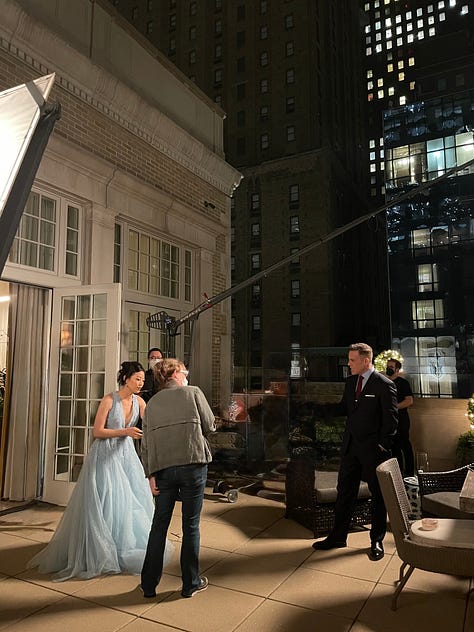
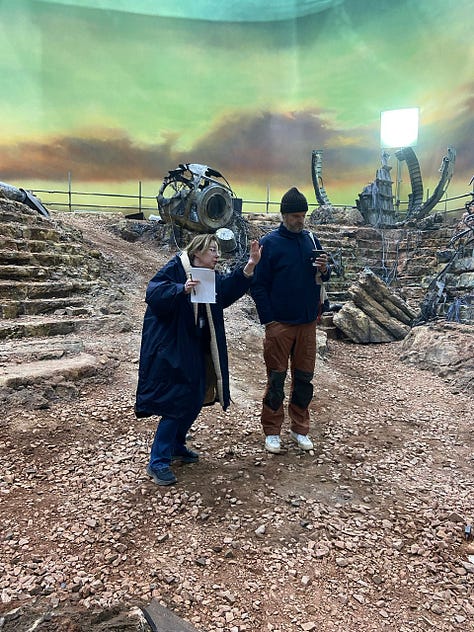
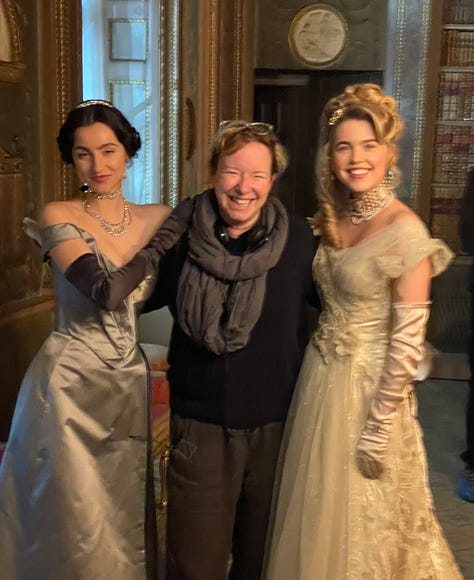
Alexi asked me recently how I frame my thoughts when I’m about to start directing a new pilot or a series. Like when I’m thinking about creating the look and feel of a show, but before it’s properly begun. I’ve kicked off a lot of television series and features and the main thing for me is to find the “vision” for it and use that vision to gain momentum as we move towards the shoot. Of course directing is a collaborative art and part of that art is helping to establish a shared understanding and vision by all the participants.
Every director will have their own way of working. This is mine.
I find KEYWORDS, and once I find them, I use them to filter decisions to be made moving forwards.
FINDING CLARITY:
When there is a CLEAR PURPOSE and vision, I’ve noticed everyone involved in a project works well together. Clarity keeps the team in step and it also helps me focus even when I’m under the gun on set. But how does ‘finding a vision’ happen?
LETTING THE VISION EMERGE:
For me, it begins with really sinking down into the script. (Perhaps it means reviewing a design brief, analyzing a new project proposal, or interpreting a business goal in another industry?)
Here’s an example from my life. It’s about a comedy I directed. We don’t always think of “comedy” and “vision,” but it’s my experience that everything on screen—big and small—benefits hugely from a sense of direction and vision in the making of it. I’m guessing in other walks of life this is also true.
I read the script for The Middle, a comedy I kicked off for ABC. Then, I put the script down. And WAITED. (I can’t force the next part.)
I waited. I fed my toddler. I folded clothes. I took a shower. I went to bed.
Nothing.
The next morning I had breakfast and went about my day. I wasn’t thinking about the script (not on purpose) but in the back of my mind, I knew I had to pitch on it to be allowed to direct it so it was percolating somewhere. I was letting it develop without getting in its way.
Without a vision for this script, I definitely wouldn’t land the job.
Waiting is an act of faith.
Then, at lunchtime, it came.
My vision for the show landed fully and clearly. It would be:
A LOVE LETTER TO THE MIDWEST
Despite my accent, which gives away that I’m from a small working class town in Northern England, my grandfather Ethan came from Southern Illinois. I had MEMORIES from childhood when I’d visited him and I suddenly became immersed in these memories.
THE COLORS in the show would reflect the Midwest: yellows and browns, blues from an endless sky. The American flag would appear in almost every frame without being too obvious. The shooting and framing would be wide like the sky. It would be beautiful, inviting, textured, like my childhood memories.
IN RETROSPECT I can see that this vision seems obvious, but in fact there were many other ways to pitch the show’s style. For example, it didn’t have to be a love letter. It could have emphasized the relative insecurity of the family using colder colors. Instead of the WIDER LENSES and SMOOTH transitions, we could have chosen a hand-held style in terms of camerawork, using the longer lenses that were at the time very in vogue like in The Office or Modern Family. Instead of using epic wides on the open plains, we could have decided to shoot it three-camera style and walked towards a traditional sitcom but then it wouldn’t be a love letter? There were so many options.
The writers/creators, Eileen Heisler and DeAnn Heline, really liked the vision I pitched. We had found our lens. The show ended up running for nine years.
BUILDING THE FRAMEWORK FOR DECISION MAKING:
This vision becomes the LENS, by which we make every decision moving forward. I keep refining the key words that will guide us: Community, Warmth, Big Sky, Inviting, Love Letter. Having these words constantly in front of mind during hectic days brings a terrific sense of clarity.
With these words I collaborate with other members of the growing team—a team we have been building with a view to their skillset and how they can shine and elevate the final product.
I am no longer making decisions on the basis of “every possibility in the world,” a DAUNTING prospect. Now the vision (and key words) help with recruitment, with collaboration, with all the stages that follow.
What’s the TAKEAWAY? For me, it’s that first step. Having the confidence that a vision will emerge. Allowing it to come through, not rushing, and then when it’s becoming fully formed, letting it dictate your lens. Having the key words front of mind gives me, as a director, the ability to gain momentum and move very quickly in terms of decision making (when life picks up speed, and moves so fast you feel it will flatten you). This technique helps me in many areas of life, not just on set.
No posts
Comments
Nothing yet. Say the first thing.
Sign in to join the conversation.