
Couple days ago the full schedule dropped, and my instant reaction is that 84 games just feels weird. I know it’s only 2 extra games… but I think I’m going to stick to running per 82 GP projections… we’ll see.
The net result is that every team plays 2 more than you’re used to: 1,344 games in all, from opening night on September 29 to the final Saturday on April 10. Biggest change though and to make fantasy hockey commissioners lives easier is there’s no Olympic break this year, so the fantasy calendar runs straight through, 28 clean Monday-to-Sunday weeks with no gaps except few a minor usual breaks.
I pulled the league’s PDF in Claude Code to codify it and turn it into something that could help us prep for drafts and run our seasons.
Here’s what matters for your draft 👇
Like most seasons, Saturday is the big night, averaging almost 13 games. Thursday and Tuesday are also heavy, around 10 and 9 games most weeks. Then the floor drops out: Monday, Wednesday, Friday, and Sunday average about 5 games each.
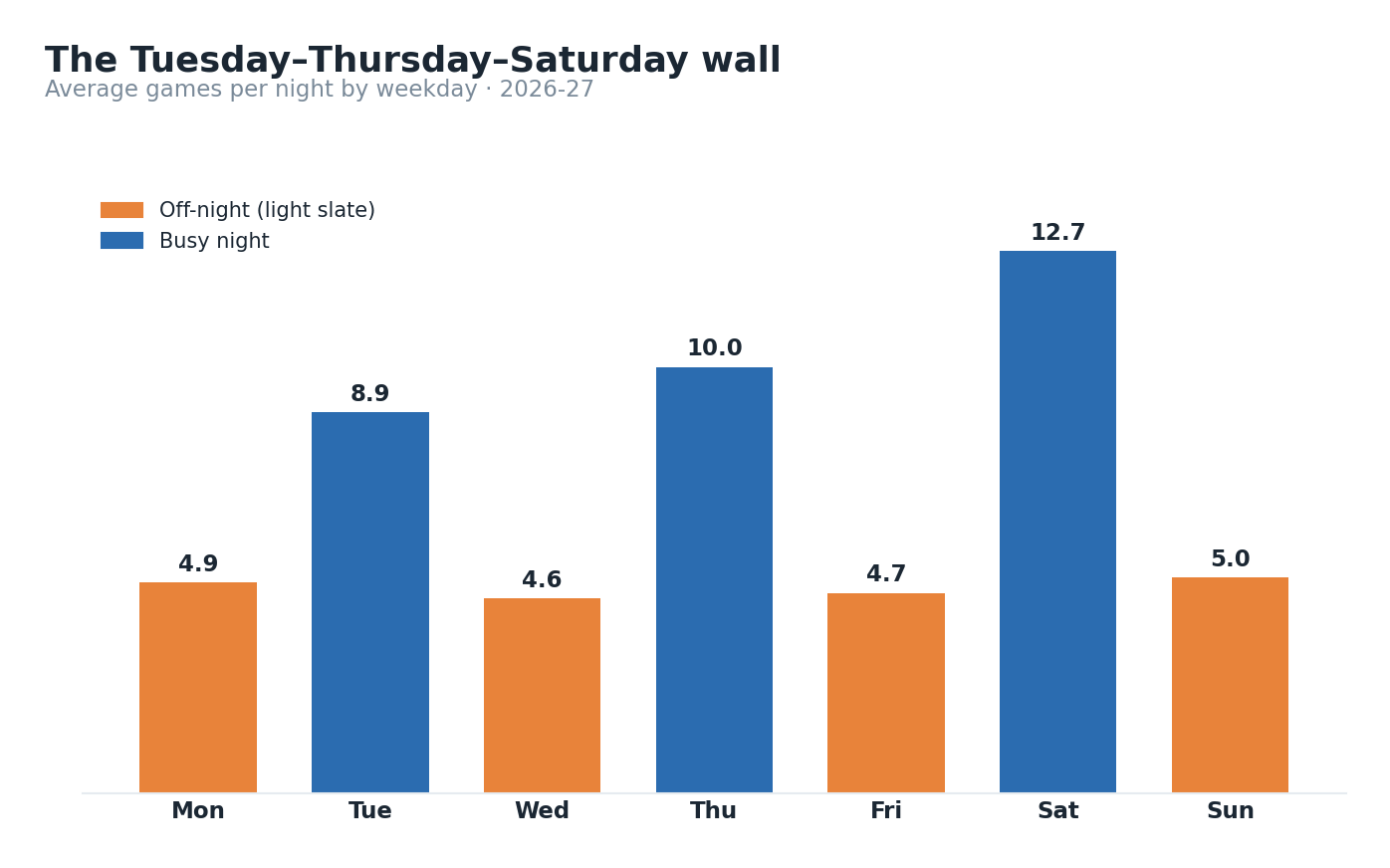
You can set yourself up for success in fantasy hockey with a strong draft, but I’m a big believer that you win in-season making the most of man games and picking up streamers. The off-night split is one of the most important thing in fantasy scheduling, because it decides how often you can actually stream a player. On a 13-game Saturday, most of your roster is already active and you’re often faced with sit-play decisions. But on a 4-game Wednesday, an extra skater on the ice could be the difference between winning shots or hits that week against your opponent.
If you take only one thing away form this post, let it be that Washington plays 40 of its 84 games on off-nights, the most in the league, a whopping 48% of its schedule. The Rangers (39), Colorado (38), and Utah (37) are right behind. On the other end of the chart, Nashville plays only 22 off-night games, with St. Louis (24) and Tampa Bay (25) close by.
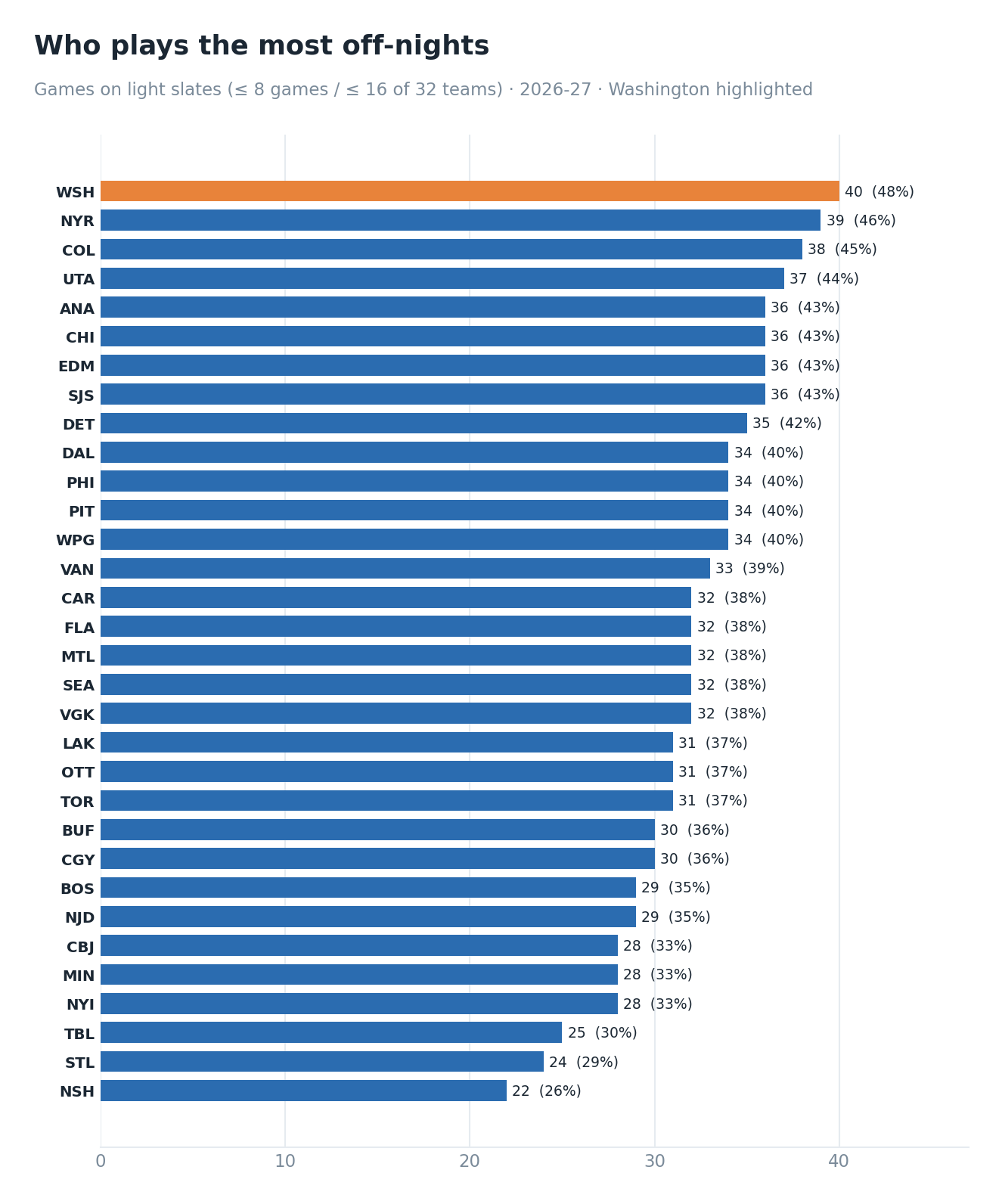
All that being said, I don’t put a TON of stock into this during the draft, but it can be a fun tie breaker if you’re debating between a few options. Default to the player whose team plays more off-nights. Over a season it’s potentially over a dozen extra usable starts.
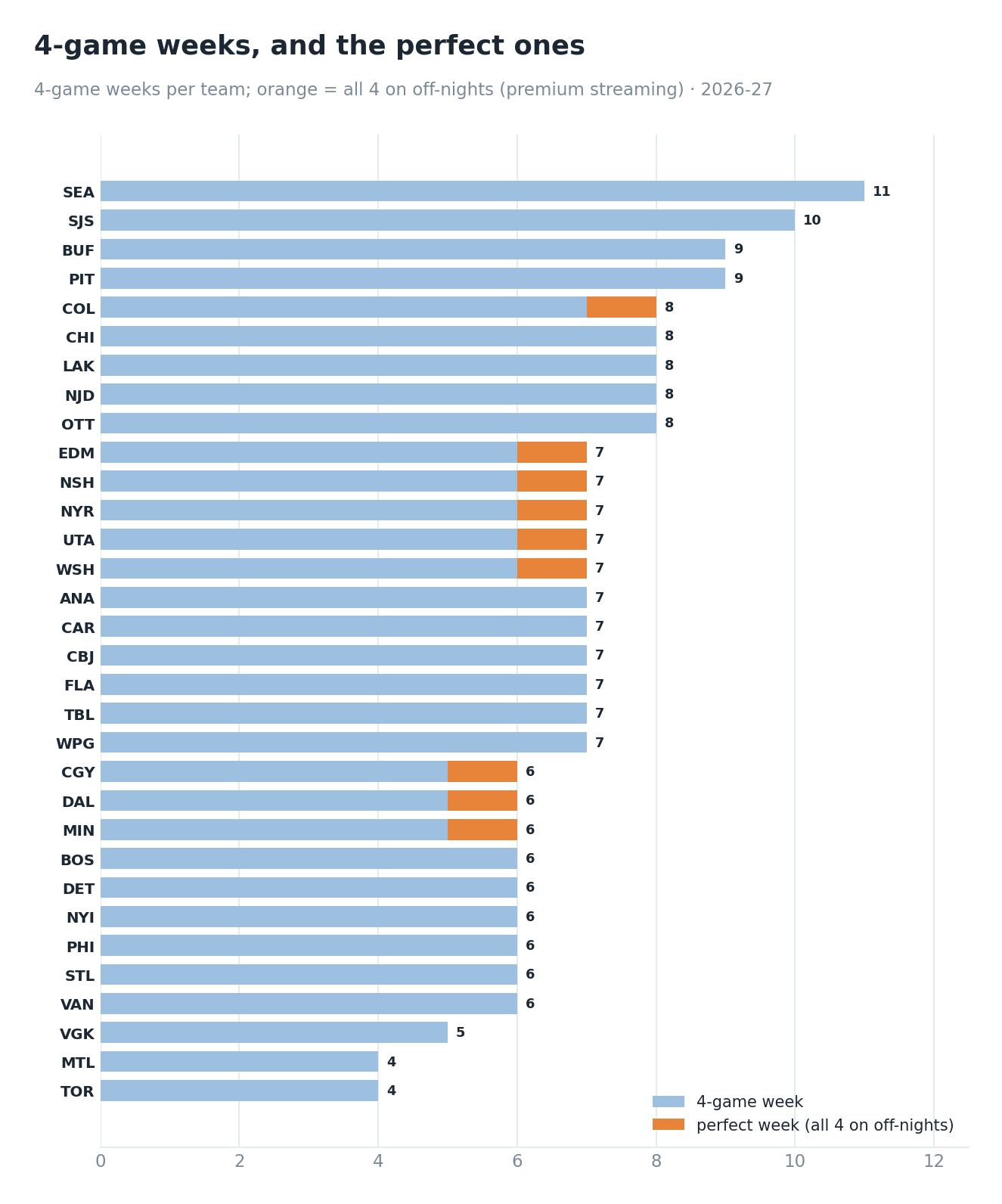
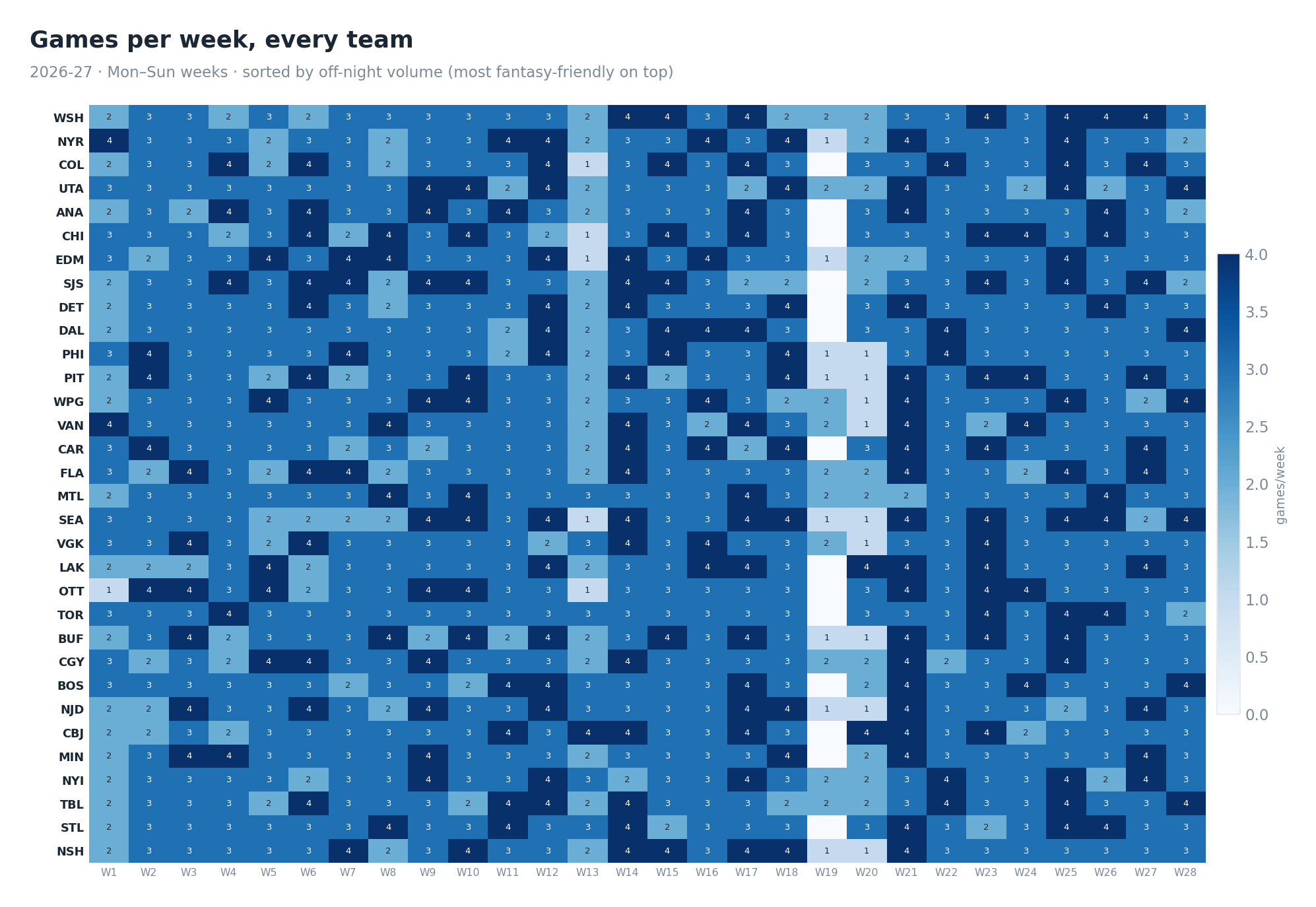
A fun way to look at this is what you could call a perfect week: a 4-game week where all 4 games land on off-nights, so you get max man games and you can slot every one into a full lineup. There are 9 of them this season: Washington, Colorado, the Rangers, and Utah each get one, along with Calgary, Dallas, Edmonton, Minnesota, and Nashville.
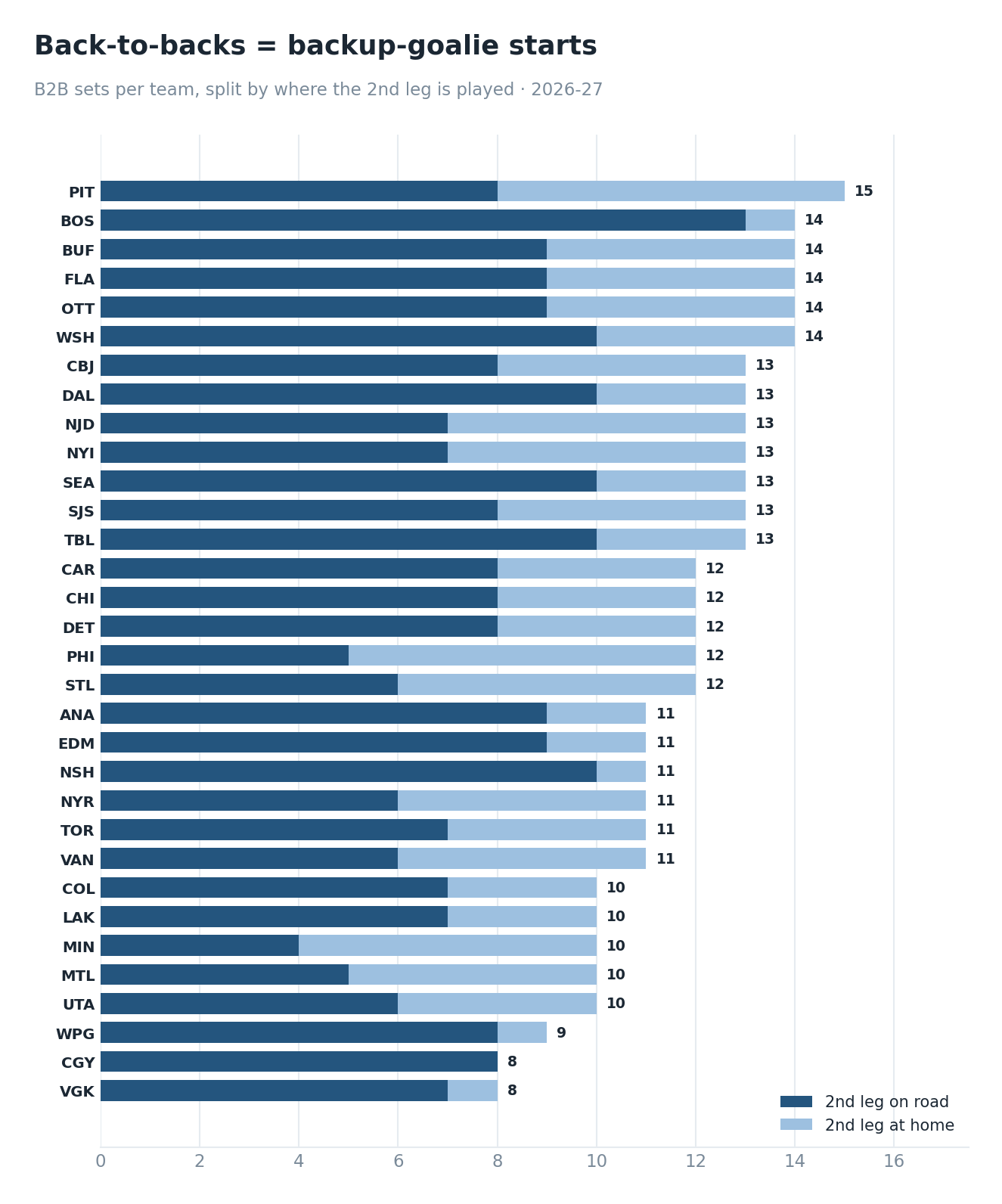
Most teams don’t play their starter on both ends of a back-to-back anymore, so these back-to-back games is where there’s a solid chance the backup gets a start. You can almost count the back-to-backs and you’ve got a rough idea of which backups have a solid floor of games played.
Pittsburgh leads with 15 back-to-back sets. Boston, Washington, Buffalo, Florida, and Ottawa each have 14. Vegas and Calgary sit at the bottom with 8 apiece, so their backups might get pretty bored. One detail on Boston: 13 of its 14 second legs are on the road, the toughest possible spot.
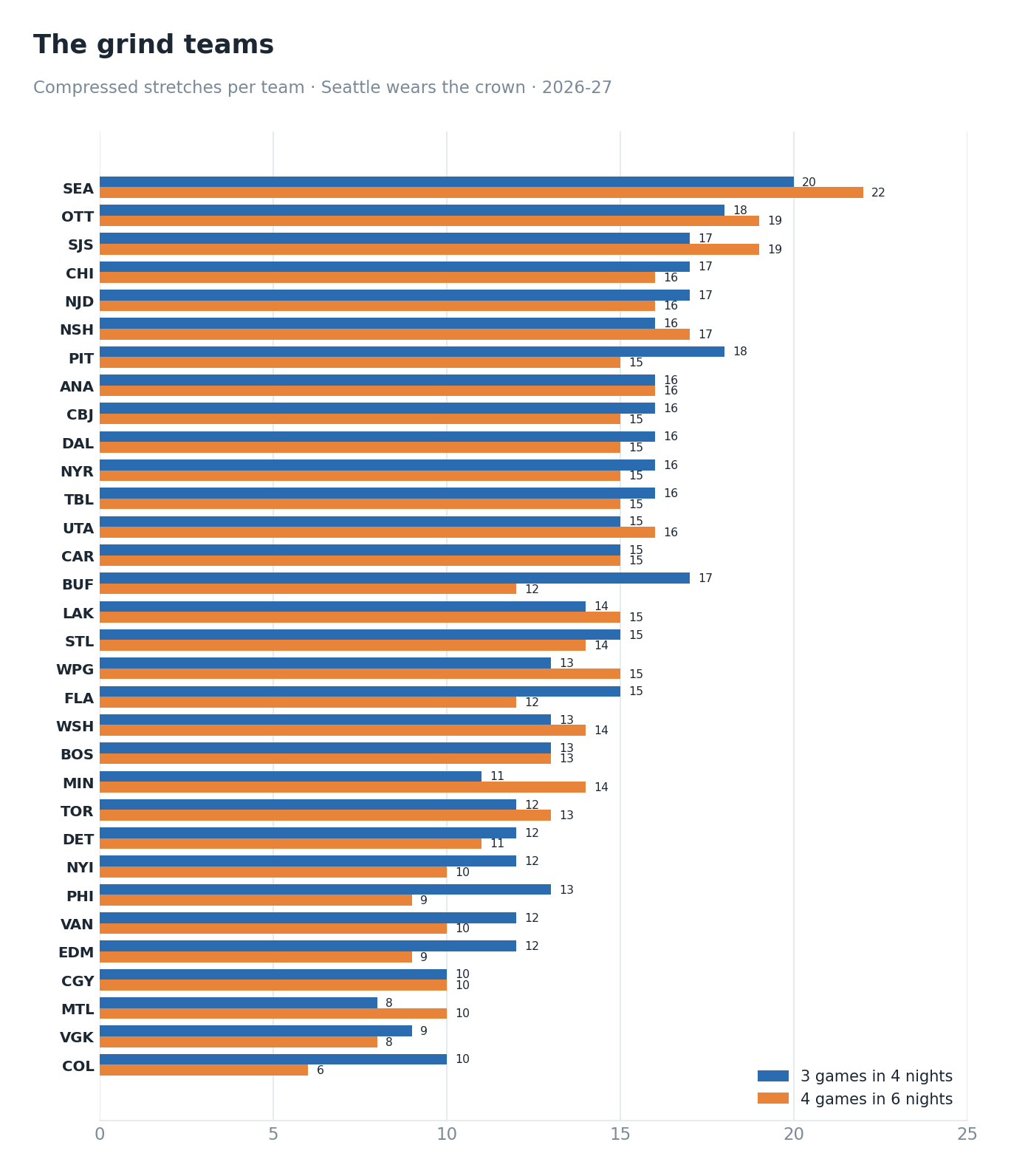
Fatigue is an interesting factor in the long grind that is an NHL season. While back-to-backs are for sure part of that story, I like looking at the denser stretches, 3 games in 4 nights and 4 games in 6. Seattle stands alone as the grind team of the year, with Ottawa and San Jose close behind. Those clubs could get worn down, which softens their stars on tired nights and hands their backups even more work. Might also be facing more injuries.
If you weight every game by how startable it is, counting an off-night game for more because you can actually slot it in, you get a single number for how ‘streamable’ each team’s calendar is. Washington tops it, followed by the Rangers, Colorado, and Utah. The bottom is Nashville, St. Louis, and Tampa Bay again.
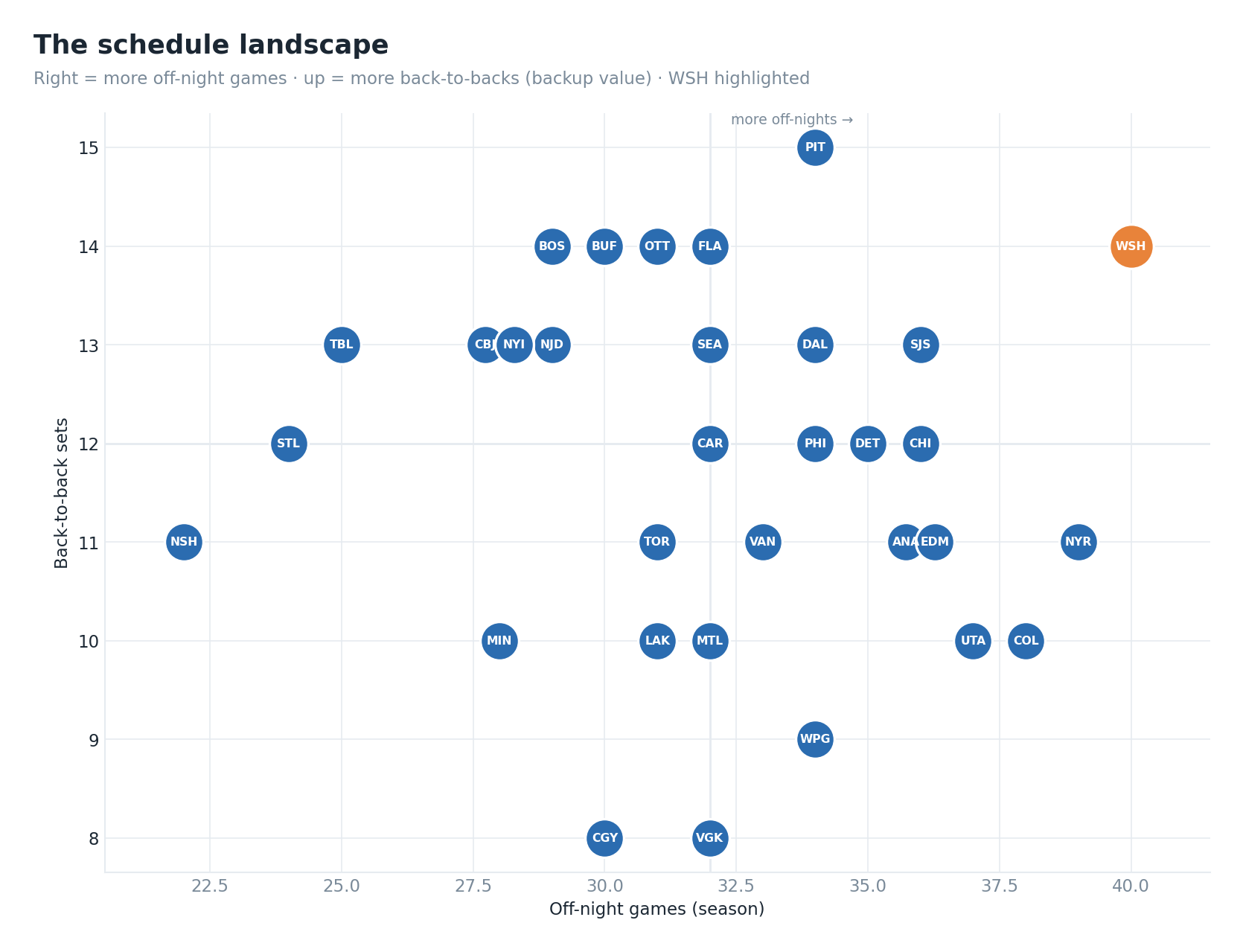
This obviously never outranks talent. But it’s a fun factor to consider in the later picks of your draft when it feels better reaching for a guy like a Jenner or Kyrou.
Playoff timing varies by league, so there’s a bunch of different ways to look at this. My banger home league for example usually ends a few weeks before the end of the real regular season to avoid having championship finals during the same weeks that teams are resting star players for the real playoffs. We also have 2 week-long matchups per round which removes some of the variance and luck that can favor a team simply based on the schedule. But most teams are on Yahoo default and while it’s not open yet, I think it’s a fair assumption that like most years, the last 3 weeks = the 3 playoff rounds:
quarterfinals: March 22 to 28
semifinals: March 29 to April 4
championship: April 5 to 11
Washington (again) is the schedule champion in the 2 later windows: 11 games in the standard setup with a 4-game quarters and semis, and a league-best 12 if your league ends April 4.
If your finals land earlier, on March 22 to 28, Chicago takes over with 11 games and a ridiculous 8 of them on off-nights, with Washington right behind. Across every scenario, Washington finishes first or second, so it’s the one team you can draft for the playoffs before you even know your league’s exact dates.
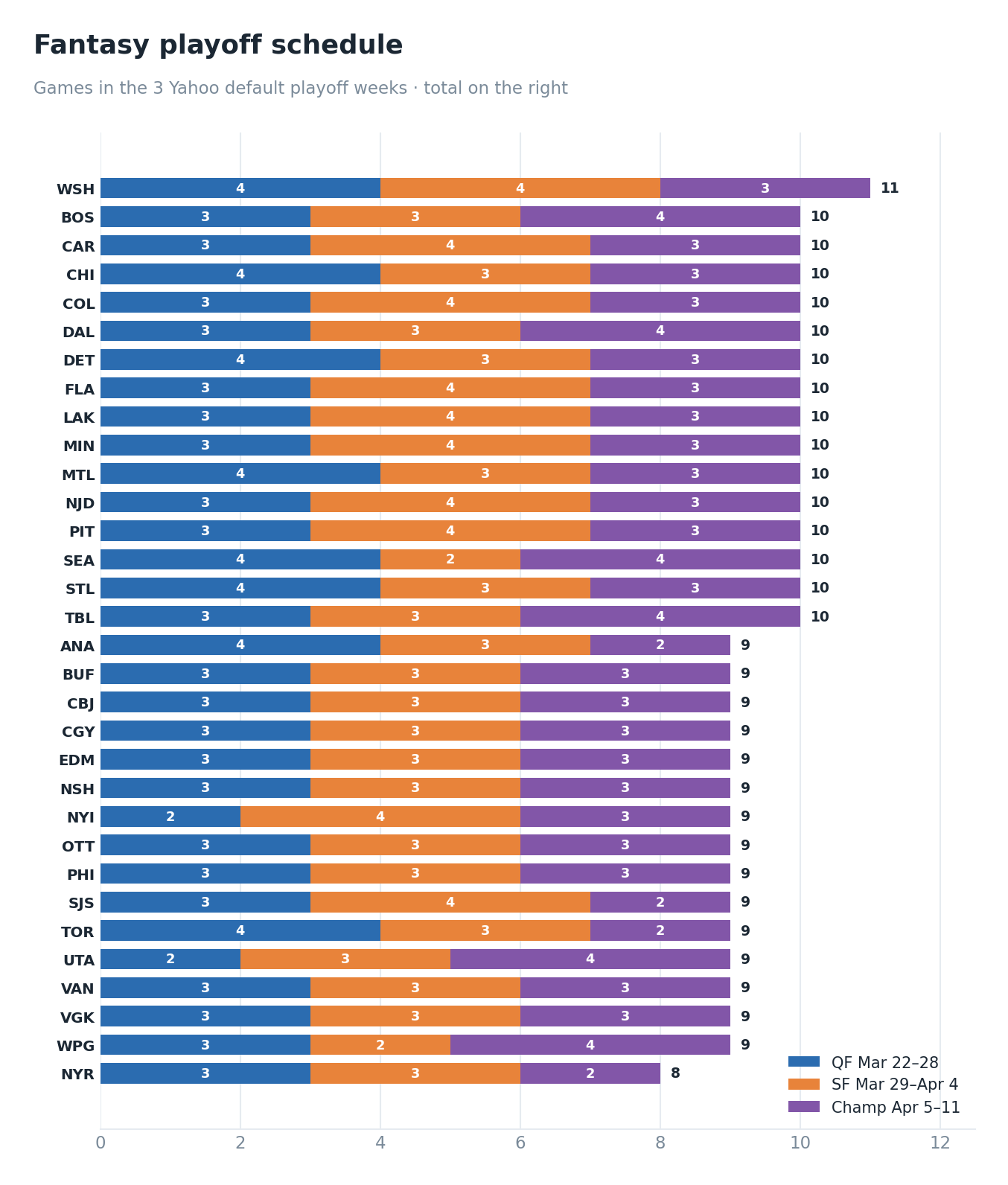
The championship week itself is the one to weight most. In the standard setup, 6 teams get a 4-game week to close: Boston, Dallas, Seattle, Tampa Bay, Utah, and Winnipeg. 4 of them, Boston, Dallas, Utah, and Winnipeg, play 3 of those 4 games on off-nights, which is about the best title-week setup you can draw. Anaheim, the Rangers, San Jose, and Toronto play just twice that week, so lean on their depth pieces at your own risk.
Double-check your league settings before you bank on any single week. You can use the weekly-games sheet to help you analyze this based on your league settings.
A few nights carry solid fantasy weight, and a couple are just fun:
Opening night, September 29: a 5-game slate with Carolina raising its banner against Florida, plus Gavin McKenna’s likely debut in Toronto. I still think it’s hilarious that a team that finished with 108 points at the top of the Eastern conference in 2024-25 somehow managed to get 1st overall in 2026. Wild.
There’s only 2 full-league nights (all 32 teams, 16 games): October 13 and the April 10 finale. The season (sort of) opens and closes with everyone on the ice.
For Sens fans, Panthers fans, and fantasy banger league enthusiasts everywhere, Brady Tkachuk’s return to Ottawa could be epic: October 21. If you need some PIMs, this might be a good one.
Outdoor games: the Heritage Classic (Montreal at Winnipeg, October 25), the Winter Classic (Colorado at Utah, December 31, Utah’s first), and the Stadium Series (Vegas at Dallas, February 20).
Global Series trips: Carolina and Seattle play twice in Helsinki (November 12 and 14), and Chicago and Ottawa play twice in Dusseldorf (December 18 and 20). Watch for extra rest when those clubs get home.
The All-Star break runs February 4 to 7, with the game back for the first time since 2024. Around it, every team gets a scattered 9-to-12-day bye somewhere from late January to mid-February, so plan those matchup weeks early.
The full list, with every matchup verified against the schedule, is in the key-dates sheet.
Probably a bunch of other little things to glean from this but I think those are the biggest factors. Excited for the season ahead, some fun announcements to come on this years projections and rankings sheet!
No posts
Comments
Nothing yet. Say the first thing.
Sign in to join the conversation.