
Citadel has bought the remnants of the Situational Awareness fund blowup and people are asking if they also caused it.
I managed my first multibillion dollar fund at 27 for a Goldman spinout and then went on to manage over $10 billion in assets including a UCITS hedge fund book, so here’s my two cents from what I’ve seen trying to move large positions around.
As far as I know, I’m the only one that posted this as a possibility on Tuesday before the events unfolded so it’s not just feeding fodder to conspiracy.
As a disclaimer, my opinions are just observational and purely speculative.
Leopold’s Situational Awareness is required to disclose its public stock positions through the SEC Form 13F. It’s a delayed quarterly filing but because of how big his fund was compared to many of the stocks he was investing in, you could infer he was still holding onto these as of last week.
Citadel has two arms - Citadel Securities is their market making arm. They’re the ones that when you buy a stock through someone like Robinhood, they pay money for the privilege of giving you commission free trades.
Why? Because free is never free.
You’re giving away vital information of what your positioning is. And if you’re thinking, hey I’m just your average Joe, who cares? Well, it turns out the average Joe tends to think and behave alike. And when they know a stock is crowded, they also know your entry point and, on average, how much pain you’re willing to take.
A margin call occurs when the value of your investment holdings fall beneath a certain level. That value is determined by the last trade price. It doesn’t matter how much volume traded at the last price, if it gets there, even from a single share, brokers can margin call you. Now if it snaps back the next second, they likely won’t give you the tap.
Bad actors will try to move the price during less liquid times and when sentiment is weak to try to trigger these margin calls. Margin calls = Forced selling = More attractive prices in the aftermath.
In positions like Leopold’s, moving the prices wouldn’t be too difficult - many were small caps, not covered by banks i.e. no institutional support, and retail was already fully invested.
For institutional investors, the margin and marking (which prices are “real”) structure generally depends on how much pull your firm has. If you recall, Michael Burry had a nightmare getting his positions marked properly. The best firms now negotiate specific protocols for fair marking. As Leopold was new (and probably financially naive), he likely gave up too much control to the prime brokers. And the footprint shows:
A forced block sale of his public equities book while still having a decent return for the year despite the huge July loss
Reportedly trying to raise new funds even after selling the equities book
The Bill Hwang Archegos blow up also has likely pushed prime brokers in recent years to negotiate more bank-friendly frameworks.
Leopold Aschenbrenner and Bill Hwang seemed to share a similar market footprint. They bought so much of the stocks they owned on leverage that they created a self fulfilling price squeeze higher. Michael Saylor also did this in the earlier days of Bitcoin.
Buy AI stocks, stocks do well
People invest more in your fund
You buy more of the same stocks, stocks do well
Repeat
This works particularly well in strong momentum factor markets until the music turns a bit - in market speak, when the second derivative slows. In this case, this was the rising prevalence of viable open source models triggering circular financing concerns and coinciding with peak negative FCF for hyperscalers.
People have been pointing to the recent price action and saying that his fund would’ve been up if he had just held for one more day.
This fails to understand that the reason his holdings were up so much in the first place was because he put too much money into small, less liquid stocks and the reason the same stocks fell so much before rebounding is because a fund of his size was being forced to sell.
Stocks go down
Sell stocks to meet margin calls
Stocks go down because you’re selling
Sell stocks to meet margin calls
Repeat
When your positioning sizing is too large for the specific assets you’re holding, you don’t have anyone big enough to sell to and stop the cycle.
I highlighted the risk of Leopold’s fund last month and highlighted the factors I saw leading to the second derivative slowing which is why I took off most of my positions and put on hedges.

trader joe@hitraderjoe
His performance and picks have been amazing but with the fund at that size I wonder how many names will survive any withdrawal flows when we ultimately have a top and reversal of the AI infra theme. Not sure there's enough institutional size to support the numerous types of AI

Q-Cap @qcapital2020
Leopold Aschenbrenner's fund is now as big as @BillAckman and @DanielSLoeb1 and is up +1,000% since inception This is legitimately insane LOL
9:09 AM · Jun 9, 2026 · 4.18K Views
1 Repost · 4 Likes
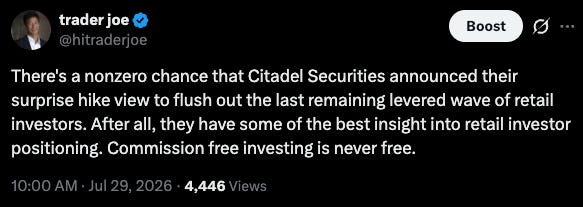
Seemingly out of nowhere, Citadel Securities announced on Monday evening that their view for the next day’s FOMC meeting was a surprise hike.
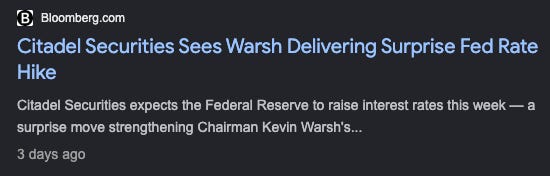
As far as I know, no major bank had a surprise hike as their call and it certainly stood out of place. (I highlighted why I didn’t see a Fed hike just yet here)
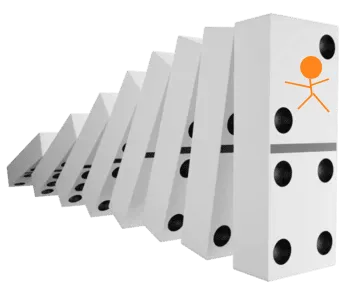
For me, this was the final domino.
Retail looked to hit a wave of stop out levels which exacerbated the selling flows and ultimately triggered the final margin call for Aschenbrenner.
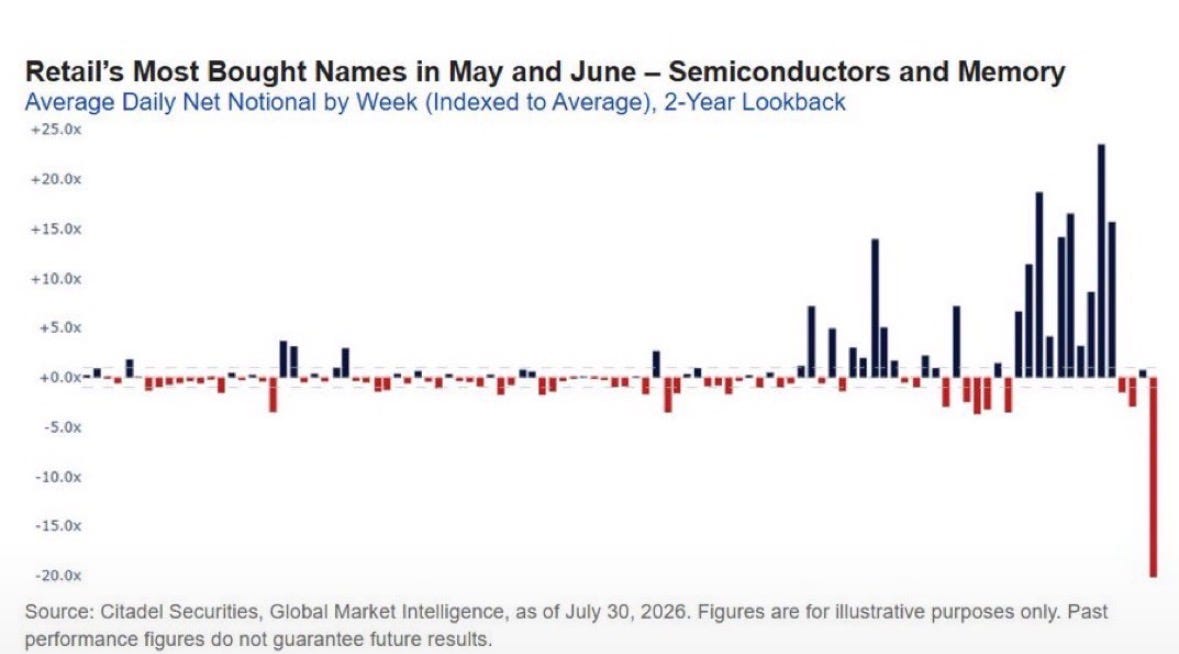
We can infer the timeline of the events by working backwards.
Thursday, 30th
Deal to buy the portfolio finalized.
“An auction was held overnight Wednesday and the winner was Mr. Griffin’s hedge fund, Citadel. The deal was closed early Thursday, one of the people briefed said.”
Wednesday, 29th
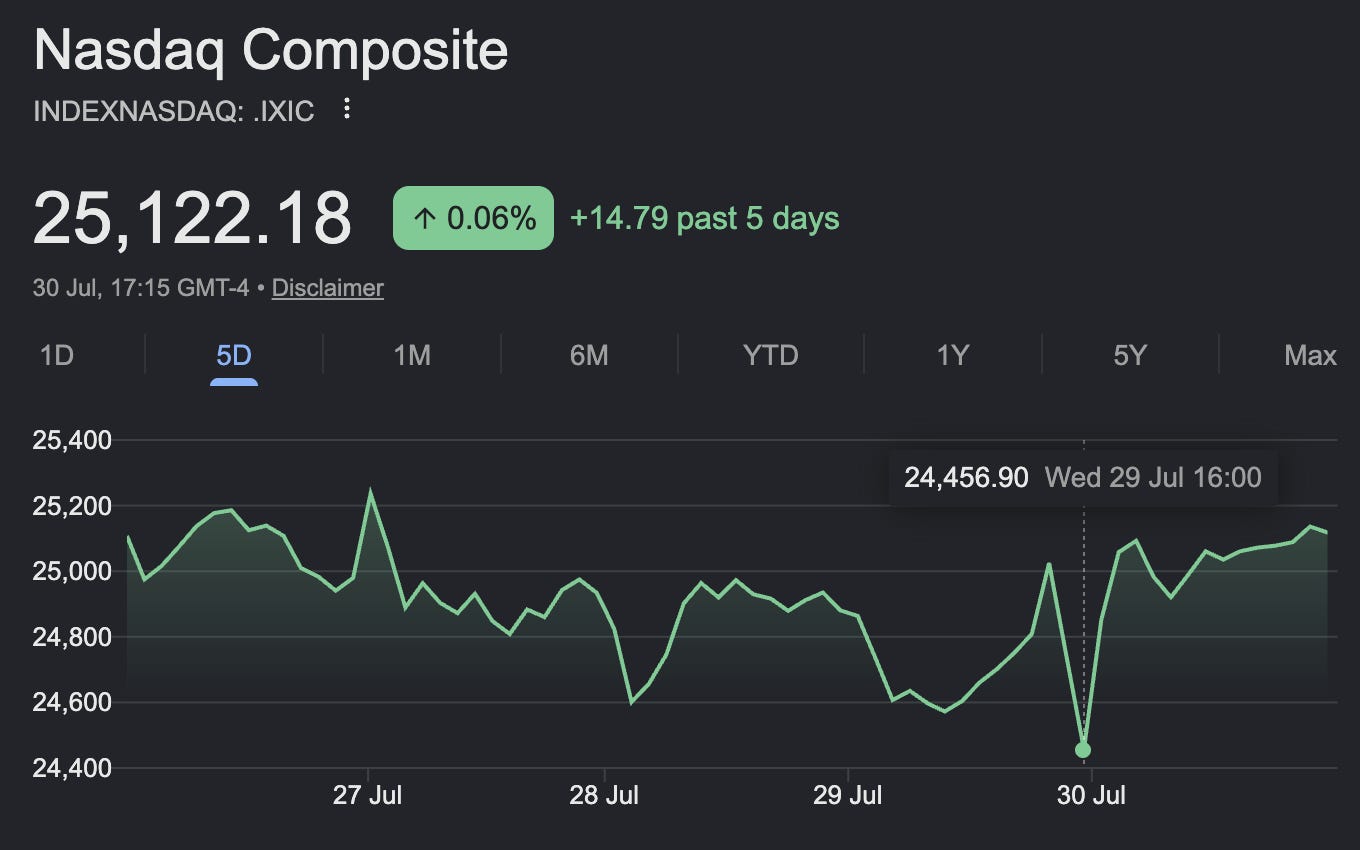
If you’re holding an auction on Wednesday night, that means you got the tap on the shoulder to sell everything during Wednesday, which means that Tuesday’s market closing prices set off the trigger for the prime brokers to push through the liquidation.
Tuesday, 28th
So, if you believe that the market drop on Tuesday (which triggered the liquidation) was caused by Citadel’s surprise hike view announced on Monday night, then I’ll let you infer from that what you will.
Monday, 27th
We also know that the FT reported yesterday (Thursday, 30th) morning that
“The fund held discussions with existing investors and lenders in recent days seeking to raise new capital[…] The fund had also offered some investors the option to buy assets in its portfolio”
The key word in that quote, is “days” plural. That means that news of this would already likely have been spreading by Monday. There’s almost zero chance that through the AI carnage that we saw, that an investor in Aschenbrenner’s fund, didn’t talk to others in the industry whether or not they should invest more capital - and, of course, little birdies like to talk.
Someone as new to the market as Leopold wouldn’t have the experience required to know who to talk to, who to trust, and how to negotiate with the banks.
Prior Week
If you’re approaching people to raise capital and offering to sell assets directly, it means you’ve already tried to sell your holdings in the open market and realized that there was no actual buyer in the market able to buy in the size you needed - again, HE WAS THE MARKET.
For buying a portfolio of that size, a market maker would offload some single name stocks right away and then hedge the beta of the portfolio by selling index futures (Nasdaq in this case). They would then try to slowly sell down the remainder of the portfolio.
According to reports, the auction was competitive - in other words, more than one bidder. This means that multiple firms now know what’s in the book and how much needs to be sold. Generally when a trade order of this size comes through the market will show the footprint of it right away. Not just because of the direct hedging, but because other market makers will hedge in anticipation of the selling flow.
But, all we saw on Thursday was a complete one way bounce, in huge size, in the names that Leopold held. To me this means, not only was the hedging already done, but that the market was possibly net short - i.e. hedge funds/banks already knew of this information and were already short these names in anticipation of the forced selling. Which would mean that the brutal price action that led to the ultimate liquidation was a blood in the water setup.
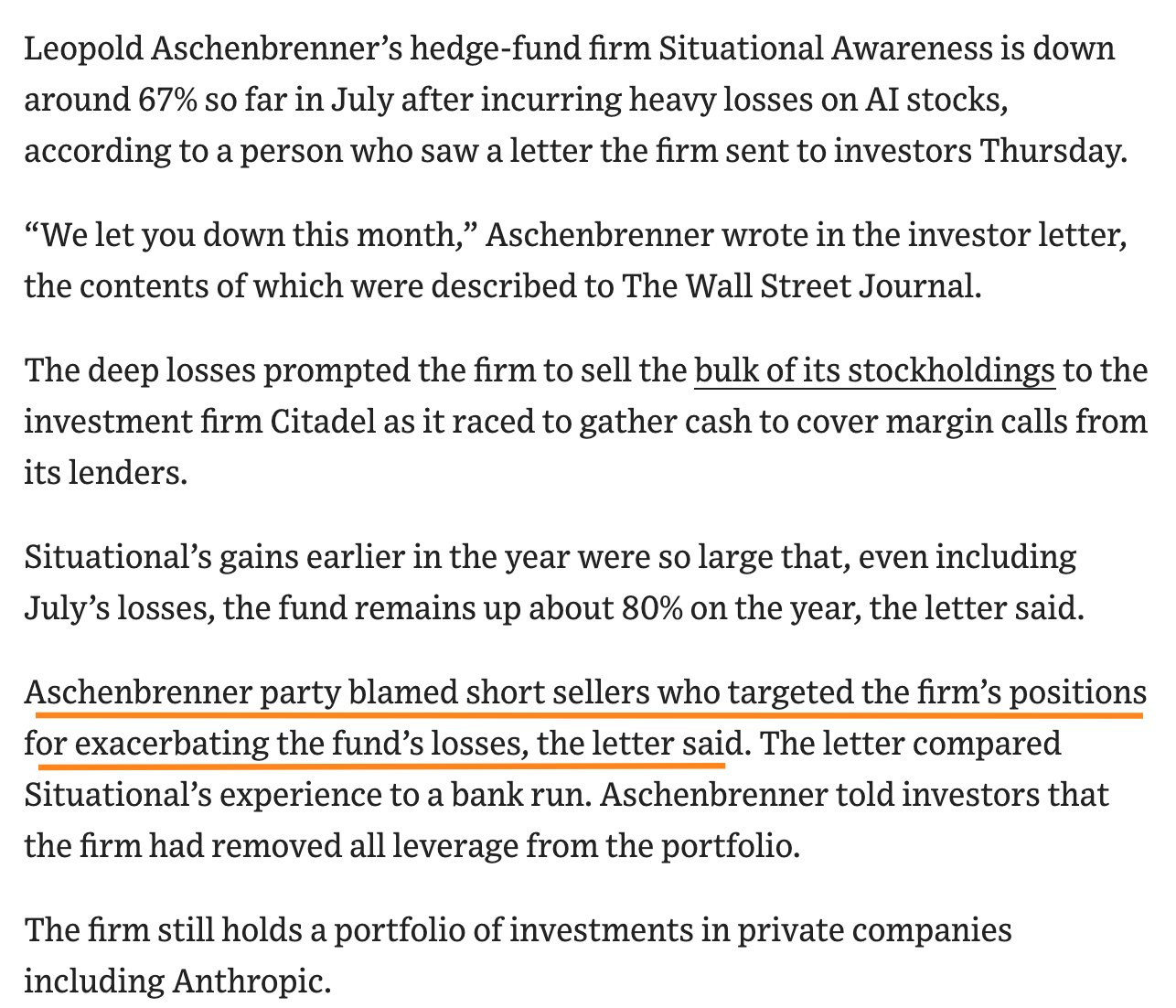
Now, no one couldn’t have orchestrated a Situational Awareness blowup from the beginning. But, you could have seen that the necessary conditions were in place to allow for this:
Fundamental story: Open source competition, circular financing concerns, hyperscaler negative FCF
Positioning/flow story: Retail overlevered, Korea overlevered
Liquidity story: Fed potentially tightening rates
Black swan story: U.S. Iran war is really going to escalate this time
We have seen investors take advantage of forced trading setups for as long as markets have existed. We saw the reverse happen with GameStop, we’ve seen Soros (with now Treasury Secretary Bessent) break the Bank of England, and it even happens to you on a regular basis.
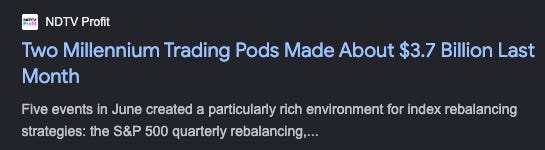
One of the biggest, most profitable desks on Wall Street is the Index Rebalancing desk which profits from predictable buying and selling by passive index funds - your 401k, your VOO and chill strategy, etc. all get chipped away at by hedge funds.
If it makes you feel better though, even Citadel has been on the bad side of an illiquid positioning dump. In 2017, Citadel set up a unit known as Macro Strategies which was wound down 2 years later after getting stuck in UK long bond trades - an asset that looks liquid until it suddenly doesn’t. Again, positioning, sentiment, liquidity, and position sizing set the conditions for the wipeout.
I believe that the next stage of the AI trade will be different than what we’ve seen up until now. Investors may feel more emboldened than ever to chase the AI trade higher setting us up for a repeat.
With my Substack community, I help work through the important macro drivers to stay on top of along with single name stock analysis. Come join us if you haven’t already. We have an interesting year ahead.
GLHF
< My macro deep dives, stock specific analysis, and personal positioning is usually paywalled and prices will continue to rise over time to reward my earliest subscribers. If you want to be the first to see them or support my work in general please consider upgrading to a paid subscription. Students get 50% off - please use this link. >
No posts
Comments
Nothing yet. Say the first thing.
Sign in to join the conversation.