
Alphabet beat revenue expectations with Cloud as the main driver growing 82%. Q2 capex came in above estimates and management raised full year capex guidance. Free cash flow also turned negative this quarter for the first time ever in the company’s public history.
Initial takes were that the earnings report looked great and that the cloud business looks strong.
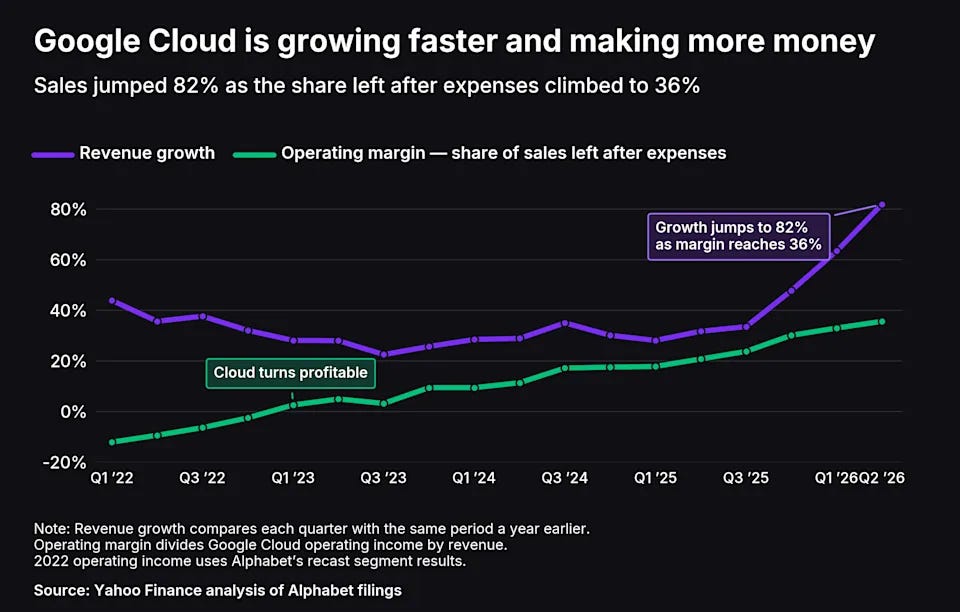
Alphabet runs an “unallocated” corporate cost bucket which grew 72% YoY. Frontier model training and development costs sit in here such as frontier development talent compensation, compute depreciation, and other shared items.
Cloud business figures are flattered by the fact that a chunk of its growing costs aren’t directly attributed to its segment financials.
We don’t currently see the ROI story for AI capex BUT the jury is still out. The financial profile of aggressive capex that ultimately does pay off also shows a similar profile to what we’re seeing now in the peak spending phase before operating leverage kicks in.
The leading indicator of the AI capex trend is growth of backlog growth (the 2nd derivative). If inference is growing exponentially then backlog growth should reflect that.
Alphabet’s backlog growth didn’t reflect that level of growth. However as they had the biggest jump out of the hyperscalers in Q1 2026 the trend in the chart may be skewed. Other hyperscaler backlogs may offer a clearer view on this.
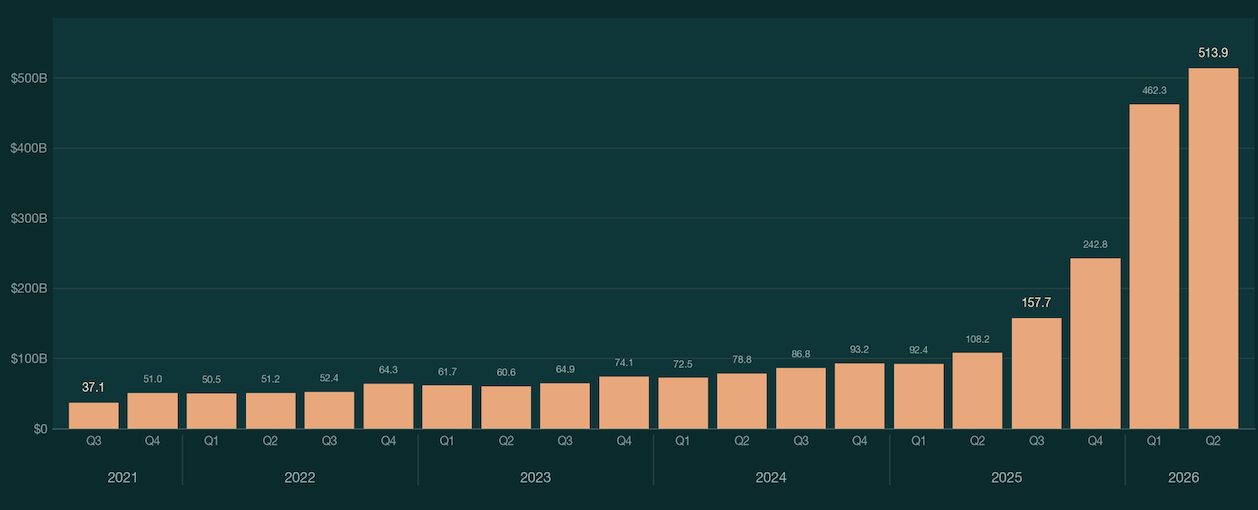
The higher capex print and guidance means that the flow into AI infra spending remains intact for now.
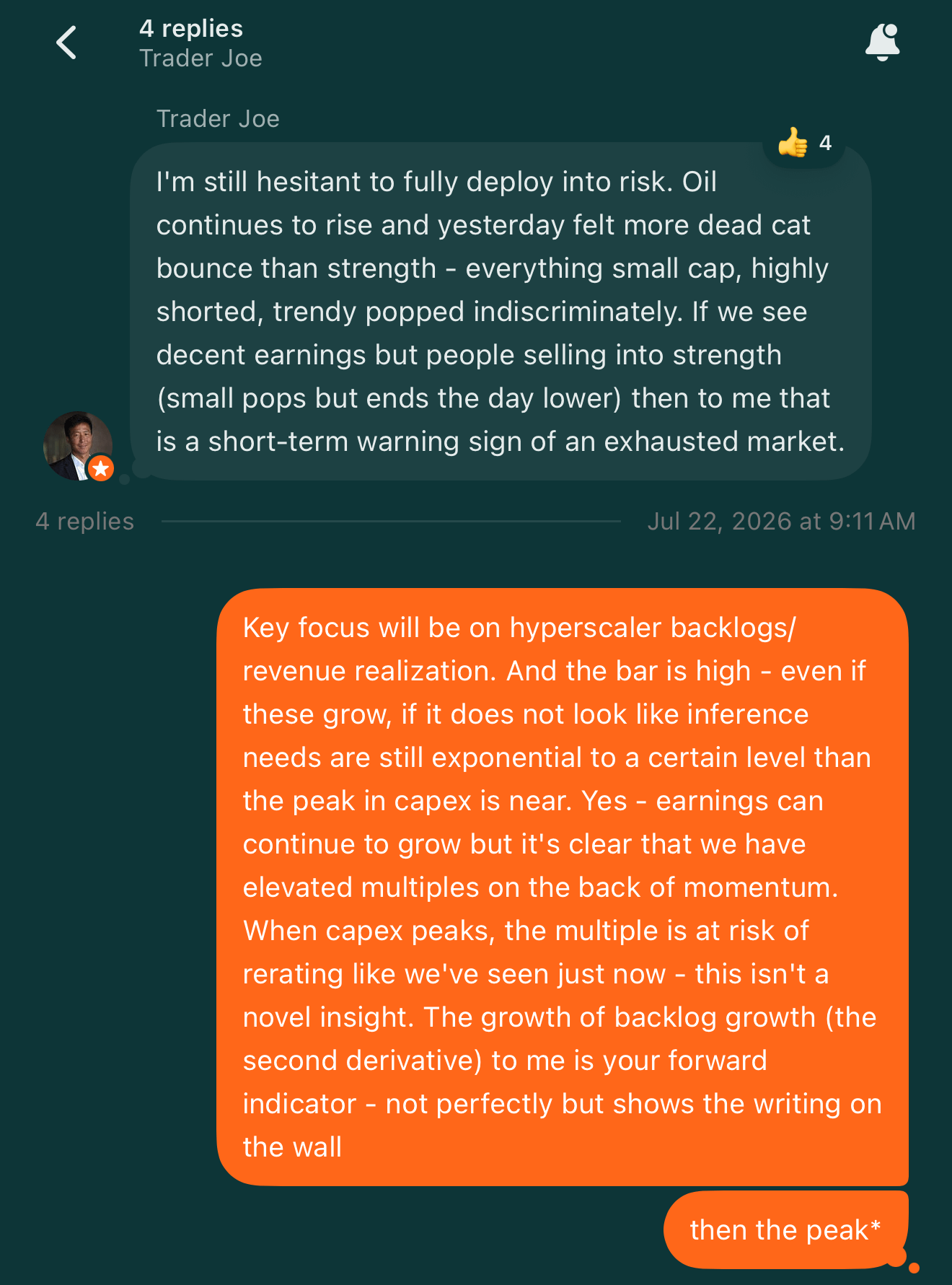
What I sent to subscribers yesterday (pictured below) remains my view and the price action that we saw with GOOG tells me that we likely have some short-term exhaustion.
ServiceNow reported earnings that beat headline expectations and revised subscription guidance higher. The stock popped after hours, recovering the sharp decline that occurred heading into earnings.
The headline figures are flattered a bit so let’s first lay out the blunter side of what’s happening.
ServiceNow recognizes most subscription revenue smoothly over the contract term but on-premise deals (where software is hosted on the customer’s servers) are recognized upfront. The U.S. government is one such case and government deals that were expected to close in Q3 closed in Q2 so the revenue was recognized earlier, leading to Q2 looking better than expected but “at the expense” of Q3.
The YoY growth is also flattered. NOW has made a string of acquisitions over the last year - Moveworks, Veza, Armis - whose revenue now shows up in the earnings statement but the YoY figure only compares it to NOW’s solo revenue from a year ago. As the 1 year marker starts to pass for each acquisition, we start to see what the underlying growth really is.
Gross margins fell. In the subscription segment (97% of revenue), revenues rose ~25% but costs rose ~65%. The cost drivers were partly due to deal amortization (~38%) with most of the remainder due to operational costs (~57%) - though part of this could also be attributed to the acquisition deals.
A growing trend to keep an eye on: ServiceNow’s historical margin edge came from building and running its own data centers. But management has flagged that customers are increasingly demanding to run NOW’s software on hyperscaler clouds. This means renting compute from a hyperscaler at metered rates and this doesn’t scale the same way running your own infrastructure does - costs keep growing roughly in proportion to usage.
Why this push? Part of it is data rules but another part is that enterprises obtain discounts for committing to a minimum cloud spend with the hyperscalers. This incentivizes shifting software compute onto these platforms.
Aside from this push, AI product offerings also push ServiceNow away from their own historical edge. In order to provide AI products and features, NOW needs to obtain more compute and going through cloud service providers is the easiest way. But again, this means that as AI-based product revenue grows, that costs keep growing roughly in proportion to usage, which means structurally lower margins. However, as token costs fall, NOW can stand to benefit. So far, higher AI usage per task has eaten up the fall in token prices we’ve seen, but if workloads start to stabilize we should see this start to come through in margins.
We are seeing SaaSpocalypse start to hit some software companies. NOW so far is bucking the trend.
Customers aren’t shrinking spend. The number of customers paying over $5 million per year grew 23%, and the number of $1 million+ deals grew 40%.
The Core business is still growing near 20%. The AI segment crossed $1 billion in Q2 2026 and is guided to reach $1.5 billion by the end of 2026.
The main takeaway shouldn’t be that this earnings release wasn’t as strong as it initially looks. It’s that the investment thesis remains intact. NOW just maintaining the status quo and showing its overall resistance to SaaSpocalypse can allow it to rerate notably higher. For a company growing with ServiceNow’s profile, the stock remains undervalued - in my view, you are compensated for the risk.
However, overall market beta risk is not something to ignore - I’ve posted my thoughts on the subscriber chat.
If you haven’t read it yet my most recent article and latest buy is here:
This is not financial advice. Always do your own research. My aim is not for you to copy my trades but to save time, help facilitate research, and present interesting ideas.< My macro deep dives, stock specific analysis, and personal positioning is usually paywalled and prices will continue to rise over time to reward my earliest subscribers. If you want to be the first to see them or support my work in general please consider upgrading to a paid subscription. Students get 50% off - please use this link. >
No posts
Comments
Nothing yet. Say the first thing.
Sign in to join the conversation.