
There are more possible states that a humanoid can be in than there are atoms in the universe. It sounds so intuitively off at first but the math checks out. A typical humanoid has (at least) 40 degrees of freedom (joints) with each joint able to spin 360 degrees. This creates 360^40 possibilities assuming incremental one degree movement - most joints can move in even finer increments though not all will freely rotate 360 degrees by design. This is something that Figure CEO, Brett Adcock, highlighted on a podcast.
The sheer number of possibilities means that you can’t traditionally code the robot software layer - there are more states than you could ever write rules for. Instead, you train a neural network to generalize. The problem is very different than next token prediction like we have with traditional LLMs (which also use neural networks). With a humanoid, you’re predicting the next action within a live environment continuously.
This article on Humanoid Compute is the third part of the Humanoid Picks and Shovels Investing series. The first two parts on Actuation and Sensing can be found here:
Nvidia views the challenge of developing Physical AI as the “three computer problem”. From Jensen Huang’s CES 2026 keynote regarding robotics:
“So, this basic system requires three computers. One computer, of course, the one that we know that Nvidia builds for training the AI models. Another computer that we know is to inference the models. Inferencing the model is essentially a robotics computer that runs in the car or runs in a robot or runs in a factory, runs anywhere at the edge. But there has to be another computer that's designed for simulation, and simulation is at the heart of almost everything Nvidia does. This is where we are most comfortable. Simulation was really the foundations of almost everything that we've done with physical AI.”
Let’s take each brain one at a time.
Powering the leading humanoid makers today are foundation models that are in the VLA (vision-language-action) model category. Vision and Language are the inputs and Action is the output. These are trained on large GPU clusters just like LLMs but with different data. So the humanoid race already shows up in the datacenter trade today but is underwhelming in its footprint vs the LLM space that it directly overlaps with.
LLMs had the internet to train off of but there’s less publicly available robot relevant data to train with. I’ve even seen some companies offering to clean your home for free in order to collect this data. Teleoperation is another route and what 1X is doing with their NEO home robot. For any non-trivial tasks, NEO is teleoperated and this data is likely to be used for training.
There isn’t a clean way to invest in the robot model layer directly - most are either developed in house within the robot makers themselves or are open source like Nvidia’s. But following the model layer does allow us to understand how the hardware is changing - more on this later.
Teleoperating or manually recording new humanoid relevant footage is cumbersome and resource intensive. The approach being more commonly used now is manufacturing the data virtually to create world models that generate synthetic training video.
This is a different workload than training. For simulation you need to actually render graphics and most datacenter GPUs have much of the graphics hardware stripped out to make space for more memory.
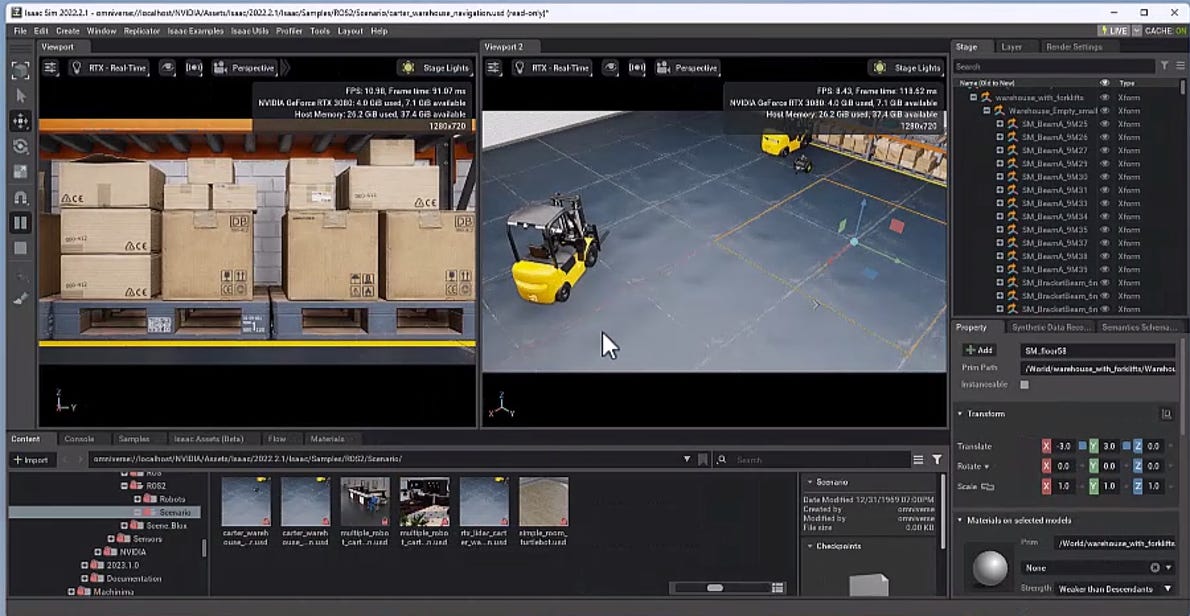
Nvidia has built an entire product family on this. Isaac Sim - physics simulation and robot learning. Omniverse - the 3D world engine powering Isaac Sim. Cosmos - world foundation models that generate photoreal synthetic training video. GR00T - Nvidia’s open source humanoid foundation model.
Just like Nvidia gave away CUDA libraries to sell GPUs, Nvidia is giving away the robot models to sell the three computer problem solution.
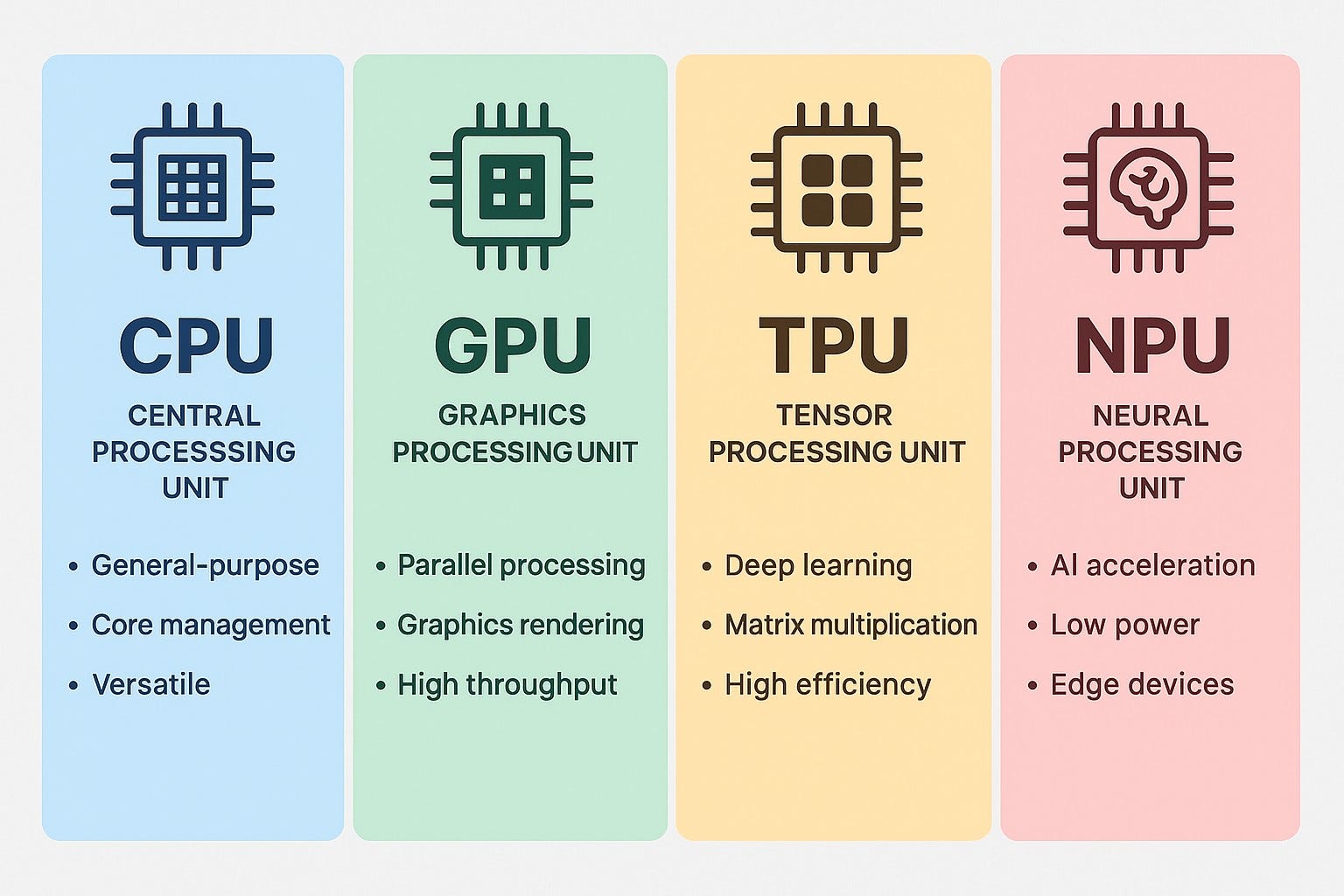
Brain #3 is an SoC (system-on-chip) which is several different processors on one piece of silicon. The SoC can contain:
CPU - Runs the operating system, sequences tasks, handles I/O
GPU - General-purpose, flexible, but power-hungry
NPU - Runs neural nets power efficiently but with less flexibility if model architectures change
MCU (microcontroller) - The reflex system, a small chip that controls the motors, keeps the robot balanced, and enforces safety with split-second timing, the newer trend is to integrate the MCU onto the main SoC
Memory - Robots use LPDDR5/5X which is the same low-power DRAM found in your phone, however the reallocation of DRAM wafers to HBM (the datacenter trade) has produced shortages and price spikes
Storage - NAND, the same as the datacenter trade
Perception, decision-making, language, body control - these are all tasks that a humanoid model needs to be capable of. Some of these calculations can be made in the cloud but some need to be done at the edge (on-device). A humanoid can’t tolerate the latency in pinging a request to a datacenter and back for finding balance or coordinating movements. There are also privacy concerns of sending video data of your entire household constantly to the cloud and back.
To address these issues, Figure’s model Helix runs fully onboard but there are tradeoffs.
Running more compute onboard results in higher battery usage and potentially more weight (bigger battery required) which are scarce resources for a humanoid. Many Chinese humanoids run hybrid - onboard chip for movement and safety reflexes and a cloud model for open-ended reasoning and dialogue.
The trend we’re seeing is that as chips become more capable, more compute is brought onboard.
I’ve tried to look at alternative angles for investing in this theme. I’ve left out the datacenter related trades from “Training” that people are already familiar with as that trade is already in the spotlight and humanoid volumes are still years away from being significant.
While Nvidia shows up with solutions across the three computer problem, that doesn’t necessarily make them the clear winner. They also tried a similar approach with AVs and used the same three computer pitch (train on DGX, simulate in Constellation/Omniverse, deploy on Drive).
< This series is paywalled and prices will continue to rise over time to reward my earliest subscribers. Students get 50% off - pls use this link. My macro deep dives, stock specific analysis, and personal positioning is usually paywalled so if you want to be the first to see them or support my work in general please consider upgrading to a paid subscription. >
Comments
Nothing yet. Say the first thing.
Sign in to join the conversation.