
Bob: “Man, have you heard about the MAPLE stuff”
David: “Yeah, it’s pretty horrible. It’s kind of weird that seems to keep happening to rat adjacent communities?”
Bob: “Indeed, I also think it is strange that we keep accepting all of these problems that consistently arise with Buddhism when we would declare it unholy and bad if it was something like christianity? Villiam has some good points in his comments and his post on this from a couple of years back”
David: “Hmm, I agree, there are a lot of crackpots in the world and one of the crackpot funnels we have open here is clearly from buddhism. I think there’s some sort of problem with the sort of belief status here, and it’s definitely related to buddhism being a religion with ~wise~ and ~mysterious~ beliefs about what to do. It trains your mind directly and so it is quite susceptible to capture from dark triad like stuff.”
David: “I kind of just wished people were a lot more chill about it somehow, like it’s not the devil and neither is it the cure to all problems that might show up. I really like some of the points in Tucker Peck’s Sanity and Sainthood as it talks about the path as one with both psychotherapy and meditation elements. You’re not going to necessarily get rid of your traumas just because you become very concentrated, you still need to work with them and through them.”
David: “You know what, fuck it, I’m gonna write an alternative version of buddhism called “Chill Buddhism”, we’re way too agitated about this shit in the community.”
(If you’ve had negative experiences with buddhism I found the following help center whilst looking up background information for this post)
Okay, Buddhism is kind of weird and kind of intense, how do we practice the more chill version of it?
Firstly, what is the goal of “chill buddhism”? It is essentially to get you and people around you to be more peaceful and happy. If you’re able to deal with the problems in your life in a more relaxed way where you find more peace in what you’re doing then this is a success. This is similar to what Rob Burbea says in Seeing That Frees, whatever works for you to feel more open and free is a good insight.
The second thing in chill buddhism is essentially that it only involves things that directly improve the things that you care about, that is your work, relationships and health. If it is “do this for 30 days and you will be happy trust me” then you shouldn’t do it. It needs to be verifiable in your own experience. Be a Bayesian.
It turns out that weird naps are basically the one and only combined gateway drug, they’re also known as yoga nidras which are kind of the same thing as Non Sleep Deep Rest. I’m gonna give you some samples on the science behind this one but the main thing is that it just makes you more effective on a day. You have energy curves throughout a day and a normal human usually has a dip anywhere between noon and 2 pm in the afternoon. What usually happens is that you’re less productive during that time but if you take a nap instead, you will regain some energy and you will have more energy throughout the rest of the day. This means that the 15-30 min you spend napping in the middle of the day will have productivity benefits for you.
The thing that a yoga nidra does is that it gives you the benefit of a nap whether you fall asleep or not. So it is essentially free in terms of productivity drop.
For the purposes of the path of the chill, it also helps you with parasympathetic activation of the nervous system, a.k.a becoming less stressed.
The cool thing about it is also that it can help you work through challenging experiences in an interesting way.
I lie down somewhere safe, I am calm, and I deliberately bring up a painful memory and stay with it without flinching away. That is just sustained attention to a negative memory in a low-arousal state. It is a much lighter version of what imaginal exposure does in a clinical setting, and it needs no special brain state to explain it. That ordinary mechanism has 51 randomised trials behind it, which is considerably more than anything specific to yoga nidra.
I might be able to set an intention to dive into pain that I had from being bullied growing up and be able to meet that pain in an open way. This has led to changes in my relationship with that pain and the way that it shows up during the yoga nidra is really strange, it is not the same as if you’re thinking about it from a day to day experience part, it is a lot more like a really really strange dream.
There’s also a bunch of psychotherapy stuff around yoga nidra but it seems like there is quite a lot of pseudoscience in that area so I would approach it all with a grain of salt.
So for the path of the chill Yoga Nidra is free real estate and it helps you with the hardest part of the meditation practice, not making it into a hardcore practice to do! It helps you find a more peaceful state of open awareness which is what we will get into next.
It allows you to chill in the moment and it allows you to chill more in the future as you don’t get quite as activated when trauma adjacent experiences show up.
Okay, the 2nd part of “Chill Buddhism” might be what we call open awareness practice. What is it? Well, it is like a walk in the forest where you don’t do anything else but allowing your mind to wander with a bit less of allowing your mind to wander.
The goal is to chill in whatever shows up and just being with that. You can do it by lying down on a couch for 15 minutes, you can go for a walk for an hour or you can sit down on the meditation mat for an hour doing nothing else.
Chilling out is basically always possible.
What do we need to chill the fuck out?
The intention to chill for a couple of moments
The time and space in the day to chill
The ability to not get caught in our random thoughts when we chill
The ability to not get caught in random sensations when we chill
How are you gonna chill if you get caught by random thoughts and follow these thoughts? You will instead of being calm be excited about whatever new project or game catches your fancy and you will daydream about it. In doing this you will activate mindwandering and the default mode network (DMN), and it does not induce rest automatically! Usually the DMN makes you ponder your relationships and memories, this is not necessarily relaxing. But there are ways for it to be relaxing, this is the skill of meditation, it makes the rumination part of the DMN shut the fuck up!
You gotta tell your boy the HPA Axis and his homie the vagus nerve that you’re in a chill mode where you’re not prepping for the future so it can shut down the stress “oh shit, what will happen” part.
I will just give you the predictive processing story here. I wish I had more detail on neurophysiology but it’s a bit hard to decompose. You have a model of the future, you can either spend time on making that model more concrete or you can spend time on taking actions that minimise the uncertainty of that model. Rumination is planning future scenarios to get a better model, this is often not that chill.
There are different levels of goal setting here, your brain is an hierarchical machine with layers of sub-systems. Your emotions lie at a lower level and are sometimes a bit hard to access. Chilling generally happens at the emotion level.
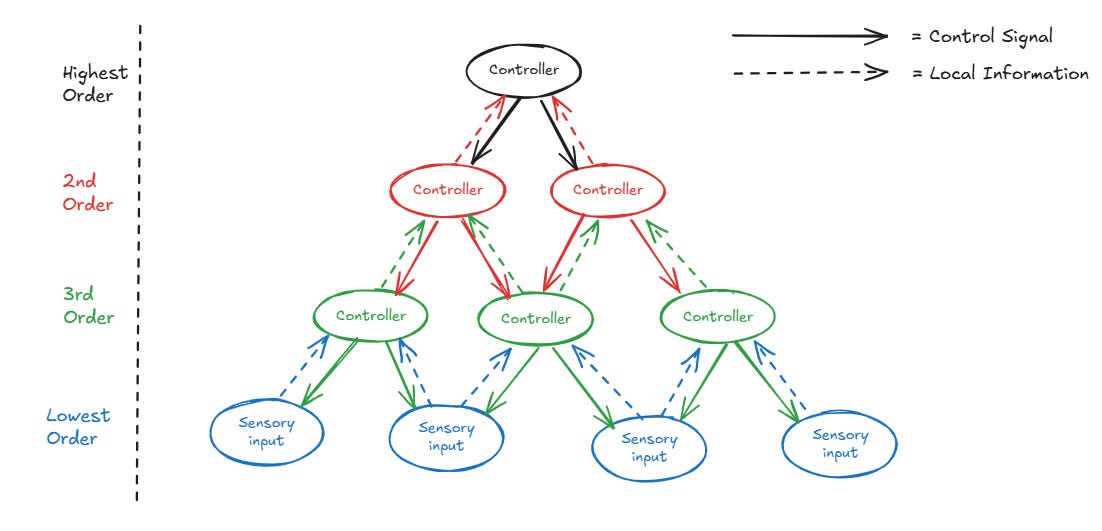
This is the picture I have in mind. Now what the open awareness practice does is pull you from the higher order planning module (the mind) into the generator of signals (the body). In this you get different error signals that you had from before. It is often hard to chill just by thinking, your full system’s gotta chill and to do that you need to feel the prediction error of the smaller sub-systems.
So through decreasing the activity of dmPFC meditation makes you better able to access sub-controller systems. This makes you better at chilling!
Can I neurophysiologically back this up? Well… It’s complicated but the predictive processing literature is essentially saying this.
The brain runs on minimising prediction error, either by updating the model or by acting on the world; it predicts your bodily states rather than just reading them off with the anterior insula as the comparator; there’s a formal version of this aimed squarely at emotion; and people have pointed the whole thing at contemplative practice. None of it tests my specific claim, but I’m not making the framework up.
Chilling is always possible but you can be differently good at chilling. You probably know some people who instead of grabbing a bag of chips and laying down to play video games or read a book chill by building some weird shit in their yard. Whatever floats your boat you know but also, the couch person is probably better at chilling.
Hardcore chilling is a skill and it is actually one of the skills that differentiate world class athletes from others. After a race they come down from activation faster than the rest of us, and this is in my speculation due to them having exposed themselves to more extreme states often. The mechanism is mostly vagal and it runs on a timescale of minutes: central command switches off, muscle acidosis clears, the baroreflex resets, and the parasympathetic brake comes back on.
The more really good chilling you do, the more really good activated stuff you can do because you have more resources to do things with!
The skill of chilling or resting is the main part of the practice.
So, what if you want to get really good at chilling? Well, then you would have to get really good at not being distracted by not chilling.
This is where focus practices come in. If you do the practices in the mind illuminated which essentially involve meditating on your breath for 45 minutes a day, you will become a lot better at chilling.
But! You should learn to chill first, no point in getting good at the theoretical skill of chilling if you’re not chill in the first place.
Also, if it’s not chill for you to do 45 minutes of chilling practice per day you don’t have to! Ask yourself “can I make this chill?” and if the answer is no, then don’t do it.
So chilling is good but is it nirvana good? Well, here’s a nice little meditation story for you to ponder:
Ah, listen young sage, I will tell you the story of Chill McChillface, the great venerable one who instead of going to push to nirvana, chilled the fuck out.
Chil McChillface was just living his life, working a 9 to 5 and he was of course chronically online but chilling. No toxicity, whenever he opened twitter he was like “nah, this is not chill enough”, he did his own thing, chilling.
In part of this chilling he would spend time chilling on a cushion and when he was walking he was chilling, when he was eating he was chilling.
In his adventures online, he met many people who were not chilling, they in fact were quite activated and non-chill all of the time. They would tell him “Oh you should come and further your path, come to this longer meditation retreat, why don’t you join this really strict zen monastery?” but the chill one he was like “nah, i’m chilling”.
He would of course go sometimes on longer chilling retreats, he liked to call them “vacations”, during these times he would practice deeper chilling, he sat on a meditation mat for hours doing absolutely jackshit. Just chilling with the deep open still nature of reality. Sitting in stillness. Moving in chillness, moving in stillness.
As his mantra went “bro, just chill, it’s not that serious.”
In the chill, he wouldn’t conflate much either, generally chilling. In the hearing just the hearing, in the seeing just the seeing, in the sensing just the sensing, in the thinking just the thinking, in the chilling just the chilling. There was nothing to do but chill. There is no path beyond chilling and anyone who says anything different is just trying to be something they’re not.
Ah, and in this he would be sad for the people who felt they had to chronically post on twitter. “Ah, man that looks kinda stressful, poor people” is what he would say. For in chilling he noticed that other people did not chill and his chill-heart would naturally feel that everyone should chill for that is the natural state of the world.
“Bruh, just chill.”
“It’s not that deep pal, just calm down”
“I get that you’re mad at Brian Johnson but he’s just living his best life, let him do so, just chill”
“May all beings chill, may all beings not have to be ratioed on twitter, may all beings find the advanced level of their inner couch potato.”
The venerable one was like a still rock in a raging lake, unmoved by the world, chilling through everything. This did not mean that he did not act!
“Yann, this airplane analogy clearly does not work, it’s not chill to go on an airplane without safety tests!”
“Bros, this entire AI thing, maybe we should slow down a bit? Like chill a bit before we release stuff we don’t know what do with?”
You can chill and act at the same time.
Whenever you’re doing a goal oriented pursuit your dopaminergic system activates and one of the very interesting things about the dopaminergic system is that it actually has two different rewards that show up (approximately!). One is the reward from the thing in itself and another is the expectation of the reward in the future. If you’re constantly engaged in the reward in the future it is kind of hard to chill because you’re always pulled away. There’s always a prediction error calculation hiding in the moment.
Therefore we should try to get to the type of motivation that we find when we climb a mountain, a more serene sense of peace, a deeper chilling.
There are different levels to chilling, some are local chilling, some are deeper chilling and sometimes it is hard to know to what extent you’re chilling. Whether the chilling you’re doing is not actually that chill.
So how do you know how well you’re chilling? Well, you’re either chilling or you’re not. What shows up in your experience? Do you feel more chill from it? Does it help you feel more chill in the future? What is it like for you to chill?
Do you feel that others should also be more chill? Is it an open and aware chilling? Do you feel tired after the chilling, if that is the case maybe you should chill in a better way? Is the chilling restorative?
I think that a lot of the discourse around Buddhism in the rat-adjacent spheres are inspired by Theravada Buddhism and similar and these forms are not very chill. There’s a fierceness to them where they demand lots and lots from you for the benefits of all beings.
This leads them to be a lot more easy to get stuck in and it makes you worse at knowing whether or not you’re doing the right thing.
They give you less time to think and force you into a frame where you might not want to be, your experience is not primary.
There’s something similar in non-dual traditions as well which I believe is part of the religious part of it and partly due to it not being able to be memetically propagated if it didn’t have it.
I sincerely believe that I have represented the core teachings of the Buddha well in the above passage. It’s not that deep pal.
Peace is the state which gives you all of the insight of the buddha and we know it as chilling. It’s just like really really deep chilling, nothing of your existing life disappears when you chill, it just becomes easier to deal with.
Chilling is quaint, it’s nice, it gives you space and time to process and with our busy lives it just is kind of calm and gentle? It’s a kind and open thing and I think it is a good way to think of the path.
No posts
Comments
Nothing yet. Say the first thing.
Sign in to join the conversation.