
A West German journalist named Annamarie Doherr asked the question at a press conference in East Berlin on June 15, 1961. If a free city were created, would that mean a state border at the Brandenburg Gate?
Walter Ulbricht, who ran East Germany, answered that nobody had any intention of building a wall.
Nobody had asked him about a wall. He had introduced the word himself, and eight weeks later he built one.
The problem he was solving was that his country was emptying. Since 1949 something like three and a half million people had left East Germany, close to a fifth of the population, and by the summer of 1961 they were going at a rate of more than a thousand a day. They were not, on the whole, the people a state can afford to lose. They were doctors, engineers, teachers, skilled workers, the young. Berlin was the hole in the fence. The border between the two Germanys had been closed for years, but inside the city a person could still ride the U-Bahn from one sector to another, walk out of the station, and simply not come back.
The operation to close it was called Rose. It began at about one in the morning on Sunday, August 13, and the timing was not an accident. A summer Sunday was the night the city was least awake, when Berliners were out at the lakes or asleep after a late Saturday, and when the men who would have organised a response were away from their desks.
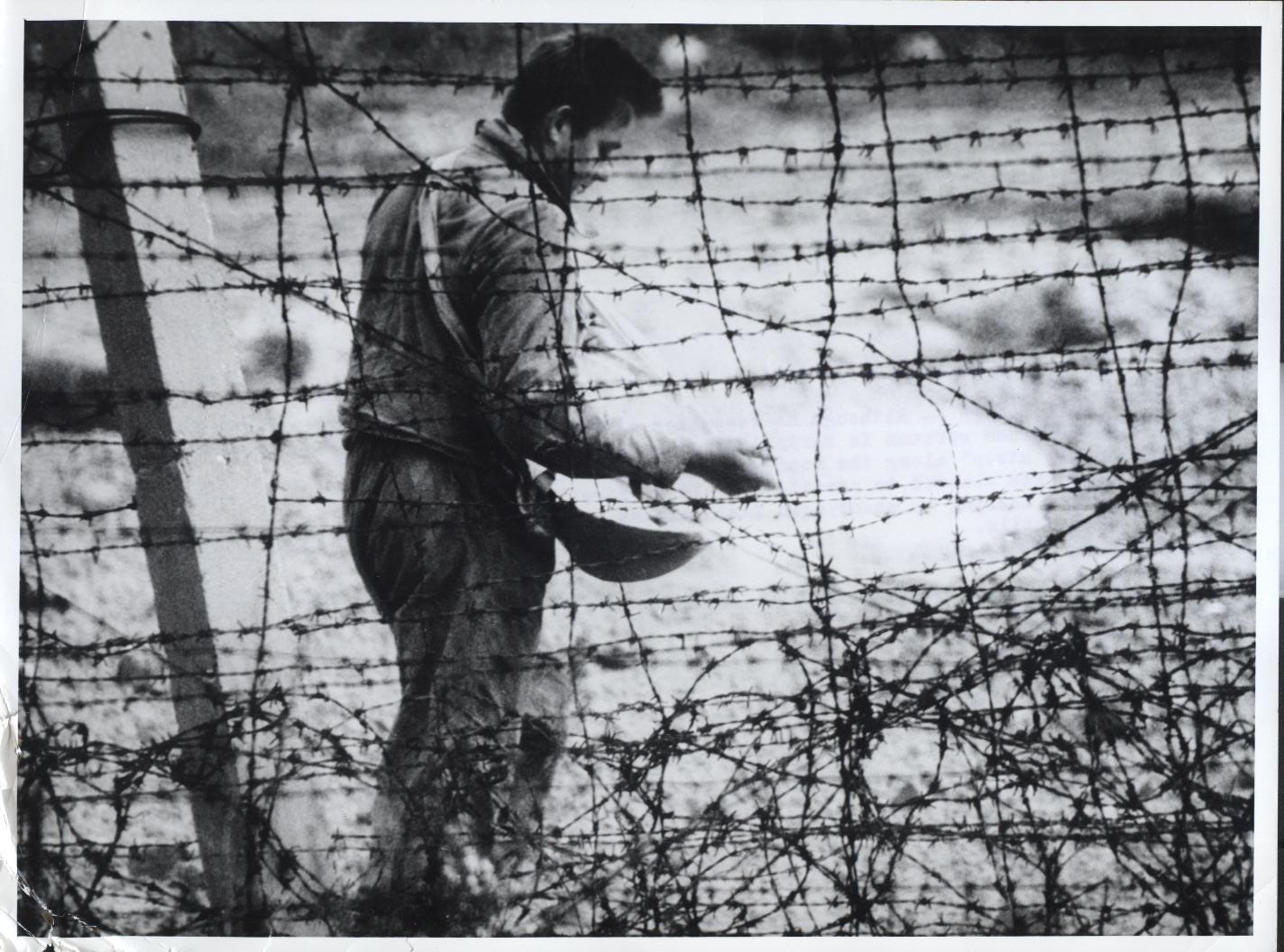
They had stockpiled for it: eighteen thousand two hundred concrete posts, a hundred and fifty tons of barbed wire, five tons of binding wire, two tons of staples. Soldiers, police and factory militia moved out to the sector boundary and began tearing up the streets, cutting the tram and rail lines, and rolling out wire. There were forty-odd kilometres of boundary through the middle of a living city, and by dawn most of it was shut.
Berliners woke on Sunday morning to find that the city had been divided while they slept.
What that meant was not abstract, because the boundary did not run along anything sensible. It ran along old administrative lines drawn in 1945, straight through neighbourhoods, down the middle of streets, and in places directly along the face of apartment buildings. On Bernauer Strasse the buildings stood in the East and their front doors opened onto a pavement that was in the West. For a few days people simply walked out of their own front doors into another country. Then the doors were bricked up, and the ground-floor windows, and then the upper windows, and people began going out of them anyway.
Families were cut apart in the middle of ordinary arrangements. A woman visiting her mother on Saturday could not go home on Sunday. Couples were separated, children were on the wrong side, and the sixty thousand or so who lived in one half of the city and worked in the other found their jobs on the far side of a wire fence. Crowds gathered on both sides and stood looking at each other across the barrier, close enough to shout, and were pushed back by soldiers.
The West did nothing, which was the other half of the calculation. Ulbricht and Khrushchev had judged that the Americans, the British and the French would defend their access to West Berlin but would not fight over what East Germany did to its own citizens. That judgement was exactly right. Kennedy was told during the day on August 13, said little in public, and privately observed that a wall was a great deal better than a war. West Berliners felt abandoned, and they were not entirely wrong.
The wire went up first because wire is fast. The concrete came later, and then a second wall behind the first, and the strip of raked sand between them where a person could be seen, and the watchtowers, and the order to shoot. It stood for twenty-eight years.
The barrier was two days old when people started going over it. Some got across, and some did not, and among the very first to run was a nineteen-year-old in uniform whose job that afternoon was to stop them.
1898: The Battle Both Sides Agreed to Fake
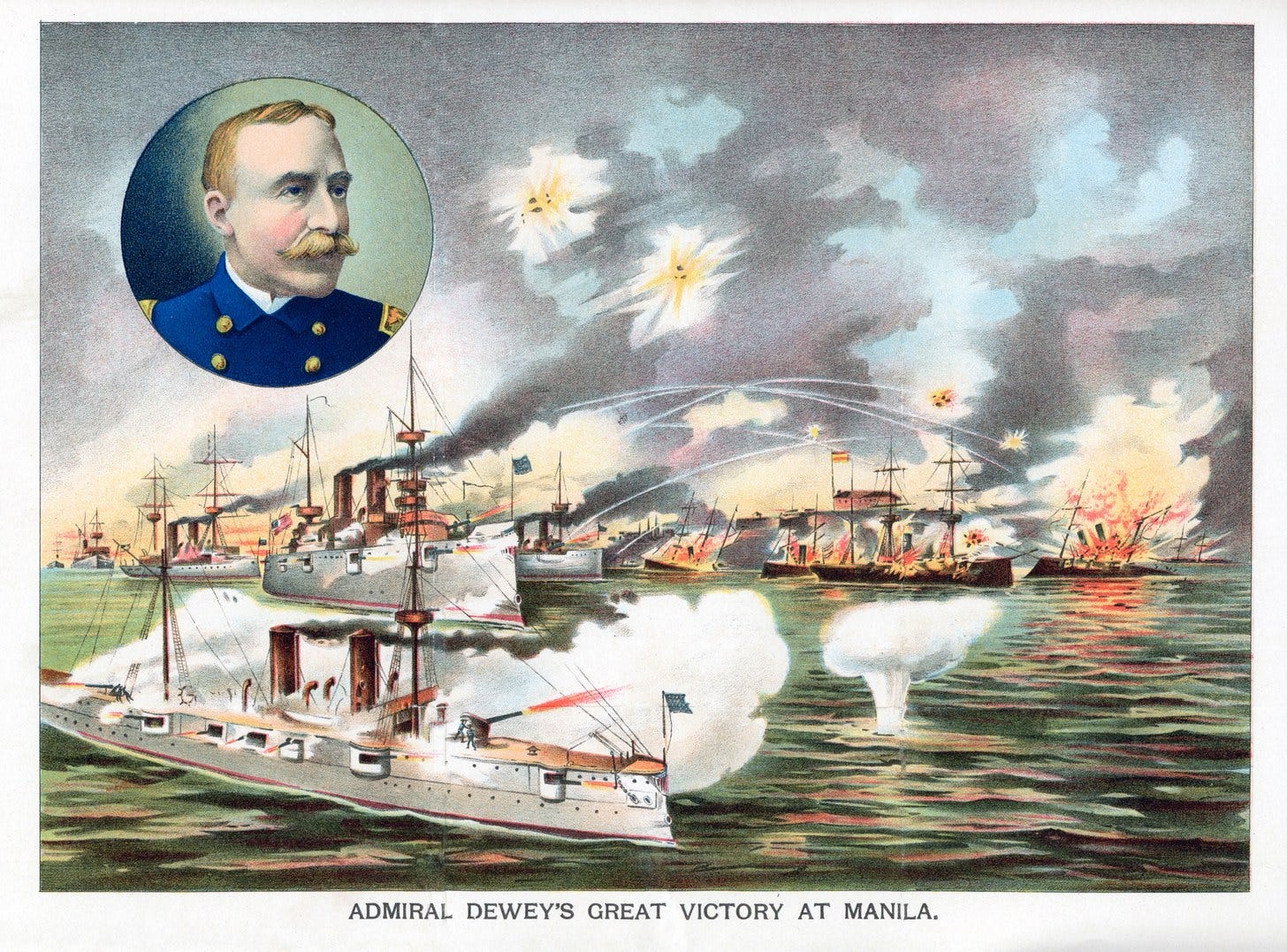
Spain and the United States had signed a peace protocol in Washington on August 12, ending the Spanish-American War. Nobody in Manila knew, because Commodore George Dewey had cut the undersea telegraph cable to Hong Kong months earlier after the Spanish governor refused to make the line neutral. So on August 13 the two sides fought a battle that had already been arranged in private. Dewey and General Wesley Merritt had spent days negotiating secretly with the Spanish governor, Fermin Jaudenes, and settled the terms on August 10: the Americans would fire a token bombardment, the Spanish would offer token resistance and then run up a white flag, and Spanish honour would survive a surrender that was actually a handover. The real purpose was not Spanish pride. Manila had been under siege for weeks by Filipino revolutionary forces under Emilio Aguinaldo, who had fought alongside the Americans against Spain and expected to enter the capital they had helped surround. Both sides of the staged battle wanted to keep them out, and the Filipinos were not told. They attacked in earnest, took real casualties, and were then blocked from the city they had besieged. Within six months the United States and its former allies were at war with each other, and the Philippine-American War killed far more people than the war that had just ended in a fake battle.
1918: Opha May Johnson Joins the Marines
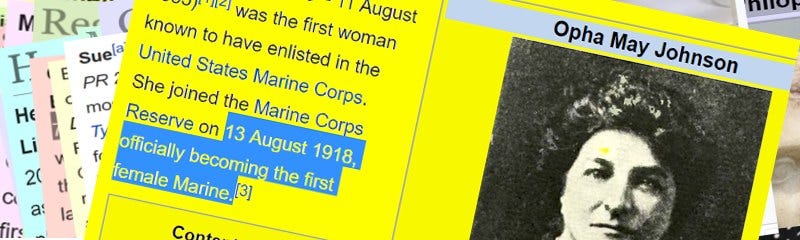
The United States Marine Corps had been an entirely male institution for a hundred and forty-three years when it ran out of men. With the war in France consuming replacements faster than they could be found, the Corps authorised the enlistment of women to take over clerical work at headquarters and free up Marines for combat. On August 13, Opha May Johnson, a 40-year-old civil service clerk who was married and working as a clerk in the Marine Corps' quartermaster department, stood in a line of some three hundred women outside the recruiting office in Washington and became the first to sign. She was made a reserve private, later a sergeant, and she spent the war running the paperwork for the Corps' own reservists. About three hundred women followed her in, and every one of them was discharged when the war ended, the experiment closed as neatly as it had been opened. It stayed closed until 1943. Johnson went back to civil service work and died in 1955, and the Marine Corps she had walked into now counts women in every occupational field it has.
1876: Wagner Opens Bayreuth With a Theatre Built for One Work
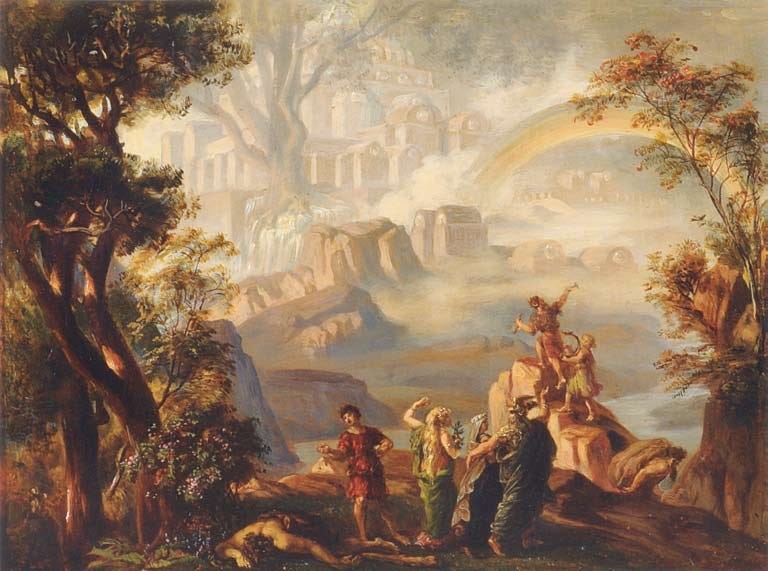
The first complete performance of Richard Wagner's Ring cycle opened with Das Rheingold at the Bayreuth Festspielhaus, a theatre Wagner had designed and had built for the sole purpose of staging it. He had spent twenty-six years writing the four operas, and no existing opera house could do what he wanted, so he raised subscriptions, took money from Ludwig II of Bavaria, and put up his own building in a small Franconian town. The design was an argument. He sank the orchestra into a covered pit so the sound rose to the audience without the players being visible, abolished the boxes where the aristocracy sat to be looked at, ranked every seat to face the stage, and darkened the auditorium during the performance, which was close to unheard of. Almost everything on that list is now simply how a theatre works. The festival was an artistic triumph and a financial disaster, leaving a deficit that took years to clear, and it has run in that same building nearly every summer since.
The full deep dive is about the people who went over the wire in those first days. The nineteen year old border guard who threw his rifle away in mid-air and jumped, photographed by another nineteen year old who had been waiting an hour for exactly that, and what the rest of that man's life was actually like once he became the most famous defector in Europe. Then the two people who died in the first fortnight: the woman at 48 Bernauer Strasse who went out of a third-floor window because her own front door had been bricked up, and the tailor shot in the water in front of witnesses. Start your free 7-day trial to read it.
Comments
Nothing yet. Say the first thing.
Sign in to join the conversation.