
Two questions, asked intermittently over the years by BBC anchors in London, used to mildly grate. “Why Are Americans so obsessed by royalty?” was the first, a line of inquiry which always made me want to unleash my inner nerd. Many revolutionaries were royalists, I wanted to say - historical terrain, I know, which we have already traversed. The American Revolution was primarily targeted against parliament rather than the king. George Washington came close to being called “Your Majesty,” and ended up with more prerogatives than George III. But it is hard to compress all of that revisionism into a forty-second soundbite, so I usually answered the question by reaching for banalities, such as the absorption of the royal family into US celebrity culture and the country’s long-running love affair with homegrown dynasties, such as the Kennedys.
The other question, posed like clockwork every four years, was “why do Americans not like football?” That, manifestly, is a canard. Among children, soccer, if we must call it that, is the highest participant sport. For adults, it is the fourth most followed code after American Football, basketball and baseball. As The Economist reported last year: “America has become the biggest foreign market for the four largest European leagues.” The women’s national team, which has won four FIFA Women’s World Cups, is a powerhouse. The men’s World Cup, where the “USMNT” has come nowhere near scaling the same heights as the women, nonetheless brings to the fore hyphenated America. Italian-Americans congregate to watch the Azzurri - or, at least, they used to. Mexican-Americans cheer on “El Tri”. Likewise, German-, Dutch-, and English-Americans, among others, display their dual allegiance.
It is more a case, of course, of US networks not much liking football. Unlike gridiron, basketball and baseball, formats which lend themselves to the stop-start staccato of commercial breaks, football matches are more flowing. The much-hated hydration breaks brought in by FIFA at this World Cup are a sop to corporate America: an attempt to turn a game of two halves into a game of four quarters.
In a collective act of inverse US isolationism, the rest of the world prefers it when the United States refrains from interfering. So the creeping Americanisation of the global game has been met down the decades with resistance. Recall the outcry ahead of the 1994 World Cup, the last time the United States hosted, when some bright spark, probably on Madison Avenue, suggested the goal nets could be increased in size to encourage higher scoring games. Or remember when, in 2021, 12 of Europe’s top football clubs announced plans for a breakaway super league. The plan was for a cartel-like closed competition, where no side would ever face relegation, as was the norm in the American codes. That, though, violated the European sense of competition and fair play. Nor did it help that two of the main drivers of the league, Liverpool and Manchester United, were American-owned, and that JPMorgan Chase, the Wall Street super bank, was underwriting the deal.
On the football front, the TV character Ted Lasso, has been more to global liking: the hapless but humble coach who embraced the idiosyncrasies of Britain rather than bestriding the changing room in the manner of General Patton. Many football fans around the world also cheered on the FBI, when in 2015 it spearheaded a crackdown on corruption within FIFA.
The Americanisation of the game is one thing. Its Trumpification has brought even louder howls of protests. Consumers the world over, whether filling their tanks in Manila or buying a lettuce in Milton Keynes, were already smarting at having to pay higher fuel and food prices as a result of Trump’s fumbled Iran war. There will be heightened anger over this week’s resumption of hostilities, which has already led to a spike in oil prices. His interference this week in the World Cup - let’s call it “Operation Epic Fix” - made him, on social media, global enemy number one.
Trump, of course, browbeat FIFA chief Gianni Infantino into reversing the one-match ban on US striker Folarin Balogun, who had been sent off against Bosnia and Herzegovina. But the move boomeraged. Trump, showing his usual disregard for the rules-based international order, exposed his sporting illiteracy by not even being familiar with the basics of the world game. A Belgian team which had bickered between themselves in previous matches came together, like Marvel Avengers, to thrash the USA. In celebration of their fourth goal, the players even performed a party piece by mimicking Trump’s trademark jig.
Ahead of kick-off, it had felt that we were all Belgians now. Long before the final whistle, when it became clear the Americans had been completely outplayed, there was a collective sense of poetic justice. Not just the American team had been vanquished, but the American president.
Needless to say, the Internet, beforehand, was awash with mocking memes.
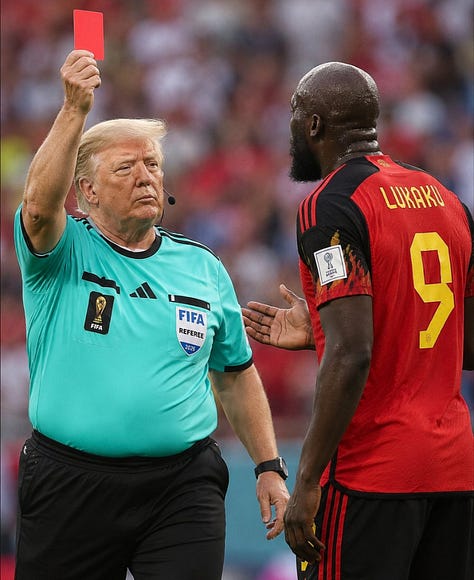
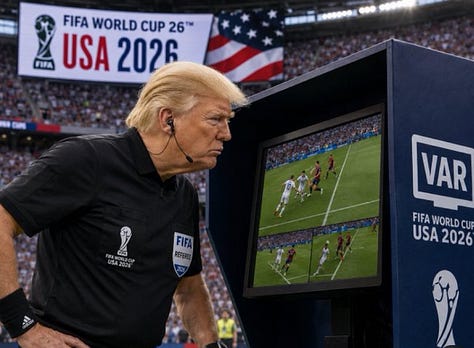
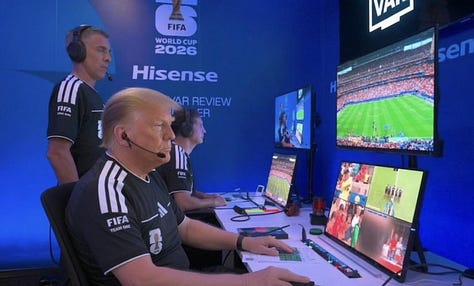
And also afterwards…..
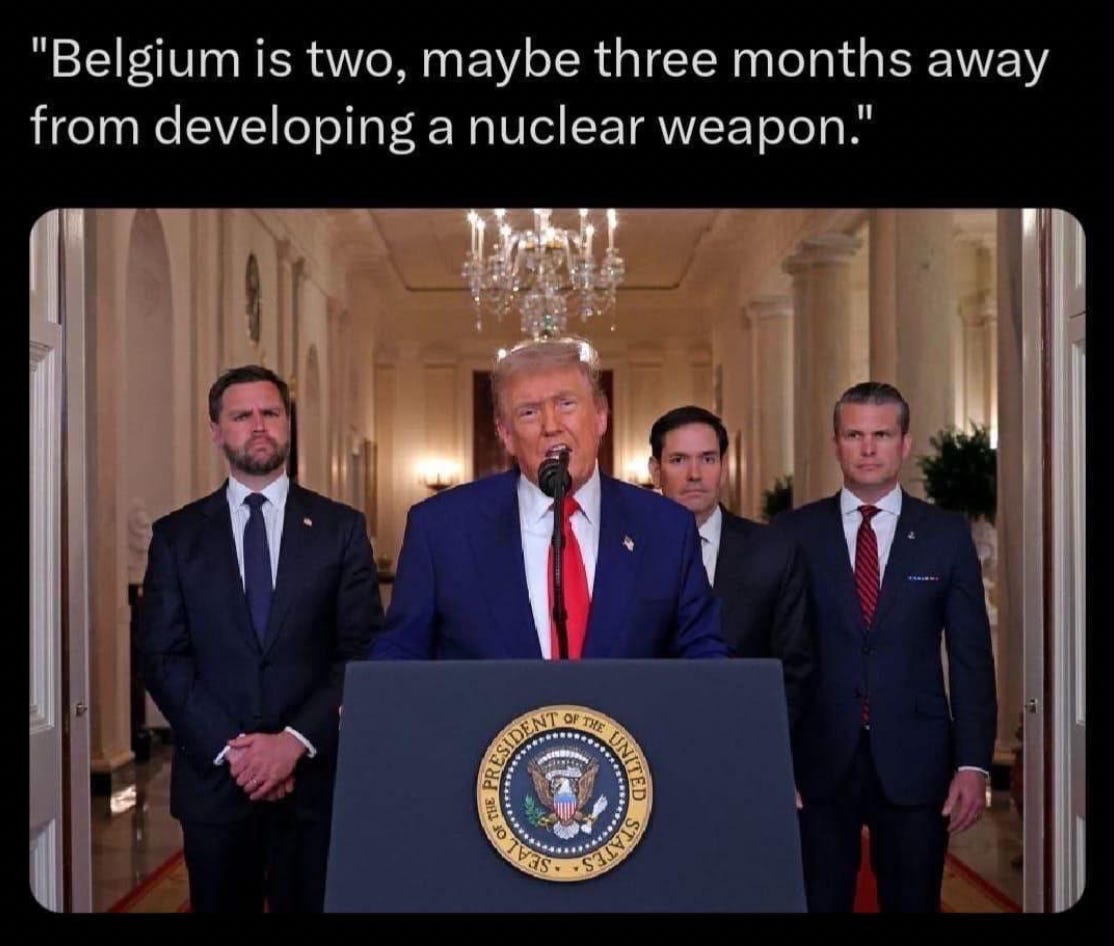
Not even Trump, a famously sore loser who routinely cheats at golf, could fix a 4-1 defeat. Ringing up the FIFA chief and asking “Gianni I need you to find me four more goals,” would have raised too many eyebrows. So, too, presumably would be declaring victory for the United States, convening a Stop the Steal rally outside the World Cup final, and urging his militias to storm the stadium in an attempt to overturn the result. Trump was trumped.
Even before this week’s antics, a YouGov poll suggested 81% of British people have an unfavourable view of Trump. A recent poll in Australia conducted by the Lowy Institute confirmed the president’s profound unpopularity, with the lowest confidence rating of any US leader in the history of the poll. The tragedy was that the American team, as well as the president himself, became a symbol of toxic US exceptionalism. That, too, was unfair.
So it was heartening this week to read the results of a poll conducted by the London School of Economics which showed Europeans make a distinction between Trump and the American people. A survey of 2000 people in the UK, Germany, Denmark, Italy and Poland showed they still liked Americans while rejecting Trump. As its authors noted, the findings “make clear that Europeans do distinguish Trump and his administration from the American people.” Crucially, given Trump’s successful attempt to shred the FIFA rule book, the survey also found “the majority of respondents in each of the five countries thinks that Americans are a trustworthy people to varying degrees. In the UK the figure is 83%, Germany 73%, Denmark 69%, Italy 75% and Poland 75%.”
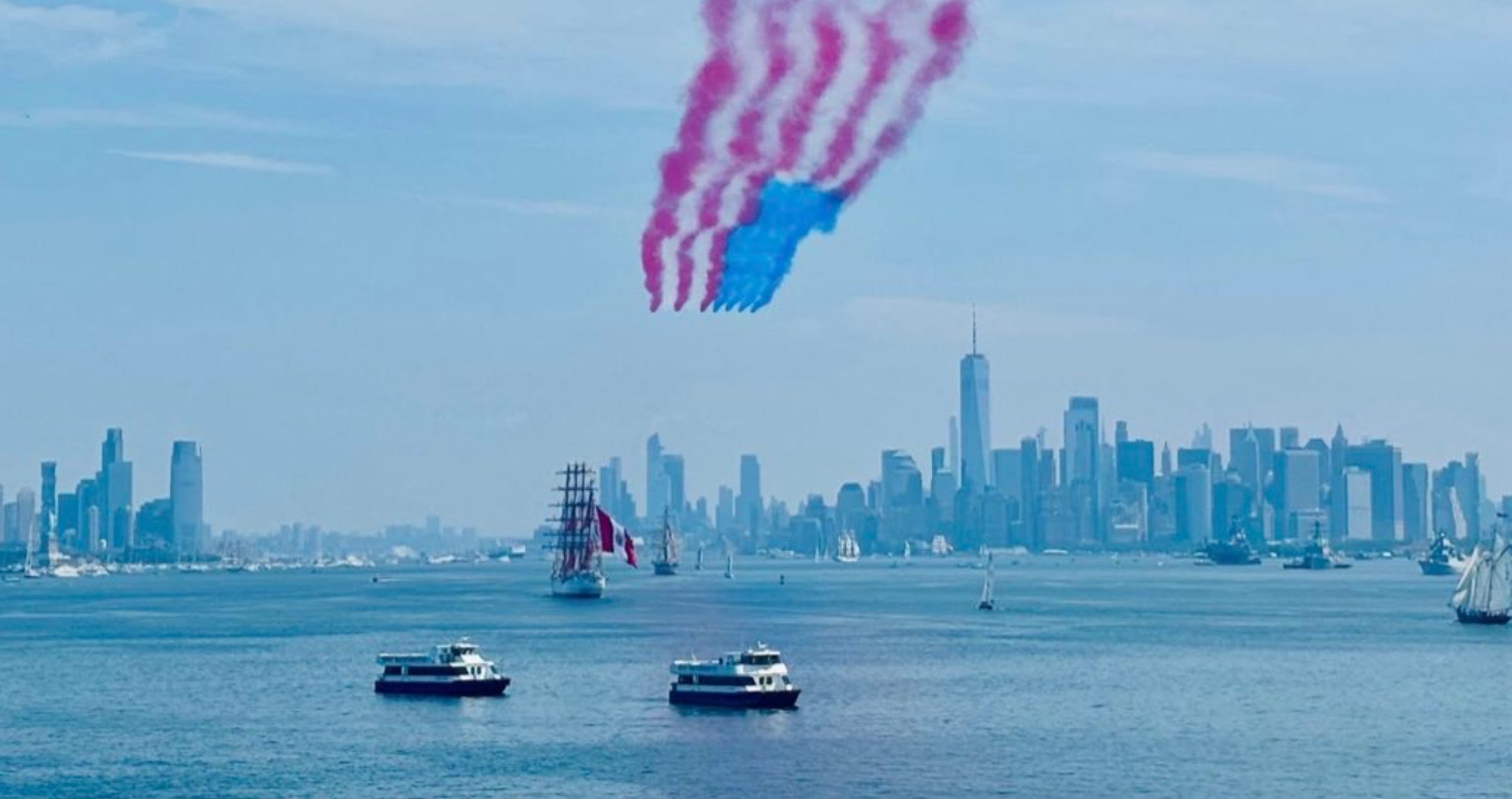
Reputationally speaking, one of the upsides of America being so chronically polarised is that the rest of the world realises it is chronically polarised. Rather than buying into the idea of the red, white and blue, we think of it instead in terms of the red and the blue - partisan colours, incidentally, which only came to be adopted at the 2000 election, when the US networks all decided to adopt the same schema.
Trump’s shock victory in 2016 was mistakenly seen as an aberration, because he succeeded in winning the Electoral College but failed, immaterially, to win the popular vote. More disturbing was his victory in 2024, partly because it came after the lawlessness of the January 6th insurrection, and partly because he became the first Republican since George W. Bush in 2004 to win a plurality.
Belatedly the idea took hold that Trump was more representative of America than many international onlookers cared to think. Still, the sharp-eyed would have noticed that he failed to win a majority of the vote, achieving a 49.8% share. Trump is also the only resident of the White House never to crack the all-important 50% threshold in Gallup approval polls, which underscores his status as a minoritarian president.
With or without Trump, America will long retain its cultural hegemony, as Taylor Swift’s marriage to Travis Kelce at Madison Square Garden last week attested by capturing so much global attention. China might be able to produce better electric cars, but has nothing to contend with the Met gala (although, admittedly, that might be a sign of its emerging pre-eminence).
For me, watching the Fourth of July fireworks explode over New York made me miss my one-time home and reminded me of why the world’s maximal city exerted such a magnetic pull in the first place. Hearing of football fans catching a baseball game between football matches has brought back happy memories of summers past. Seeing the country host a major global tournament made me recall my first visit on the eve of the Los Angeles Olympics in 1984, which became a season of American resurgence.
America can still be beautiful, it is always worth remembering, whatever is unfolding in Washington. Happily, the world, evidently, can differentiate between the two.
Comments
Nothing yet. Say the first thing.
Sign in to join the conversation.