
History Never Ended, as regular readers know, is partial to an anniversary. America’s semiquincentennial. Ten years since Brexit. This week marks five years since the chaotic U.S. withdrawal from Afghanistan, which returned the Taliban to power and hammered a couple of nails into the coffin of Joe Biden’s presidency. Next month is a quarter century since the attacks of September 11th, the news event which cleaved in two the careers of journalists of my vintage. The world before 911. The world after 911.
Closer to the anniversary, maybe we will debate whether those horrific terrorist attacks were even the most consequential event of the back end of 2001. Global thinkers with more of an economic bent might argue China’s entry into the World Trade Organisation on December 11th that year ended up being more momentous. Not only did it accelerate the rise of China but handed Donald Trump one of his cause célèbre. Mentally for me, though, 911 is delineating. With manic suddenness, it shook us out of our post-Cold War complacency and demonstrated history was still up for grabs.
This month also sees a few personal milestones. Five years ago I left the BBC. Five years ago I returned to live in Australia, although my mind has never fully migrated from the States. Six months ago, I launched History Never Ended.
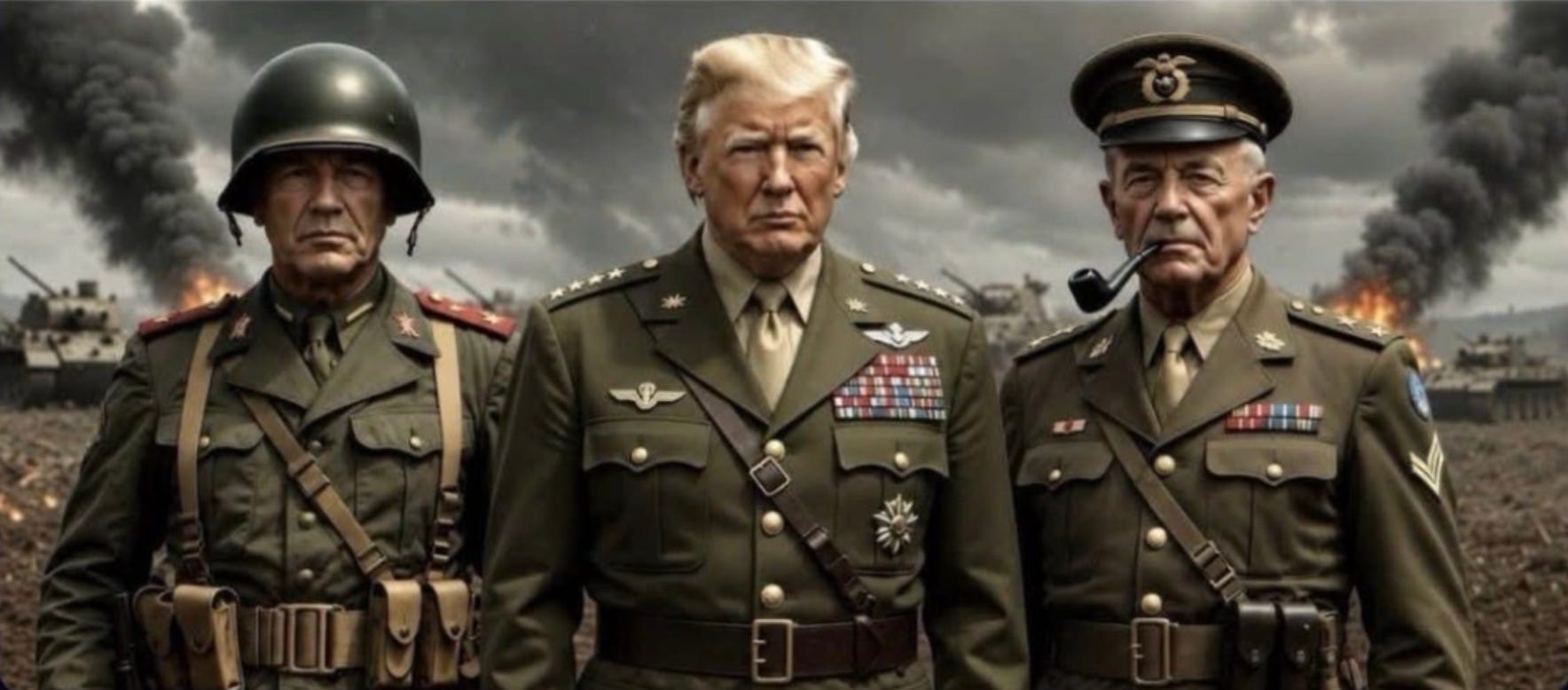
Almost from the first week, history came at a galloping pace. The president who promised not to launch new wars did just that, undeterred by advice from senior generals that the Tehran regime would instantly shut down the Strait of Hormuz. Trump’s giant strategic misstep has dominated the news agenda and this Substack. That said, Trump 2.0 is even more of a shuffle play presidency than Trump 1.0. One minute you are talking about the latest round of failed peace talks or most recent presidential threat to wipe out Persian civilisation. The next, it is cage fighting on the South Lawn of the White House, green algae in the now inaptly-named Reflecting Pool or the latest AI slop posted by the world’s most powerful man in the middle of the night on Truth Social. Everything from Trump as Elvis to Trump as decorated general alongside Douglas MacArthur and George Patton; Trump as George Washington, the father of America, to Trump as Jesus, the son of God.
An essay on “Jesus of Mar-a-Lago” actually became my most-read post. It bemoaned the failure of the media to do enough to call out Trump’s madness and described how the BBC Complaints Unit, in a case study of brainless both-sideism, found against me for suggesting that the ten out of ten score Trump awarded himself for his handling of the COVID pandemic was a “ridiculous boast”. Not to describe that as ridiculous would have been ridiculous.
"Jesus of Mar-a-Lago", and the questions it raises for the media.
·
Apr 16

The Goldwater rule is the edict handed down by the American Psychiatric Association in the early 1970s which stated it was unethical for psychiatrists to make diagnostic assessments of public figures without consulting them in person. The nomenclature, of course, comes from Barry Goldwater, the Arizona Senator, former Air Force pilot and godfather of th…
Since launching on Substack, Britain has got a new prime minister - although so commonplace has become the sight of the podium outside 10 Downing Street that it feels these days more like punctuation than anything more profound. Polls at one point suggested Australians would prefer the flame-haired populist firebrand Pauline Hanson to occupy The Lodge than incumbent Anthony Albanese. The Canadian prime minister Mark Carney, in the elite conclave of the World Economic Forum at Davos, delivered one of the most searing speeches of our age. “We know the old order is not coming back,” he said. “ We shouldn't mourn it. Nostalgia is not a strategy, but we believe that from the fracture, we can build something bigger, better, stronger, more just.”
That day, Carney delivered a rallying cry for middle powers to remake the world, not only to exert their collective influence but to guarantee their survival. “If we're not at the table, we're on the menu,” he famously said. And there has been ample proof of middle power clout since History Never Ended came into being. The leader of a country of just 10 million people, Israeli prime minister Benjamin Netanyahu, talked Trump into assassinating the Iranian Supreme leader, Ali Khamenei. Iran, a country of 93 million people, stood up to the United States, a country of 342 million people. Ukraine continued to resist Vladimir Putin’s Russia, which harbours 100 million more citizens.
China, under President Xi Jinping, has been actively courting middle powers and putting itself forward as a more stable alternative to an ever more unreliable United States. Beijing has hosted more that 25 international leaders this year, if you count foreign ministers as well as heads of government. The list includes Keir Starmer, Mark Carney, Spain’s Pedro Sánchez, German Chancellor Friedrich Merz, Pakistan prime minister Shehbaz Sharif, Finnish PM Petteri Orpo and Vladimir Putin.
Donald Trump visited, too, in a superpower summit which once again displayed his infatuation with strongmen like Xi Jinping and awe at the martial trappings of authoritarianism. “I say it to everybody, you’re a great leader,” gushed Trump, in fulsome fanboy mode. “Sometimes people don’t like me saying it, but I say it anyway because it’s true. I always say the truth.” Xi has established a personal dominance over Trump, partly, one suspects, because he is one of the few international leaders not to adulate the U.S. president. Put another way, XI is the anti-Infantino.
For all the words I have devoted to fall of the United States under Trump and the rise of China under Xi, I would still contend that by far the most salient story of the year is the AI revolution. Too often we focus on the big man theory of history to the detriment of the big tech theory of history. Because of the automation of critical and creative thinking, and because of the danger that will happen beyond the control of its human handlers, AI will be even more disruptive than the worldwide web. Each week brings more breakthroughs and breakages.
Launching History Never Ended has given me a new lease of journalistic life. I needed a fresh challenge. I wanted a different kind of relationship with readers. Through the global reach of Substack, I was keen to reconnect with people who had followed my work at the BBC. It has been great to land in inboxes the world over.
History Never Ended has enabled me to indulge my nerdy side. Where else could I have published a list of 25 books which have helped me makes sense of 250 years of US history? I thought America at 250: a bibliography might attract a few dozen eyeballs. To my surprise and delight, thousands of you took a look, and many of you read some of the recommendations.
America at 250: a bibliography
·
Jun 13

Books about America have been part of my life for almost as long as I have been able to read. I wish I could track down the first title I bought with my pocket money, a picture book produced by Marks and Spencer in the 1970s with photo spreads featuring landmarks then unfamiliar, such as Independence Hall, Mount Rushmore, the Statue of Liberty, the Holl…
History Never Ended has provided a platform for some myth-busting, especially in exposing the fantasy that America’s founding fathers wanted to conduct an experiment in mass democracy. Alas, Donald Trump’s ongoing campaign to stop millions of U.S citizens from voting is faithful to the founders’ idea of a democratic closed shop, restricted at the outset primarily to white men of property.
On a lighter note, I’ve been able to tell you about the day I came face to face with Banksy, a story that got picked up by papers around the world, including The Hollywood Reporter (which was not on my bingo card).
My brush with Banksy
·
May 2

Always there is a frisson when Banksy unveils a new artwork. Yet even by his epic standards, the latest installation in the heart of London is an electrifying coup executed with fabulously subversive subterfuge. In Waterloo Place, enclosed by buildings which stand as landmarks to “Rule Britannia” imperialism, he reminds us of the perils of blind nationa…
A lifetime spent in public broadcasting made me want to subvert the Substack business model by not erecting paywalls. So a million thank yous to those who have become paid subscribers in order to support my work, and keep it free for others. I’m trying hard to keep everything I write accessible to all. But since this is the primary home of my writing and writing is the primary source of my income, I fear the free-to-air model is unsustainable unless I can persuade more of you to contribute. I have always been loathed to ask people for money, but the subscription is the equivalent of one of two coffees a month, depending on the language or dialectical twang of your barista. Each week, it is coins not notes. Spare change. From the outset, I deliberately kept it on the low side.
Over the coming months, there will be more audio and visual. I’ll activate a comments stream to allow you to create threads on subjects you want to discuss. Please give me your feedback. Tell me what works, and what doesn’t.
The back end of the year is sure to be busy. We’ve got the congressional mid-terms in November, which will be another stress test for U.S. democracy. October sees elections in Israel which will determine the make-up of the governing coalition. Eventually, the war in Iran will come to an end. Or will it? Can Gianni Infantino, who has pulled off the extraordinary feat of making football fans nostalgic for his predecessor Sepp Blatter, survive as FIFA president? And who will Donald Trump appear as next on Truth Social? Odysseus? Spiderman? SpongeBob SquarePants?
All of us, I suspect, could all do with more escapism, so I will write more about literature and the arts, in addition to the more newsy and historical posts. As the great Maya Angelou memorably put it: “Each person deserves a day away in which no problems are confronted, no solutions searched for.”
Thanks, as ever, for reading.
Comments
Nothing yet. Say the first thing.
Sign in to join the conversation.