
This Memorial Day, Americans are honoring the fallen of past wars while looking forward to the 250th Independence Day next summer. The intersection invites comparisons to 1875, when — with the centennial a year away — the Civil War generation strove to heal divisions that might again spill into bloodshed.
Today social media and the press are glutted with accounts of America coming apart at the seams. Few voices aim to unite ahead of the 250th anniversary as America did for its 100th. Warnings of a second Civil War are met with nods as if fatalism is enlightened.
Post-Civil War Americans refused to accept the inevitability of conflict and resolved that future disagreements would be settled at the ballot box. Sometimes this was accomplished by tolerating evils like Jim Crow, but the national compass bent toward liberty and justice for all.
“The Battle Hymn of the Republic” declares that the body of an abolitionist, John Brown, “lies a-mouldering in the grave but ... his truth is marching on.” The message is that, although Brown was executed for treason against Virginia for attempting to spark a slave rebellion in 1859, his goal of liberation endured.
The violent resolution Brown sought came the following year, leaving rebellious states in ruins and sparking an economic depression. At least 620,000 people died, about two percent of the population, equal to 6.8 million today.
For Americans who buried fathers, brothers, and sons, the death toll wasn’t just a statistic, and few encouraged violent rhetoric in politics. Their families had been shattered because the South gave in to resentment, resorting to war rather than using the tools the Constitution provided for settling disputes.
On May 31, 1875, The New York Sun reported on what was often called Decoration Day for the custom of adorning the graves of the fallen. The Civil War’s cannons had been silent for a decade, and speeches marking the occasion aimed at keeping them cold.
At Brooklyn’s Greenwood Cemetery, Reverend Noah Hunt Schenck eulogized the Union’s dead and urged the living to learn from their fate. “Let the past,” he said, “bury its dead under the flowers of mutual concession and sweet reconciliation."
Southern states were no longer under strict federal occupation by 1875. President Grant had crushed the KKK, and Reconstruction seemed to be succeeding. In 1872, Senator H.R. Revels of Mississippi had been sworn to join six fellow Black Republicans in the House.
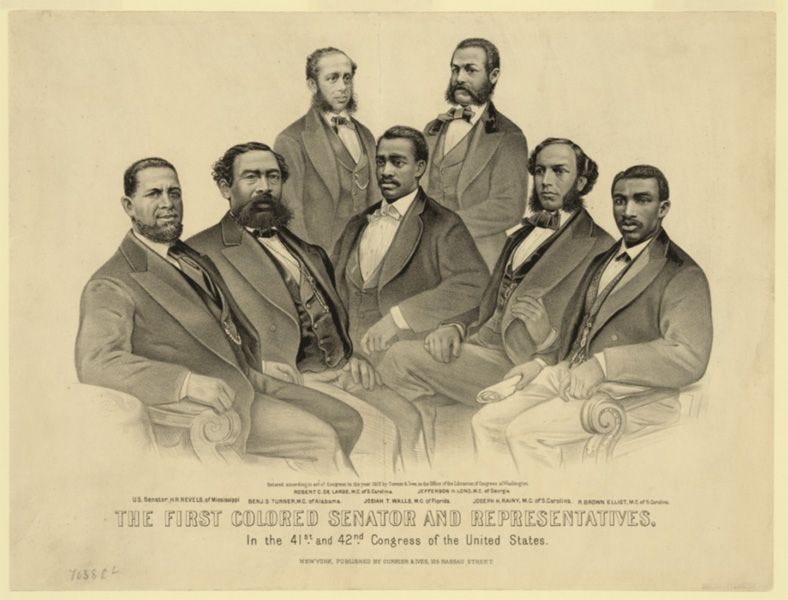
It was the high watermark for dreams of that “sweet reconciliation” and racial equality. As in Afghanistan, after 20 years Americans would grow tired of nation building and feel they’d done enough. Freedmen like Revels paid a steep price for that exhaustion.
But a year before the 1876 centennial, citizens dedicated themselves to building a more perfect union with room for everyone. At Arkansas, the ninth state to secede, The Sun reported that Black "ex-Federal soldiers" marched alongside a "regiment of Confederate cavalry” under the national flag.
Georgia — whose disillusionment with the war had it consider seceding from the Confederacy — marked Memorial Day on April 26, 1875. At Augusta, General Clement Anselm Evans captured what The Sun described as “true reconstruction spirit” from the losing side.
“Let us do nothing,” Evans told the crowd, “to keep alive the passions of war. To study its lessons is prudence, to profit by its teachings is wisdom. But to stir up the old animosities is madness.” He said the Confederacy was “buried” and “utterly defeated, and we dismiss our resentment.”
Evans, by then a Methodist minister, lamented “the purple tide of blood that flowed from the hearts of” Southern “sons.” But he announced that the former secessionists took “with the true hand of Southern honor the staff that holds the flag of stars and stripes.”
Heeding the Civil War’s lessons brings honor to all who rest in military graves. It ensures that — as President Lincoln said at Gettysburg — "government of the people, by the people, for the people, shall not perish from the earth.” So long as that truth is marching on, America will be better at its 250th birthday than it was on its 100th, and stronger each year long into the future.
No posts
Comments
Nothing yet. Say the first thing.
Sign in to join the conversation.