
Every gravestone presents an almost infinite amount of stories, data points, and current links that often go unnoticed. Graveyards are among the most fertile sites for beginning local and regional exploration of an area’s past and present.
A cemetery can reveal patterns in disease, war, crime, migration, social norms, and organizational structures dominant in the region at different times, etc. On occasion, I have found family connections using gravestone inscriptions that had been lost in the records.
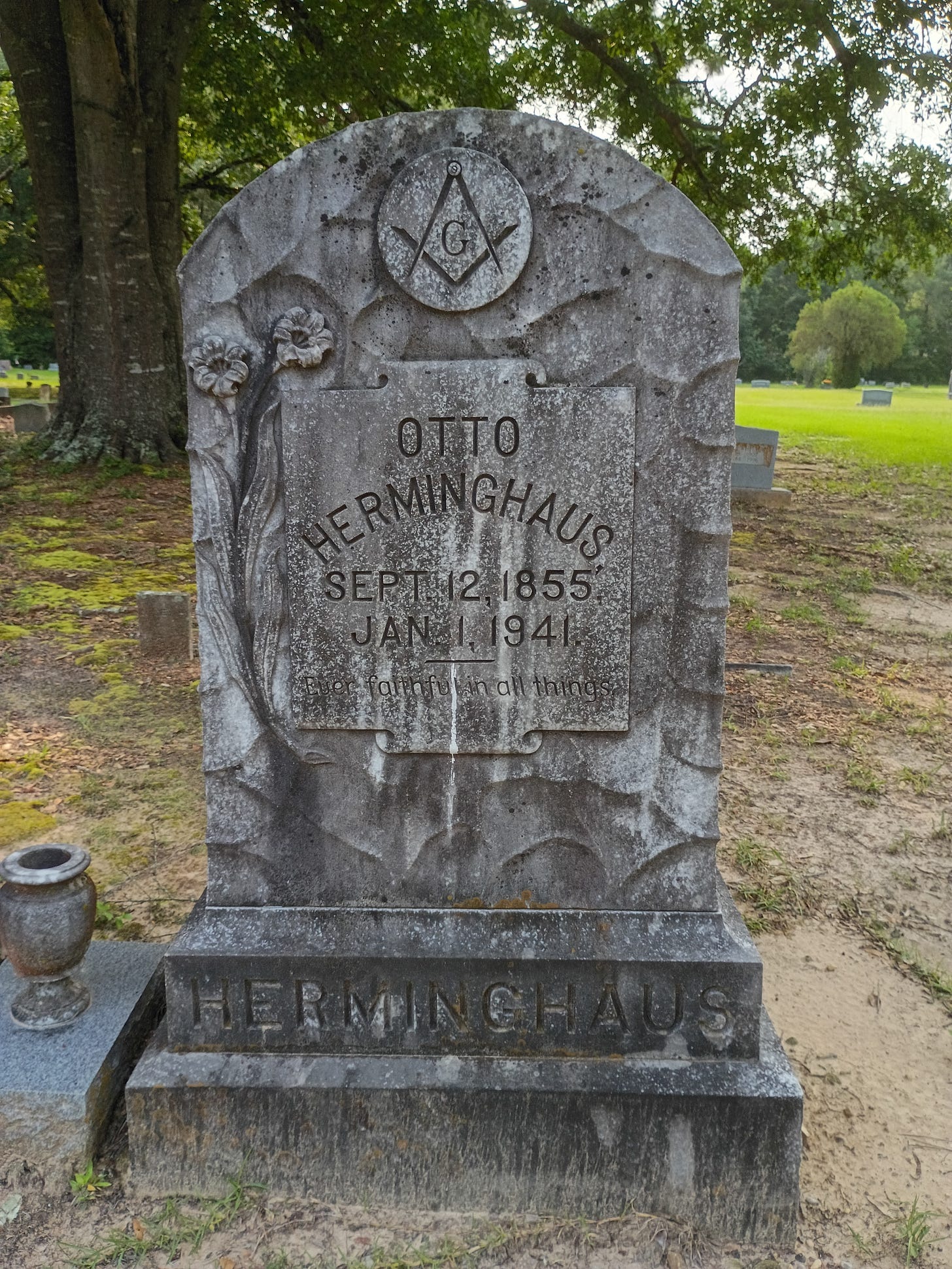
Photo: Gravestone at the Old Leesville (aka Ferguson Dennis) Cemetery, in Louisiana. One of many displaying the Masonic symbol of lodges that exist to the current time in the region. Photo by author.
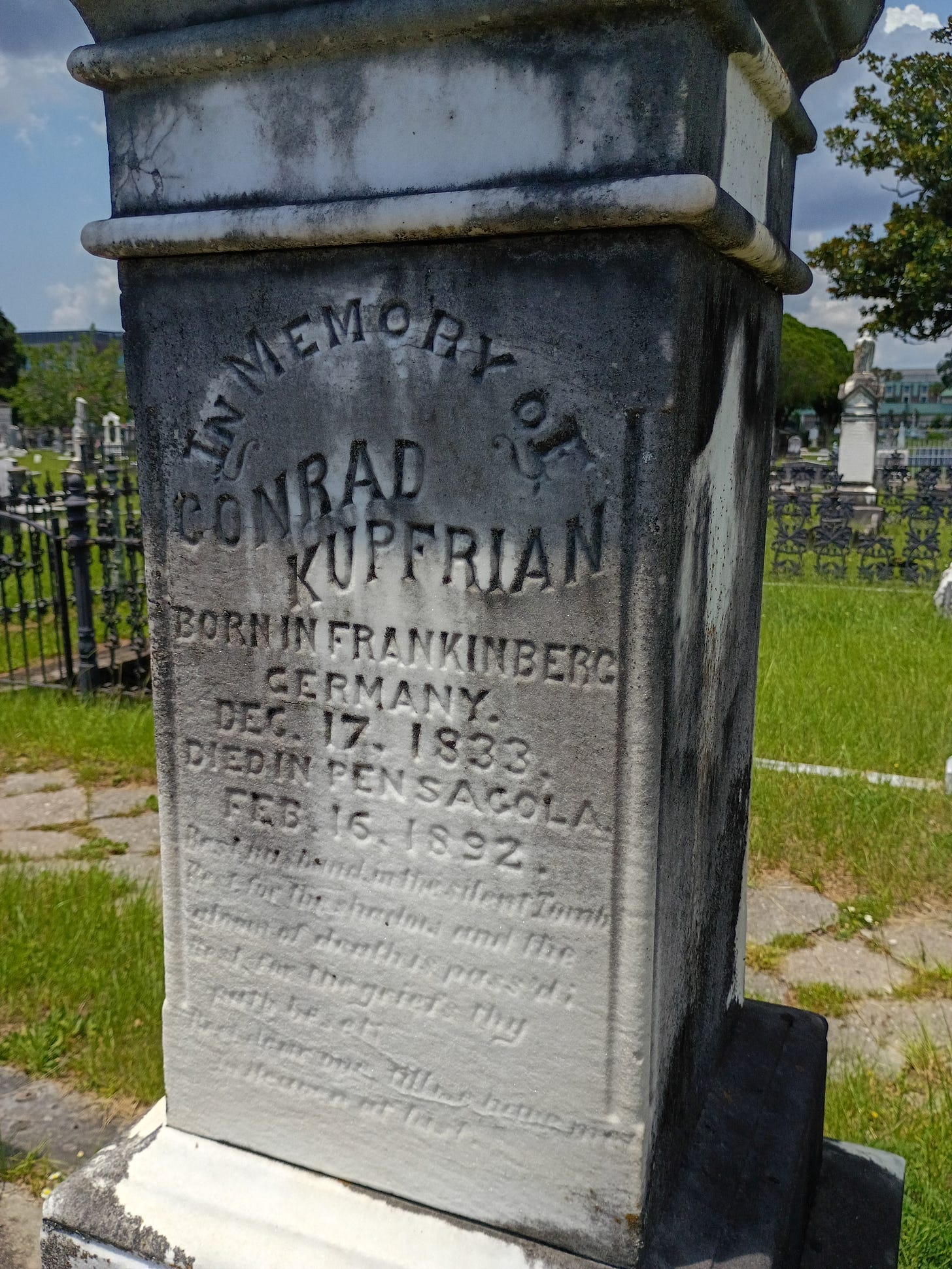
Photo: Gravestone at the St. Michael Cemetery in Pensacola, Florida. Conrad Kupfrian migrated to America at 14 years old, and later founded the Pensacola Streetcar Company and the city’s first public transportation system in 1884 and eventually an amusement park. Photo by Author.
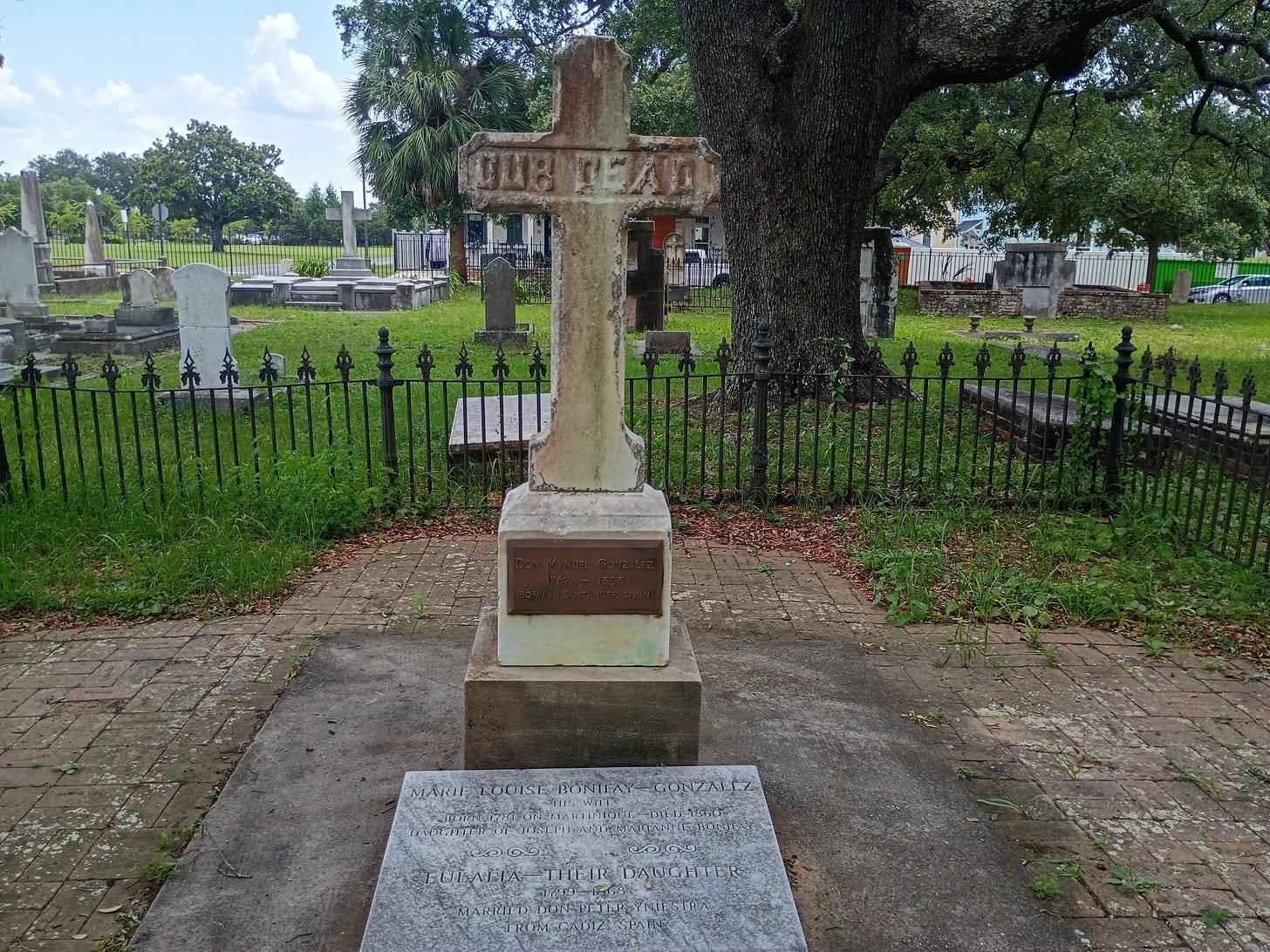
Photo: Gravestone representing the Gonzalez family. One member, Don Manuel Gonzalez, was born in Spain, joined the Army, and was sent to New Orleans (then a territory of Spain). He eventually moved to Pensacola, Florida, and retired to become a successful Rancher. When the US acquired Florida from Spain, Don M Gonzales was appointed Justice of the Peace and Quarter Master General of the Florida Militia. Photo by author.
Death reports from the past remind us there is truly nothing new under the sun.
Recently, I visited Fort Meade in South Dakota, an old Cavalry post that housed the 7th Cavalry (Custer’s unit), the 25th Infantry (Colored), and other forces from the 1870s through World War II.
Few today realize the post even existed.
The area is better known for Sturgis (famous for its annual motorcycle rally) just outside the gates or Deadwood up in the hills, popularized by the TV series.
Just south of the post lies a military cemetery, consecrated for soldiers and some family members of this isolated outpost.
Only 188 individuals rest there, yet their stories could fill volumes.The history of those buried at Fort Meade was preserved superbly in a 1989 publication available at the Fort Meade museum: Old Post Cemetery 1878-1943 Fort Meade, South Dakota by Phyllis Bridge Egge. It opens with the line “Some came a long way to die” and details causes of death, backstories, and the social and environmental factors behind each passing of soldiers, civilian contractors (even then), and family members.
Two observations stood out as I read the reports:
The book is a gold mine. It is in my opinion, far superior to many more recent material attempting similar preservation. Ms. Egge presents inscriptions alongside fort logs, local newspapers, and other primary documents, quoted as recorded, with minimal author notes only for discrepancies. Sources are cross-referenced and presented in full. Kudos to Phyllis Egge and the Old Fort Meade Museum and Historic Research Association. At times, it feels we are moving backward in information preservation, not forward.
The causes of death and social patterns of Ft Meade in the late 1800s matched the social patterns of any given day around a military base in the 2000s. The more one reads about the background of what was occurring in Ft. Meade, the more it stands out that it could be about incidents occurring today.
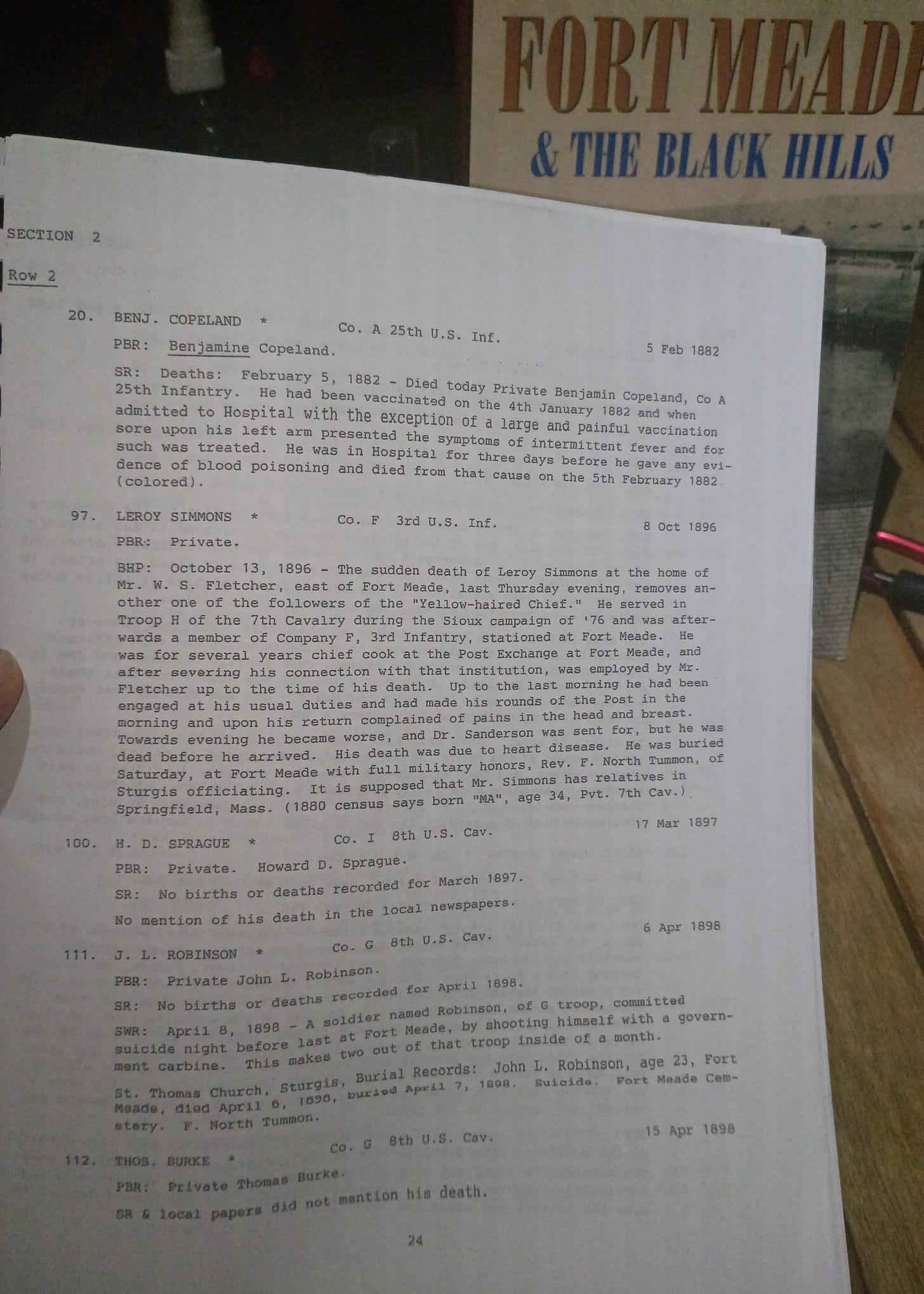
Photo: Page from Old Post Cemetery 1878-1943 Fort Meade, South Dakota by Phyllis Bridge Egge.
To illustrate the point. From page 24 of the list we have:
Benjamin Copeland, 25th Infantry (Colored). Died February 5, 1882, from vaccine injuries.
Leroy Simmons, 3rd US Infantry. Died October 8, 1896, from heart disease.
J.L. Robinson, 8th Cavalry. Died April 6, 1898, by suicide (the second suicide in a month).
Elsewhere: wives dying from excessive opium use, murders, training accidents, road accidents, deaths from drinking and exposure, accidental discharges, and more suicides. Soldiers’ visits to “ladies of the evening” frequently led to violence, suicide, or murder.
Private George Jones (Section 1, Row 5, Plot 110), 8th U.S. Cavalry, is one such case.
“Quite a little excitement was created last Saturday forenoon by the finding of the dead body of George Jones, a soldier belonging to G Troop, in the wine room of the resort “across the creek:. He was found by one of the girls, and was lying upon the lounge in a pool of blood. He had the appearance of being asleep, but closer examination revealed a gaping wound directly in the center of the forehead caused by a 38-caliber revolver, army pattern, which lay on the floor beside him.”
The lack of any heard gunshot and the wound’s placement raise questions about the official “suicide” ruling.
Most cases align with modern military patterns, but a few do not. Take the case of lynching. Corporal Ross Hallon, Company A, 25th US Infantry (Colored), buried in Section 1, Row 4, Site 59, was killed August 24, 1885:
“August 24, 1885 - Corpl. Ross Hallon Co. A 25th Infantry taken out of jail at Sturgis City D. Ty and hung to a tree by a mob. This man has the distinction of being the only man buried here who met his death at the hands of a Lynch mob….and by a strange coincidence, he was lynched for murdering a man named Lynch.”
Hallon had shot Dr. H.P. Lynch, owner of the local drugstore. While in jail, a mob overpowered the guards and lynched him.
Local newspapers and military records reveal how many deceased traveled far to reach the Black Hills. Ireland, Scotland, and Germany predominate.
Some were Civil War veterans, others survivors of campaigns with Custer and Reno. A few cases demonstrate how the American empire was moving overseas. Grave records now tell of those buried who had been fighting the new “Indians” in occupied territories for routes and resources at the end of the Spanish American War. William Barker, a contracted wagonmaster (Section 3, Row 9, Plot 156), came from the Philippine Islands after campaigns there that echoed those against the Lakota Sioux, Cheyenne, and Arapaho.
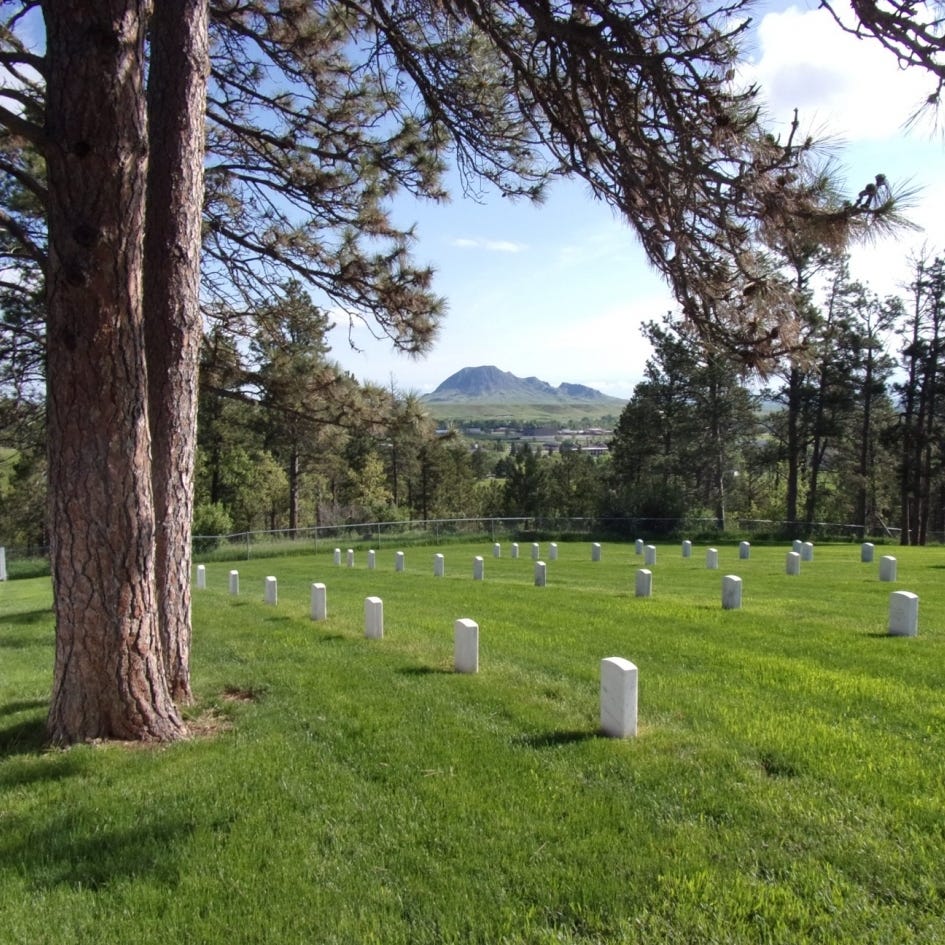
Photo: Ft Meade Military Cemetery. Source: https://sturgisareachamber.com/membership/profile/fort-meade-museum
Veterinary Surgeon Dr. William Henry Going died November 7, 1900, of cancer at age 57. Born in Tipperary, Ireland (1843), he served in the English Army, then the U.S. Army, including the 7th Cavalry. He left a wife and seven children; his oldest son served in the Philippines during the initial occupation. Of note, Dr. Going was listed as a Mason, yet he and much of his family later were baptized to Catholicism.
Another journey, perhaps longer than mere geography, belongs to Lucy, a Sioux Indian child buried in Section 4, Row 8, Plot 128:
“An Indian baby died at the post Wednesday, and permission was asked by the visiting redskins to bury the child in the cemetery there. Col Hayes consented if it was found that death was not the result of contagious disease. The baby was buried, and a big war dance followed.”
Infant Lucy rests near Infant Riggle (child of a civilian employee) and others in Section 4. In this section rest mostly children of soldiers stationed at a post built to “pacify” the Sioux. And yet here also lies a Sioux infant among the children of her people’s recent enemies. Quite a long journey in the span of a few years.
There were also a few aging veterans, oddities by the time the funeral honor guards, born long after their service, buried them.
Sgt. Jacob Engler served 30 years in the same unit: a bandsman with the 9th US Cavalry, he began fighting the Sioux and ended in Cuba during the Spanish-American War. He returned to the Black Hills post and died weeks after mandatory retirement on April 15, 1901 (Section 2, Row 3, Plot 126).
The post, established as Camp Sturgis in 1876 and renamed Fort Meade in 1878, ceased Army operations during World War II. The barracks that housed Custer’s 7th Cavalry, Philippine veterans, and troops from both World Wars stand silent. Yet the post, and its graves, remain ready to tell the rich history of a brief but intense chapter in a South Dakota corner.
There are other cemeteries with other stories. Each unique and a treasure trove of information for historical research. Revealing narratives that are at once global and span decades, and event driven personal ones.
So, the next time you drive past a cemetery, stop. Walk the grounds. Read the names, dates, symbols, and look at the relationship by position. A rich history waits in every stone.
Ok, the sentimental part is over. Now for the investigator’s complaints.
As I often note, older records frequently yield more detail than modern ones.
I can uncover more about soldiers in the Philippine Insurrection/Independence struggle over a century ago than about actions in Operation Iraqi Freedom less than 20 years ago.
A growing memory hole forms because most information, ironically including this blog, is stored on unstable, rapidly obsolete digital media.
The Fort Meade records and gravestones prove my point: a durable stone inscription cross-referenced with newspapers and archived military reports (often on microfiche). Newspapers once recorded births, deaths, marriages, business openings, and migrations. These combine to provide a deeper understanding of history.
Today? In many places, local papers are mere advertising circulars with very few paid death notices at best. County records often vanish into state systems, which may not release individual data.
Information itself has a graveyard, and modern society is removing the tombstones.
NOTES
Fort Meade National Cemetery Information https://genealogytrails.com/sdak/meade/cemftmeade.html
Information on Kupfrian’s life and Park in Pensacola from the Pensacola News Journal. https://www.pnj.com/story/news/2020/01/12/kupfrians-park-pensacola-once-popular-entertainment-spot/4432823002/
Egge, Phyllis Bridge. Old Post Cemetery 1878-1943 Fort Meade, South Dakota. Fort Meade: Old Fort Meade Museum and Historic Research Assn. 1989.
No posts
Comments
Nothing yet. Say the first thing.
Sign in to join the conversation.