
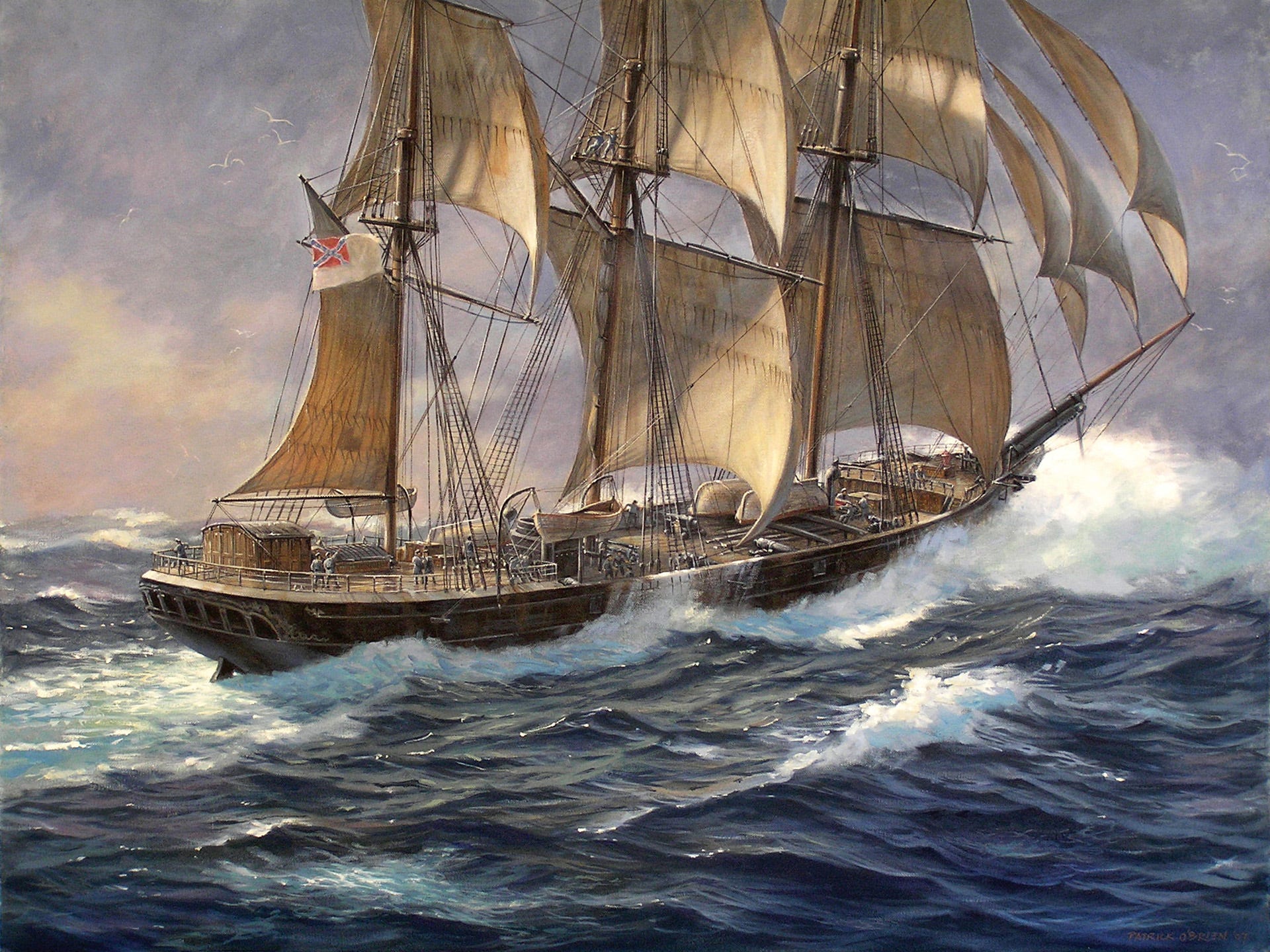
Photo: CSS Shenandoah. Painted by Patrick O’Brien. More of his remarkable art here https://principlegallery.com/gallery/patrick-obrien/
The CSS Shenandoah was the only Confederate warship to circumnavigate the globe, arguably fire the last shot of the Civil War, and impact diplomatic ties post war with England, Chile, and a Sultanate.
Originally a British merchant vessel, she was purchased in 1864, converted into a commerce raider, and placed under the command of Lt. James Iredell Waddell of North Carolina. Built with a teak-and-iron hull, this versatile ship, capable of both sail and steam power, compiled a remarkable record despite joining the fight late in the war.
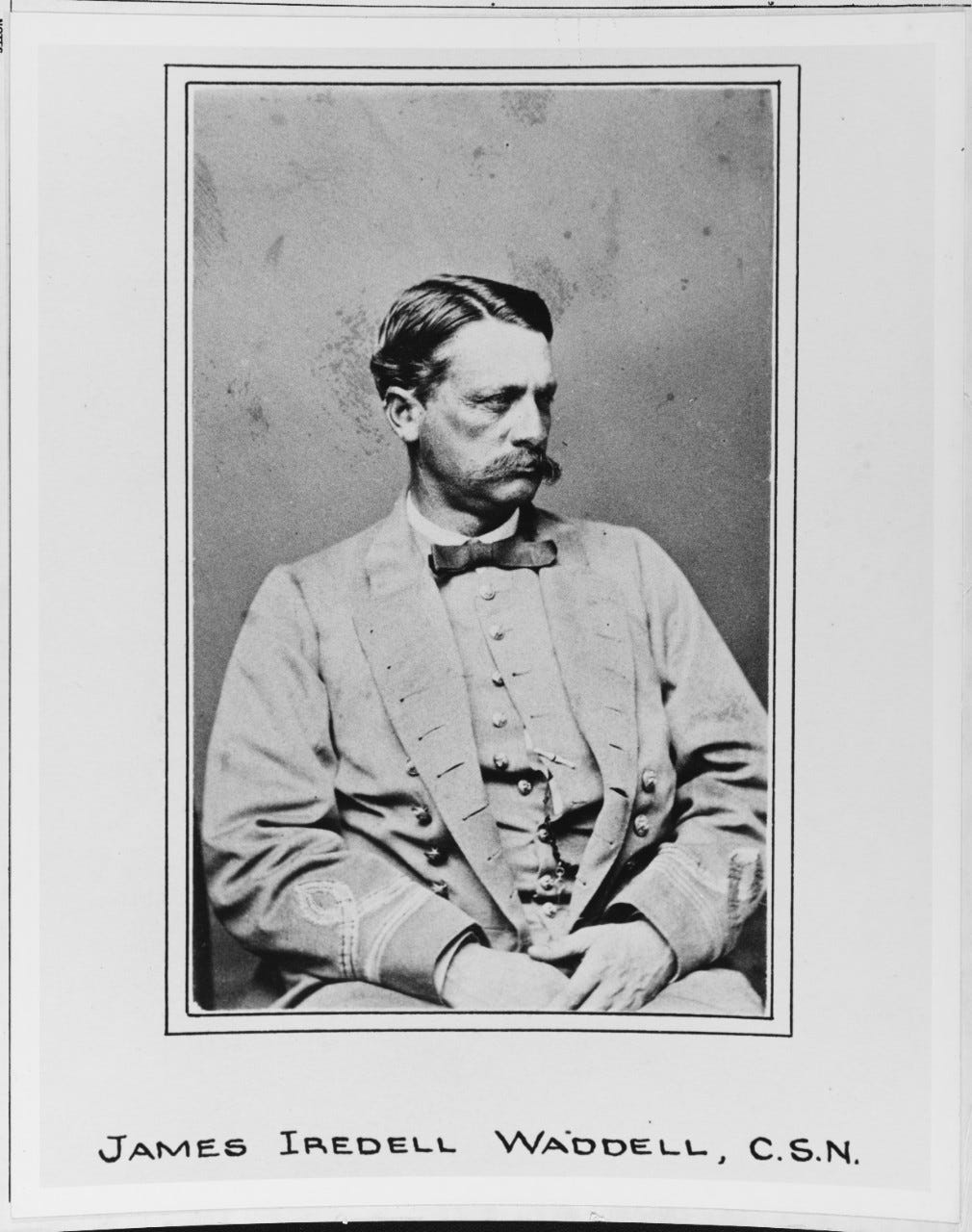
Photo: Lt. James Waddell, commander of the CSS Shenandoah. Source: US Navy
Commissioned on October 19, 1864, the Shenandoah spent just 12 months and 17 days at sea. In that time, she sailed more than 58,000 miles and captured or sank 38 Union merchant vessels, most of them whalers. Her success came despite starting with only two functional 12-pounder guns and a skeleton crew. Like true sea raiders of old, Waddell filled out his ranks and armament from captured prizes along the way.
Waddell’s odyssey ended on November 6, 1865, when he sailed the Shenandoah into Liverpool, England, and surrendered her to British authorities making her the last Confederate command to strike its colors, more than six months after Appomattox.
But the ship and her crew’s story was far from over.
The Shenandoah became a key element in the Alabama Claims, the United States’ postwar demands for compensation from Britain. The U.S. accused Britain of violating neutrality by allowing Confederate raiders (including the Shenandoah, Alabama, and Florida) to be built, equipped, or supported in British ports and territories.
An international tribunal in Geneva, established under the 1871 Treaty of Washington, ruled Britain negligent, especially regarding the Alabama and Shenandoah. The settlement was a landmark event in US diplomatic history, as many were calling for war with England, yet President Ulysses S. Grant decided to move the decision to an international and impartial trial setting. Placing Secretary of State Hamilton Fish in charge and supporting a neutral evaluation rather than war. In 1872, Britain was ordered to pay the United States $15.5 million in gold (a vast sum equivalent to hundreds of millions today). This landmark arbitration helped mend Anglo-American relations and set important precedents for international dispute resolution.
In 1866, the United States took possession of the Shenandoah. She was sold to the Sultan of Zanzibar Majid bin Said, who renamed her El Majidi. While Britain paid reparations in the early 1870s, the ship met a dramatic end: she was wrecked in a storm off the coast of Africa and ultimately foundered in 1879.
Like her Captain, many of the CSS Shenandoah’s crew faced uncertain futures. Ex-Confederates often lingered in London, a relative haven while awaiting U.S. amnesty. Skilled in naval warfare but short on funds, some turned to mercenary opportunities. One notable venture involved Henry Harrison Doty, a Virginian inventor who had refined the spar torpedo, a devastating weapon thought of as so effective that both the U.S. and Britain later sought to restrict it. Smaller South American nations, wary of larger naval powers like Spain (and potentially the U.S.), saw its value.
Doty reportedly recruited former Shenandoah crew members for Chile, which lacked a strong navy and faced blockades. These experienced Confederates helped crew and operate torpedo boats in the effort to challenge superior forces. The artist James Whistler even makes an appearance in this former Rebel task force when he wasn’t throwing people through glass windows in pubs and clubs in London…but that is a story for another day.
Bailey, Martin. “From the Secret Archives of the Victoria and Albert Museum: Flinging More Than a Paint Pot.” The Art Newspaper, March 31, 1999. https://www.theartnewspaper.com/1999/04/01/from-the-secret-archives-of-the-victoria-and-albert-museum-flinging-more-than-a-paint-pot.
Carnahan, Burrus. “The Grant Administration & International Law.” Friends of the Lincoln Collection. Accessed June 7, 2026. https://www.friendsofthelincolncollection.org/lincoln-lore/the-grant-administration-international-law/.
Naval History and Heritage Command. “James Iredell Waddell.” U.S. Navy. Accessed June 7, 2026. https://www.history.navy.mil/our-collections/photography/us-people/w/waddell-james-iredell.html.
Naval History and Heritage Command. “Shenandoah.” U.S. Navy. Accessed June 7, 2026. https://www.history.navy.mil/research/histories/ship-histories/confederate_ships/shenandoah.html.
No posts
Comments
Nothing yet. Say the first thing.
Sign in to join the conversation.