
In the case files of America’s more curious historical coincidences, a few tend to stand out if you are “dialed in” to the historical record. By “dialed in,” I mean to research in depth and examine broadly prior to the pre-packaged, wholesale marketing of information that occurred as the internet ossified into an entertainment and indoctrination platform. But enough of my bitterness about what has become of the information superhighway; let’s talk about these cases that struck me as informative of a peculiar pattern in societies such as America regarding apocalyptic groups.
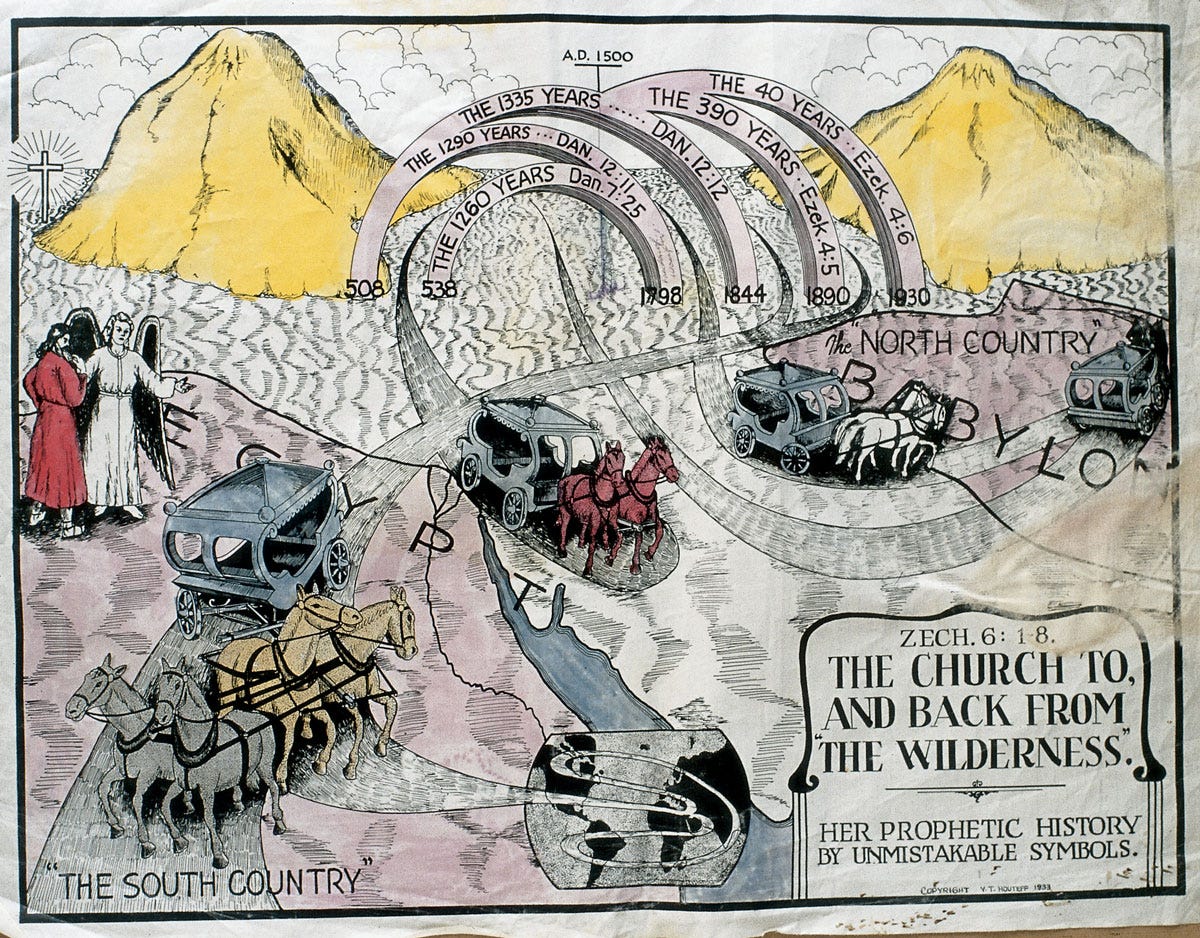
Photo: Victor Houteff (Koresh #1) illustration of the end times. Note the locations and timeline.
Our case for today centers around two figures at the head of similar organizations who both assumed the name “Koresh.”
Koresh #1: Cyrus Reed Teed (1839–1908)—launched a utopian movement in the 1890s that blended hollow-Earth cosmology, celibate communalism, and radical monetary reform.
Koresh #2: Vernon Wayne Howell (1959–1993), who legally became David Koresh—led the Branch Davidians into a deadly 1993 confrontation with ATF and other federal agents at Waco, Texas.
Both men claimed the biblical mantle of Cyrus (כּוֹרֶשׁ “Koresh” in Hebrew and derived from the Persian word Kuru/Babylonian Kuraš). Cyrus/Koresh was known as the anointed shepherd-king. Both American Koreshes built insular communities focused on Protestant views of the end times that challenged mainstream power structures in a time of rapid paradigm shifts in American society. Both movements, though separated by a century, illustrate how religious charisma, economic discontent, and political tension have repeatedly intertwined in the United States, occasionally with deadly results.
As J Phillip Arnold observed in the February 2023 article published in Nova Religio:
“During the standoff between federal agents and the Branch Davidians in 1993 at the Branch Davidians’ property outside Waco, Texas named Mount Carmel Center, David Koresh proclaimed that he was the Endtime Christ who would reveal the meaning of the Seven Seals of the book of Revelation. One hundred years earlier there was another Koresh, Cyrus R. Teed, who also claimed to reveal the Seven Seals from his Koreshan Unity center in Estero, Florida. David Koresh echoed many of Teed’s, i.e. the earlier self-proclaimed Koresh’s, teachings. What kind of connection, if any, existed between these two aspiring Endtime messiahs? Using primary sources, such as Teed’s magazine, The Flaming Sword, and transcriptions of the FBI audiotapes of negotiations with David Koresh and other Branch Davidians recorded during the 51-day siege in 1993, the answers emerge. Since these answers indicate a link between the earlier Koresh and David Koresh, they also raise the issue of how this information about the earlier Koresh and his theology could have been used by FBI agents to persuade the Branch Davidians to come out of the Mount Carmel Center residence and be taken into custody. “
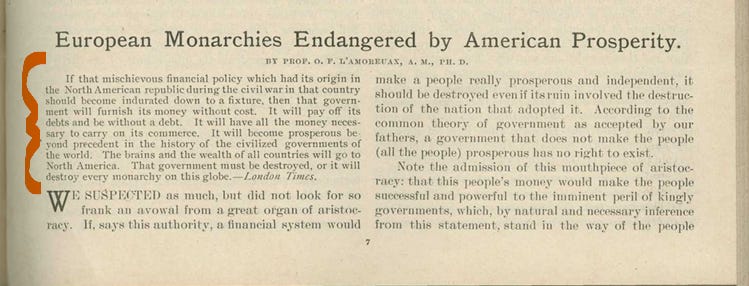
I came into this historical parallel while investigating a persistent fabrication: an online reference to a fiery 1860s The Times of London editorial warning that America’s Civil War-era “greenback” currency threatened every monarchy on Earth. Upon delving into it more I found the quote “If that mischievous financial policy… That government must be destroyed, or it will destroy every monarchy on the globe” has been endlessly recycled in monetary-reform literature, often falsely attributed to British banking elites description of Abraham Lincoln and his economic policy during the Civil War.
After investigation, it turns out that quote NEVER appeared in The Times. But that didn’t stop countless online commentators from repeating it.
The actual documented birthplace of the quote is from The Flaming Sword, the 1898 house organ of Teed’s Koreshan Unity.
The archives of the 1890s Koreshan Unity movement are fascinating and reflect one strain of Protestant messianic response to the turbulent transition that was 1880s and 1890s America.
Teed, a self-taught eclectic physician and Civil War veteran from upstate New York, experienced an 1869 “illumination” after an electric-shock laboratory accident. He claimed a radiant feminine figure revealed him as the seventh incarnation of the messiah and commanded him to fuse science and Scripture. Rechristening himself “Koresh”, he founded the Koreshan Unity.
By the 1890s, the group operated printing presses, cooperative stores, and a Florida “New Jerusalem” commune in the town of Estero. Their signature doctrine—the Cellular Cosmogony—placed humanity inside a hollow, concave Earth shell. Yet beneath the cosmology lay a sharp economic critique aligned with 1890s Populism and greenbackism.
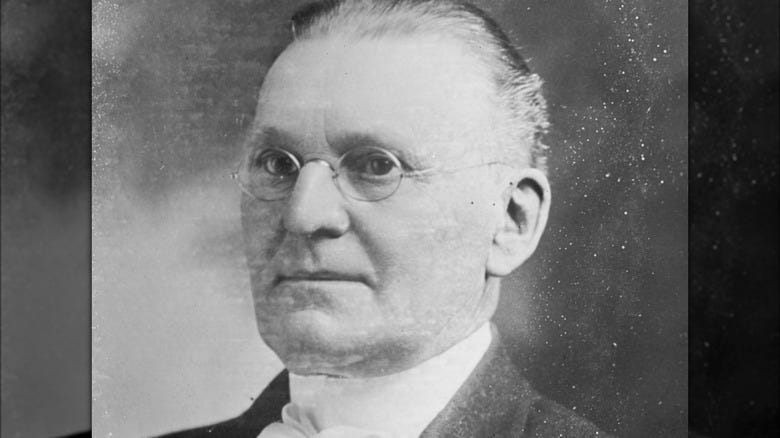
Photo: Koresh #1 Teed Koresh founder of Koreshianity. https://www.grunge.com/img/gallery/estero-the-failed-hollow-earth-utopia-of-florida/intro-1674064956.jpg
Koreshians railed against debt-based finance, wage slavery, and plutocracy. They envisioned government-issued, interest-free currency that would eliminate national debt, attract global talent, and render monarchies obsolete.
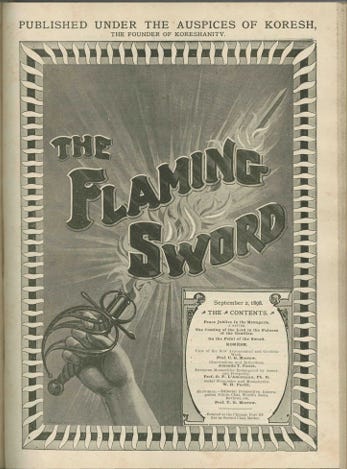
The Flaming Sword (Vol. XII, No. 42, September 2, 1898) inserted the now-famous “London Times” passage under the heading “European Monarchies Endangered by American Prosperity.” The editor followed it with triumphant commentary: the admission proved that sovereign money would empower the people and doom aristocratic rule.
No date, page, or issue of The Times was ever cited. The Times had never published the article.
The passage was fabricated to fit the Koreshian message. The Times Digital Archive and contemporary scans can be searched, and no trace of anything resembling what Koresh alleges was ever published is found. The quote’s earliest verifiable printing is the Flaming Sword itself; it spread from there into U.S. reform circles and eventually, a century later, into online posts and literature that retroactively linked it to Lincoln’s greenbacks.
Teed’s death in 1908 after a political brawl in Fort Myers ended the movement’s peak, but the monetary myth he helped birth proved immortal. Detached from its Koreshan cradle, the fabricated editorial still circulates today as “proof” that international bankers feared debt-free American currency.

Photo: Koreshian Unity members at their Estero, Florida commune, early 1900s. Source floridastateparks.org
While Teed’s movement faded, a parallel cult lineage was forming within another Protestant branch, the Seventh-day Adventists (SDA). In 1929, Bulgarian immigrant Victor T. Houteff, an SDA Sabbath-school teacher in Los Angeles, began publishing The Shepherd’s Rod tracts. He claimed new light on the 144,000 sealed servants of Revelation and positioned himself as the antitypical Elijah/David who would purify the church before Christ’s return. Excommunicated in 1930, Houteff organized the Davidian Seventh-day Adventists (popularly called Shepherd’s Rod) and established Mount Carmel Center near Waco, Texas. After his death in 1955, leadership passed briefly to his widow, Florence, whose failed 1959 prophecy of the kingdom’s inauguration splintered the group.
Photo: Chart by Victor Houteff. Note the location and timelines.https://www.cabinetmagazine.org/issues/5/steinberg.php
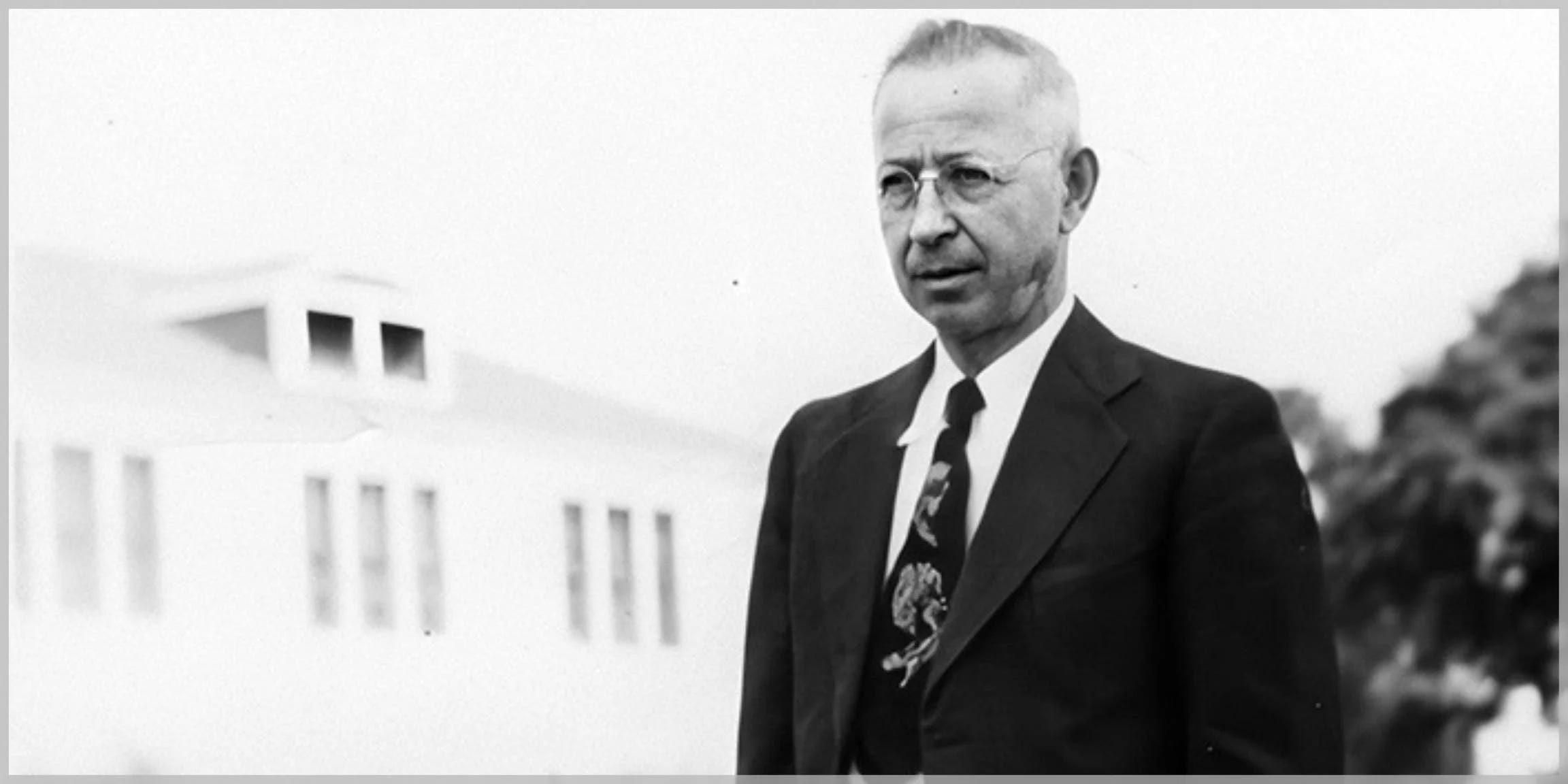
Photo: Victor T Houteff. Source https://www.prophetsofbaal.com/part-2
A longtime Shepherd’s Rod sympathizer, Roden claimed succession in 1955 and announced that the “Branch” prophesied in Zechariah 3–6 and Isaiah 11 had arrived. He and his wife Lois, formalized the Branch Davidian Seventh-day Adventists, still headquartered at Mount Carmel. When Benjamin died in 1978, Lois assumed leadership. She emphasized the feminine Holy Spirit and, crucially, studied earlier messianic writings—including those of Cyrus Teed. Scholars now document ideological and textual overlaps, with Lois Roden possessing and annotating Koreshan literature that influenced her son-in-law and successor, Vernon Howell.

Howell joined the Branch Davidians in 1981, seized control by the late 1980s, and in 1990 legally changed his name to David Koresh, “David” for the messianic king, “Koresh” for Cyrus the anointed deliverer. He taught that he was the Lamb of Revelation 5 who would open the Seven Seals, ushering in the end times. Like Teed, Koresh regulated sexuality (claiming “spiritual wives” under the “New Light” doctrine) and built a self-contained community. He traveled to Israel and initially recruited many Israelis to join him in Waco, however, only one followed him to the compound. Firearms trading helped fund operations. On February 28, 1993, the ATF raided Mount Carmel on weapons charges; a 51-day siege ended April 19 with a fire that killed Koresh and 75 followers.

Photo: Aerial view of the Mount Carmel compound after the 1993 fire. Source Public Domain.
The two Koreshes mirror each other in many ways. Both were self-taught visionaries who fused biblical typology with modern science and “prophecy”. Both had fetishized a variation of Zionism with a fictional notion of “Israel” and connections to the end times in a physical location. Both demanded celibacy or controlled sexuality as paths to immortality or spiritual purity, while extending their own personal sexual proclivities on cult members. Both established intentional communities that rejected mainstream economics and governance. Teed’s through interest-free currency and communal ownership, Koresh’s through apocalyptic self-sufficiency and arms trading. Both faced violent confrontations with local or federal authority: Teed’s fatal 1906 beating by a marshal; David Koresh’s deadly ATF siege.
Their political entanglements reveal shifting American fault lines. Both Teed and later David Koresh were responding to rapid shifts in American social, political, and economic power. The earlier Koreshans rode the 1890s Populist wave—economic radicalism aimed at “the money power,” sympathetic to greenback and anti-monopoly reforms. The Branch Davidians, by contrast, capitalized on the 1990s’ increased visibility of federal overreach by expanding access to information and opinion. Both capitalized on a mythical concept of Zionism to attempt a mechanism of control and explanation for the shifting paradigm that many were experiencing.
The Times of London quote remains a textbook case of historical ventriloquism. Fabricated in a Florida utopian print shop to dramatize the threat of sovereign money, it was later stripped of context and weaponized against the Federal Reserve, central banking, and any government that dares issue currency without interest. Its false 1860s dating and Lincoln-era linkage persist because the narrative serves modern monetary populism on both left and right. In the end, the Case of the Two Koreshes is less about hollow Earth or Seven Seals than about America’s recurring fascination with charismatic reformers who promise to upend corrupt systems, whether through debt-free dollars or apocalyptic deliverance.
Both movements collapsed under external pressure, yet their legacies linger in state parks, Protestant apocalypse forums, and the uneasy memory of Waco.
They remind us that when economic anxiety, religious fervor, and political distrust converge, history tends to rhyme, even when the rhyme is built on fabricated editorials and interpretations like the faked Times quote from 1898 and Protestant Zionism.
James E. Landing, “Cyrus Reed Teed and the Koreshan Unity,” in America’s Communal Utopias, ed. Donald E. Pitzer (Chapel Hill: University of North Carolina Press, 1997), 375–395.
J. Gordon Melton and James R. Lewis, “Did David Koresh Plagiarize Cyrus R. Teed?,” Nova Religio 26, no. 3 (February 2023): 101–126.
The Flaming Sword 12, no. 42 (September 2, 1898), International Association for the Preservation of Spiritualist and Occult Periodicals (IAPSOP) archive. https://iapsop.com/archive/materials/flaming_sword/flaming_sword_v12_n42_sep_2_1898.pdf
Lyn Millner, “The Allure of Immortality: An American Cult, a Florida Swamp, and a Renegade Prophet” (Gainesville: University Press of Florida, 2015).
Great overview post on the Koreshians by Kathleen McCook:
George W. Reid, “The Branch Davidians/Shepherd’s Rod—Who Are They?,” Adventist Biblical Research Institute, accessed May 2026.
Orgel, Hugh. “Israelis Spurned Koresh Attempt to Establish Cult Branch There” . May 7, 1993 Jewish Telegraph Agency. http://pdfs.jta.org/1993/1993-05-07_085.pdf
No posts
Comments
Nothing yet. Say the first thing.
Sign in to join the conversation.