
Welcome or welcome back to History Buzz! If you’re a subscriber to the Buzz, thank you! If you’re new here, or you haven’t become a subscriber yet, hit that subscribe button to have History Buzz delivered directly to your inbox. If you can, please consider a paid subscription to support the research and writing that make History Buzz possible.

Today, we welcome back History Buzz contributor Chris Klein and the Andover Celebrates America 250 Committee. History Buzz is published by the Andover Center for History and Culture.
In the days following the Battles of Lexington and Concord, Harvard College transformed into an armed encampment for nearly 1,700 patriot troops, including boys and men from Andover. With the British under siege in Boston—and Cambridge suddenly thrust onto the front lines—colonial militias poured into Harvard Yard, pitching a sea of tents. The provincial government shuttered the college as dormitories and classrooms were pressed into service as makeshift barracks and hospitals.
While students found refuge at home, the college decided to evacuate its 2,000-book library and scientific equipment to the countryside for safekeeping. The day after the American Revolution erupted on Lexington Green, Harvard professor of mathematics and natural philosophy John Winthrop fled to Andover to stay with Reverend Jonathan French, a Harvard graduate and South Church’s second minister. Weeks later, the college’s books made a similar exodus.
“the library, apparatus, and other valuables of Harvard College be removed as soon as may be to the town of Andover.”
The Provincial Congress initially voted on June 15, 1775, that “the library, apparatus, and other valuables of Harvard College be removed as soon as may be to the town of Andover.”
The following night, provincial soldiers received a blessing from Harvard’s president, Reverend Samuel Langdon, before marching off to Charlestown where the Battle of Bunker Hill exploded on June 17. While college librarian James Winthrop was engaged in the battle—during which he received a wound to the neck—Harvard alum and future Phillips Academy founder Samuel Phillips Jr. worked to pack the books from the Harvard campus for their exile to Andover. He was so intent on his task he missed the cacophony of the Battle of Bunker Hill that day: “Amid all the terrors of battle I was so busily engaged in Harvard Library that I never even heard of the engagement till it was completed,” he recounted.
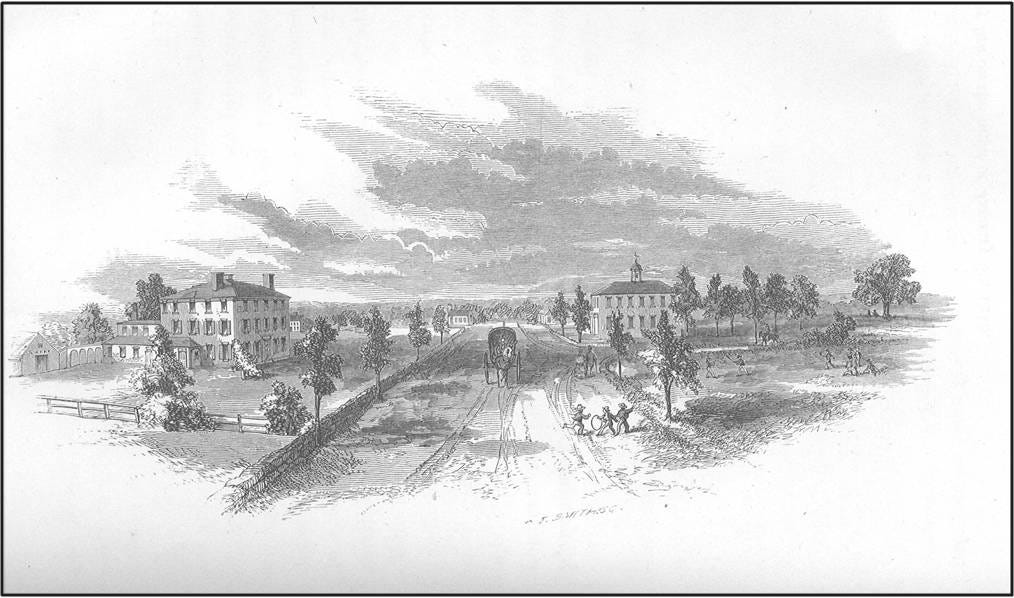
On June 23, the provincial congress voted to disperse the library to additional locations besides Andover, but books were shipped to the house of Samuel Osgood—later the first U.S. postmaster general—in present-day North Andover and to the house of George Abbot, who lived near the present-day intersection of Phillips Street and Old Campus Road. The 50-year-old Abbot was a member of the Andover militia who answered the alarm on the morning of April 19, 1775, when news of the Battle of Lexington arrived in town. Unfortunately, Abbot died several months after the arrival of Harvard’s books and was interred in the South Parish Burying Ground the day after Christmas. (In 1777, Phillips purchased the house, which was razed in 1889, to be closer to the site of his academy.)
Meanwhile, not only was Harvard’s library homeless—but the entire college as well. After house-hunting in more distant Massachusetts towns, including Andover, Harvard’s overseers chose to relocate its 100 students to the nearby village of Concord for the 1775-1776 school year.
Once Harvard settled into its temporary home, it financed the construction of bookshelves in a private Concord residence, reuniting its scattered library and closing a little-known chapter of revolutionary history in which Andover safeguarded one of revolutionary America’s intellectual treasures.
Thanks for reading. Be a part of the History Buzz community and leave a comment, like, or share this post.
History Buzz is a reader-supported publication. To receive new posts and support our work, consider becoming a free or paid subscriber.
References:
Bailey, Sarah Loring. Historical Sketches of Andover
Klein, Christopher. “When the Revolution Hit Cambridge, Harvard Moved to Concord.” Harvard Magazine: https://www.harvardmagazine.com/harvard-celebrates-america-s-250th/harvard-american-revolution-concord-massachusetts-year
Potter, Alfred Claghorn and Bolton, Charles Knowles. The Librarians of Harvard College, 1667-1877
19 Phillips Street. Andover Historic Preservation: https://preservation.mhl.org/19-phillips-st
Comments
Nothing yet. Say the first thing.
Sign in to join the conversation.