
Note: read Part I.
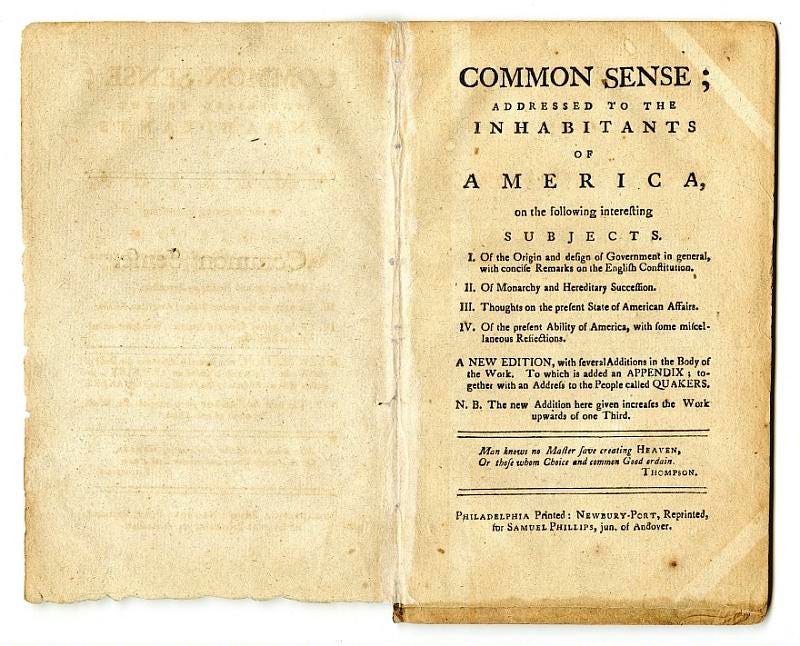
“Some writers have so confounded society with government, as to leave little or no distinction between them; whereas they are not only different, but have different origins. Society is produced by our wants, and government by our wickedness; the former promotes our happiness positively by uniting our affections, the latter negatively by restraining our vices. The one encourages intercourse, the other creates distinctions. The first is a patron, the last a punisher.”
— Thomas Paine, Common Sense, 1776
In October 1774, Paine sailed for Philadelphia aboard a ship called the London Packet. It was not the vessel he’d originally booked. He’d changed his passage after finding the first “not having proper Conveniences,” an exchange he later admitted was “much for the Worse.” During the nine-week crossing, what Paine called a “putrid fever” broke out among the roughly one hundred and twenty passengers traveling below decks, indentured servants who’d contracted away years of future labor in exchange for the cost of their crossing. The likely culprit was epidemic typhus. Five died and were buried at sea, and Paine wrote that no more than five others escaped the illness entirely.
Paine himself was a paying passenger, with his fare likely funded by the settlement from his separation from Elizabeth. But the ship couldn’t keep the sick contained. He caught the ailment in its full force, writing that he “suffered dreadfully with the fever. I had very little hopes that the Capt. or myself would live to see America.”
But live he would, though he arrived in America too weak to stand. When a Philadelphia physician named Dr. John Kearsley attended the ship on arrival and learned that Paine had with him a letter from Benjamin Franklin, he arranged lodging and sent men to carry Paine off the ship and bring him there.
Six weeks passed before Paine was well enough to deliver the letter to Franklin’s son-in-law, Richard Bache. Opportunities followed almost immediately: offers to tutor the children of Philadelphia gentlemen, and through that same circle, an introduction to Robert Aitken, a Scottish-born printer preparing an ambitious new magazine of American writing. Aitken brought him on first as a contributor, then as editor beginning with the magazine’s second issue.
By March 1775, Paine wrote to Franklin to report on everything the letter had set in motion: “Your countenancing me has obtained for me many friends and much reputation,” he began, before turning to Aitken’s magazine specifically — “He had not above six hundred subscribers when I first assisted him. We now have upwards of fifteen hundred and daily increasing.”
Yet it would be his own writing that would make Paine famous in the Colonies. One anonymously published essay from this period, a ferocious attack on slavery, has long been attributed to Paine and believed by some to be his first piece of writing as an American. It challenged the colonists on their own hypocrisy directly: “With what consistency, or decency [do] they complain so loudly of attempts to enslave them, while they hold so many hundred thousands in slavery?”
Whether Paine actually wrote the essay remains disputed, and recent scholarship has cast doubt on the attribution. But Paine’s opposition to slavery does not depend on the disputed attribution. Fifteen years later, writing from Paris to an old friend, Paine confessed he no longer expected to live to see the slave trade actually abolished, and urged him to keep up the fight in America.
By the autumn of 1775, Congress had still not fully embraced independence, even as the king rejected the colonies’ Olive Branch Petition that August and declared them in open rebellion. Many delegates hoped reconciliation might somehow be possible. George Washington had written the previous fall about independence: “I am well satisfyed, as I can be of my existence, that no such thing is desired by any thinking man in all North America; on the contrary, that it is the ardent wish of the warmest advocates for liberty, that peace & tranquility, upon Constitutional grounds, may be restored, & the horrors of civil discord prevented.”
Comments
Nothing yet. Say the first thing.
Sign in to join the conversation.