
Today, we’re going to return to debunking mode.
Since the start of the catastrophic Iranian “excursion,” there has been a marked increase in discussion over a couple of topics that have long been standard in online discourse. You see these everywhere you look.
My usual disclaimer: I am not an economist, nor do I play one on TV. I’ve simply looked into these topics and determined most of the discourse on them to be hokum, even if I don’t claim to know everything about the topic. I know enough to know that much, and I’m tired of all the fearmongering and misinformation online, especially when so many other topics deserve our attention, so I decided to take on this subject as a public service.
The theories start from the following premises:
That the United States dollar has some kind of “official” status as the world’s reserve currency.
That the dollar’s value is ultimately backed by petroleum the same way it was backed by gold before 1971. This is the so-called the “petrodollar system,” which supposedly supplanted the previous Bretton Woods system devised in the aftermath of World War Two).
That as part of this, there is a requirement to sell oil only for U.S. dollars.
That the money Gulf States make from selling oil is necessary to finance the national debt.
That if oil were ever sold in any other currency besides U.S. dollars, the dollar’s value would suddenly vanish.
That if the U.S. dollar ever lost its official status as the world’s reserve currency, the United States economy would collapse overnight—mass starvation, homelessness, riots in the streets, fire and brimstone raining from the sky, cats and dogs living together, mass hysteria.
You’ll find these tenets all over on the internet, so much so that it’s now universally believed by the terminally online. No one even questions these premises—they are simply the received wisdom on forums like Reddit and Hacker News.
Yet it turns out that none of these statements are true. They are simply online conspiracy theories that have taken on a life of their own. Yet I constantly hear the most blatant fearmongering coming from various commentators online, even from those that I normally listen to and respect in other instances. In yet another demonstration that Horseshoe Theory is true, these predictably come from political sources on both the extreme right and the extreme left. Well, I guess they agree on something, even the things they agree on are utter nonsense.
Here’s the truth:
There is no single “world reserve currency.” No currency has any such official status. although the dollar is currently the most popular.
The value of the dollar is not backed by oil. “Petrodollars” is a term originally used to refer to dollars earned by selling oil on world markets. There is no such thing as the “petrodollar system” (there is, however, petrodollar recycling, which is different).
There is no requirement to price oil in dollars, or any other particular currency for that matter, and there never has been—not even for Saudi Arabia. In fact, oil transactions can be—and have been—priced in a number of different currencies over the years. The dollar has been by far the most dominant, but recently more and more transactions are priced in currencies other than U.S. dollars.
The value of global oil transactions pales in comparison to the total volume of global trade. In fact, the relative value of oil to the world economy has been steadily falling for a long time.
The demand for US dollars is sustained by the sheet size of the US economy and the depth and sophistication of its financial markets, not because oil is priced in dollars. This meant a lot of petrodollars ended up in the financial system, but the dollar’s value is not dependent on this.
The United States is not dependent on foreigners to finance its deficit, whether from Gulf states of anywhere else.
If the demand for U.S. dollars falls, there will be macroeconomic effects to be sure, but these are well-known and in-line with the predictions of conventional economic theory. The U.S. economy will not suddenly collapse overnight. In fact, demand for dollars relative to other currencies has already been falling pretty consistently over the years, and is currently at a multi-decade low. There is still plenty of global demand for U.S. Treasuries which are considered a safe asset.
The strength of the United States’ banking and financial institutions, which really did underpin the international value and popularity of the U.S. dollar, are being rapidly undermined by the incompetent Trump administration which will have lasting implications. That should be the real discussion we’re having online, not silly conspiracy theories about the dollar which are easily debunked.
Let’s start with the reserve currency story.
In fact, no currency on earth has official status as the world’s “reserve currency.” According to Wikipedia, there are currently 180 currencies in use in the world today. Most of the world’s major currencies are held in reserve by various individuals, businesses, pension funds and central banks.
Of those currencies held in reserve, the U.S. dollar is by far the most popular. This is why it’s often referred to as “the world’s reserve currency.” Thus, it becomes a semantic issue whether or not that is accurate; however, I don’t like using the phrase because it implies an official status that simply isn’t there. As Adam Tooze notes, “It reifies the idea of a reserve currency and obscures how dynamic the currency and financial system is.”
So hopefully that makes it a little more clear. No one is making a binary decision to hold their wealth exclusively in U.S. dollars or not. They have many currencies to choose from, and people can—and do—typically hold their surplus wealth in a basket of currencies at any given time. It makes sense to do so, given that currencies rise and fall with respect to each other all the time. If your wealth is held exclusively in dollars, and mine is held in Euros, and the dollar falls relative to the Euro, then you’ve just lost wealth relative to me. There is no global institution enforcing any currency’s reserve status, nor does any country choose to have its currency be a reserve currency, let alone the reserve currency. It’s chosen by others. As economist Dean Baker noted in 2013:
Being a reserve currency is not a zero-one proposition. The dollar is the preeminent reserve currency, which means that most of the world’s reserves (@70 percent, last time I checked) are held in dollars. However other currencies like the euro, the British pound, the Japanese yen, and even the Swiss franc are also held as reserves.
In fact, dollar reserve holdings have been declining since Baker wrote this. It’s hardly anything new. According to data freely available to anyone on the internet, foreign exchange reserves of US dollars held by central banks around the world fell from 71% in 1999 to 59% in 2021. Currently, as of this year, the U.S. dollar fell to its lowest share of global reserves since 1994.
Yet somehow, the economy has not yet collapsed.
The idea that the dollar is “backed” by oil is extremely popular online.
As I understand it, the story goes like this. Back in 1971, the U.S. closed the “gold window”—the convertibility dollars directly into gold. Then, in 1973, it permanently severed the link to gold allowing international currencies to “float” freely against one another.
But the dollar needed something else to back it, or else it would become worthless.
So, in the early 1970s the United States went to Saudi Arabia and hatched a secret deal. The Saudis were the world’s largest oil producer. According to the agreement, they would sell their oil exclusively for U.S. dollars. In exchange, the United States would defend Saudi Arabia and global shipping lanes using its military might. In addition, the Saudis pledged to invest the profits from selling oil back into the United States economy. This would allow the United States to run huge and persistent trade and budget deficits, which it would not be able to do otherwise. These deficits would allow the U.S to afford said military spending, along with all the other features of the “American Way of Life™.”
Because the Saudis were the world’s largest oil producer and a key member of OPEC, all other oil producing nations also agreed to sell their oil exclusively for dollars. This created an “artificial” demand for U.S. dollars. Because every country in the world needed to buy oil, every country in the world had to hold U.S dollars in reserve in order to do so. This is what gave the dollar its status as “the world’s reserve currency.” The dollar is, in effect, “backed” by oil. This is the so-called “petrodollar system.”
Because of this artificial demand for U.S. currency to buy oil, the dollar’s value is inflated even the face of persistent trade and budget deficits. This makes American exports uncompetitive, which is the reason behind the deindustrialization of the United States. At the same time, the money flowing into U.S capital markets led to the financialization of the U.S. economy. Yet, despite deindustrialization and persistent budget deficits, demand for dollars in order to buy oil and the Gulf Oil money flowing back into the United States are single-handedly financing the deficit and keeping the fragile American economy afloat.
If oil were ever sold in anything other than U.S. dollars, the argument goes, this alleged “petrodollar system” would fall apart and the US economy would collapse overnight. When Saddam Hussein priced oil in Euros, that was supposedly an existential threat to the United States economy. This was the “real” reason for the Gulf War (that they won’t tell you about!). With Iran currently selling oil exclusively for Chinese Yuan, these ideas are once again au courant all over the internet.
Furthermore, according to the theory, if the U.S. dollar were ever to lose its official reserve currency status, there would a fire sale of U.S. Treasuries and a flight into Yuan and Euros. The United States would no longer be able to fund its budget deficits because no one will want to buy U.S. debt anymore. Demand for dollars would simply disappear, and the deindustrialized U.S. economy would collapse. In that instance, we would be helpless in the face of such a catastrophe, with no other recourse besides living in a Mad Max movie.
That’s how the story goes, anyway. Hopefully I’ve done it justice and told it accurately (if somewhat tongue-in-cheek).
But there are several problems with this story.
First, the U.S dollar was already the major medium of global trade and the world’s most popular reserve currency long before this alleged secret agreement with the Saudis. In fact, it was even more popular than today when it did not have to compete with Euros and nobody wanted Chinese currency. I’m not sure exactly when the United States took over as the world’s paramount reserve currency from the previous claimant—the British Pound sterling—but it was certainly before 1970 (I think it was even before World War 2).
Second, while the U.S. severed the link to gold, under the Bretton Woods agreement no other currencies were linked to gold, either. That meant there was no particular reason to flee the dollar for other currencies, nor was there a need to be “backed” by anything—including petroleum—since no other currencies were, either.
Third, the contents of this alleged “secret” agreement with Saudi Arabia have been public knowledge since 2016 due to the Freedom of Information Act. And, guess what? There was no requirement to sell oil for U.S. dollars in it! Let me say that again: there was no provision in this alleged secret agreement to sell oil for U.S. dollars. It’s simply a myth.
In fact, the reason oil is sold in U.S. dollars is because most international transactions are priced in U.S. dollars. It’s simply easier to denominate transactions in a single currency than 180 different ones. This is widely known and common-sense.
In order for a currency to be widely used in international economic transactions, there has to be enough of it, and it needs to be freely available to end users to use for transactions (for example, no capital controls). The fact that dollar denominated deposits can exist outside the United States outside the control of the Federal Reserve Bank means that it’s easier to procure sufficient dollars for international transactions than any other currency and to hold dollar accounts abroad. This was due to the so-called Eurodollar market.
The Eurodollar market is a complex topic, and I don’t claim to understand it fully. However, it is seen by knowledgeable experts as a much more likely reason for the dollar’s outsized role in international transactions than conspiracy theories about Saudi Arabia and the petrodollar. If you’re a hard-core finance nerd and want to do a deep dive, the excellent podcast Odd Lots did a three-part series about this topic last year. Here’s Adam Tooze writing about it at Chartbook:
The real reason for the agreement with the Saudis was to ensure a steady supply of oil to the United States. Recall that this was the early 1970’s. The United States hit Hubbert’s Peak in 1970 and fracking hadn’t been invented yet. There were gas lines around the country due to the oil embargo and the Nixon Administration wanted to ensure a steady supply of from the world’s largest oil producer to bring down prices. Its had nothing to do with ensuring sufficient demand for U.S. dollars (of which there was enough already).
It’s true that the U.S at the time wanted the Saudis to sell oil in dollars, and we did want that money invested in the United States, and we did hold meetings to coordinate these efforts. Prior to this era, oil transactions were roughly 75-25 percent dollars to Pound sterling. After this time, they were nearly all in dollars. Certainly the American government wanted this to happen, but it would be a wild overstatement to say that this was some sort of grand master plan to “back” the dollar with oil instead of gold. As this article notes,
No, there is no such thing as a petrodollar; there never was. These events did not create an entirely new currency, as the petrodollar term alleges, rather a few new entrants into the wealthy national club were welcomed into the existing and by-then well-established global eurodollar framework.
The existing eurodollar network—offshore bank-centered reserve-less money—merely extended oil producers the same full-range capacities that it had developed over nearly twenty years of massive, unrecognized expansion (qualitative as well as quantitative) before 1973.
But the biggest refutation of the petrodollar theory, in my opinion, is simply the fact that the dollar value of oil transactions is minuscule compared to the total volume of all cross-border trade. To put this into perspective, the value of all oil transactions in an entire year is only one-third of the value of cross-global trade in a single day! There are over 200 official trading days per year, so when the numbers are crunched, the value of oil transactions pales in significance compared to the total yearly volume of world trade. Even if every single barrel of oil were priced in some other currency, it would be vanishingly small portion of the total demand for dollars in international transactions.
So selling oil for dollars did not create some kind of “artificial” demand for U.S. currency; nor is it he reason for the dollar’s (implied) reserve currency status, and it certainly does not underpin the dollar’s value in any meaningful sense.
Defenders of this theory will point out that every country in the world needs oil to run their economies and not, say, bananas. But so what? Why does that matter? If all bananas were priced in dollars, would the dollar now be “backed” by bananas (i.e. the bananadollar)? And besides, the relative importance of oil to global economies—even to the United States economy—has been steadily declining over time. Oil was much more important to the economies of the 1970s and 1980s than it is today, so, by this logic, the petrodollar system should have been falling apart a long time before now. And the United States itself is now a net oil exporter.
Besides, there’s nothing stopping anyone from exchanging their currency for dollars, making a purchase, and then converting the money back into some other currency. In fact, that’s what usually happens: when two non-US currencies are being traded: currency A is first turned into US dollars, and then the US dollars are turned into currency B. Dollars are freely available for anyone to transact in, so countries don’t need to keep huge reserves of dollars on hand in order to buy oil. Many entities do hold dollars as a matter of convenience, but that’s simply a choice.
While the petrodollar system itself is a myth, petrodollar recycling is an actual thing. The Gulf States have relatively small populations and sell the world’s most valuable resource to the rest of the world (there’s a reason it’s called “black gold”). This leads to enormous dollar surpluses for them. This is what the term “petrodollar” originally meant. Much of these surplus dollars are invested back into the United States financial system, including buying U.S. Treasuries.
But this wasn’t due to any secret agreement—it’s simply because the United States was the only place in the world able to aboard such large surpluses at the time. And the idea that we need Gulf money to finance our deficits is silly. If you look at who holds U.S debt, the big ones are Japan and China, with Gulf states holding only a tiny fraction of the total. The amount they hold is not significant.
All of what I said is available in this video below, from where I got many of the points made in this post. I find his argument convincing, much moreso than the questionable conspiracy theories floating around online on sites like Hacker News and Reddit.
Ultimately, the reason the U.S. dollar is the world’s most popular reserve currency has nothing to do with a secret pact with Saudi Arabia, or because people need it to to buy oil. The value of any currency is based on the amount of goods and services available to be purchased in that currency; its relative value compared to other currencies (there is no absolute value); and faith in that country’s political and economic institutions.
…while understanding the value of the enormous and volatile foreign exchange markets remains a work in progress, the standard factors that lead investors to buy and sell currencies have to do with changes in national interest rate, inflation rates, and productivity rates. Also, the Federal Reserve can and does adjust the supply of US dollars, and it can take the demand for the US dollar as a global reserve currency into account in doing so.
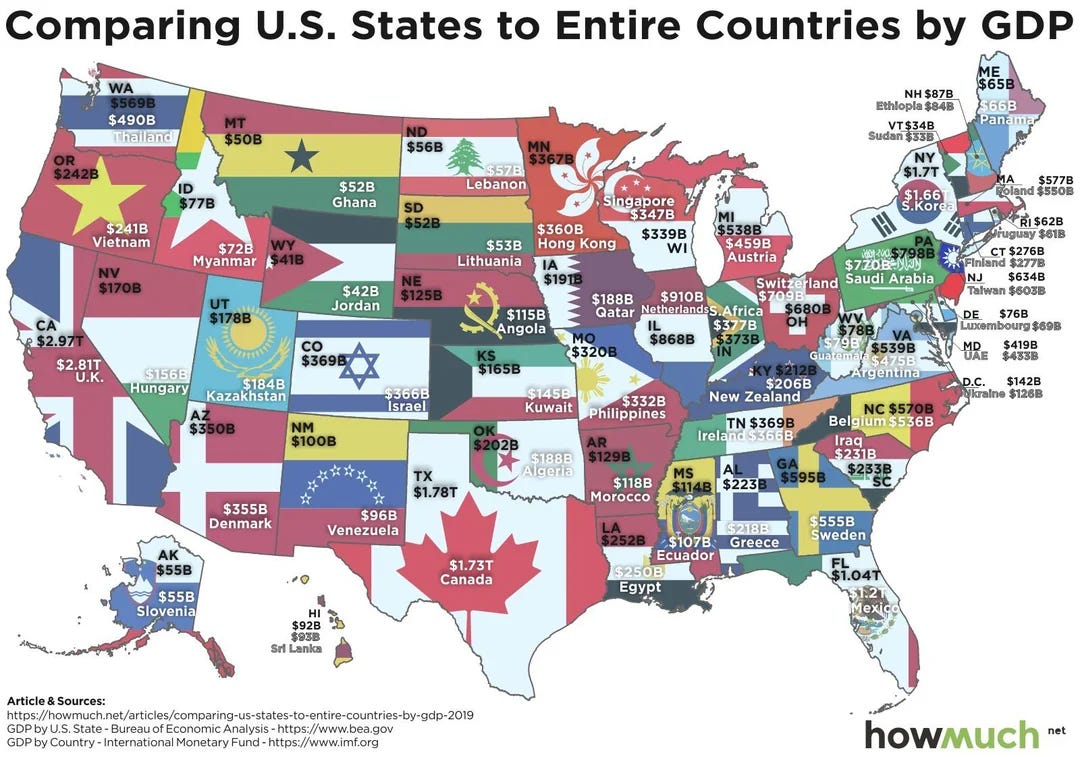
I always like to show this image below. It correlates the size of each state’s domestic economy with an equivalent global nation-state. Thus we see that, by holding U.S. dollars, you essentially have the equivalent of fifty currencies in one. That alone is a pretty significant incentive to hold dollars. Returns on investments and U.S debt have generally been pretty good for investors. We don’t need to invoke conspiracy theories to explain the dollar’s dominance—people and institutions hold dollars because they want to, simple as.
There are a few caveats, however. The Euro is used by a large number of European states, including by Europe’s single biggest economy, Germany. And, in fact, the Euro has indeed become relatively more popular to hold as a reserve currency. The only other competition would be a single currency from a country with a GDP equivalent to the United States. The only country that falls into that category today is China. However, as Michael Pettis has noted, the Chinese government has bent over backwards to prevent the Yuan becoming the world’s reserve currency. Pettis has even called reserve currency status an “exorbitant burden,” rather than a benefit.
One is forced to wonder why, if being the world’s reserve currency supposedly confers such enormous advantages—so much so that the U.S. economy would literally collapse overnight without it (according to the pervasive fearmongering online)—then why would the Chinese be working so diligently to prevent their currency from becoming the new reserve currency, even as more and more people want to invest in Chinese markets? How do so many other countries manage to run successful economies without having reserve currency status, and why would the U.S. be incapable of doing the same?
Economist Dean Baker has previously debunked the petrodollar theory for The Economist and The Financial Times. More recently, he wrote a short post on reserve currencies which I’ve drawn on for many of my points above:
If international demand for dollars falls, the dollar will lose value relative to other currencies. This is well-known and already accounted for in standard economic models. There are even arguments that United States might be better off if the dollar loses it’s unofficial currency “status,” although there is disagreement about that:
If the Dollar Stopped Being the Preeminent Reserve Currency It Would Mean More Jobs and Growth (Center for Economic Policy and Research)
Does the US Benefit When the US Dollar is the Global Reserve Currency? (The Conversable Economist)
In the article above, Baker describes some of the effects this might have on the U.S economy, and why it’s not a cause for panic:
If there was a loss of confidence in the dollar, we are presumably talking about a drop in the ratio of reserves held as dollars. Maybe it would fall to 40 percent, perhaps 30 percent. It is almost impossible it will fall anywhere near zero as long as the United States is in one piece with a functioning economy.
The effect of this loss of confidence would not be to deny the United States the ability to borrow in its own currency. Many countries borrow in their own currency, including countries like Malaysia and Colombia, which are not ordinarily thought of as titans of the world financial system.
Less stable countries typically pay somewhat of risk premium based on the risk of inflation in that country’s currency and the risk of the demise of the country (think Yugoslavia). In several cases this risk premium is negative. For example, the interest rates on Japanese, Swedish, and Danish bonds are all lower than the interest rates on U.S. bonds. These countries do not appear to have suffered from not having the world’s preeminent reserve currency.
Falling demand for U.S. dollars would indeed cause the dollar’s value to fall relative to other global currencies. This means that more dollars would have to be exchanged in order to purchase goods from abroad, possibly leading to higher inflation domestically. However, the other side of this equation will be that American exports will become cheaper. A falling currency will also mean it will be less expensive for tourists to visit the United States, possibly leading to an influx of foreign currency from tourism.
However, even if this were to happen, it’s unlikely that any of these gains would be realized due to the Trump administration’s incompetence.
The Trump administration’s position on this issue has been schizophrenic, to put it mildly. On the one hand, Trump demands a “strong” dollar (because “strong” means good and manly, of course). On the other hand, he also want to increase American exports, which would benefit from a weaker dollar. But since “weakness” is gay and feminine, we can’t have that. It’s worth noting that “strong” and “weak” are not value propositions—they are simply the technical terms used by economists to describe currency fluctuations. It’s certain that Trump himself, as well as many of his officials, are too stupid to understand this.
Additionally, Trump himself has repeatedly claimed that U.S. needs to have to the world’s reserve currency in perpetuity. However, as the Conversable Economist article notes, other Trump administration officials have said the exact opposite—that having the world’s reserve currency is an enormous detriment to the United States. So which is it? Does anybody really know? That’s why it’s doubtful the administration will achieve any of its goals. It doesn’t even seem to agree internally on what those goals are.
Supposedly the way to square this circle is through high tariffs. However, all tariffs did was start a pointless trade war, meaning that U.S. manufacturers will be cut out of any future international trade deals putting them at a disadvantage. Retaliation from other countries will mean counter-tariffs imposed on U.S. manufacturers alone, which will put them at a disadvantage relative to other exporters even if the dollar’s value falls. Tariffs have raised the costs of raw materials imported into the U.S., raising the costs for U.S. manufacturers which will be reflected in higher prices. And, in fact, we’ve not seen the trade deficit reduce at all, even as China’s trade surplus with the rest of the world has grown.
As the Conversable Economist article additionally notes, U.S. manufacturing output has steadily increased despite its supposedly “overvalued” currency. This means that it’s doubtful that a devalued dollar will bring manufacturing jobs back. The fact that U.S. manufacturing employment has declined despite increasing output is probably due to automation and efficiency gains. And manufacturing jobs have continuously declined, not increased, since Trump took office. Manufacturing employment is currently near twenty-year lows. Tariffs and banning alternative energy in favor of fossil fuels will not bring back the smokestack economy of the 1950s back to the heartland, and that seems to be the only economic plan the administration has (besides deregulation, corruption and looting).
Tourism to the United States is down considerably since Trump took office and launched his crackdown on foreigners. Headlines about random people being swept up and sent to concentration camps have turned people around the world off on visiting what they see as an increasingly authoritarian regime. Even with the World Cup and the Olympics, travel to the U.S. is lower than expected, so it’s unlikely that we would benefit from a weaker currency in this arena. According to Bloomberg, Trump’s policies have cost US travel industry $40 billion dollars so far. According to another recent economic analysis, the immigration crackdown has not created more employment opportunities for US-born workers and, in fact, has harmed their prospects, as well as cost an enormous amount of money.
But the most lasting damage has been to the United States’ core institutions. The value of the United States dollar and the ability to finance deficits was always due the fact that the United States had the most trusted financial institutions in the world. No more. Everyone around the world cannot help but notice the drastic decline in the political situation in the United States. The rest of the world is looking on as the U.S. rapidly destroys itself from within due to a radicalized Republican Party which is basically a modern-day fascist party. Whenever Trump speaks, people around the world are able to hear him directly without the pervasive sanewashing performed by domestic U.S. media outlets, and they hear the ramblings of an unhinged madman (quite possibly in the throws of dementia). They have also seen the various clowns, cranks and incompetent sycophants placed in positions of power and authority throughout the federal government. One of the most important tasks for businesses is long-term planning, and for that you need reliability and predictability. But the Trump administration is one of the most volatile and unpredictable regimes on the planet. Not exactly where you want to invest your money. As Dean Baker notes, the U.S. dollar has already fallen in value relative to the Euro, and will likely continue to fall further as long as Trump is in office.
Does the fact that Iran is trading oil in Yuan mean that China is gradually taking its place as the preeminent reserve currency? Not yet, and it’s impossible to know the future, but it would certainly be a long, slow process even if it were. A lot would have to change for that to happen. But the destruction of America’s institutions will have dire economic consequences, even if much of the online conspiracy theories, fearmongering and misinformation has no basis in reality. And the loss of 20 percent of the world’s oil supply will have even more dire consequences on the global economy going forward.
So I hope this rundown has proved useful. So, the next time some commenter, media personality, or influencer starts spouting off about the “petrodollar” and how the economy will supposedly collapse once it’s no longer “the world's reserve currency,” you can now know they’re full of shit and probably shouldn’t be taken seriously about any topic ever again.
Comments
Nothing yet. Say the first thing.
Sign in to join the conversation.