
A few weeks ago, on a gray November day in Istanbul, my friend Maeby and I ducked into the Little Hagia Sophia. Originally built as a Byzantine church and then converted into a mosque,1 it’s pretty cozy for a place in the touristic quarter of the city. Along one side of the interior are raised alcoves lined with cushions and bookshelves, a clear invitation to stay for a while and contemplate divine wisdom. You could read El Sagrado Corán or Der Heilige Koran, but on the shelf where we sat, the only books in English were some excerpts translated from the Risale-i Nur, a collection of treatises written from the 1920s to 1940s by Kurdish Islamic scholar Said Nursi in protest against laïcité, the set of policies that tried to make the new Turkish Republic into a more secular state inspired by France. Nursi was fighting against a powerful wave of forced modernization: sharia courts were closed, mosques came under state control,2 all dervish lodges were closed down, the dervishes were no longer permitted to whirl, were even forbidden to wear the robes and hats of their order and office. He determined to fight fire with fire, to ground Islam in science and logic and convince unbelievers they were in error.3 I picked out a slim volume entitled On Nature, sat down between the cold stone walls, and began to read.
I’m writing this from a much cozier place, the off-grid one-room cabin I spent a good chunk of the last two years building. I’m trying to make sense of my relationship with Turkey, and this moment in a mosque alcove seems to pull on a lot of threads: the suppression of the dervish culture that drew me there in the first place, the Kurdish people I kept running into who showed me such kindness and hospitality, my discomfort in Istanbul’s ancient layer cake of extractive opulence. For some reason, I was pulled into a relationship with Turkish land and culture, and now I want to know why. Because after two years away, the romance seemed to have gone out of it, and Turkey wasn’t feeling as magical to me as it did before. It felt harder to ignore the pushiness and grasping and greed of urbanized Turks; I found out that the “dervishes” whirling in Konya were just paid performers doing another job for tourists, looking tired and bored; the eerie mystical quality of the Anatolian steppes gave way to a realization that they’d been exploited by one civilization after another until very little wildness was left. Something inexplicable had drawn me there, and now I felt something else was pushing me away. But what was it?
In the Little Hagia Sofia, Maeby read for a bit and then curled up on the cushions, hidden from the mosque’s caretakers behind a column. I continued flipping quickly through On Nature, trying to finish it before it was time to leave. I wasn’t so much interested in grasping the specifics of Nursi’s arguments as the worldview they sprang from. There are things about Islam that attract me: its refined aesthetics, its ambitious architecture, its sense of unity, its embodied forms of prayer, meticulously oriented in time and space. But there are also aspects that I’ve never been able to resonate with: its privileged positioning of Arabic language and culture, its aggressive drive to dominate whole nations, its total focus on human society at the expense of non-human nature. And while the majority of Muslims I’ve met have been generous and gracious, some seem hostile to outsiders, unfriendly and judgmental. I’ve heard that certain sects feel it’s a sin even to smile at an unbeliever.
But this wasn’t it; every faith seems to have its sour apples, and I knew there was something deeper and more fundamental behind my doubts. Nursi’s writing was impassioned, holding up the miracle of life but somehow detached from the alien beauty of it, in the same way that the blue arabesques snaked across the tiles of the mosque, suggesting vines perhaps, but vines forced into a sterile universal order, seeking a geometric perfection instead of their own particular patch of sun. Toward the end of the book, I came across this passage that felt like a window into the heart of the argument:
…by its very nature, sovereignty rejects interference. Even an insignificant director or official does not tolerate the interference of even his own child with his authority. The fact that in history some religious rulers have killed their innocent sons in fear that the sons might attempt to interfere in their rule demonstrates how fundamental this “law of rejection of interference” is in rulership. The “law of prevention of others’ participation,” which the independence of sovereignty demands, rejects the existence of two sovereigns at the same time in the same place, whether it be a country or town. This has shown its great force through upheavals in human history.
Thus, if the sense of relative and transient rulership and sovereignty in humanity, which is powerless and in need of help, rejects the interference and participation of others, and seeks to preserve its independence in its position so jealously, then, if you can, compare how indispensable the rejection of interference and prevention of participation is to the All-Majestic One, Whose absolute sovereignty is based on or arises from His absolute Lordship over creation, Whose absolute rulership arises from His Divinity, Whose absolute independence arises from His absolute Oneness and Uniqueness, and Whose absolute self-sufficiency arises from His absolute Power.
Reading this, I felt the difference between the writer’s worldview and mine in my gut. He couldn’t imagine a harmonious society or a harmonious universe that wasn’t ruled by a singular, central power. His was the ancient view of civilization: a supreme ruler commanding a hierarchy of lesser powers, and it naturally extends into a way of seeing the body as a brain commanding sense organs and muscles, or seeing nature and the cosmos as following a single divine plan. When I look into nature and the cosmos, I see a divine spark too, but it’s permeating everything and acting from everywhere, with an incomprehensibly intricate order in which you and I are no closer to God, no more special or chosen than a leaf or a stone. There are strains of Islam that seem to approach this; what drew me to Turkey was seeing a TV show depicting Sufi dervishes chanting “la ilaha illallah” (there is no god but The God) and I imagined they were taking this core statement of Islamic monotheism to its extreme by stating that there is nothing but God. That the cosmos is not one ruler with many subjects but a single being whirling in countless internal motions.
Looking back, I think I’ve been on a quest to reconcile the wild with the civilized. Maybe this comes from my childhood of growing up in the deep woods without many modern conveniences, playing in a forest that was slowly reclaiming the cotton fields of the old south while also tinkering with the new laptop computers that formed a window into the future. Civilization was a miracle that allowed us to let the land run wild, without needing to scratch a living out of it, but also a globalized monster devouring minerals and topsoil and ancient traditions alike at a breakneck pace. Raised outside of organized religion, I longed for some spiritual teaching that would make sense of this conflict, but neither the powerful world religions nor the indigenous traditions seemed to know how to handle modernity—apart from living like a full-time historical reenactor—and both seemed to be dying out.
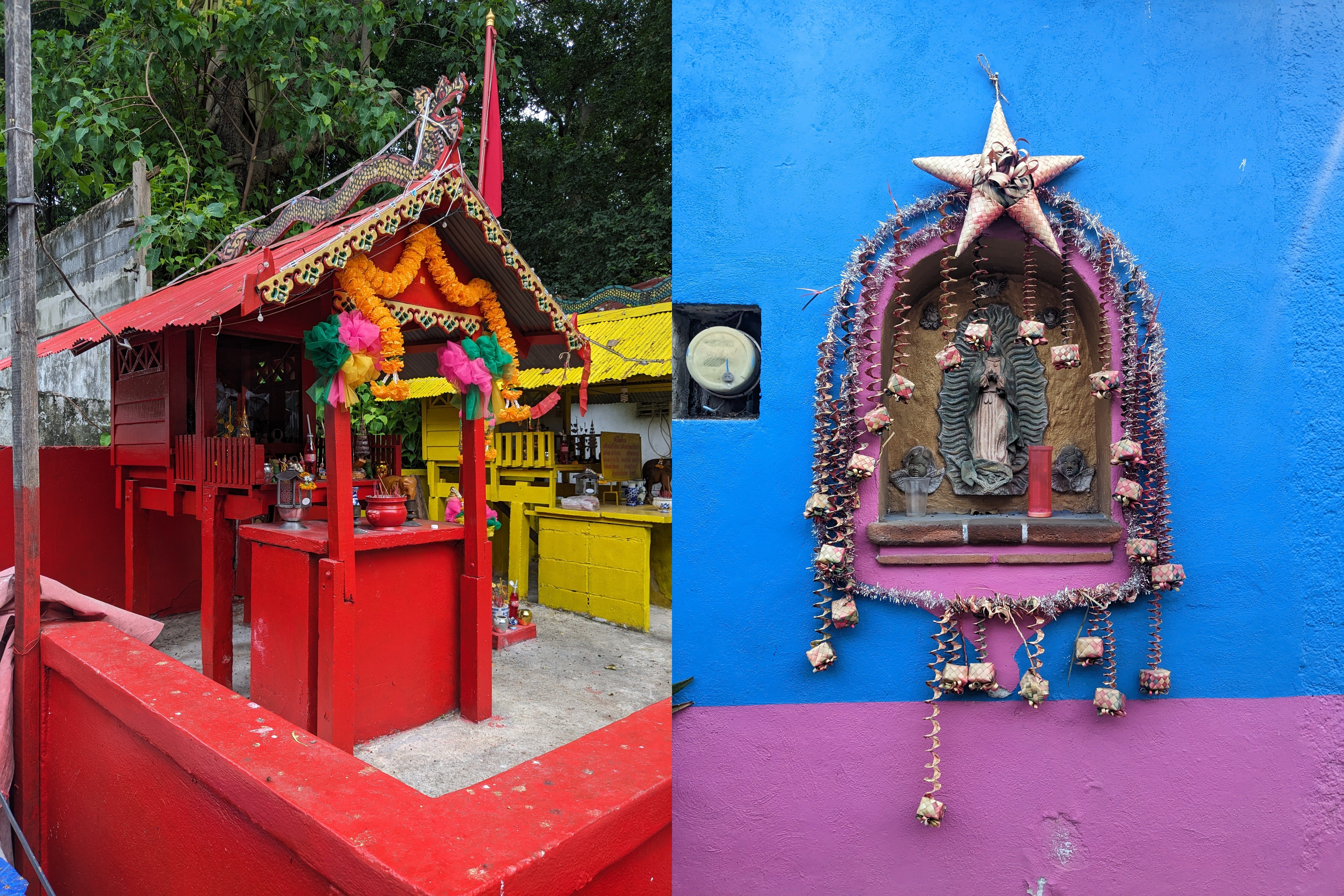
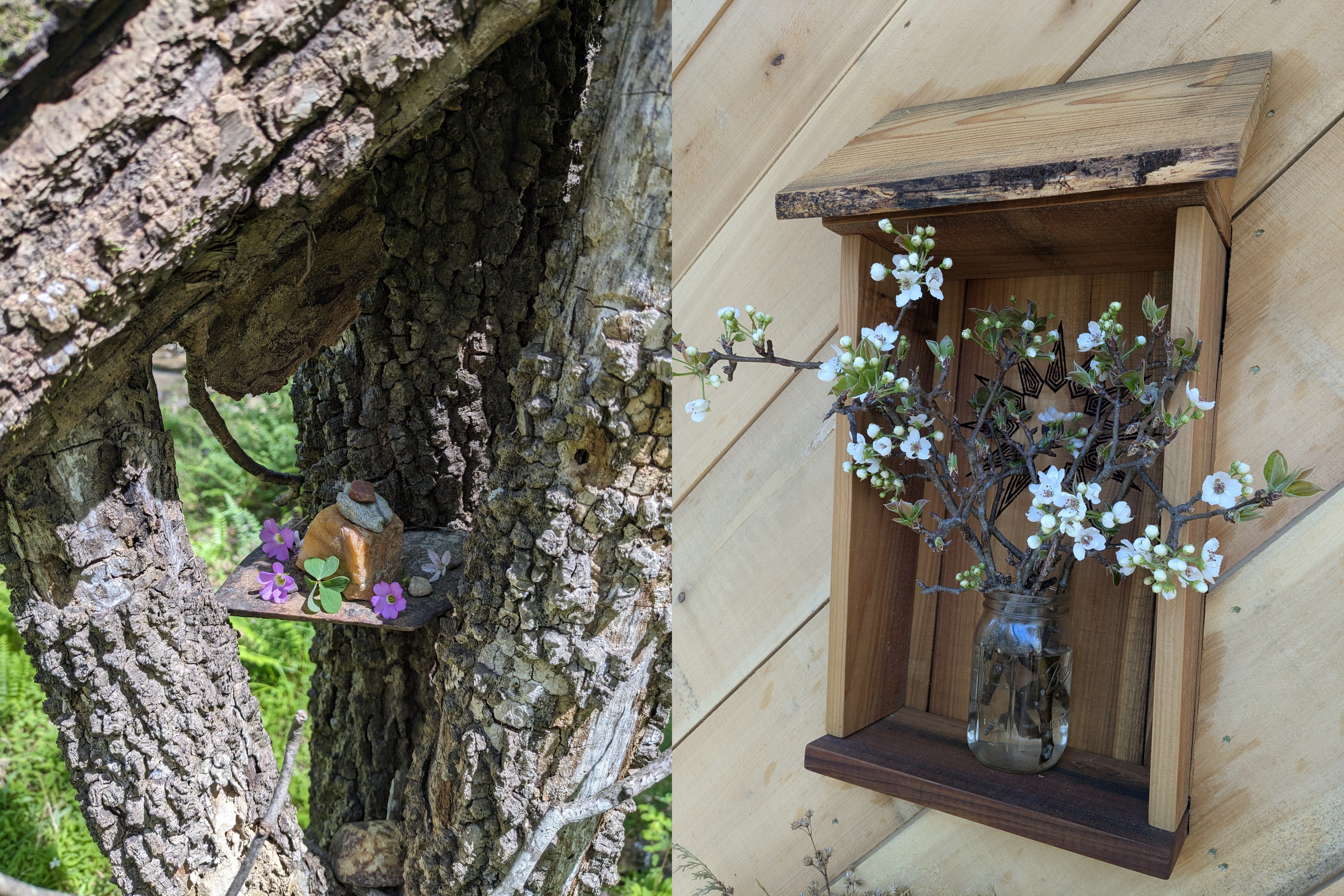
But there was something else under the surface. When I think about all the spiritual structures and practices I’ve run across in my travels, the ones that move me most are the ones that seem to seep up from the land itself, expressed in small gestures by ordinary people. In Japan, it was not the impressive Shinto and Buddhist temples but the pile of smooth stones placed underneath an ancient tree deep in the mountains. In Mexico, it was not the carved and gilded cathedrals but the little wayside shrine to the Virgin of Guadalupe. In Turkey, it was not the soaring domes of a mosque but the ribbons tied to tree branches near the tomb of a saint. Or in England, it was ribbons tied in the sheltering beech groves at the corners of Avebury Henge, not the hymns echoing in St Paul’s. In Catalonia, it wasn’t the Sunday mass but the villagers dancing the Sardana afterwards in the town square; it seemed to me that the smiling young man with Down’s syndrome needed no Latin to commune with God, he simply took the hand of one old lady after another and pulled them into the circle until they laughed with joy. The sight of it brought tears to my eyes.
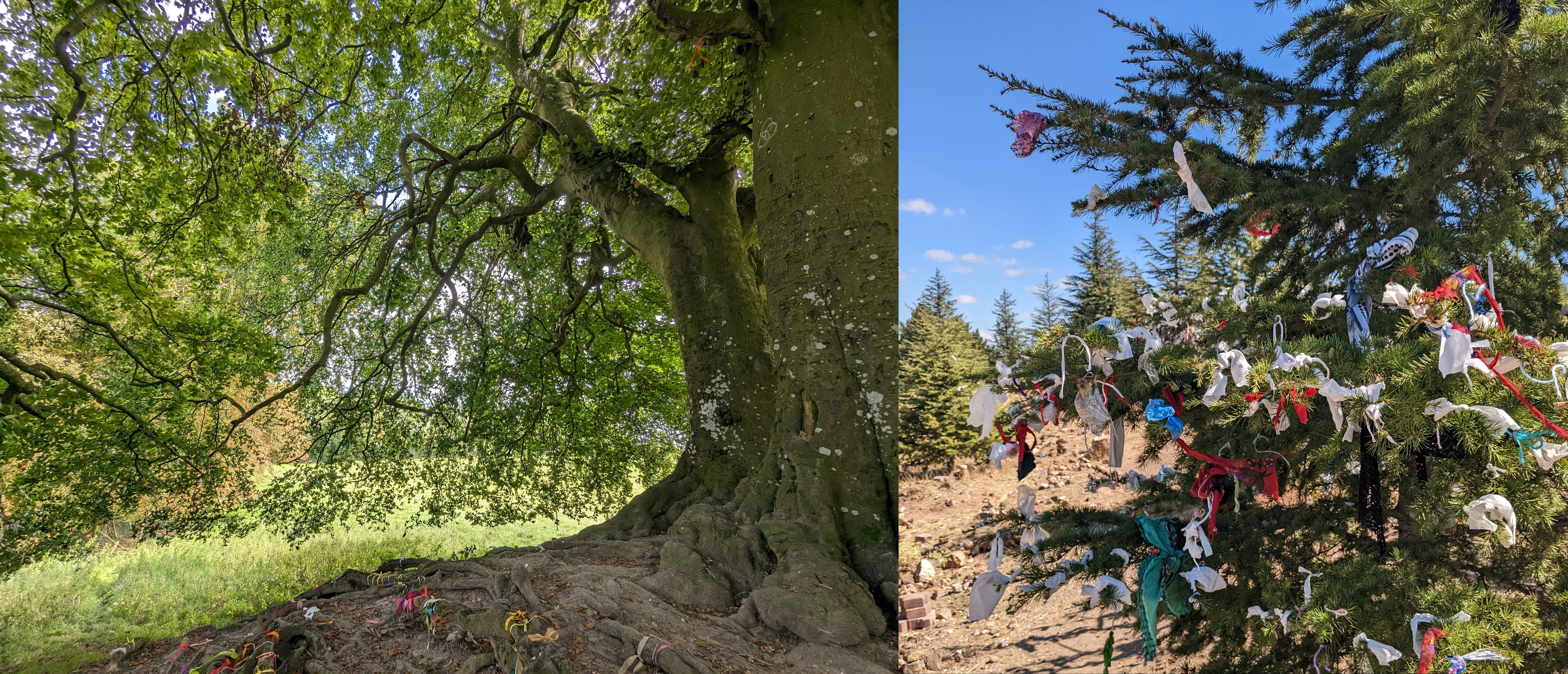
Maybe we can call this “folk religion.” It’s often practiced quietly in out-of-the-way places, in the hinterlands, away from the dominance of large organizations. Some might see it as a threat to the religious establishment; the official signs posted at Turkish tombs are practically a catalog of folk-religious observances, forbidding visitors to leave offerings, sacrifice animals, light candles, tie ribbons, throw coins, rub hands over their faces, wish for healing, or walk in a circle around the tomb. All the things people want to do but the clergy doesn’t want them to do.
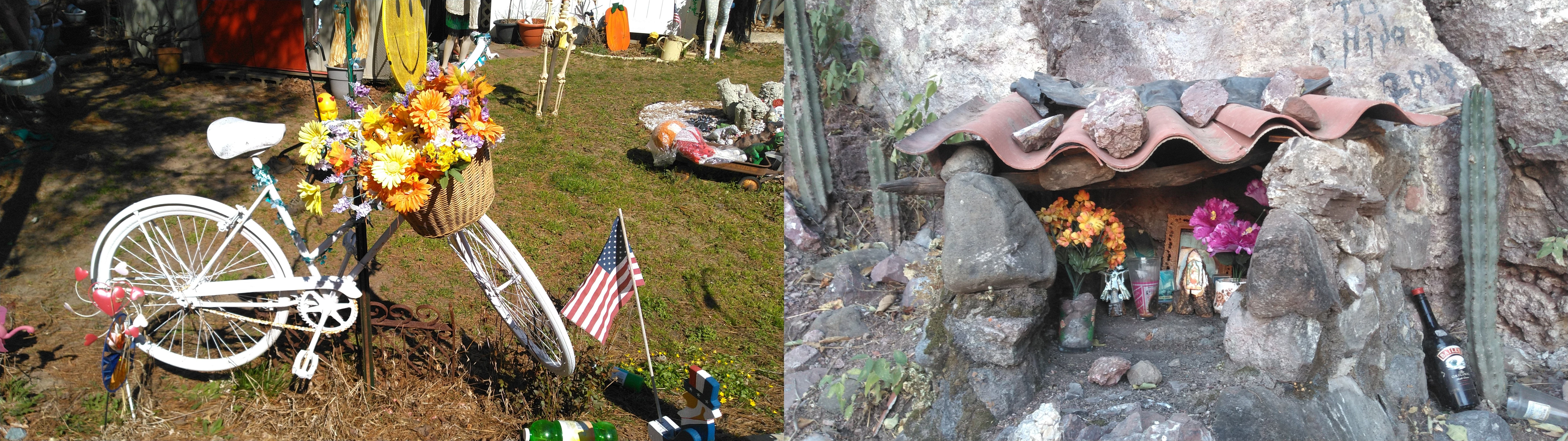
But the two are not always in conflict; I imagine that Catholicism and Buddhism owe some of their success to incorporating folk religion, turning traditional local gods and goddesses into saints or bodhisattvas, making a place to light candles or incense in front of an effigy, making a place in a crypt to throw coins or rub the stones, embracing the makeshift shrine in an alcove or the spirit house at the edge of a parking lot. Even in the seeming spiritual poverty of America, I’ve walked the roads and seen countless little shrines: crosses, photos, flowers, ghost bicycles. The highway holds some of our last remnants of the sacred, where we accept that life and death must touch, that all true freedom must carry some risk.
I would like to think that folk religions descend in an unbroken chain from a time when that was the only kind of religion there was, a time when all of our ancestors migrated in small bands, a time that lasted at least twenty times longer than civilization has lasted so far. I don’t know if that’s literally true, it may be that just as birds sing, humans make offerings to spirits. Maybe folk religion will naturally spring up in any time or place. But either way, I see it as both part of a continuity with our prehistoric past and also a seed that’s always ready to sprout in new ground. And maybe it’s even the unsung hero of civilization. Despite civilization’s awesome power to direct immense flows of resources, labor, and energy, I believe it would soon collapse without a deeper foundation of trust, cohesion, and unity, a foundation that isn’t built from rules and regulations but from customs and manners. Yes, the laws and scriptures warn us against sin and encourage virtue, but look how differently they’re interpreted in different cultures and different lands! Rituals of politeness, respect, and hospitality show up in countless local forms, part of the unwritten glue that holds a people together. I think they must spring from some deeper source.
Sometime I can almost believe that there’s a sort of universal folk religion, everywhere different in detail but everywhere the same in spirit. I’m drawn to it, and of course I found it in Turkey, wound up lighting beeswax candles and kissing sacred rocks with Alevis, putting my hand on my heart and bowing, learning the special clasps and hugs and ritual exchanges of words to convey mutual respect and care. But it was always under the shadow of more powerful cultures, under the pre-recorded call to prayer blasting from minaret speakers at ear-splitting volume, under the towering apartment buildings where nobody knows their neighbors anymore, among the new markets where business is done briskly and efficiently, with no time to share a pot of tea. On this trip it was harder for me to ignore these things, and I came to realize that while Turkey has changed me in profound ways, I have no wish to become Turkish.
Because I long for the wild places and the rural places, where the landscape is filled with creative expressions of individual humans and of other animals, of plants and fungi and the teeming soil. In cities I can only see the expressions of a few people who I’ll never meet: prophets, politicians, architects, marketers, industry analysts. Cities can provide endless excitement, beauty, and entertainment, but I soon tire of these; I find my energy comes from being surrounded by the life-force of beings living according to their own natures, whether they’re rough roadside weeds or thoughtful human artisans. In Turkey I can only seem to find faint echoes of this wildness, maybe in a 13th century Seljuk mosque held up by a forest of wooden columns, a monument to the living forests it came from, forests that have all been cut down. I can admire and mourn the dead trees, but still they are dead, and my body longs to be in direct contact with living nature.
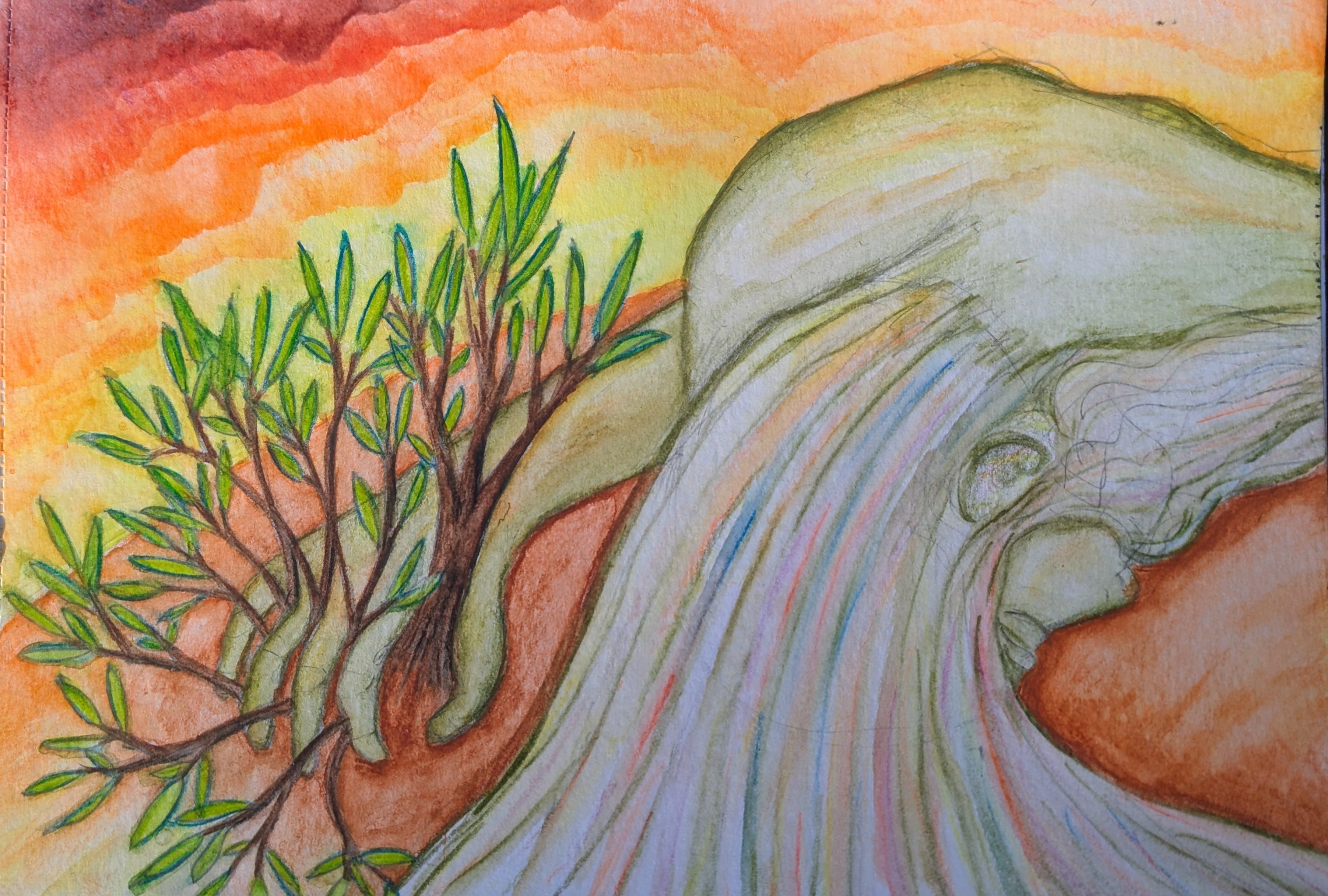
On my way back from Turkey, I landed in Barcelona and threaded my way through the long-term parking lot to a disused access road along the margin of the Llobregat Delta. In a patch of grass at the edge of the crumbling pavement, I took off all my clothes, put my bare feet on the ground, and bathed in the fitful rays of the autumn sun. I watched the airplanes taking off, and felt myself recharging like a dead battery, only then realizing that I’d been missing critical nutrients, missing the life-force that pours from the heavens and flows gently and subtly from the earth below. I had lost contact with it, immersed in a culture that forcefully broke its ties with nature long ago to experiment with the dominance of Man. This is not to say my time in Turkey had been wasted, because I deepened friendships and learned so much, but I think the most important lesson I learned was that there’s something else I really need—even the coziest of mosques will never be the place for me. My travels in Turkey ultimately led to me meeting my life partner, returning home with her, and seeing that everything I needed was right there.
I guess that’s how the classic hero’s journey ends, but I feel like I’m just beginning a new journey, and I want to touch on a couple of points about how I see the essence of folk religion, then talk about the role it could play in shaping the future:
Its worldview is profoundly polycentric: the cosmos is seen as a dense web of interacting beings, all of them fundamentally important. These beings can be permeated by a great spirit, or make up a part of a pantheistic unity, but the divine is not a ruler and there is no center. This springs naturally from people living in local interdependence, like a network of villages or an affiliation of tribal bands, and from people making a living by cooperating with the other-than-human world. It focuses on mutually supportive relationships rather than dominance and hierarchy.
It depends on the ability to find beauty and sacredness in the small and ordinary. For example, a little shrine is built and maintained by the devotions of a small number of people. It can’t have the awe-inspiring grandeur of a massive stone cathedral or mosque,4 which testifies to the combined energy of thousands or millions of people, so to appreciate this shrine you have to appreciate the way the beautiful and the sacred are everywhere, in every being no matter how humble, and not just concentrated in a few special places.
If beauty, sacredness, and dignity are shared out through all things, then believers should respect all things. Not just living beings but even materials like wood and stones are worthy of care and attention; it’s not good to waste them or to treat them as if they’re unlimited. It’s not good to work them or destroy them thoughtlessly. I’ve seen Sufi musicians kiss their instruments as they take them out and put them away, a lovely expression of this principle.
Folk religion is more concerned with unrecorded oral culture than with writings. Its rituals and structures need to be flexible enough to follow the present needs of the living instead of the frozen ideas of the dead. You might worry that this could lead people away from some important wisdom of past generations, but I believe the most important wisdom is not in any specific rules or procedures but in the worldview that lies beneath. If the people maintain the kind of spirit I’ve described above, I think they’ll stay on the right track. For example, the specific rituals performed by the Sioux have made several major shifts in the last few hundred years, but their fundamental essence holds.
I’ve been thinking a lot about our culture’s need for spiritual renewal. It seems like modern secular culture has the power of draining any sense of the sacred from whatever it touches. I was thinking we needed some new religion, some new prophet, to restore people’s belief in something bigger and grander than their own immediate wants and pleasures. But now I wonder if new prophets and texts aren’t what we need. Judaism, Christianity, Islam, Confucianism, Daoism, and Buddhism all appeared during a time when the written word was still rare, transformative, and magical and most people were raised with some sense of the sacred. The words of the great prophets and sages spread like brush fires through masses of people thirsty for unity and meaning. Now many people never had any sense of the sacred, and we’ve all consumed so many words and images that we need to close our minds to keep them from leaking in, through signs and loudspeakers, through our inboxes and news feeds, through TV and movies. So many people (and now people-simulators), demand our attention and don’t deserve it that we’ve lost much of our trust in words and images.
Let me make an analogy to music. The other day I listened to a pop song and wanted to close my ears, it ran so hard against my values. We might agree that pop music has gotten pretty unwholesome, but how to change that? One solution would be to somehow launch an even bigger pop star, someone with incomparable talent and wholesome values that couldn’t be compromised even when they’re offered vast quantities of money, casual sex, and drugs. Seems next to impossible. But what if instead we turned away from the whole idea of pop music and made folk music instead? What if our goal wasn’t to fill stadiums with applause but fill our living rooms with cozy vibes instead?
I think this might be a way back to wholeness, turning our attention to the ordinary beauty and sacredness right next to us, to the sky above us showering down life-giving sunlight and rain, the earth beneath us patiently holding our weight, the beings around us who we rely on for every single thing we need. The ground may look barren at times but I believe it’s full of seeds, waiting only for a little light and water to grow. Those seeds might bloom into strange flowers, like nothing we’ve ever seen before, but there will be a recognizable spirit underneath, a unique reflection of what it is to be alive inside the great mystery.
You can usually tell when a church has been converted into a mosque because the building will not have been oriented with one wall facing Mecca, and so the qibla (the alcove indicating the direction to Mecca) will be added on at some oblique angle, and the long stripes on the carpet indicating where to line up for prayer will not be parallel to any wall.
Note that Turkey has never been fully secular or neutral to religion in the way European countries are; Islam was simply stripped of its governance power and brought under control of the state. Today the government funds the building, maintenance and staffing of mosques, and only mosques; there aren’t many minority religions in Turkey, but the ones that do exist don’t get government support.
Some of his arguments suffer in hindsight, for example this one:
If your body had not been “written” by the Pen of the Eternal All-Powerful One, Who is One and Unique, and were rather a work of nature or “natural” causes, then there would have to be as many printing-blocks or molds of nature as the number of its cells and the compounds they form in your body contained one within the other. (source)
It’s aged poorly with the discovery of DNA, which looks a lot like having a printing press or factory housed in every single cell.
The hotel where I usually stay in Konya is next to the Aziziye Mosque, which is built in the baroque style. Looking into its aesthetic origins I found that baroque architecture arose in Italy as a response to the protestant reformation, with the explicit intention of pulling the faithful back to Catholicism by doubling down on the rich ornamentation and flamboyant touches that the austere protestants rejected. Baroque made its way to Turkey too, and I wonder if it resonated there for some similar reason. The mosque is quite beautiful, although like most richly ornamented religious buildings it makes me wonder how much it testifies to the glory of God and how much to the glory of the humans who designed, built, and paid for it.
No posts
Comments
Nothing yet. Say the first thing.
Sign in to join the conversation.