
“Not like this!” the ney salesman said, blowing forcefully across the top of an empty bottle. “Breathe from here,” he patted his diaphragm, “say Huuuuuuu…1” I tried to follow his instructions, but it was just like every other time I’d tried to play the ney: I couldn’t manage to make even a single note. I sat on the bench and blew across the mouthpiece every way I could think of, and all that happened was I got dizzy and my fingers started tingling. At best the flute let out a faintly musical wheeze. “Look at this guy,” I heard the salesman saying in Turkish to a group of tourists, “he’s American and he’s not giving up.” Damn right, I thought, I’m not giving up, I just need to buy this thing and keep trying until I can make it sing. He was a good salesman.
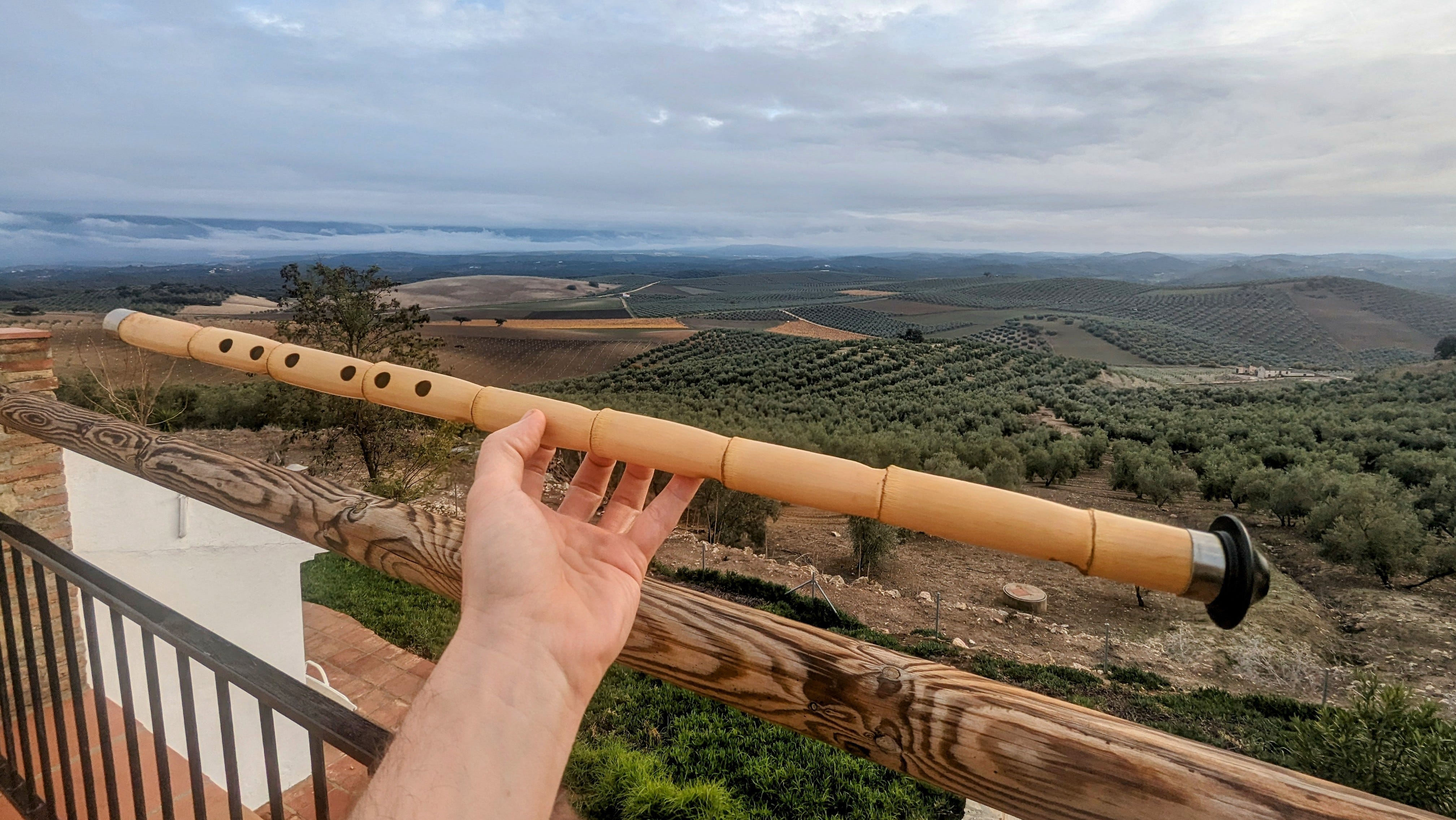
So every day, I spent some time blowing on my new ney, exploring small variations and stumbling around trying to start a resonance. I can’t remember if it was the next day or the one after that when I found my first note, but the thrill only lasted a moment before the frustration took over. I couldn’t seem to find it again. The trouble was that there were so many things to get right all at once: the posture of my lips and tongue, the volume and force of my breath, the angle of the instrument (in two directions!) and the precise positioning of airflow over the mouthpiece, and all of them seemed to matter. Even my mood seemed to matter, because in some sessions I would hit a note on the first try, and in others I couldn’t do it at all. But as I started to learn what worked, it became increasingly clear that this wasn’t really about technique at all. The ney had a character of its own; it had secrets to reveal to me.
The first of these secrets was that the main thing I needed wasn’t so much practice as attention. There’s a process of exploration, and it’s often random and aimless, but simple attention gradually turns these wandering paths into a map. So at first I felt lost, because my map of what my lips and breath and the instrument were doing was so vague that it was hard to even get to the same place twice, let alone navigate with confidence. But as I focused my attention on my lips and breath and the instrument, the map became more and more precise, and finding the notes became easier and easier. Motions that before seemed subtle and indescribable began to seem clear and definite. I think many skills in life are like this: the hard part is not so much learning to do something as it is learning to perceive something.
Whenever a Sufi musician takes out or puts away a ney or a saz or any other instrument, they will always give it a tender kiss. I had seen this many times, never realizing that the second secret of the ney was hidden in this simple gesture. I think they do this because, if we touch an instrument as if it’s only a dead thing made of reed, or wood, or metal, it might make notes but it will not make music. The instrument wants to come alive, it wants to find its voice, and to sing, it needs to be touched like a dear friend or a lover. Attention is important, and the quality of attention is even more important. As soon as I realized this, I took out the cheap plastic song flute2 I’ve been carrying and felt the sensuality of my fingers on its holes and my lips on its fipple, the subtle flow of my breath, and just like that it was singing like I’d never heard it sing before.
The third secret came to me while I was stacking heavy wet lumber, the ney sitting nearby in the tool bag in good company with my century-old handsaw and stout razor-sharp chisels. My mind went back to a moment when Alex and I were eating lentil soup by the Aziziye Mosque in Konya, trying to figure out what it was about the city’s atmosphere that felt so grounding and peaceful. I had wondered aloud whether it was in the way people worked: in any American city there would be constant sounds of things being banged around, as if from carelessness or suppressed rage, but in Konya there was none of that. The deliveryman set down his boxes with care, the baker slid the long etliekmek in and out of the oven gently and attentively. Stacking my lumber, I began to handle each board like that, like it was a lover, and right away the work was easier and more pleasurable. Music can be a prayer, and also all of life can be a prayer.
I’m still not very good at playing the ney; I still can’t coax anything I’d call music out of it.3 But the things I’m learning from it are even more important than music. I’m beginning to see how the salesman’s strange instructions contain a deep wisdom. To say “Huuuuuuu”, a particular syllable and a name of God, feels a particular way on the inside, and that feeling is what matters more than any technique or any sequence of movements. As I lift and move each heavy board, the board moves me back, flexing my muscles into the earth, gently massaging all the organs in my belly as I twist and dip. It feels sensual and deeply satisfying. The inside and the outside are one; I am the player and I am the instrument. I lay the board tenderly into its resting place with the others and let out a breath. Huuuuuuu….
No posts
Comments
Nothing yet. Say the first thing.
Sign in to join the conversation.