
I posted couple of posts using recent Chinese open models (Minimax M2.5, GLM-5) in Claude Code and replies were gone insane “how can you use these models in CC” which is propetriary to Anthropic.
Minimax-M2.5 in CC:

himanshu@himanshustwts
I have been vibetesting Minimax M2.5 on CC since a week. Its a wild model like an ultimate agentic workhorse. Found it better in coding/reasoning logic than 4.6 with crazy speed! Give this model a hit. It really is kinda beast on Sys design/Backend stuff.


Skyler Miao @SkylerMiao7
A glance of MiniMax 2.5, are you ready?
3:53 PM · Feb 12, 2026 · 46.8K Views
14 Replies · 11 Reposts · 256 Likes
GLM-5 in CC:
himanshu@himanshustwts
Dude this is crazy model. been quite sometime i have been vibe testing GLM-5 on Claude Code. My first initial impressions: + impressively good in design (one shotted better ui with glm than Opus 4.6) + it is actually not sycophantic (tried rigorously) + nearly no


Z.ai @Zai_org
Introducing GLM-5: From Vibe Coding to Agentic Engineering GLM-5 is built for complex systems engineering and long-horizon agentic tasks. Compared to GLM-4.5, it scales from 355B params (32B active) to 744B (40B active), with pre-training data growing from 23T to 28.5T tokens.
1:23 PM · Feb 14, 2026 · 198K Views
62 Replies · 47 Reposts · 1.49K Likes
Actually, its as simple as it can be!
Claude Code is actually an awesome harness to ship code. The general perception is you can use CC only with Claude-native models. I started experimenting with open source models which are cheaper and faster, specifically MiniMax-M2.5 and GLM-5. They are recently released and quite good on benchmarks.
Claude Code is built on Anthropic’s SDK. Anthropic made their API format public, and other providers built compatible endpoints that mirror it exactly. MiniMax and Z.AI (which runs GLM-5) both did this. So Claude Code thinks it’s talking to Anthropic but the request actually hits a completely different model.
Two environment variables control where Claude Code sends requests:
ANTHROPIC_BASE_URL - where requests go
ANTHROPIC_AUTH_TOKEN - how you authenticate
Override these, and Claude Code routes to whatever provider you point it at.
Step 1: Get your API Key
For MiniMax, go to platform.minimax.io/user-center/basic-information/interface-keyand and generate an API key.
For GLM-5, go to z.ai/manage-apikey/apikey-list and generate an API key.
Step 2: Clear existing auth
This is the step most people skip and then wonder why they’re getting 401 errors.
If you’ve ever logged into Claude Code with your Anthropic account, or previously set API keys manually, those values are already existing in your current terminal session AND saved in your ~/.zshrc. They will conflict. Clear both.
First, unset from the current session:
Then remove them permanently from your shell config:
Step 3: Configure settings.json
Env vars are session-only. They reset every time you open a new terminal. The right way to do this permanently is through ~/.claude/settings.json. Claude Code reads this file on every launch.
Open it:
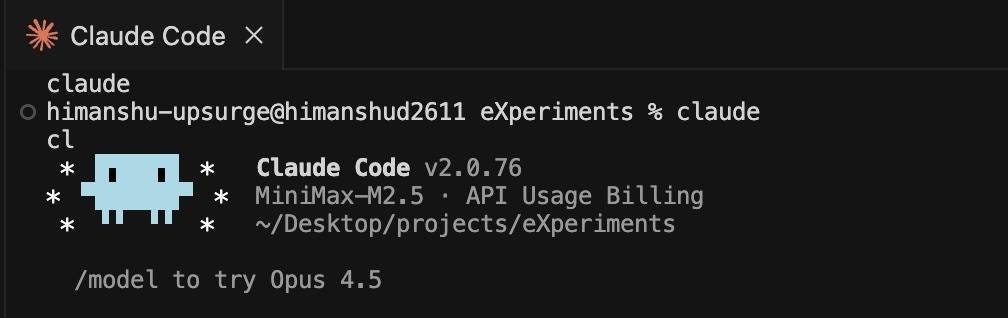
For Minimax:
Save the file. Open a fresh terminal. Run claude.
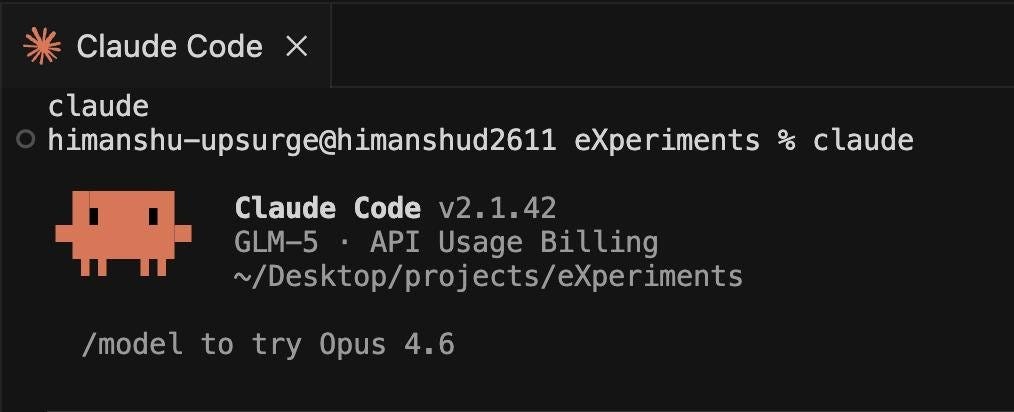
For GLM-5:
Save the file. Open a fresh terminal. Run claude.
If you're on the GLM Coding Plan, skip all of the above and just run:
It’s an interactive CLI that auto-configures everything - sets the base URL, injects your API key, maps all the model variables. Then just run claude.
Step 4: Verify it worked
Inside Claude Code, run /status. The header should show the model name you configured. Or just ask it: “what model are you?” It’ll confirm.
Step 5: Switching between models
Edit settings.json, swap the base URL, the auth token, and all the model names. Open a fresh terminal. Run claude.
That’s it.
No posts
Comments
Nothing yet. Say the first thing.
Sign in to join the conversation.