
Housekeeping:
I’m speaking at Lenny & Friends Summit (aka LENNYCHELLA) on September 10 in San Francisco, alongside incredible leaders from companies like Anthropic, OpenAI, Lovable, Ramp, and Stripe. Get get a front-row seat for how top teams are operating today, and connect with 1,000+ leaders shaping the future. Apply to attend!
I enjoyed chatting with Kyle Chayka at The New Yorker for his piece on the A.I.-design aesthetic that’s taking over the internet. As I say in the piece: “There’s no easy button for good work,” for reasons including the standards for “good work” change as AI capabilities change.
Last week, the AI image-generation company Midjourney announced that it is getting into healthcare.
Its first hardware product is a full-body ultrasound scanner that lowers you into a shallow pool ringed with half a million sensors and maps your insides in about 60 seconds. It is a prototype with no FDA clearance, so for now it produces body-composition maps rather than diagnoses, but the ambition is clear. The company plans to put the first ones in a San Francisco spa.
The response has been contentious. On one side, physicians argue that an increase in medium-quality diagnostic screening will do real harm as false positives will increase medical anxiety and unnecessary procedures. On the other, tech boosters argue that more data (both higher quantity and also longitudinal) will result in more precise diagnostic models; and besides, a person’s relationship to data changes when they have more of it, so patients and doctors alike will become more savvy consumers of that data over time.
I have come to see this argument as the central conflict within companies attempting to innovate in the healthcare space. On one side, you have people trying to protect against downside risk — before we do anything, let’s think about the harm we might cause — and on the other, you have people trying to create maximum upside — let’s end suicide, let’s eradicate heart disease.
Healthtech companies will have both types of people in them. Whether they actually innovate comes down to whether the upside-maximizers are the ones in the driver’s seat — and what kind of upside-maximizer they are.
Let me pose a thought experiment.
Imagine you live in Technotopia, a quiet town where residents live a good life … except for one problem.
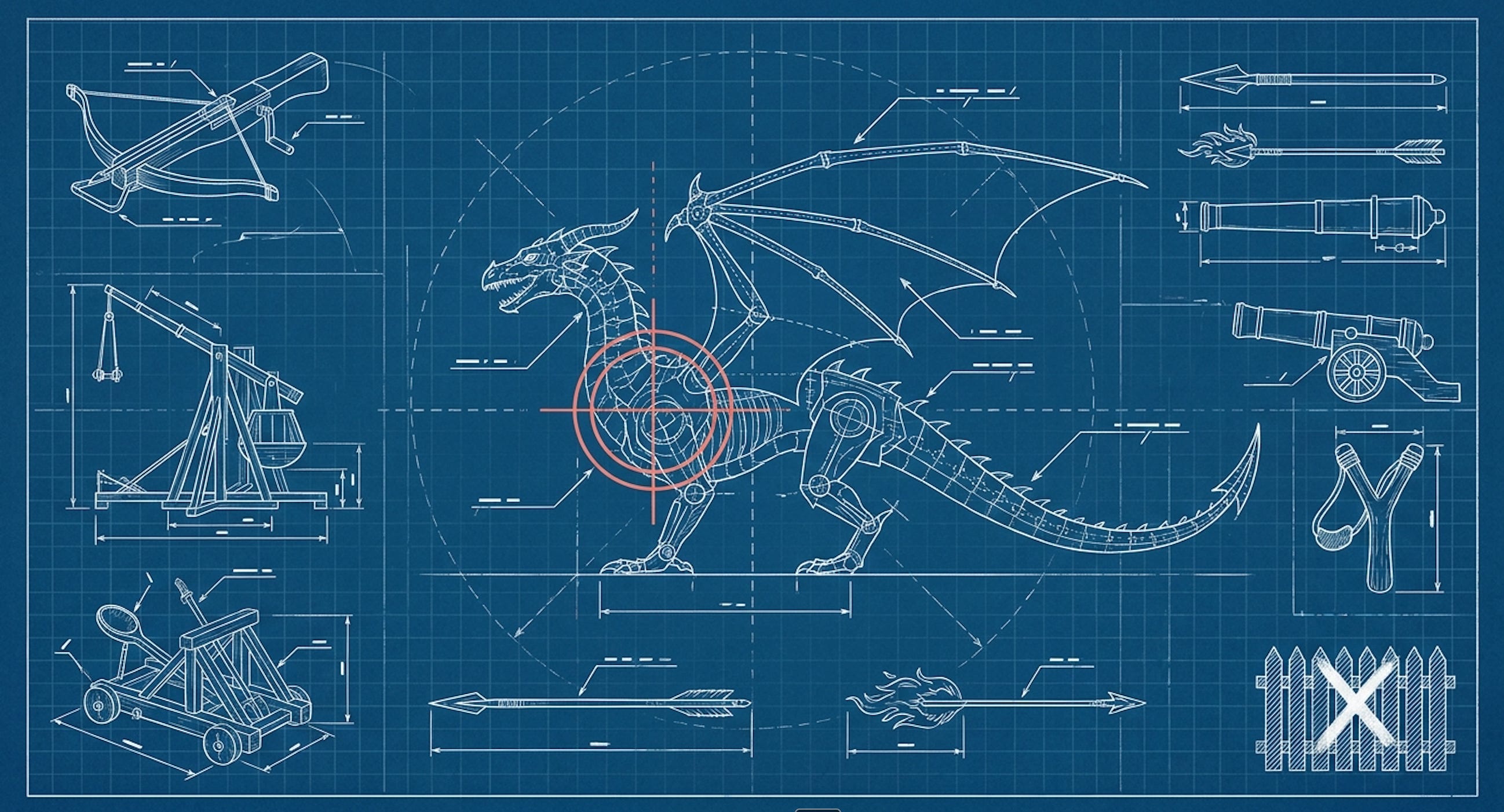
Outside the town lives a dragon. The town council has negotiated a stable peace with the dragon: it can wander into town and eat one resident every month. As long as it does no additional damage, nobody gives it trouble; as long as nobody gives it trouble, it does no additional damage.
One day, the local weirdo announces that he has invented a new weapon that he is pretty sure can kill the dragon. The weirdo has no specific dragon-related experience, though he is a generational fly-fishing talent.
The town council tells him to buzz off. If the dragon even catches wind of this, he might burn the whole town down.
If the local weirdo is right, no one ever gets eaten again. If he is wrong, Technotopia is toast.
What should the town do?
In December 2024, Lenny Rachitsky triangulated a list of the top companies for accelerating a career in Product. He noticed that five of the top ten companies were in Fintech. One explanation, put forth by Dennis Yang, “is that fintech nurtures strong product leaders because fintech work is on hard mode—lots of risk/fraud vectors, difficult stakeholders (e.g. compliance, regulations), and endless complicated tradeoffs.”
As someone who has spent a lot of time in healthtech companies, this rationale struck me as incomplete. Being a PM in healthtech is absolutely “hard mode,” for many of the same reasons: high risk, difficult stakeholders, endless complicated tradeoffs.
But how many of the 45 companies on Lenny’s list were healthtech?
Zero.
Zero! Out of 45.
Why is that?
I would argue that healthtech companies disproportionately attract people who primarily orient around protecting downside risk rather than creating upside value.
These are the people who, in the dragon scenario above, would take the side of the town council — a lot might go wrong if we attempt to kill the dragon; maybe we should focus on those things instead of killing the dragon.
Downside protection is not inherently bad. People with this orientation tend to have good reasons — often because they have seen first-hand, and have been responsible for, the outcomes of risk.
Physicians have had hundreds of conversations with patients where more information, especially easily-misinterpreted information, has led to bad outcomes. I don’t blame them for looking at tech people, who can easily abstract away the messy details in service of their elegant theories, with scorn.
But you cannot be simultaneously oriented around downside protection and upside creation. And so downside protection is inherently at odds with visionary progress. At the end of the day, you will either try to kill the dragon, or you will talk yourself out of it.
I want to walk through how conflict between these two types of people plays out in organizations, because I have seen it many times. As one recent example: yesterday, WHOOP announced that the FDA formally closed its warning letter against the Blood Pressure Insights feature; a major development following a long product saga that began with an ambitious but impossible-seeming idea: cuffless, continuous blood pressure measurement. I was, at one point, the lead Product Manager on this initiative, and later hired and managed the next lead Product Manager.
Big, ambitious projects require working through thousands of small decisions along the way. The CEO can’t be in the room for most of these decisions, so relies on the team to work through them themselves, then bring him the recommended path forward.
Let’s play this out in the context of Technotopia. Imagine the town has agreed, at least in theory, to try and kill the dragon. Everyone is excited. The mayor gives a big rallying speech. The local weirdo recruits a Weapons team to begin work on prototypes. The villagers begin imagining a future where nobody gets eaten.
At the first review, the Weapons team presents a spear to the town council subcommittees: Safety, Legal, and Public Affairs.
WEAPONS: It's very simple. If we can get close enough to the dragon, this will pierce its heart.
SAFETY: What happens if it pierces the wing instead?
WEAPONS: Um, that would injure the dragon.
SAFETY: So, it would make the dragon angrier.
WEAPONS: Possibly.
LEGAL: I want to flag that we should not call it a dragon-killing spear until we have evidence that it kills dragons.
WEAPONS: We cannot get that evidence without trying to kill a dragon.
LEGAL: I understand. But until then, I’d be more comfortable calling it a dragon-interaction device.
PUBLIC AFFAIRS: I’m also worried about the word “spear.” Could we call it a dragon engagement tool?
WEAPONS: If the point is to get the village to support the plan, they need to understand that the tool is meant to kill the dragon.
SAFETY: If we tell people that, they may overestimate its effectiveness.
LEGAL: We can say it is designed to support dragon-related safety outcomes.
PUBLIC AFFAIRS: I like that.
WEAPONS: We are definitely going to lose our funding if that's what we call it.
SAFETY: I’m not trying to be difficult. I just don’t want us to create a false sense of security.
WEAPONS: No one here wants that.
SAFETY: Then maybe, instead of a spear, we start with something lower risk. What if we build a fence?
WEAPONS: The dragon can fly.
SAFETY: A taller fence?
The team agrees to explore a fence-based approach, and brings their plan to the Mayor.
MAYOR: I thought we were trying to kill the dragon.
This is how teams who set out to kill the dragon undermine their own efforts. They set out to build a spear, and then thousands of small (and completely rational-seeming) decisions later, they realize they have built a fence.
(7) Advocate “caution.” Be “reasonable” and urge your fellow-conferees to be “reasonable” and avoid haste which might result in embarrassments or difficulties later on.
-from the CIA’s Simple Sabotage Field Manual
This is not to say that all downside protectors are bad, nor that all upside creators are good. When you are building products in high-risk areas like healthcare, you need people who are capable of thinking through and mitigating potential harms.
But this is a separate attribute from the impact orientation that I’ve been discussing. This is more about whether you can translate an ambitious vision into a concrete sequence of decisions that moves the work forward with urgency.
Here’s my framework for thinking about the intersection of these attributes:
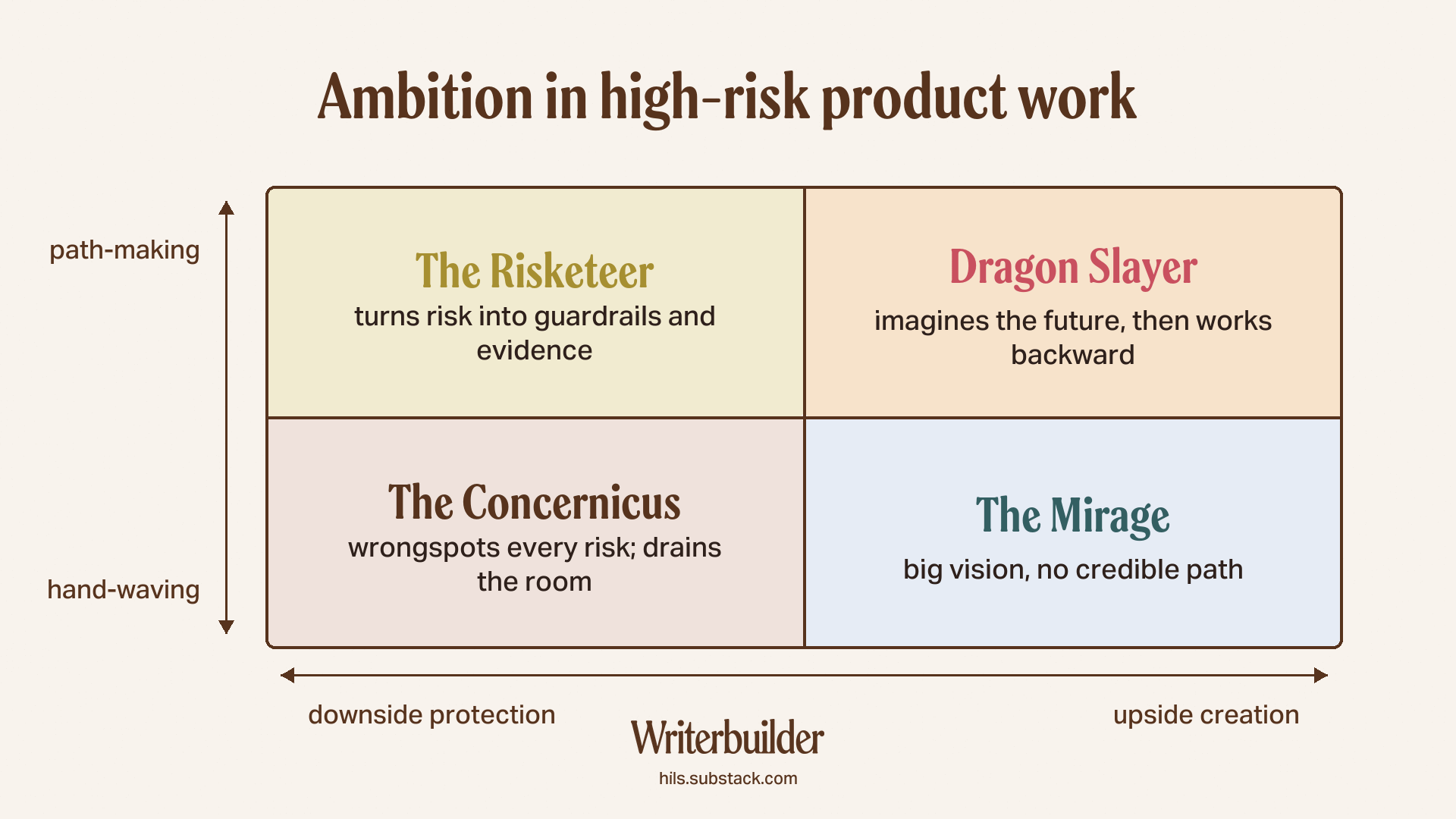
The reason I want to separate these out is because one of the biggest mistakes you can make when building product teams in high-risk industries is to inadvertently screen for people who lead with caution rather than ambition. But the ambition is not the problem, in fact, a lack of ambition is guaranteed to doom your efforts to innovate. But, ambition itself is not sufficient to succeed.
This framework introduces four types:
The Concernicus (hand-waving downside protector) loves wrongspotting. They can name every risk, and they are not wrong. But they will completely deflate a team that is trying to innovate in a high risk area. They are often very well intentioned, but they are indistinguishable from a saboteur.
The Mirage (hand-waving upside creator) has big visions, but no interest in or capacity for thinking through the path to reach those visions. Very much the energy of the Forbes-30-under-30-to-prison pipeline. They can be actively dangerous in high-risk fields.
The Risketeer (path-making downside protector) is the kind of person you want on your legal and compliance teams. They can help you see the landmines you might step in, while also being skilled at navigating around those landmines.
The Dragon Slayer (path-making upside creator) is who you want on your product team. They are capable of thinking through potential harms to find the best path, but crucially, they do not do this until after they are crystal clear about what success looks like, and have set success at a sufficiently ambitious level that others think they are a bit out to lunch.
Back to the question of why there were zero healthtech companies on Lenny’s list of career accelerators. Healthtech teams tend toward two failure modes: a Concernicus or a Mirage ends up in the driver’s seat.
With this framing, it’s not a surprise that an AI image-generation company was able to make such a splash. They have the ambition, and (in the eyes of some people, at least) they have credibility to execute.
If you are leading a Product team trying to innovate in a high-risk environment, here are some tactics I’ve found to be most helpful:
Screen for impact orientation in interviews. Give scenarios like Dragon in Technotopia as a mini case interview question and ask them to work through their reasoning with you. Look for past evidence of effectively pushing back on stakeholders to keep a high bar for ambition.
Set clear expectations around their role on the team. Most people want to be liked by the people they work with, even if just to make their lives easier. If you don’t explicitly tell them that in order to be successful in their role, they will need to expect and fight against softening ambition, they will likely defer to the social dynamics of the team. (Or, they won’t, but they will make enemies in the process, which is a separate problem).
Set clear expectations around escalation. Many PMs will avoid escalating conflict to you because they worry this will make it seem like they can’t handle problems themselves. However, this is how you lose days or even weeks to needless arguments that could be resolved immediately if run up the chain. Make it clear that you expect and welcome this escalation, and show them how to do it.
Remind everyone that the status quo is unacceptable. We often fear the possible harms that come from action more than the guaranteed harms that come from inaction. (See: people worrying more about the dozens of deaths resulting from driverless cars than the hundreds of thousands of deaths from human-driven cars). I have found that reframing around the status quo helps people remember why the work is important, and drives urgency: “Every day we don’t launch this, people don’t get the help they need.”
It bums me out to see fields like healthtech being so underrepresented on lists like Lenny’s because it becomes a self-fulfilling cycle: the work is seen as unlikely to succeed, so ambitious people worry it will limit their career growth and choose to work elsewhere, making the work less likely to succeed. But these are exactly the types of fields, and problems, that most need ambitious people, and especially the Dragon Slayers who can not only raise the ambitions of people around them, but also chart the course towards their vision.
It is people like that who can bend the future.
xoxo,
hils
is there a good way to write with AI?
·
Jun 17
I recently ran a survey of 100 leaders about their biggest AI-related pain points. One of the most common answers I heard was a frustration with how badly everyone around them was using AI: “Everyone is generating a million garbage AI documents and no one reads them.”
sea legs
·
Jun 3
When I ask people what is stopping them from betting on themselves, they tell me about a time when they did bet on themselves, and it did not go well. They read this as evidence that they should never bet on themselves again. Worse, they read it as evidence about themselves: if they had been worth betting on, surely it would have worked.
on copying
·
May 28
The more everything trends toward sameness, the more valuable a practice of inspiration will become. People might want to hear the same song over and over and over again, but eventually they will tire of it, and want something new. People who can actually make something new will be few and far between.
A practice of inspiration is, emphatically, the only defense against sameness.
No posts
Comments
Nothing yet. Say the first thing.
Sign in to join the conversation.