
My lecture in the last week of last term focusing on William Empson’s poem ‘Legal Fiction’, published in 1928, emphasised the old-fashioned English notions of class but disputed the argument, set up you might say for the sake of argument, that these archaic notions necessarily decided areas of sympathy or adherence in the peculiar business of composing poetry. Empson’s poem, you may recall, established its field of discourse in the archaic but residually active legal fiction Cuius est solum, eius est usque ad coelum et ad inferos (to whomsoever the soil belongs that also is his to the height of the heavens and to the depths of the earth). In the earliest days of flying machines this fiction got at least one English landowner off of a charge of murder. Subsequently, as mass air travel and international rocketry became commonplace, it was found necessary to emend the fiction of aerial trespass to a mere fanciful shadow, though when fracking gets under way in force here, as it will, I would expect some revived attempt to cite the matter of subterranean accounting and accountability, either for protest or profit.
I described Empson’s poem as a powerful, albeit technically imperfect, and powerfully moving poem about original sin which to Empson, the militant atheist, is a clause in christianity’s vile take-over and moral make-over, but is nonetheless an ever-threatening agent in the manufacture of general mortal woe. The poem’s rhetoric is a po-faced parody of calvinist predestination polemic and marxist class diatribe, both viewed as exhilaratingly frightful chop-logic. I remarked that the question, whether the brute fact of territorial ownership grants security of possession in all underlying substances, was a matter of real familial import to a poet whose father happened to be a Yorkshire landowner (Empson) but was necessarily of remotest import to the fifteen or sixteen year old son of a Worcestershire village bobby. So why the immediate sense of affinity that this son of a village bobby felt for this poem by the son of a Yorkshire landowner? I remember making that point; I don’t know how it was received. My intention was to sing the praises of poetic structure, or more broadly, of imaginative structuring.
So why bring my own juvenile self into the scenario at all? Well, first, because in all matters and questions to do with critical assessment you have a duty to tell your audience where you are coming from. Critical objectivity entails an unending struggle to overcome subjectivism, of which state or condition ‘how refreshing’ or ‘leaves a bad taste in the mouth’ are the essential idiom. Secondly, if you accept Wallace Stevens’ dictum - ‘the poem is the cry of its occasion, part of the res itself and not about it’ - you are not in simple consequence acceding to that perennial piece of bad advice ‘write only about what you know’. It is rather that you choose to make a vibrant, ringing structure out of semantics and metrics, and through that to discover what it is that you know. If in imagination you fancy your own name - e.g. ‘G W Hill, lower sixth’ - instead of William Empson’s at the head or foot of ‘Legal Fiction’, you are not alone in your desire to give a shape to your as yet embryonic factum est.
Neil Sedaka has recalled, apropos certain seven inch 45rpm vinyl records, that prior to his achieving celebrity he would occasionally enter his own name on the central label of a disc that he especially admired. Christopher Logue, maker of the superb War Music has observed of his own childhood and early adolescence, ‘I have always envied precocious achievers like Pope’ - achievers, note, and not self-expressionists - and also ‘secretly, I put my name not Kipling’s at the end of my fair copy of Gunga Din’. I insist that in the case of Sedaka and Logue, and doubtless of others too, the desire is not for self-expression but for the achievements of the first essential self-defining structure, the prime objective correlative of self-being.
Between the ages of seventeen and twenty, Dylan Thomas maintained a series of poetry notebooks, the drafts of which he drew upon for the remainder of his writing life. I recall reading early critiques of his work, critiques that I have not re-read for fifty years, studies that stress their own Freudian hypotheses as to the vade mecum of his adolescent genius; and I do agree that he had and has genius, albeit not the genius of young Rimbaud or Henri Gaudier. I would not say however that, in reading these drafts, and these have all been available in print since 1967, that the obligation to Freudian analysis presents itself as ineluctable. When you read through them you are struck more by a concern on his part for verbal pattern and structure. ‘I build a tower and I pull it down’ as he writes in one place; and in another ‘I who am steady was once savage’, ‘I was savage but am now steady’, two complementary lines which conclude one of the early sketches. Or again he says ‘moving symmetrically in chaos’. That is what he's interested in - ‘moving symmetrically in chaos’ - not exhibiting the fascinating chaos of his own adolescent self. I would guess the psychic motivation here, the psychic desire less for expression than for structure, to be not unlike that of the twelve year old Alan Turing in a letter to his mother. He says in that letter:
I always want to seem to make things from the thing that is commonest in nature and with the least waste of energy.
‘Least waste of energy’ here means with near perfect economy, not with minimal exertion. Now a twelve year old poet, provided she was blessed with a gift to rival Turing (she would need to be Emily Dickinson ) might foresee that it was or would be in her power to make things with the least waste of energy, from that which was commonest in nature, the detonating commonplaces of New England provincial polite society, and the brutal pernickety habits of the local fauna. That there is a deep dynastic wound, correlative to such achievement, it would not be possible to deny. And apposite citations are for the taking. Consider Emerson (‘The Transcendentalist’):
The profound nature will have a savage rudeness; the delicate one will be shallow, or the victim of sensibility; the richly accomplished will have some capital absurdity; and so every piece has a crack. 'T is strange, but this masterpiece is a result of such an extreme delicacy, that the most unobserved flaw in the boy will neutralize the most aspiring genius, and spoil the work.
Or John Henry Newman (Apologia Pro Vita Sua):
Did I see a boy of good make and mind, with the tokens on him of a refined nature, cast upon the world without provision, unable to say whence he came, his birthplace or his family connections, I should conclude that there was some mystery connected with his history, and that he was one, of whom, from one cause or other, his parents were ashamed. Thus only should I be able to account for the contrast between the promise and condition of his being. And so I argue about the world;—if there be a God, since there is a God, the human race is implicated in some terrible aboriginal calamity.
Read as the aftermath of my most recent allusion to the fifteen or sixteen year old son of an English bobby, such passages may be supposed as redirected toward some notion of autobiographical poignancy. But this was not my intention. Adherents and opponents of Judeo-Christian theology will draw the inevitable, but not totally inescapable, conclusion that the phrase ‘deep dynastic wound’ is someone’s mnemonic code for the doctrine of original sin, and that I propose to make the theme the main burden of this present lecture. Now if Emerson accepted that doctrine, and it would be very difficult for a nineteenth century new englander not to, at least as a cultural premise, it must be said that he modulated it in terms such as ‘alienated majesty’, which Whitman, who rejected the doctrine, found ab origine inspirational.
In ‘word-craft’, permit me the fancy term, the doctrine establishes itself ‘word-ily’. Now I have to say that I think Newman’s paragraph is grotesque, not for what it says, but through verbal mishearing. ‘I should conclude that there is some mystery connected with his history’ - by what dire oversight did he allow this absurd internal rhyme to stand in final proof, to mar with its ludicrous jingle a passage that he clearly designed to carry his message of poignant but fatal judgment? How he weighs his clauses to create the effect of joint finality, at once grammatical and juridical: ‘And so I argue about the world: - if there be a god, since there is a God, the human race is implicated in some terrible aboriginal calamity’. This is a paragraph which will establish itself over the following century and a half as a passage to which we too much love to attach the epithet ‘magisterial’. And yet at its syntactical heart is this grotesque little hop-and-skip of a phrase, at once unwittingly comic and vacantly malign.
The gist of my argument so far is this, that the phrase ‘a deep dynastic wound’ makes excellent sense if we take it to derive from the doctrine of original sin, a doctrine which Newman and Hopkins, in some respects Newman’s protege, accepted without reservation, as did Eliot, though Yeats and Pound rejected it outright. But we are not totally committed to understanding it in that sense. It does bear other interpretations, social-political readings for instance. So far as English poetry and prose are involved, what I want to say is that the wound is predominantly in the grammar, by which I mean syntax and cadence, it is the same in kind for poetry and for prose, but exponentially so in the case of poetry, because of the extra condensation. What is sought I think by all who take writing seriously is Turing’s ‘near perfect economy’ and when that fails, one is judged wanting by one’s great predecessors.
The dynastic connection, grammatically considered, may be represented in the syntactical relationship between main and subordinate clauses in a verse paragraph. I would cite particularly here, though I will not recite it as you all know it, the opening of the first book of Paradise Lost, in which the main affirmative clause, comprising three words only, is not heard until the first half of line six, and the matter does not end there, after a comma the subordinate clauses take up again, until the second main clause at lines twelve and thirteen ends also with a comma, flowing into three further lines of adjectival and adverbial phrases until we reach the first full period at the end of line sixteen. The shape of the syntax in those first sixteen lines is sinuous or serpentine, a form appropriate to a tragedy of deviant ethics, but appropriate also to the writhings of an agon of painful redemption. A modern analogy might be that of a radar scanner sounding out perimeters and horizons of breakdown and regeneration. Milton would certainly have understood what it is I am endeavouring to say, though he might have written in the margin of my manuscript ‘can do better’. I will here call Milton’s verse syntax a ‘dynastic syntax’ because it is designed to embody and project simultaneously the hegemonies of derived rebellious power, and the hierarchical grammar of salvation. But I would add that I call it ‘dynastic’ in part because this way of considering syntax derives itself from a powerful European syntax, traceable at least to the fifteenth century Florentine academies, and I would expect much further back than that. Dicta, in which our human grammars, whether of obedience or rebellion, are manifestations of God’s grammar.
I have said elsewhere, that with Donne, ‘style is faith: a measure of delivery that confesses his own inordinacy while remaining in all things ordinate’. ‘God carries us in his language’, he says. Now, where in any point later than in eighteenth century hymnody of Isaac Watts, or Charles Wesley, do our poetry and prose take as a given such a sense of the mutual architectonics of cosmic pattern and divine intervention in individual destiny expressed as language, the very matter and nature of the medium in which one works? The evidence is thin. Where it exists, it does so mainly as parody, as in ‘Legal Fiction’, a poem by the militant atheist William Empson, it exists in the prose of the profoundly catholic writer James Joyce, and in a critical work on Joyce by the young Samuel Beckett, first published in 1929 before he had made any mark as a novelist and dramatist. In his essay of that year, entitled ‘Dante, Bruno, Vico, Joyce’, writing of Work in Progress, as it was known then, subsequently becoming Finnegan’s Wake, Beckett argues that:
Here form is content, content is form. You complain that this stuff is not written in English. It is not written at all. [...] How can we qualify this general esthetic vigilance without which we cannot hope to snare the sense which is for ever rising to the surface of the form and becoming the form itself?
Beckett’s essay is dense with citations in the Italian of Dante and Vico, which remain untranslated. There is an arrogance to Beckett in this particular mode which, I must confess, I find preferable to the fawning populism of a number of our immediate contemporaries, but nonetheless which remains a form of affectation. Setting aside such exacerbations we must take note that although in Work in Progress we are told that ‘form is content, content is form’ the hierarchic relation is in reverse order to that found in Donne and in the opening verse paragraphs of Paradise Lost. ‘God carries us in his language’ says Donne; Beckett states that in Joyce the sense is ‘forever rising to the surface of the form and becoming the form itself’, the dynamic motion of a volcano, rather than the descent of the dove.
Those more expert than I in the literature of the English seventeenth century would argue that I am out of touch with history in claiming for Milton similarities to Donne in his understanding of God’s grammar. Donne is an Anglican hierarchist; Milton, by the time of Paradise Lost, manifestly is not. It could be further argued that the dynastic movement, grammatically speaking, is much more akin in Milton to that which Beckett detects in Joyce. The sense is forever rising to the surface of the form, and becoming the form itself, a movement shown at its best in passages of sublime semantic animus. This too is from Book I of Paradise Lost:
Jehovah, who, in one night, when he passed
From Egypt marching, equalled with one stroke
Both her first-born and all her bleating gods.
The allusion is to Exodus 11-12, the first passover, Moses leading the captive Israelites out of the land of Egypt, God’s slaying of the first born of all Egypt’s sons and the first born of Egypt’s cattle. Egypt’s gods were also in the form of beasts, they are called ‘bleating’ (a) because of their animality and (b) because they are ineffectual. And ‘equalled’ has a sense of ‘laying low’ as well as of ‘treating equally’. What I have called the ‘animus’ of these lines, and Book I in particular proliferates and is turbulent with numerous like examples, is an energy at once etymological and rhythmic, the rhythm achieved through the masterly enjambment of grammatical clauses across the line endings.
Now a great part of the energy of Book I is the energy of anarchy, as Milton gives voice to the monstrous truculence of the rebel angles. The technical crisis for Milton, as for any didactical poet of his stature, is that the essential creative energy of the poet has elements within itself that are scarcely distinguishable from the saeva indignatio of those who though ruined yet retain, even in distorted form, some elements of their original authority. Satan at line ninety-eight of Book I speaks of his own ‘high disdain’ for God’s ordinances. At the same time, a part of what we value as Milton’s own characteristic tone, whether on behalf of the triumphant republican cause or speaking defiance on behalf of the buried republican cause, could also be characterised as ‘high disdain’. It may appear to you as if I am drifting to an acceptance of Blake’s hypothesis in The Marriage of Heaven and Hell, that Milton was ‘a true poet and of the devil’s party without knowing it’. But the observation, as popularly understood, is radically misleading, and even when the words are rightly taken, they suggest an emphasis without knowing it, that fails to do justice to the poet’s consciously exercised powers.
Andrew Marvell’s poem On Mr Milton’s Paradise Lost, prefixed to the second edition of 1674, is more to the technical point. Marvell’s praise poem is a poem in heroic couplets, celebrating a poem in unrhymed, that is to say, blank verse. And Marvell defends Milton’s choice (in Restoration England Milton certainly needed defending) by admitting that in the deep dynastic quarrel between rhymed and unrhymed poetry, he (Marvell) has aligned himself with the more trendy party. Both Marvell, derivatively, and Milton, originally, stress the inextricable conjunction of matter and style. Not only is style constrained by ethos, it asserts a reciprocally containing force, and it had better be got right:
When I beheld the poet blind, yet bold,
In slender book his vast design unfold,
Messiah crowned, God’s reconciled decree,
Rebelling Angels, the Forbidden Tree,
Heaven, Hell, Earth, Chaos, all; the argument
Held me a while, misdoubting his intent
That he would ruin (for I saw him strong)
The sacred truth to fable and old song,
There is here a magnificent use by Marvell of that characteristic Miltonic verb ‘Ruin’; (“Hell saw / Heaven ruining from Heaven” Paradise Lost Book VI, lines 868; ‘What ruins kingdoms, and lays cities flat’, Paradise Regained Book IV, lines 363), implying, on Marvell’s part, the moral anxiety that Milton might, in the joyous exercise of creative power, come to prefer the metamorphic vitality of the pagan fables, which it was his duty to subdue, to the unchanging word of God. That he would make the urgent need to do God’s work on earth as remote and irrelevant as ‘Niobe, all tears’. In the light of Milton’s theological-political standpoint and Marvell’s, insofar as we have any evidence of what Marvell’s was, some such reservations are not out of place. After all, a century after Marvell expressed them, and came up with those lovely words, ‘Old song’ would become ‘Ossian’, and ‘all sang’ incited Jacobite rebellion in both 1715 and 1745. The genius of Marvell is to make the strength of what he feared potent in the lovely cadence of that line.
Milton in his 1668 defensive ‘Note on the Verse’ attacked some famous modern poets, among whom he may have had to number, albeit reluctantly, sage and serious Spencer, to whom he was much indebted, for having been carried away by custom to their own vexation, in the trivial labyrinths of rhyme, ‘the Invention of a barbarous Age’. We detect in such phrasing how error itself is conceived to be dynastic, and correction is regarded as due to the inspiration of individual courage and genius, albeit drawing upon the beneficent ancients:
This neglect then of Rhime so little is to be taken for a defect, though it may seem so perhaps to vulgar Readers, that it rather is to be esteem'd an example set, the first in English, of ancient liberty recover'd to heroic Poem from the troublesom and modern bondage of Rimeing.
Although Milton can hardly have foreseen the creation, in the early eighteenth century, of the Milton dynasty, in considerable part through the intervention of Addison’s eighteen papers on Paradise Lost, published in The Spectator, in the early months of 1712, there is evidence that he gave thought to the survival of his moral-political legacy. See Achinstein’s pamphlet Citizen Milton published by the Bodleian Library for the 2008 quatercentenary. In his latin ode of 1647, to John Rouse, Bodley’s librarian, ‘Ad Joannem Rousium’, Milton writes admittedly in a sequence of commonplaces that
Perhaps our remote descendants
And an age of greater wisdom and purer heart
Will render fairer judgment
On all things.
Then, thanks to Rouse,
With envy in the tomb,
A saner posterity will know
If any merit is mine.
In the matter of post-restoration censorship, this university’s record is poor, though the reputation of the Bodleian shines. Milton’s books were twice in 1660 and 1683 condemned to be publicly burned as treasonous and subversive matter. In 1660 the Bodleian squirreled them away and they survived, as they survived also the later assault on writings condemned as being destructive of the kingly government.
Addison, in 1712, presented Milton largely as a treasure house of heroic beauties and moral apothegms:
We were told in the foregoing Book how the evil Spirit practised upon Eve as she lay asleep, in order to inspire her with Thoughts of Vanity, Pride, and Ambition.
Or again:
‘As Milton every where fills his poem with circumstances that are marvellous and astonishing…’
Addison establishes Milton’s preeminence as a poet by neutering his political and theological radicalism. Because of late seventeenth century orthographical and typographical conventions, such as capitalising the first letters of nouns, in reading these very early defences of Milton by people like John Toland and his nephew Philips, you think you might be reading German, a language, say, in which you know a few abstract nouns, but in which the conditionals of verbs and other grammatical nuances mostly escape you. And it may be that the relapse into capital virtues and broad general appeals to the judicious reader, which one notices throughout 18th century poetry presentations, derives in part from attempts to make the Milton inheritance acceptable to posterity in which anti-commonwealth animus was strong. That is why one senses the particular satisfaction in Samuel Johnson’s voice, that sense of swimming against the stream of cultural platitude, when he refers to Milton as an ‘acrimonious and surly republican’, thereby rendering the poet much more of his honest due than he received from the earlier, cornered, extemporising partisans, pioneers of the eighteenth and nineteenth century Miltonic critical dynasty.
When Martin J Svaglic annotating his ‘magisterial’ edition of Newman’s Apologia Pro Vita Sua writes of its second edition in 1865 as having been developed into the ‘clearer, more vivid and dramatic story of a still more engaging figure’ he is imitating, though not so far as I can tell parodying, the voice of the judicious reader. The judicious reader always prefers the still more appealing human being to the threatening device of the poem itself so that over the years more and more poems come to be written for the judicious reader who can even be taught in time that words like ‘fuck’ are part of the inoffensive appeal. The judicious reader copes less well perhaps with lines such as, ‘Your spun farm's root still on that axis dwells’. As Riding and Graves noted in 1927, the year before Empson composed ‘Legal Fiction’:
the poet has committed the unforgivable modernist sin of allowing the audience to have more than one possible reaction to a single poem.
They were referring not to Empson but to a poem, ‘Captain Carpenter’ by the American poet John Crowe Ransom. Ransom, who had served as a first lieutenant of field artillery with the American expeditionary force in France in 1918, admired Robert Graves, who reciprocated the respect, writing an introduction to Ransom’s first English collection, Grace after Meat (1924), which was in fact dedicated to graves, if you follow me.
The quality that caught Graves’ attention in Ransom’s work was, and I quote, ‘an extremely fastidious art disguised by colloquialisms and a pretense of every which way’. Rather to my belated surprise, Graves is becoming something of a key figure in this series of lectures. Incessant self-education is one of the recurring pleasures of my kind of work. Graves’ cruciality I now see is due to two conjoined factors - craft and trauma. Graves served in the trenches, was once reported in the press as having died of wounds, and was demobilised with shell shock (or PTSD). And I think the fact that Ransom had fought in France would have been for Graves a subjective enhancement of an objective appraisal and appreciation.
Two of Graves’ early prose books On English poetry (1922) and Poetic Unreason and Other Studies (1925) I would certainly recommend for auto-didactic, self-apprenticed, deeply eccentric, young poets. Though there has been much quarrelling over the matter, I think there can be no doubt that Graves’ suggestions in the three pages entitled ‘Conflicts of Emotion’ in the book On English Poetry, anticipated Empson’s method in Seven Types of Ambiguity (1930) by almost a decade. I call Graves a ‘crucial figure’; that is because his work constitutes a crux, a crux of techne with mental and emotional crisis. When you have techne without crisis the result is work similar to that by the Movement poets of the 1950s, John Wain, John Holloway and others. Donald Davie was, I think, the best of these dogmatists, with Philip Larkin as a sort of presiding genius as, of course, was Empson. Wain claimed with some justice that his essay ‘Ambiguous Gifts’ in Penguin New Writing vol 40 (1950) had established Empson’s presidential status in the immediate post-war years. Crisis without a sound grasp of or a naive indifference to techne has inspired works such as those of Margot Ruddock, briefly Yeats’ protege.
On the matter of poetry and dynasty, I believe that the matter resolves itself into two clauses: (a) poets who have a sense of their own worth are no the less pleased to derive their virtue from their ancestors (Yeats; the Eliot of ‘Tradition and the Individual Talent’ and of After Strange Gods; the self-named fugitive poets of the American 1930s, John Crowe Ransom, Allen Tate, Robert Penn Warren, being once the best known); (b) poets who have an alarming tendency to wish to establish dynasties, Yeats again in such major poems as ‘A Prayer for My Daughter’, ‘Meditations In Time of Civil War’ and his lunatic anthology of the 1930s, the Oxford Book of Modern Verse. Lunatic, in that it gave fifteen pages to Dorothy Wellesley, and sixteen to Walter James Turner, and eleven to Oliver St John Gogarty, while omitting Wilfred Owen entirely, on grounds that he was a ‘revered sandwich board man of the revolution’.
My title, ‘A Deep Dynastic Wound’, is taken from a poem by John Crowe Ransom, ‘Dead Boy’:
The little cousin is dead, by foul subtraction,
A green bough from Virginia's aged tree,
And none of the county kin like the transaction,
Nor some of the world of outer dark, like me.A boy not beautiful, nor good, nor clever,
A black cloud full of storms too hot for keeping,
A sword beneath his mother's heart—yet never
Woman bewept her babe as this is weeping.A pig with a pasty face, so I had said,
Squealing for cookies, kinned by poor pretense
With a noble house. But the little man quite dead,
I see the forbears' antique lineaments.The elder men have strode by the box of death
To the wide flag porch, and muttering low send round
The bruit of the day. O friendly waste of breath!
Their hearts are hurt with a deep dynastic wound.He was pale and little, the foolish neighbors say;
The first-fruits, saith the Preacher, the Lord hath taken;
But this was the old tree's late branch wrenched away,
Grieving the sapless limbs, the shorn and shaken.
Between the first edition and the Selected Poems (1945), Ransom made numerous small verbal changes. Too many to give in detail here. Though, I would say, generally that they are all what I would call ‘Gravesian changes’, though Graves preferred such changes to be made in the form of prepublication to the final drafts, see section twenty-five (‘Putty’) and forty-four (‘Surface Faults and Illustrations’) in On English Poetry, and the chapter, ‘Secondary Elaboration’, in Poetic Unreason. The pitch that Ransom chooses, both initially and by those minute changes, is well-caught in Graves’ words of commendation, ‘we find an extremely fastidious art, disguised by colloquialisms and a pretence of every which way’. Ransom is a great master of what Pound called melopoeia, the melody, and what I would call the cadence, of lines.
Ransom taught Allan Tate at Vanderbilt, and Tate, albeit informally and somewhat to his alarm, taught Robert Lowell (the young poet was a self-invited house guest, and on arriving at the house was told that there was no room for him, so he pitched a tent on the front lawn). Tate also wrote the introduction to Lowell’s first collection, Land of Unlikeness (1944), in which he concluded:
"The history of poetry shows that good verse does not inevitably make its way; but unless, after the war, the small public for poetry shall exclude all except the democratic poets who enthusiastically greet the advent of the slave-society, Robert Lowell will have to be reckoned with. Christopher Dawson has shown in a long historical perspective that material progress may mask social and spiritual decay. But the spiritual decay is not universal, and in a young man like Lowell, whether we like his Catholicism or not, there is at least a memory of the spiritual dignity of man, now sacrificed to mere secularization and a craving for mechanical order."
Hmm, you will say, this sounds a bit like Hill…
By the ‘advent of the slave society’ Tate means post-1944 ‘secularisation and a craving for mechanical order’ or what the Anglo-French writer Hillaire Belloc had termed the ‘servile state’. And the good natured reader says, hold on… the slave society in the USA existed in the pre-1865 American South, and in 1944 the year of this diatribe the American armed services are segregated, and in the South in 1944 and for at least twenty years after, blacks cannot eat in public with whites, and are required to give up their seats on public transport. There is something very crudely dynastic going on here in Tate’s argument and without the reserves of appraisal that Ransom can write into the dynastic lamentation of his poem through the superb handling of melopoeia, and the weighing of phrase and of clause.
I said that the Lowell book, which Tate introduces there, was his first; it was a Cummington Press book, with limited runs. Land of Unlikeness ran to 250 copies of which, and I quote the printers colophon, ‘26 are on Dacian paper, numbered, and signed by the author’. The most recent copy on offer was priced at 1200 pounds. Such editions are cenacle offerings. There is in Tate’s introduction a distinct sense of dynastic tradition and inheritance, all the more strongly implied because the next generation has arrived, and arrived in the form of young Cal Lowell, an apostate Puritan, the scion of one of New England's most distinguished families. Now the Fugitive group attitudes are directly cited and applauded in the opening paragraphs of T S Eliot’s After Strange Gods (1934), based on lectures given in 1933 at the University of Virginia:
Yet I think that the chances for the re-establishment of a native culture are perhaps better here than in New England. You are farther away from New York; you have been less industrialised and less invaded by foreign races; and you have a more opulent soil.
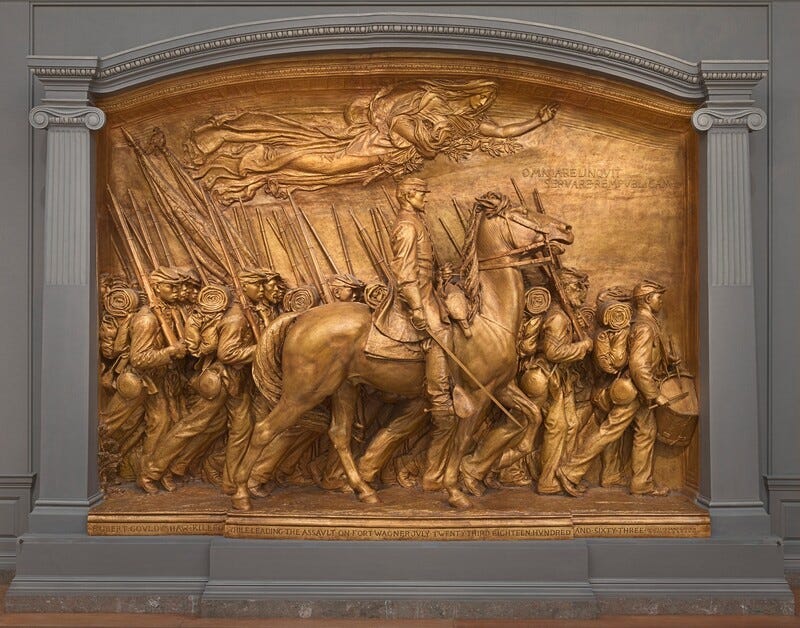
This is a dynastic rhetoric with which the young Robert Lowell felt privileged to be associated, and I can well understand why. It has created some excellent modernist poetry, with a strong emphasis on oratorical structure. Allen Tate’s ‘Ode to the Confederate Dead’ is, in my estimation, a masterpiece of modernist oratory, and Ransom and Tate were charismatic teachers. Lord Weary’s Castle (1946), Lowell’s second book, produced largely under Tate’s aegis, is one of the finest verse collections since the work of Yeats’ final decade. By the time of the book For the Union Dead (1964), nineteen or so years later, Lowell is aware that the legacy is compromised, tainted even. The title of this collection of Lowell’s is of course an example of the apprentice striving to kill the master. ‘For the Union Dead’ is an obvious Meistersinger-challenge to Tate’s own masterly ‘Ode to the Confederate Dead’ of some twenty years previously. Now Lowell’s topos is the Saint-Gaudens bronze relief sculpture, outside the State House on Boston common, erected in memory of the 54th Massachusetts, a black regiment with white officers, led by Colonel Robert Gould Shaw, who died together with many other black rank-and-file in the assault on Fort Wagner in July 1863, and was tossed with them into an unmarked, mass grave on the site. Here are just two stanzas:
The stone statues of the abstract Union Soldier
grow slimmer and younger each year—
wasp-waisted, they doze over muskets
and muse through their sideburns . . .Shaw's father wanted no monument
except the ditch,
where his son's body was thrown
and lost with his "niggers."
That last word in the text is carefully encased in double inverted commas, and I recall a BBC tape of Lowell at a public reading, some time in the early or mid seventies, in which he breaks off the recitation of the poem to interpolate the explanation that the word was not his responsibility but is a quotation from a remark made by Shaw’s father, when asked where he wished his son’s body to lie. Lowell's voice in breaking off the reading of the poem, as I recall it, over a considerable number of years, is nervous, staccato and strained.
I began by alluding to the doctrine of original sin, and it appears that I also must terminate with that doctrine. The work of Allen Tate, to judge from my inquiries, has been virtually erased from the reconstructed liberal pedagogic memory of the States. I say the issue is complex; complex with Tate, as is the case with the anti-semite, Ezra Pound. Pound the fascist, the vicious slanderer of jews, is a great poet, and the greatest benefactor to poetry in the twentieth century. And Tate, the pained Confederate elegist, is at his best as in this poem, a minor poet of most impressive power. Both things are true; you cannot melt the one into the other, whichever way you want the melting to take place. The two facts stand, affronting each other. And I believe in all honesty that one must allow this mutual affrontation to exist.
Reading the other day Susan Bridgen’s recently published work on the Henrician court poet Thomas Wyatt, my eye was caught by a citation from Juan Luis Vives, compatriot and counsellor to Henry VIII’s first wife, and some would say only true wife, Catherine of Aragon. Vives says ‘the words proper to poetry’ are ‘lofty, sublime, brilliant’ but ‘fatal faults are mixed with them’. It's a partial view. Terms such as lofty, sublime, brilliant touch on only one aspect of poetic achievement and that a narrow one. Yet as a reminder of the innate and intrinsic flaw in creative endeavour it is timely. The deep dynastic wound is neither exclusively ethical or exclusively structural. It may effectively be conceived of as perennially embedded in the very nature of human grammar itself, constituent with those elements that are drawn on in the highest achievements of the verbal arts.
No posts
Comments
Nothing yet. Say the first thing.
Sign in to join the conversation.