
It’s strange how things go sometimes. Early last month at the Groundswell Festival in the UK - apparently the world’s largest regenerative agriculture festival, although it was almost entirely ignored by UK mainstream media - I bought a book titled The Serviceberry by Native American author and botanist Robin Wall Kimmerer. Reading it a couple of weeks later I came across a reference to US President Donald Trump, during his first term, attempting to open up a huge area of land - “the first tribally focused national monument”, called Bears Ears - to “a private uranium-mining company. It took an election to reverse it.”
What was this all about, then? Intrigued, never having heard about this particular case but aware of the devastating impacts of uranium mining on Native Americans, I went online and learnt that just the previous day, 13 July, Trump had signed two proclamations that would “virtually eliminate” Bears Ears and another national monument, Grand Staircase-Escalante, by reducing them by almost three million acres.
“For nobody to use, right? You can’t do anything [in those areas],” Trump claimed during the White House ceremony to sign the proclamations, spouting absolute nonsense as so often. “You can’t go hunting. You can’t go fishing. You can’t do anything. You can virtually not even walk on it.”
In other words, Trump is at it again. First he tried to gut the two monuments, both in southern Utah, in 2017, before President Joe Biden restored them four years later - the moves to which author Wall Kimmerer was referring. Now he has come back for them a second time.
This is despite the fact Trump patently doesn’t have the authority to do what he has just done, or the lawsuits and widespread outrage sparked by his efforts nine years ago - particularly from Native Americans, environmental organisations, many Utahns and other members of the public, and companies including Patagonia and The North Face.
The Bears Ears Inter-Tribal Coalition (BEITC), which formally proposed establishing the monument over 10 years ago, describes Trump’s latest move as “devastating.” “Among the Tribal leaders connected to Bears Ears, the response has included deep disappointment, hurt and grief,” the Coalition tells me in a written statement. “There is also a strong determination to continue protecting the landscape.”
According to a BEITC statement released in immediate response, Trump’s proclamation “weakens protections for a living cultural landscape and sacred ancestral homeland that has been cared for by Indigenous peoples since time immemorial and is a major setback to one of the nation’s most extraordinary models of collaborative management of public lands between Tribal Nations and federal agencies.”
Randi Spivak, from the Arizona-headquartered Centre for Biological Diversity (CBD), calls this “the largest elimination of protected land in American history by far.”
“Trump’s evisceration of Bears Ears and Grand Staircase National Monuments goes even further than his failed effort in 2017,” Spivak tells me. “His proclamations cut 2.93 million acres, or about 90%, from both monuments, leaving just 302,637 acres from the original designations. When it comes to our cherished public lands, Trump always puts private profits over the public interest.”
This time the President has gone even further than 2017 in another sense by terminating the Bears Ears Commission, an inter-tribal body established to co-manage the monument with the Bureau of Land Management and US Forest Service. Together, they had developed - and only last year began to implement - a “Bears Ears Resource Management Plan”, which the BEITC calls a “historic achievement, demonstrating how Tribal leadership, Indigenous Knowledge, and western science can work together to care for one of America’s most significant regions.”
For the BEITC, the decision to disband the commission means ending the US’s “first and most established framework for Tribal collaborative management of a national monument.”
“This feels even more consequential than 2017,” the Coalition tells me. “The reduction is larger, and much more was built in the years since. The Monument had been restored, the Bears Ears Commission was actively working with federal agencies, and the Tribes and agencies had completed a historic Resource Management Plan. This action did more than remove protections from 91% of the Monument. It also dismantled the collaborative management framework that the Tribes had worked so hard to build.”
The two proclamations - on Bears Ears and Grand Staircase-Escalante - are part of a wider drive under Trump to rollback protections on millions of hectares of public land and open them up to extractive industries. According to the CBD, they “pave the way for new mining and exploitation by corporate polluters in some of our most beloved natural and cultural landscapes.”
“Trump’s cuts are about appeasing Utah’s congressional delegation, enriching polluting extractive industries, and a broader hostility toward keeping public lands public,” the CBD’s Spivak says. “It’s not about uranium. There’s plenty of uranium elsewhere. What’s not available elsewhere are the irreplaceable sacred cultural sites and historical objects Bears Ears National Monument was specifically designated to protect.”
Both proclamations include a list of “critical minerals” reportedly lying under the two monuments and state that the areas now excluded from them can soon be open to mining and other operations. Both say it is “imperative” that the US shouldn’t rely on other countries to supply those minerals.
“We don’t have to speculate about whether mineral development played a role because the proclamation says so directly,” the BEITC tells me. “It identifies uranium, vanadium, copper, silver, molybdenum, lead and zinc as important to energy independence and national security. It also directs lands removed from the Monument to reopen after 60 days to mining and mineral and geothermal leasing. We would not say uranium was the only factor, but the proclamation makes clear that expanding access to minerals and other forms of development was part of the administration’s rationale.”
The Grand Staircase-Escalante monument was established by President Bill Clinton back in 1996 and Bears Ears by President Barack Obama in 2016, under the 120-year-old Antiquities Act. Out of all the many national monuments across the US, the latter is unique not only because of the commission’s role in co-running it, but because it was “the first. . . to grow out of the thinking, study, support, and political power of Native American nations”, as a Sierra Club magazine article put it in 2018.
“In 2010 [Navajo organisation] Utah Diné Bikéyah (UDB), Round River Conservation Studies, the Navajo Nation Division of Natural Resources, and several academic experts initiated an ambitious project of ethnographic mapping, also referred to as “cultural mapping,” for the Bears Ears region,” explains the 2016 BEITC report proposing the monument.
“This project was designed as a primary authoritative resource for the purpose of determining the proper boundaries of the proposed Bears Ears National Monument,” that report continues. “Spanning more than six and a half years, this cultural mapping effort including three years of thorough ethnographic research, an intensive interviewing regime, and data analysis. . . The Ute Mountain Ute Tribe and Utah Navajo Chapter Houses were early collaborators in the process, and were later joined by the Hopi, Zuni, and Ute Indian Tribes.”
The BEITC report describes its research methodology as a “joined enterprise of Traditional Knowledge and western sciences. . . [It] reflects the careful, dedicated, and knowledgeable work of hundreds of Native people and dozens of academics. Their work shows that the Bears Ears landscape is one discrete unit, bound together in numerous ways, and it blends perfectly with other protected federal and tribal lands.”
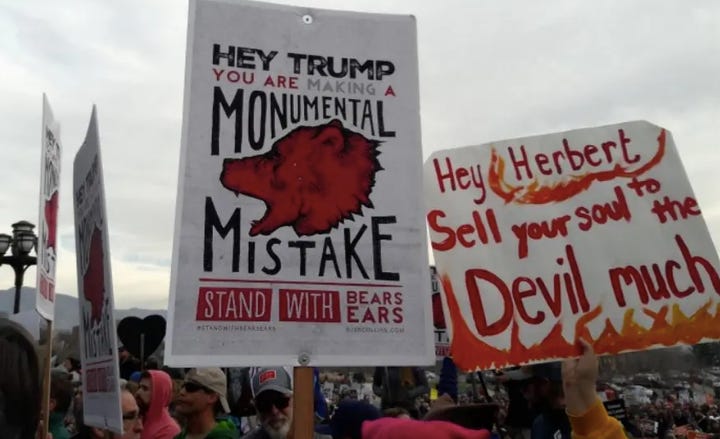
While Bears Ears monument signs have been quickly taken down and the seals of the five commission tribes removed from many of the remaining ones, some organisations, including Earthjustice and the Southern Utah Wilderness Alliance, have been equally quick to pledge legal action. In addition, numerous other conservation organisations have come out in opposition to the proclamations, as have 34 senators, more than 115 outdoor businesses and many members of the public, some of whom have participated in demonstrations.
“No political decision can sever our connection to this place, erase our histories, or diminish our responsibility to care for it,” runs a BEITC statement issued late last month. “Our ancestors lived here and our cultures continue to thrive here. Our responsibility endures, and we will continue this work for our children, our grandchildren, and the generations yet to come.”
“What has not changed is the Tribes’ connection to Bears Ears or their responsibility to care for it,” the BEITC tells me. “The Tribes are still here, and the work continues.”
Comments
Nothing yet. Say the first thing.
Sign in to join the conversation.