
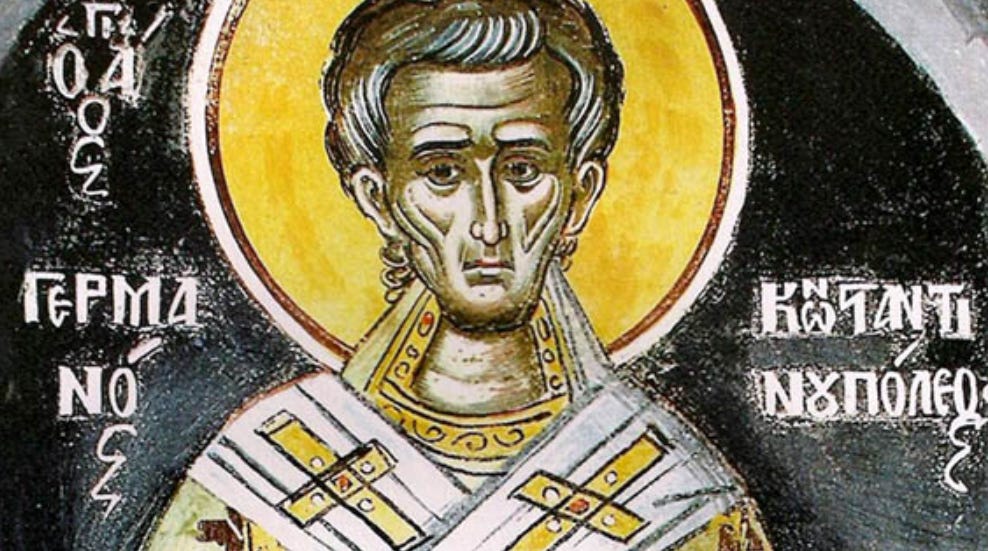
A glance at history will show us something we might today find rather shocking. Why did some Christians become willing to suffer exile, imprisonment and even death for painted images?
Most Christians today take sacred images, (or what they think are sacred images) for granted. They’re just there, like the illustrations in your children’s picture bible. Walk into almost any Catholic or Orthodox church and you’ll find Christ, the Virgin Mary, saints and angels everywhere you look in paintings, mosaics and statues. It feels as though Christianity has always accepted religious images.
But for more than a century, the most powerful Christian empire in history attempted to abolish them. By the decrees of Christian rulers, icons were destroyed and the monasteries and clergy defending them were aggressively persecuted by the state. Bishops and patriarchs were deposed and exiled, monks were imprisoned and killed, and the controversy finally became so severe that it threatened to divide Christianity permanently.
Why did some Christians become willing to suffer exile, imprisonment and even death for painted images? Well, we have a large body of writing from those same Christians explaining it.
I think its immediately relevant, because what we are seeing today, ironically with a huge deluge of online images, is in reality another great iconoclastic movement. This time the images are not necessarily being smashed with hammers or scraped from church walls. Today, the very idea of the sacred image is hollowed out. We have forgotten the distinction between a liturgical holy image, that formally represents a real person in heaven, and illustrations manufactured to provoke an emotional response. And now, with the arrival of generative AI, we have begun producing entirely fictitious “sacred” images of saints and martyrs, extruded at random from a virtual slurry of third-rate mass produced work and vomited out everywhere.

Today’s post is first of a series of a deep scholarly dive for paid subscribers, to follow up last week’s repost introducing iconoclasm as an idea and historical reality, a disaster for the Church that had centuries of repercussions. Westerners have long since simply forgotten what our sacred images are for, so it seems baffling to us that people would bleed and die for them. It’s time we were reminded.
In this series we’ll hear from the defence, from surviving primary sources. The saints who defended them are largely forgotten in the West, but they are still great in the mind of the Church, with many of them saints shared between East and West. In Part I today we’ll start with St. Germanus, a patriarch of Constantinople who directly opposed the Emperor’s decrees.
The documentation comes from the proceedings, the verbatim record of what was formally read out and said, of the Second Council of Nicaea of 787. It has come down to us through nearly 1240 years of history, and includes much of the theological source material the council used to make its judgement that icons not only may but must be used in Christian worship. I have a PDF of an 1850 translation of these documents, and have included exerpted texts from it as downloadable pdfs below.1
New here? Start here.
The Sacred Images Project is dedicated to the history, theology and practice of Christian sacred art. Through essays, guided Reading Rooms, videos and other resources, we aim to recover the visual language that shaped Christian civilisation for more than a thousand years and make it accessible to artists, students and anyone who wants to understand it.
If you’ve only just discovered the project through Google, a recommendation, or a shared article, click the Start Here button below to get the big picture and find the best place to begin.

Become a member
The Sacred Images Project is a unique source of thought on sacred art, and a permanent reference library for its history, theology and practice.
Free subscribers receive regular public essays, news and updates.
Paid subscribers get the more substantial research: long-form essays on the history and theology of Christian art, extra materials below the paywalls with serious looks at ancient primary sources, close examinations of individual works and artists.
Subscriptions support the research and writing that keeps the whole project going.
Paid members receive:
Weekly subscriber-only essays and in-depth series
Full access to the Reading Rooms and growing archive
Downloadable resources, high-resolution images and other member extras
Membership in the Ars Sacra Association and future members’ benefits
Annual membership: $75, 30% off the monthly rate.
Comments
Nothing yet. Say the first thing.
Sign in to join the conversation.