
Look at this painting for a moment.
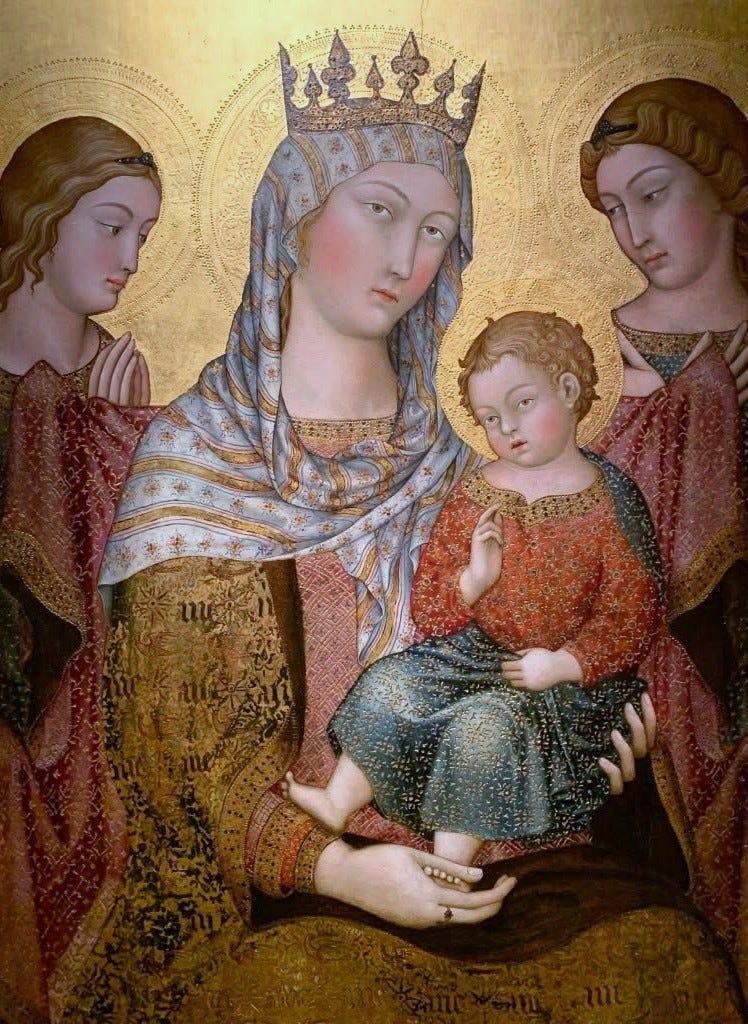
If I hadn’t told you the date, would you have guessed the early fifteenth century?
Even readers who’ve been following the Sacred Images Project for a while might hesitate. At first glance, this looks like a classic mid-14th century, “Trecento” Sienese Gothic Madonna.
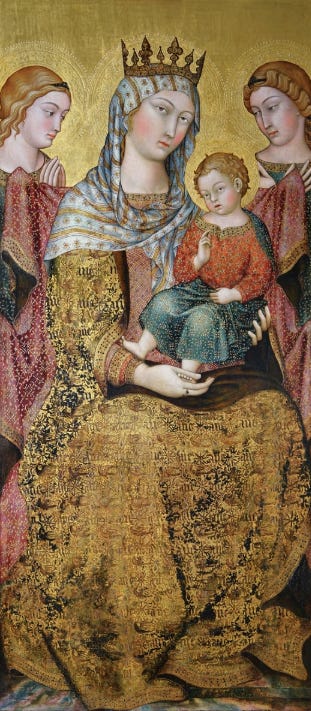
It has all the notes: a glowing gold background functioning as non-natural space, meticulously and elaborately tooled and stamped to show the haloes, the richly patterned cloth created by picking out the paint with the sgraffito technique to expose the gold underlay.
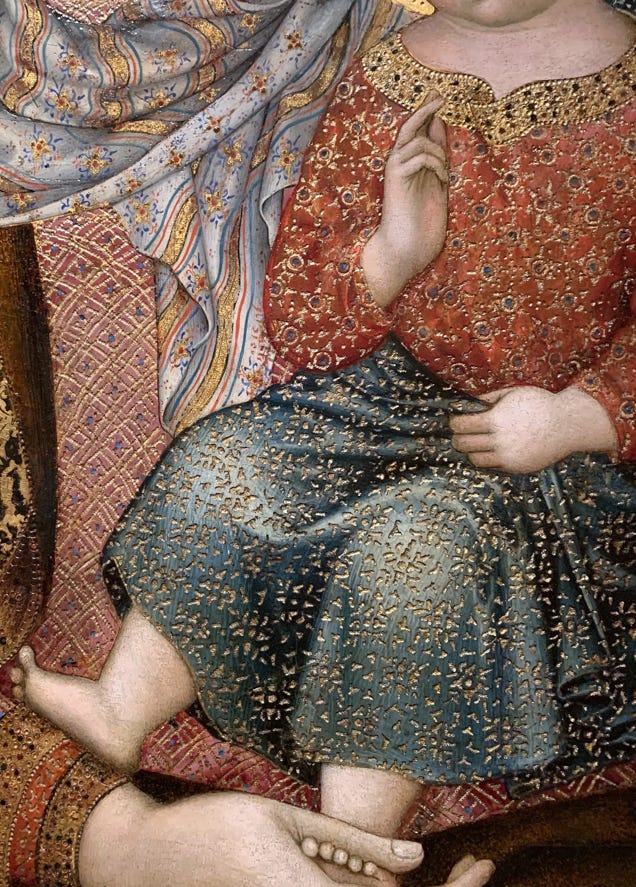
Here are the typical Sienese gentle almond eyes, elongated figures, softly rounded and luminous features, and the solemn little Christ Child, royally dressed, blessing the viewer. It all belongs to a visual language that seems to have come straight from the age of Duccio and Simone Martini.
New? Here’s our introduction to Duccio and the Sienese Gothic.
But this isn’t 1340. It was painted around 1405, sixty-five years later. What makes it so intriguing is that the great flowering of the Sienese “golden age,” so characterised by this very distinctive painting style, was supposed to have ended quite abruptly in 1348, with the Black Death that wiped out 50% of Siena’s population in a single year. But we will see below that this is an oversimplification. What if Siena wasn’t behind Florence but simply disagreed with Florence?
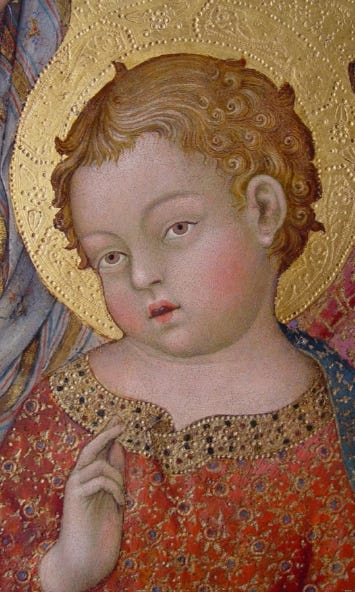
It is true that by the beginning of the fifteenth century, Siena had ceased to be the advancing edge of Italian sacred art, and Florence (Siena’s great rival city-state) that had already spent decades moving in quite a different artistic direction, was taking the lead. With the prominence of Giotto’s work, patrons increasingly wanted convincingly rounded and weighty figures, believable 3-dimensional space and a stronger sense that sacred figures occupied the same physical world we do. The great Florentine innovations of the early Renaissance were only just over the horizon.

Today’s post is divided into two parts. In the paid section below, we will look more closely at Taddeo’s career, other works and how he fits into the larger picture of his time in central Italy, with painters like Fra Angelico rising in Florence, and Gentile da Fabriano doing magnificent gold ground “Gothic” style works.
The first part of today’s post is free to read in full. Paid subscribers can keep going afterwards, as we dig further.
Yet here, barely eighty kilometres away, Taddeo di Bartolo was producing a Madonna that seems, at first glance, to belong to a previous age. What’s especially interesting is that Taddeo certainly would have known perfectly well what contemporary painters were doing in Florence. This isn’t some provincial painter in 1405 who hasn’t heard that Giotto happened. He had worked in Siena, Genoa, Pisa, Perugia, Padua and elsewhere. The conservative character is therefore much harder to explain as incapacity or ignorance.
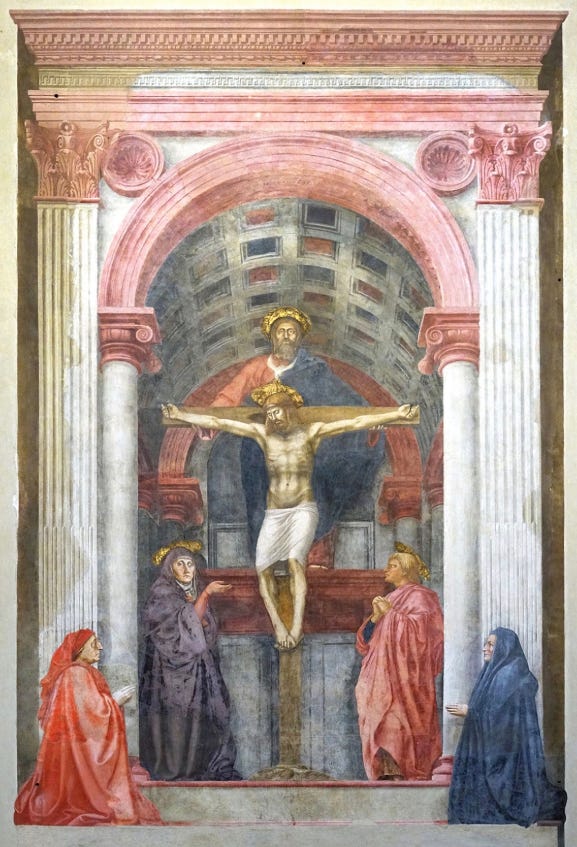
1405 was the beginning of Taddeo’s mature period, by which time Giotto had been dead for nearly seventy years. Florence had been developing a profoundly different pictorial language for a couple of artistic generations. And within twenty years Masaccio would be painting the Trinity. We are already standing on the conventional threshold of the Early Renaissance.
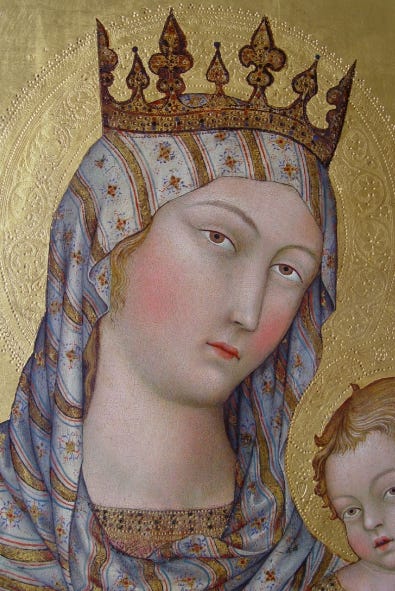
The painting has its own mysteries. It’s known as the Madonna di Belverde, though no one is entirely certain why. The unusual green-gold mantle may have given it its name. Or it may have been that the chapel it was hung in was decorated with green cloths. It became the most venerated image in Siena in the early sixteenth century during an outbreak of the plague, when people came to pray before this image to plead to be rescued and the city was spared a second calamity.
It also took a while to certainly attribute it to Taddeo di Bartolo. The website of the company that did the recent restoration, says:
Since the early 17th century, the ‘Belverde’ Madonna has been attributed to Jacopo, master of Taddeo di Bartolo. Ancient sources record that the painting was commissioned from “Jacopo” by the Petroni family in their will in 1363, but they only built a chapel after 1390, and the ‘Belverde’ panel appears to date around 1405. The controversial attribution to Jacopo di Mino is resolved by the painting’s style and the discovery of a partial inscription “eus” at the bottom of the composition, logically part of “Tadeus.”
For centuries people thought it was by Jacopo, Taddeo’s teacher, because stylistically it sits so comfortably within that earlier Sienese tradition. In other words it fooled generations of connoisseurs and restorers.

New here? Start here.
The Sacred Images Project is dedicated to the history, theology and practice of Christian sacred art. Through essays, guided Reading Rooms, videos and other resources, we aim to recover the visual language that shaped Christian civilisation for more than a thousand years and make it accessible to artists, students and anyone who wants to understand it.
If you’ve only just discovered the project through Google, a recommendation, or a shared article, click the Start Here button below to get the big picture and find the best place to begin.
Become a member
The Sacred Images Project is a unique source of thought on sacred art, and a permanent reference library for its history, theology and practice.
Free subscribers receive regular public essays, news and updates.
Paid subscribers get the more substantial research: long-form essays on the history and theology of Christian art, extra materials below the paywalls with serious looks at ancient primary sources, close examinations of individual works and artists.
Subscriptions support the research and writing that keeps the whole project going.
Paid members receive:
Weekly subscriber-only essays and in-depth series
Full access to the Reading Rooms and growing archive
Downloadable resources, high-resolution images and other member extras
Membership in the Ars Sacra Association and future members’ benefits
Annual membership: $75, 30% off the monthly rate.
Patronages and one-off donations
The other way you can help support the work is by making a one-time donation or by signing up for a patronage through my studio site, where you can choose for yourself the amount you contribute. Anyone contributing $9/month or more there will receive a complimentary paid monthly membership here. This helps me a lot because it is not subject to the 10% Substack fee.
Join us below to dive deeper into Taddeo’s work in the larger context of what was happening with sacred art in central Italy of the early 15th century.
Comments
Nothing yet. Say the first thing.
Sign in to join the conversation.