
Last weekend, I realised that sushi has dropped out of my life.
I was in a museum with my sister, both running after our respective sons, when she mentioned that she made sushi recently. I stopped, stunned. Sushi… sushi….it sounded familiar. I used to eat it all the time. But I haven’t eaten it in… years, maybe.
When we moved to the countryside from London in 2020, I told R that we can’t lose ourselves. We must preserve our open minds and thoughts, our creativity and progressiveness, our differences, our respect of differences – all the things I was scared that life outside London would slowly take from us like water boiling two urban frogs. He assured me this wouldn’t, couldn’t, happen.
Sushi, I tell my therapist this week, has dropped out of my life.
She smiles wryly, like she often does. I tell her I don’t think I’m on the same frequency as the countryside, that I know nature is good for me, but maybe in smaller doses?
I don’t see myself in many people, here, I say. I mostly frequent local child-friendly places these days, where the other parents are 10 years younger than me. She gives me her well-practiced, knowing nod, which tells me, very convincingly, that I’m not alone in my thoughts.
“Sure,“ she says, deadpan. “It’s boring here.”
We’ve been seeing each other for about two months, now, and it’s the first time she’s unambiguously expressed an opinion inside these walls, which feel remarkably neutral to say they make up an office room inside her home.
It requires a lot of effort here, she goes on, to find places that are inspiring or aspirational or cultural.
I give her a wry smile, and a knowing nod that lets her know she’s not alone in her thoughts.
--
For almost three years, I know him only from the tail end of his late night cigarette smoke, which I’d sometimes see contrasted in the darkness, floating up over the trees in-between our houses when I stood at the window, looking down the hill, rocking my son back to sleep and counting down from 10 green bottles.
I decided he was in his late 30s, worked night shifts, played acoustic guitar and video games, and ate instant noodles for tea when his wife worked late.
But then, in autumn, some men came in a van and chopped the trees down in his garden. A few nights later, awake and angry, my son asked me to sing him back to sleep. I dutifully went into the hallway, to my spot at the window, and saw the distant outline of his head and shoulders for the first time. Mid-50s, bald, something about him suggesting he’s worked in emergency services, or perhaps in a prison, something that forced him up against the darker side of society.
It was late on a Saturday evening, he was chain smoking out of the kitchen window – the only part of his house I can see – drinking beer from a can, scrolling through his phone. There’s an anxious man, I thought.
--
My therapist calls me her assistant psychologist today. Just flattery, I know, but I do feel – as I’m sure many people in therapy do – that I’m getting a free education. I take the learning home with me between sessions, carefully stashing things in my mind as secret homework, and form rudimentary theories over the week to announce at my following session.
One thing I’m learning is that I’d benefit from shifting my attention more to my external environment. But this is difficult when I spend so much time at home. Me, R and our son – and our tumultuous beginnings as a trio – are built into these walls. The furniture is covered in my thought patterns, memories on every stair of times I climbed them wearily through early motherhood, each seat a place of catastrophising and rumination – all infidelities from my burgeoning potential as an assistant psychologist.
--
I don’t see the woman for the first few weeks after the trees came down. Older, in her late 70s. Her upper back so hunched over that she has to stand on a stool in the kitchen to see what she’s doing. So, the window reveals to me; the anxious man lives with his mum.
He makes his lunch every weekday morning and takes it to work with a flask of something hot. She comes into the kitchen later in the morning to make a cup of tea, and often starts cooking before he gets home from work, sometimes wearing a floral dress.
One evening R and I are looking out of the French doors in our living room, contemplating how little time we have to look out of the French doors in the living room and contemplate things. We notice the son coming home from work, through the back door into the kitchen. He puts his bag down on the side without even acknowledging his mum, who’s in the kitchen, looking down at the sink. He isn’t a nice man, we decide.
Then, he puts his arms around her and they burrow their heads into each other. They stay that way for about a minute. I see the image every day for weeks, like I’m looking at a painting through the wrong end of a pair of binoculars.
--
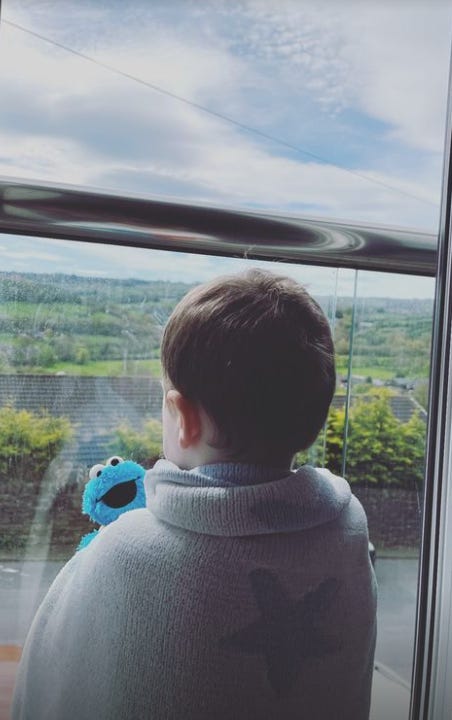
I don’t mean to watch them. I try not to. But they’re right there, whenever I go upstairs, look out the window. Our house is at the top of a hill, designed around the view. Without them, the view is just hills and headlights, connecting me to nothing. I like this new, constant reminder of other lives being lived in parallel to ours, against all the same forces, serving as a boomerang for all the human follies I fear throughout the day.
I decide I’ll wait a while before I write about them. Maybe I’ll see them do something actually interesting. Otherwise, it’ll reveal to everyone how slow my life is these days. But I’m starting to realise that this moment is never going to come. If anything interesting does happen over there, it wouldn’t be discernible to the half-keen eye of a distracted mum of a toddler living 20 metres away. It will be a quiet discussion, a lingering hug, a stationary realisation of one futility of another, or a moment of terror, to be written somewhere on the walls they share.
No posts
Comments
Nothing yet. Say the first thing.
Sign in to join the conversation.