
Greetings from Motown!
I took a road trip over the weekend through Southern Ontario. We got soaked at Niagara Falls, rolled through vineyards and inhaled smoke from wildfires burning hundreds of miles away.
Fortunately, the Canadians we encountered didn’t get mad at us over President Trump’s comments about the dirty air.
But I’m sure glad we got home before Trump slapped a new round of 50% tariffs on Canadian goods, in part as retaliation for Canadian tariffs on U.S.-built cars. Those Canadian tariffs are in turn retaliation for Trump’s earlier tariffs on Canadian aluminum and other goods.
Which brings us to this week’s High Speed Rodeo and our theme song: Bob Marley’s “War.”
“Everywhere is war!”
The reignited and expanding war in the Middle East threatens the global economy and so the auto industry. Oil prices are on the rise again. Many would-be car buyers are sitting on their wallets waiting to see what happens next to the economy.
North American automakers face an increasingly nasty trade war between Trump and Canadian Prime Minister Mark Carney. Perhaps the two leaders will smooth things over around the scheduled July 27 opening of the Gordie Howe Bridge between Detroit and Windsor.
Traffic should have been crossing the span weeks ago. But Trump blocked the opening after an appeal from the owners of the Ambassador Bridge that currently carries much of the freight between Ontario and Michigan.
The bridge drama distracts from the growing competition North American automakers face from Chinese rivals in Mexico and Canada. There’s also increasing pressure on supply chains as Big Tech’s AI building spree sucks up memory chips used in vehicles.
The icing on the cake: Japanese and Korean automakers want to add capacity and fight for share in an American market that has flatlined.
Yes, Tesla Q2 results are due out Wednesday. My plan is to do a special on what CEO Elon Musk has to say. Shareholders are most interested in the rollout of the self-driving Cybercab and Optimus, the humanoid robot. One of the most pointed questions on Tesla’s IR website: “Tesla has missed short term guidance on robotaxi 3 earnings reports in a row, from 50% coverage of USA by end of 2025 to most recently 7 new cities in 1H26. What is keeping Tesla back from accomplishing these short term goals that they've set for themselves?”
OK! I’m late already. Let’s get going:
With vehicle prices and insurance costs plateaued at levels well above pre-pandemic norms, 43% of consumers surveyed by McKinsey said they are delaying their next vehicle purchase, according to a new McKinsey Mobility Consumer Pulse survey out last week.
Over half the U.S. consumers surveyed said they intend to spend less than $40,000 for a new car or truck, which is about 20% below the industry-wide average transaction price.
Cox Automotive, separately, parsed Q2 sales data and found that sales of compact SUVs, which had an average transaction price of $31,113, rose by more than 23% in June from a year ago. Large pickup truck sales rose by just 2.5%.
“While individual product and segment prices climbed, buyers generally gravitated toward lower-priced segments in June,” Cox analysts said. (The report is here.)
The shift toward smaller, cheaper vehicles is wind in the sails for Toyota, Hyundai and Honda. The three Asian automakers increased U.S. sales during the first half of the year, while sales at Ford and General Motors fell by 10% and 7% respectively, according to Cox data.
Sales of Hyundai’s cheapest model, the Elantra, jumped by 22% in June. Elantras start just below $23,000.
All together, the McKinsey survey and the latest sales data show middle income consumers digging in their heels at rising new vehicle prices.
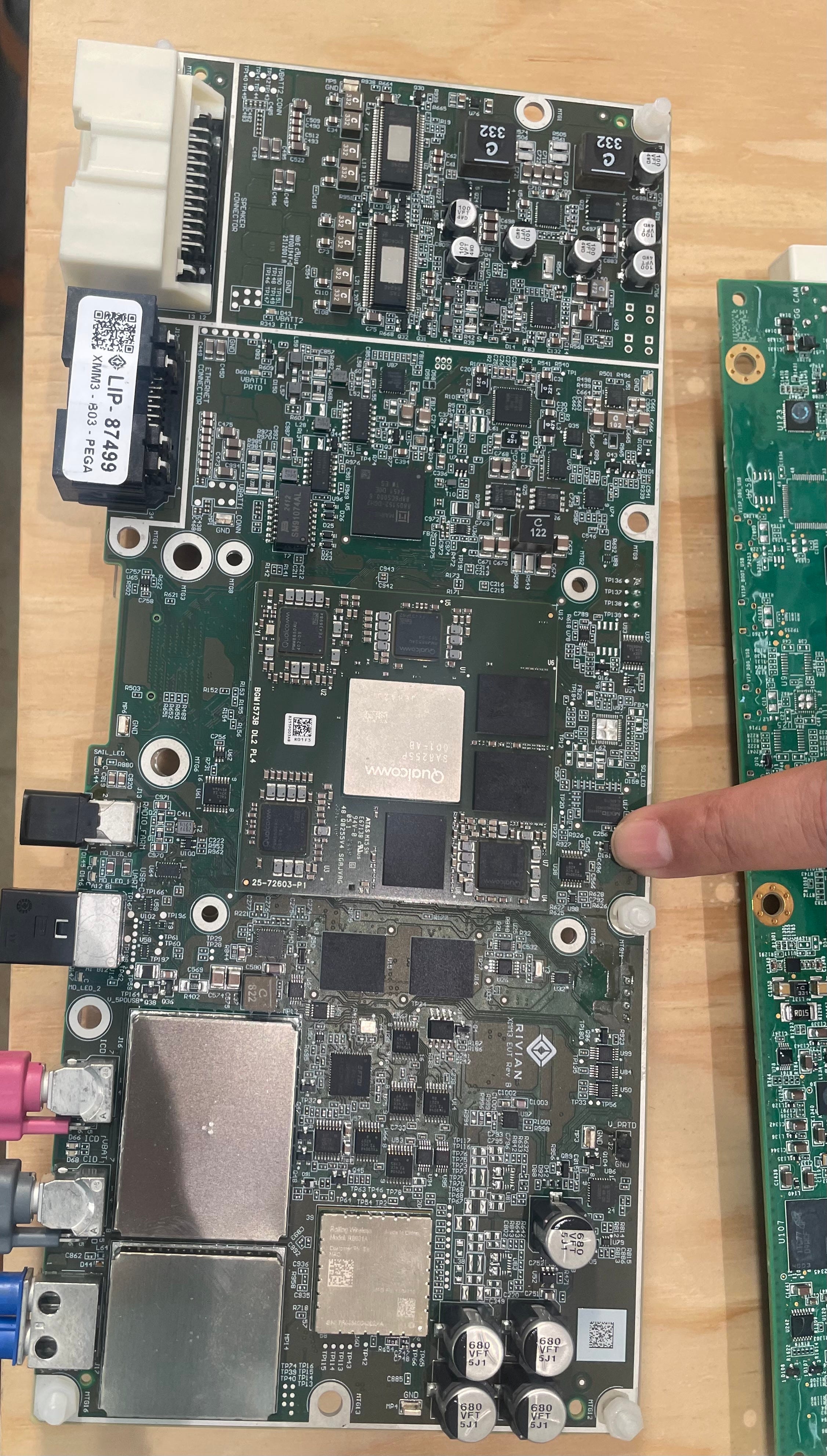
Rivian has engineered Chinese technology out of its vehicle technology stack, software chief Wassym Bensaid told the HSR during a presentation of the new Rivian R2 at the company’s Plymouth, Mich. engineering center.
“None of the connectivity technology we have has any connection with Chinese IP,” Bensaid said, while demonstrating the features of the R2’s infotainment displays. That includes lidar sensors coming early next year to enable higher levels of automated driving. Good news for Rivian investors given the legislation proposed in Congress to ban Chinese connectivity tech from American roads.
Rivian is using a Qualcomm chip to power the brain of the R2, replacing five chips used in the architecture of the R1 model line, Bensaid said.
The R2 architecture “is exactly the foundation that we are using for the Volkswagen program,” Bensaid said. Rivian has a joint purchasing agreement with VW that allows Rivian to take advantage of the German automaker’s scale economies, he said. “We leverage on the Volkswagen volume,” he said. “Our relationship with semiconductor suppliers has completely changed. They see the entry into Rivian as the entry into a much higher volume…with the VW group.”
“There’s a lot of discussion to bring our technology and our platform into even more models” of the Volkswagen group, he said.
On the heels of Toyota’s announcement that it will build a new factory in Texas, Honda CEO Toshihiro Mibe told Japan’s Yomiuri newspaper that he is considering adding an assembly plant in North America. From the article:
The combined annual production capacity of the seven North American plants is 1.67 million units, leaving little room for further production increases. Mr. Mibe said, "We are almost at full capacity. Without a buffer, we cannot make up for lost production."
This as Hyundai pursues a $26 billion U.S. operations expansion strategy.
Friend of the Rodeo Warren Browne is working on a fresh Vehicle Performance Tracker report that will assess the impact of so much new production capacity aiming at a market that promises to be flat as the Kansas prairie for the foreseeable future.
The Mexican government earlier this year imposed stiff tariffs to stem a tide of Chinese vehicles. That did not stop Mexican car buyers from buying more of them.
Chinese vehicle brands boosted sales in Mexico by 30% during the first half, increasing their market share to 17%, Reuters reported.
Mexican officials said the sales came mostly from inventory stocked before the tariffs took hold. Shipments of Chinese vehicles dropped by more than 40% during the first five months of 2026 compared to a year earlier.
The message for established automakers is clear: Tariffs may choke supply, but not consumer demand.
McKinsey found that 60% of Gen Z and Millennial consumers surveyed in Germany and the UK would consider a Chinese brand.
Canada’s experiment in using quotas to limit sales of Chinese EVs will provide more data on how consumers respond to government efforts to restrict choice. My prediction: Canada will open the door wider to Chinese brands, especially if they are willing to take over empty Motor City Three factories in Canada.
“We can’t expect to keep them out forever,” Ford Chair Bill Ford said at an Axios conference in Washington last week. The comments about competing with China start at about 12:30 in this video.
Lucid declared that it is not dead yet. The premium EV maker majority owned by Saudi Arabia’s sovereign wealth fund denied reports that it was preparing to file for bankruptcy protection or go private with help from restructuring firm AlixPartners. That gave shares a lift. All eyes will now focus on what CEO Silvio Napoli has to say about production and liquidity during an Aug. 4 investor call.
Stellantis said its global vehicle sales rose 10% in the second quarter from a year ago. CEO Antonio Filosa named new leaders for two of the automaker’s most important brands, Ram and Jeep.
China has Western economies by the throat thanks to its dominance of rare earth minerals processing, the International Energy Agency said in a new report. The IEA concluded that $6.5 trillion of industrial output could be throttled if China cut off exports of rare earth minerals and related products.
Autonomous ride service Zoox said it will recall its self-driving vehicles because they cannot detect smoke. A Zoox vehicle drove into an area where emergency workers were fighting a fire.
Vindication for hybrids. A new study concluded that subsidizing sales of hybrid vehicles is a more effective way to cut vehicle CO2 emissions than subsidizing electric vehicle sales. “…for a BEV-focused subsidy policy to outperform an HEV-focused policy, the carbon intensity of electricity generation would need to fall by approximately 45%,” the paper’s authors wrote using data from South Korea. This will be music to the ears of Akio Toyoda and others who have urged more government support for hybrids.
The study is here. H/T to Reilly Brennan’s Future of Transportation newsletter.
Speaking of subsidies. California will offer a $3,500 subsidy for EV purchases, partially replacing the $7,500 federal tax credit erased by the Trump budget bill.
Bummer of the week. Writer Matthew Shaer warns in the New York Times magazine that the U.S. auto industry could be “sealing its own doom” by turning away from globally competitive electric vehicles.
This piece matters as much because of the Times platform and its influence on Wall Street and in Washington as for the dour outlook, which is well inside the auto industry commentariat’s Overton window.
Heck, I wrote this back in February: “The pessimistic scenario: Trump’s tariffs and rollback of federal support for EVs will make America a super-sized Havana where Detroit’s national champion automakers crouch behind tariff moats harvesting cash from combustion trucks built on last century technology.”
That said, predicting the future in the World of Cars is a risky business. Automakers often do their best work when their backs are against the wall.
Thanks for reading. More later…
No posts
Comments
Nothing yet. Say the first thing.
Sign in to join the conversation.