
They are certainly not as exciting as dolphins, or as awe inspiring as eagles or even wonderful to watch like otters, but they are members of our Highland wildlife suite that are often talked about and they are both fascinating and worrying.
They are ticks - animals that are part of the class of arachnids, along with spiders, scorpions, mites, harvestmen (see my blog about these harmless long-legged ones here). You can broadly define arachnids as having 8 legs and no wings and they also do not have any antennae like insects do. Ticks have their place in ecology as part of the food web being eaten by birds and as part of the natural selection process.
If you have not heard much about ticks, I will try describing them further.
These arachnids are on a mission to drink blood of their host. They have specialised mouth parts. I have read them described as a combined saw, anchor and straw. These elements help them pierce the skin of their host, grip tightly on and drink. They ‘hope’ to stay on their host until they are full.
Ticks are drinking blood all over the world. For example, there are camel ticks in the middle east and north Africa and tuatara ticks in New Zealand (tuatara are reptiles native to New Zealand). Even in this country we have around 20 species of ticks. The biggest tick I have ever seen was when I worked on Handa Island in Sutherland. Handa didn’t have a lot of ticks but on this day when monitoring the seabirds at the cliffs, I saw one. It was bigger than the deer ticks, Ixodes ricinus, I had seen many of before. It was likely to be a seabird tick Ixodes uriae.
Most species of ticks, of which there are over 900 in the world, do not carry diseases. In the UK, by far the most common vectors are the black-legged deer ticks (Ixodes ricinus).
Deer ticks can be as small as a pin head when larvae and the adult female are as big as a pea when full of blood. Before filling up with blood, they are flat and they have a canny way of crawling on you without being detected.
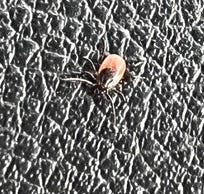
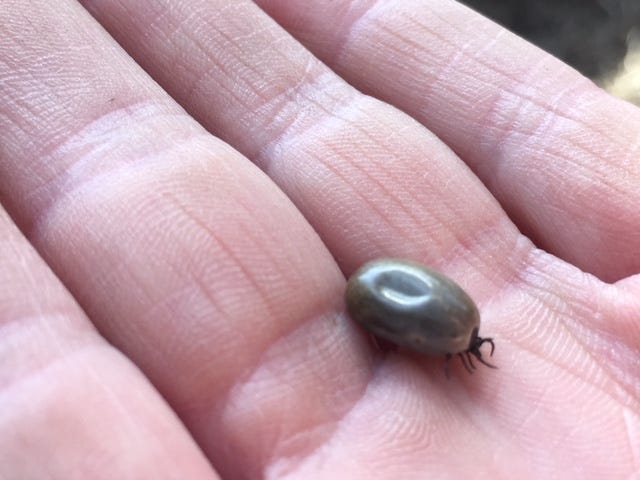
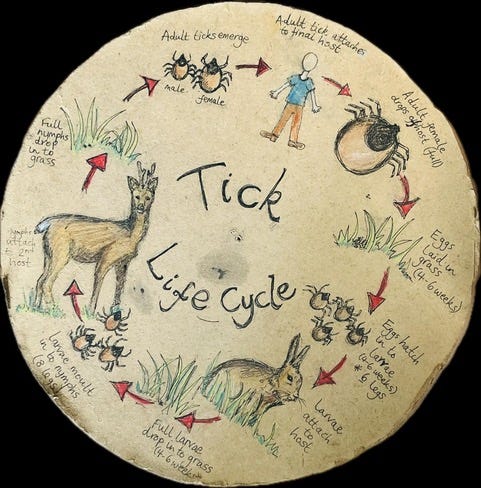
The biologist in me is fascinated by their life cycle. They have four different stages – egg, larvae, nymph and adult. Here are the different steps;
1. Eggs laid in grass
2. Eggs hatch and six-legged larvae emerge
3. Larvae attach to host 1 (usually a small animal)
4. Drop off and moult into nymphs (8 legs now)
5. Nymphs attach to host 2 (medium – humans?)
6. Nymphs drop off and moult and become adults
7. Adults – Attach to final host 3 (large), mating then female full of blood drops off, lays eggs and dies.
Just like biting insects in the Highlands, clegs (horse flies) and midges, it is the female that needs to fill up with blood to be able to produce her eggs. But unlike the midges and clegs, the male ticks also take blood, albeit not nearly as much.
Most people realise that some ticks can carry infections and it is important to have an awareness of this when going out into the countryside where ticks reside, which I am to do sensitively. Some years ago, I made this wheel to take out with me to alert groups to ticks. The last thing we want is for anyone to get poorly when enjoying nature, but we also don’t want people to fear being out and about and experiencing all the other amazing nature of the Highlands. So knowing how to keep your exposure to a minimum is key to staying safe.
Walking through vegetation, particularly long vegetation such as bracken or grass, is where you are most likely to pick a deer tick up. Protecting your skin with clothing is a good way to defend yourself. You can tuck your trouser legs in to your socks and wear a repellent if you wish.
These precautions, as well as thoroughly checking after a day out in vegetation, is what we recommend. If you do find one, taking them out the right way with the correct tool is also important to minimise the risk of rejurgitation and infection from a tick bourne pathogen (see links at the end of this blog for more precautions and tick removal information).
The first tick I remember getting was when I was in P5 in school and since then I have had, probably, hundreds on me. They have been part of my life as a naturalist in the Highlands, unavoidable really, and they have been as much a part of my outdoor life as some of the more outstanding wildlife encounters. I remember them when I studied ospreys as an undergraduate. One of my osprey watch sites I named ‘tick hill’ due to the fact whenever I spent time watching from there, I regularly had a tick or a few.
Then there was a time when I thought I had Lyme disease. I was working in Strathglass and at the time there had been quite a few Lyme disease cases reported in that area. I had also taken to looking at an osprey nest there which I often came back from with ticks attached to me. I was sure my luck had run out after feeling unwell and many years of ticks. Thankfully/luckily I have still never had a positive test result from a Lyme disease test.
Lyme disease (whih is named after a place in the US where it was first detected) is caused by a bacteria Borrelia burgdorferi which hitches a ride in deer ticks (Ixodes ricinus),. This is the tick we most commonly come across in the Highlands. Sometimes it is called a deer tick, sometimes called a sheep tick or a castor bean tick - it is the same species.
While Lyme disease receives most of the attention, it is not the only illness transmitted by deer ticks (Ixodes ricinus). According to the NHS, ticks can also carry Borrelia miyamotoi disease, which causes relapsing fever, and Human Granulocytic Anaplasmosis (HGA), a bacterial infection that can cause fever, headaches and muscle aches.
These infections highlight the importance of taking precautions against tick bites and seeking medical advice if symptoms develop afterwards.
While checking my facts for this blog, I came across another blog about tick-borne encephalitis which is currently found in Europe and has made its way to England. Something we need to be aware of as pathogens could move north.
In the Highlands we have more ticks than anywhere else in the UK and a quarter of all Lyme disease cases come from here. It is potentially a serious issue for people who contract it and I know numerous individuals who have the disease, sometimes with life-changing results.
It is these high numbers of Lyme cases which is perhaps why NHS Highland and Inverness is home to the Scottish Lyme Disease and Tick-borne infections Reference Laboratory (SLDTRL) who since 2018 have been researching ticks and the diseases they pass on to human hosts.
There is clearly a need to research ticks for human health reasons but the direct effects and wider landscape effects on animals mustn’t be ignored either.
An animal heavily infested by ticks, even if there is not a disease passed on, can experience a negative impact its health. I have seen a hedgehog absolutely covered in ticks and hardly able to move. There is a hedgehog tick Ixodes hexagonus that can weigh them down if they are already unwell. Hedgehog ticks can also use other small mammals as a host.
Ticks can also have links to land management practices and species conservation. For example, mountain hares may transmit fatal Louping ill to grouse chicks via ticks. As a result, grouse moors can have the mountain hares culled to try and control the disease which is not a nice thought. In 2021, it became illegal for anyone to cull mountain hares unless they obtained a licence. There is a debate about the available scientific evidence that culling hares stops the tick disease getting to grouse chicks.
Last year a study by Cardiff and Exeter Universities linked the mass release of non-native gamebirds to a 2.5 times higher prevalence of Lyme-causing bacteria in local ticks so the relationship between hosts and carriers is not as simple as just getting rid of hares.
Deer numbers doubling from 500,000 to 1 million since 1990 could also have an impact on the spread of ticks and the diseases they carry. While deer numbers in Scotland continue to rise, this provides more available hosts for the deer tick and we know that deer carry the diseases transmitted by ticks. Tick numbers can also be influenced by the abundance of small mammals, such as mice and voles. These animals provide an important food source for ticks during the early stages of their life cycle, meaning that years with high small mammal populations can lead to higher numbers of ticks later on.
Furthermore, a changing climate is showing that we are experiencing warmer winters and as a result, ticks are active for more of the year. I have seen ticks active in January and February in recent years.
A combination of land use, herbivore numbers and climate changes all seem to be culprits in increasing ticks and the diseases they are carrying but solutions are not simple
Have you noticed your pet collecting ticks? Like me, my dog has had many ticks over her 13 years. She knows the word T.I.C.K – I can’t say it in front of her or she runs away. She obviously doesn’t like them and she gets a lot but it is hard to know how to treat her for them. This year there was quite a bit of press about flea and tick treatments for pets and their impact on the environment. Some of the chemicals found in them can enter the environment and affect water invertebrates such as dragonflies. The same is true for land invertebrates and the ingestible tablets pets can take to keep the beasties away. Even more strength to the argument to pick up your dog’s waste! As soon as these chemicals enter the environment, they will make their way up food chains.
For anyone wanting to learn more, the LymeApp is an excellent resource. Developed with input from NHS Highland, UHI and other research organisations, it provides evidence-based information on ticks, Lyme disease, tick-bite prevention and what to do if you are bitten. The app and web portal also aim to help people better understand tick risk while encouraging safe and confident enjoyment of the outdoors
It is not all doom and gloom. All of this research is increasing our collective knowledge of the issue and there is a lot taking place currently. This hopefully means we will learn more and be able to tackle increase in ticks and the diseases they carry in an informed and environmentally sensitive way.
Broadleaf and ribwort plantain contain compounds that inhibit the bacteria that causes Lyme disease. My mini meadow in Morefield is a blanket of ribwort plantain in the early spring before the other flowers come out. It goes to show conserving wildflowers and ‘weeds’ has potential health benefits as well.
It is important that fear of ticks does not discourage people from connecting with and enjoying the natural environment. The risks are real, but they can be managed through awareness, sensible precautions and regular tick checks. We need to keep talking about ticks, and I will continue to give my “tick talk” at events and remind people at the end to check themselves thoroughly before heading home.
Jenny Grant High Life Highland Countryside ranger for Wester Ross holds a deep passion for the nature and heritage of Scottish Highlands. Her lifelong pursuit involves learning and teaching Highland ecology, embracing both scientific study and local wisdom. Jenny’s holistic approach extends beyond academia; she immerses herself in nature through hikes, wildlife encounters, and community engagement. Her enthusiasm is infectious, often sharing insights and leading conservation efforts. Jenny embodies a commitment to understanding and preserving the diverse ecosystem around her, proving that ecological knowledge is not just learned but lived and cherished.
If you find a tick attached to your skin, follow the advice provided in the websites linked below and remove it promptly using an appropriate tick-removal tool. If you develop any symptoms, feel unwell after a tick bite, or have concerns about possible infection, seek medical advice from a healthcare professional
Medical information from the NHS
https://www.nhsinform.scot/illnesses-and-conditions/injuries/skin-injuries/tick-bites/
https://www.nhs.uk/conditions/lyme-disease/
Tick Scotland website
LymeApp
STDTRL information
Tick borne encephalitis
To report ticks to the UK government’s tick surveillance scheme
https://www.gov.uk/guidance/tick-surveillance-scheme
further good advice from mountaineering Scotland
https://www.mountaineering.scot/safety-and-skills/health-and-hygiene/ticks
British Deer Society information
https://bds.org.uk/information-advice/out-about/lyme-disease-ticks/what-are-ticks/
information about ticks from the Natural History Museum
https://www.nhm.ac.uk/discover/ticks-bites-lyme-disease-how-to-protect-yourself.html
Lyme disease Uk website with more information and latest research
https://lymediseaseuk.com/current-research/
Broadleaf and Plaintan and Lyme Disease Evidence
Broadleaf plantain and ribwort plantain may help treat chronic Lyme disease | EurekAlert!
Comments
Nothing yet. Say the first thing.
Sign in to join the conversation.