
Harrison Keller found this out the hard way. When 2,800 international students the University of North Texas expected to enroll last fall never arrived, the missing tuition compounded state funding cuts into a $45 million budget hole and the elimination or consolidation of 71 academic programs.
Unrelated to the piece below, but worth a watch:
This video reports some of the important topics we have covered previously, including: Grad PLUS new limits, OBBB, access to grad programs, etc.
“Grad PLUS loans were created in 2006, allowing graduate students to borrow up to the full cost of attendance. Total borrowing rose from about $2 billion in the program’s first year to over $15 billion in 2024–25, but beginning July 1, 2026, new borrowers will face annual loan caps, leaving a funding gap for students and universities alike. Supporters say the limits will curb overborrowing and tuition growth; critics warn they could push students toward private loans and reduce access to lower-paying fields.”
This newsletter grows from your shares. Send it to a fellow colleague today!
In today’s issue (free analysis):
What the international enrollment collapse actually looks like this year, told through the institutional numbers behind the headlines
Why a story about foreign enrollment turns into a story about your clients’ financial aid, once you follow where the money actually comes from
The specific programs, positions, and tuition increases that have already disappeared because of this, at a growing list of named institutions
For paid subscribers:
How to check any school on a client’s list for this exact financial exposure before this fall’s applications go in
What that exposure predicts about which majors and programs are actually safe to build a list around, and which ones deserve a second look
The specific questions to ask a financial aid or admissions office, and what it means when the answer is silence
Paid subscribers get the full analysis every issue, including the practitioner frameworks in the section below the paywall. If this newsletter helps you stay ahead in your work, a paid subscription is one of the better professional investments you can make. Many readers expense it as professional development.
Keller was starting his second year as president of the University of North Texas last fall when the number came in. Full-tuition-paying international students, especially graduate students, who Keller has said bring $20,000 to $25,000 each to the university’s bottom line, underwrite institutional services, staffing, and domestic financial aid. When 2,800 of them didn’t show up, UNT lost the exact revenue cushion that had previously offset state budget pressures.
“I picked a hell of a time to become a college president,” Keller said.
UNT eliminated 71 academic programs. Its budget office projects another $47 million in lost revenue next year, though Keller expects the actual hit to land closer to $25 million given the cuts already underway. None of this made national news the way a campus protest or a visa raid does. It is, instead, the kind of story that shows up quietly in a family’s acceptance letter, in a program that no longer exists in the form it did when a student applied to it, or in a financial aid package that is smaller than the one a sibling got two years ago at the same school.
The scale of what happened in the past twelve months is easy to undercount if you only see it in pieces. Put together, it represents one of the most significant recent declines in international enrollment across US higher education.
The Institute of International Education’s Fall 2025 Snapshot, which surveyed more than 800 colleges, found new international student enrollment down 17% compared with fall 2024. NAFSA’s economic analysis of that same data found it translated into a 7% decline in total international enrollment once students on Optional Practical Training are excluded, more than $1.1 billion in lost revenue, and nearly 23,000 fewer jobs supported nationally. The damage was not evenly spread. Undergraduate enrollment actually rose 2%, likely reflecting decisions and visa appointments made before the sharpest policy changes hit. Graduate enrollment fell 12%. Non-degree enrollment fell 16%, cutting into the student populations that often generate the greatest tuition revenue for institutions.
Common App’s own data, independent of IIE’s survey, shows the same direction. As of March 1 this year, international students submitting applications for the 2026-27 cycle were down 9% from the same point in the prior cycle.
The picture got worse heading into this spring. A May survey of 149 institutions, conducted by NAFSA and partner organizations, found 62% reporting lower international enrollment across undergraduate and graduate programs combined, with new undergraduate enrollment down 20% on average and new graduate enrollment down 24%. And the most current federal data, tracking actual international student arrivals into the country, shows the decline has not leveled off: arrivals were down 5% in March, nearly 8% in April, and 1% in May of this year compared with the same months last year, on top of a nearly 22% drop in arrivals last summer compared with the summer before.
In other words, this is not a single bad semester that colleges are already recovering from. It is a trend that has now compounded across multiple enrollment cycles, and it is still moving as your current clients build their lists for this fall. Ten days ago, the Department of Homeland Security published a final rule ending “duration of status,” the decades-old system that let international students remain in the country for as long as they made normal progress toward their degree. Starting September 15, students and scholars will instead be admitted for a fixed period tied to their program, capped at four years, and required to file a formal extension application with U.S. Citizenship and Immigration Services if they need more time. The rule represents another significant policy change affecting future international students. It is still being written.
The instinct is to read international enrollment as a story about global politics, campus diversity, or immigration policy, all real, but distant from the domestic families an IEC actually advises. Follow the money instead, and the distance disappears.
International students are about 6% of enrollment nationally but generate roughly 12% of tuition revenue, according to research using 2016 enrollment and finance data, a share that may be higher today, though updated national estimates are not yet available. At institutions most dependent on this population, international students can account for more than 30% of total revenue. The reason is straightforward: nationally, only 16% of domestic undergraduates now pay the full sticker price, after years of colleges deepening their discounts to compete for a shrinking pool of American high school graduates. More than 80% of international undergraduates pay full price. Several public research universities, including Minnesota, Arizona State, Iowa, Purdue, Illinois, and Ohio State, charge international students between $874 and $5,218 more per year than even out-of-state domestic students, according to American Council on Education data. At UC Santa Barbara, international students pay more than three times what California residents pay, higher nonresident tuition that institutions use to support their overall finances, including institutional aid.
This is the mechanism Moody’s Ratings has been warning bond investors about since last summer. In its stress-test analysis of the colleges and universities it rates, Moody’s found that institutions where international students make up more than 20% of the student body, about 11% of the institutions it rates, face the sharpest financial exposure to enrollment declines. Modeling a relatively modest 10% drop in international enrollment, Moody’s found that 54 of the 392 institutions it rates would see a meaningful hit, at least half a percentage point, to their operating performance. Some reported enrollment declines this year exceeded the magnitude of the scenario Moody's modeled.
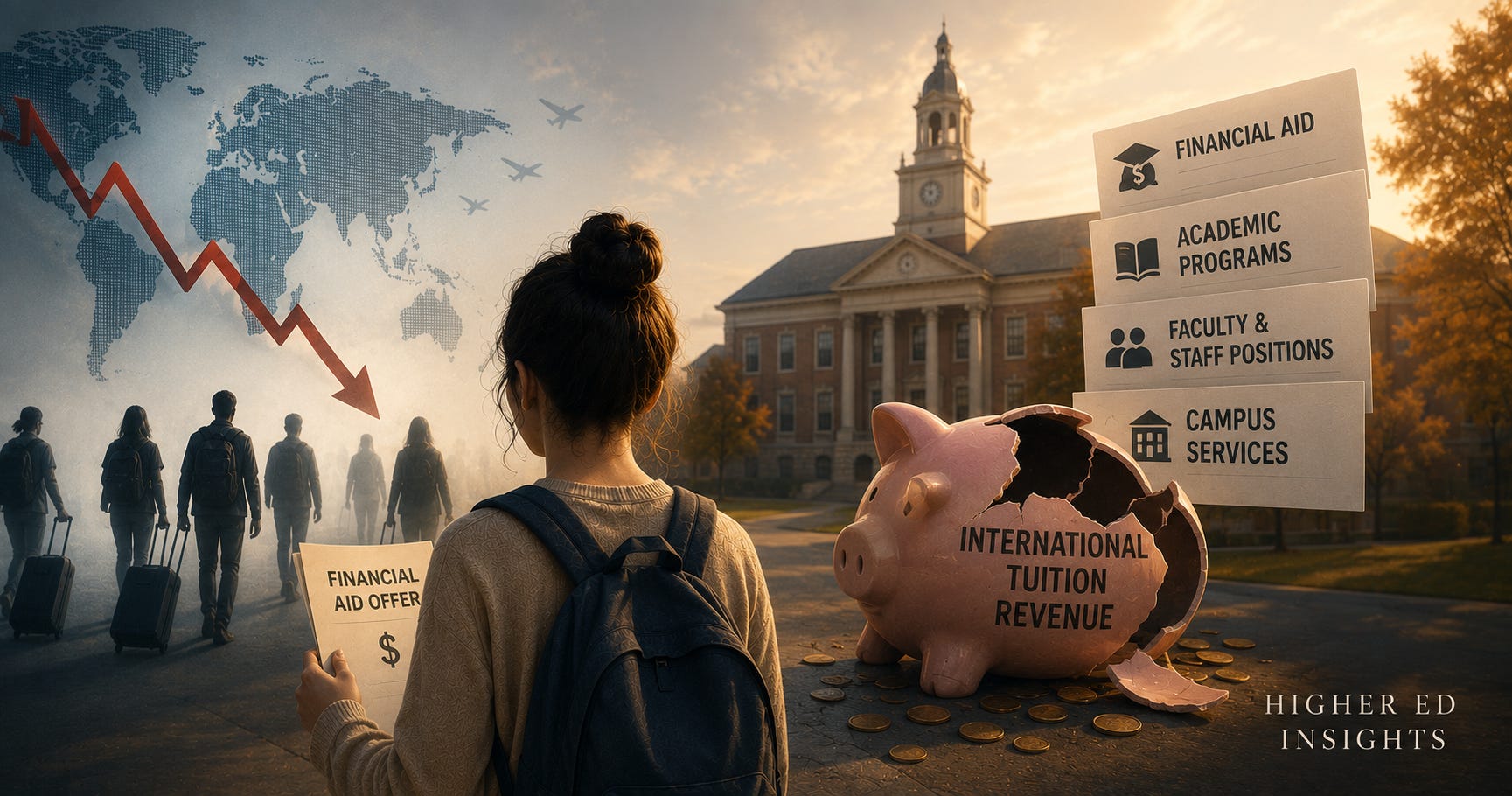
What this means in practice is that the international students your clients’ target schools have been losing were not simply filling seats. At a meaningful number of institutions, they provided unrestricted tuition revenue that many institutions used to support operations, academic programs, and institutional financial aid. When that revenue disappears, it does not vanish quietly into a spreadsheet. It shows up as a program that gets consolidated, a position that gets cut, or a tuition increase that lands on the family sitting across from you at the intake meeting.
This is no longer a forecast. CollegeCuts has tracked more than 300 publicly reported instances of colleges eliminating programs, closing departments, or reducing staff since January 2024.
Beyond UNT, DePaul University laid off 114 employees after its international enrollment fell 30% overall, driven by a decline of roughly two-thirds in new international graduate students. The University of Southern California cut nearly 1,000 jobs, including academic advisers, after citing an expected decline in international students, whose graduate applications to USC had already fallen 23%, among its financial problems. Northwestern eliminated 425 positions, froze hiring, and delayed building projects, citing federal research funding freezes alongside projected international enrollment drops. The University of Texas at Arlington saw international enrollment fall 20% year over year, its steepest annual decline in a decade, with graduate international enrollment down 36.8% specifically. A draft UT-Arlington budget projected that decline in graduate students alone would cost the university between $13 million and $15.6 million in tuition revenue this fiscal year.
Syracuse University posted a rare budget deficit tied in part to declining international enrollment and raised tuition nearly 4% for the coming year, to a total cost of attendance of about $96,000. The New School, facing its own deficits and layoffs, raised tuition 3.5%, to roughly $93,000. The California College of the Arts announced it will wind down operations and close by 2027, with Vanderbilt University acquiring its campus, a decision its president tied in part to persistent budget pressures that international enrollment drops worsened. Boston University, Niagara College, and the Stevens Institute of Technology have each pointed to falling international graduate enrollment among the causes of their own budget cuts and layoffs.
None of this shows up on a campus tour or an admissions website. A family typically encounters it in October, in an acceptance letter for a version of a program that looked different when the student applied to it than the one an older sibling received two years earlier at the same school. What follows is how to check any school on a client’s list for this exact exposure before this fall’s applications go in, and what to actually do with what you find.
Higher Ed Insights is reader-supported. If you are reading this as a free subscriber and you work in college counseling, financial aid, enrollment management, or high school education, the paid section is written directly for you.
Comments
Nothing yet. Say the first thing.
Sign in to join the conversation.