
I’ve been saying it for well over two years at this point. One of the biggest obstacles to adapting to Artificial Intelligence (generative, agentic, predictive, etc.) is the transactional model of education. This model incentives trade-ins:
A student creates educational products (papers, presentations, etc.), as efficiently as possible.
The student trades in educational products for grades.
The student trades in grades for a degree.
The student trades in the degree for a job.
This model has been problematic for a while, far beyond the advent of ChatGPT and other chatbots.But now, it’s easier than ever to bypass the productive friction of learning.
If our students’ are there to earn grades and degrees above all else, then it’s no wonder that they opt to offload their work (and thought) uncritically.
I like this way of putting it, from Tricia Bertram Gallant:
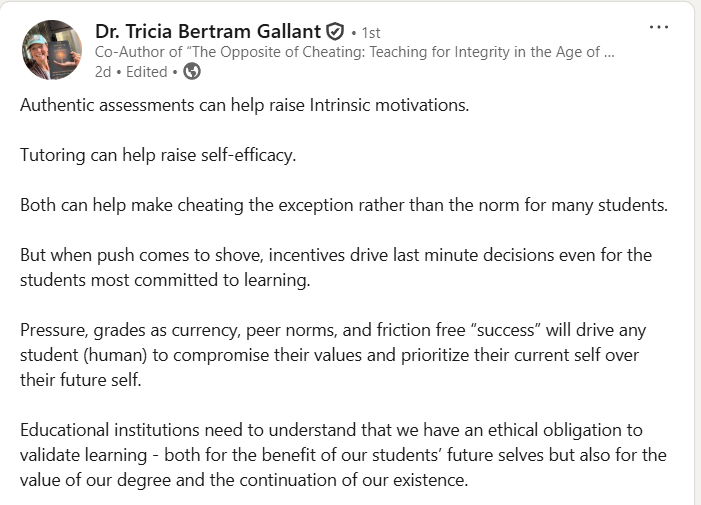
When students create processes, they (like all of us) feel the constant tension between their future selves and their present selves. In many ways, the whole point of higher education (maybe any education) is to encourage students to lean into their present tension and discomfort, confident that it will be worth it down the time.
It’s hard work.
As Gallant suggest in that LinkedIn post, I think that a lot of it comes down to rethinking the incentive structures built into our courses and institutions.
That’s what I’ve been doing.
I’ve been doing this by — over the last 2+ years — trying versions of Competency-Based Grading, Specifications Grading, and Contract Grading.
They each have their promises and limitations. I’ve started to settle into my own hybrid form. And this semester, I’m going to pilot a specific version in my Art of Film course at Berkeley. It’s an online course that has, up until this point, been graded traditionally. I’m choosing this course because (a) making alternative assessment work in online asynchronous courses can be extremely challenging and (b) I want to push against my tendency to focus on my writing courses, for teaching process.
It took me about a day to convert this course to an alternative assessment course.
In this article, I want to lay out the steps I used — not because they’re perfect (or even generalizable), but because I hope that someone will be encouraged to give alternative assessment a try by seeing how someone else implemented it.
The Course Learning Objectives (CLOs) were developed a long time ago, before I was even hired. So, when it came to moving towards alternative assessment, I returned to that structure.
I asked myself a few questions:
What concrete skills are related to those CLOs?
What sorts of assignments can I create that will help me see those CLOs in action?
The first question brought the CLOs down to the level of course design. The second question forced me to vet that skill. If I couldn’t create a few basic assignments around that skill, then it wasn’t going to work long-term.
In my Art of Film course, I ended up with 4 core skills:
Collaborating
Communicating
Analyzing
Being Creative
Here’s what I did next:
When I used traditional grading, my assignment tab looked something like this:
Discussion Boards — 30%
2 Small Projects — 20%
Large Final Project — 20%
Quizzes — 30%
That may look familiar.
But my goal is to move from a task-mindset to a core skills mindset. So, I deleted these categories and (in their place) put my 4 core skills. So, I had categories for Collaborating, Communicating, Analyzing, and Being Creative.
I made each one worth exactly 0%. (I know, it sounds weird.)
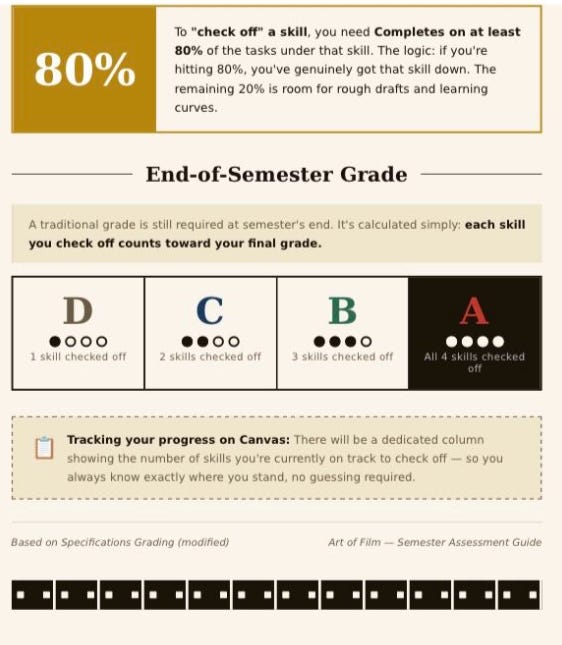
Then, I made one more category: # of Core Skills Being Hit So Far. I made it worth 100% of the grade. This is because I update the gradebook every week, so that students can see exactly how many skills they are on track to hit. (To hit a skill, they currently need to get Completes on 80% of the tasks under that skill. I’m not sold on that threshold yet.)
I set up the gradebook this way because, at the end of the semester, I still need to submit traditional grades. Their grade isn’t based on random percentages. It’s based on how many skills they hit.
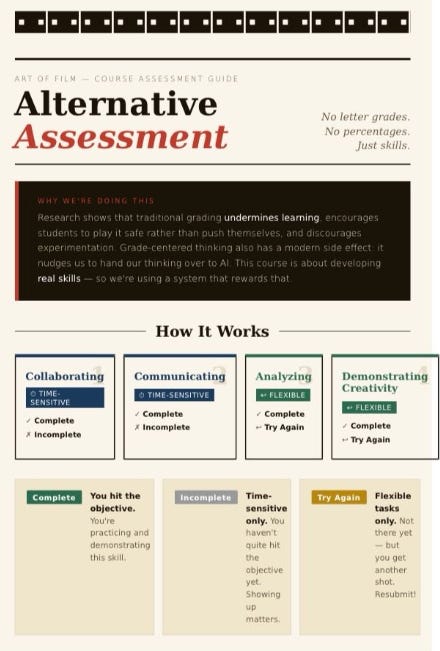
Here’s the infographic I shared with them, to make it a little easier to suggest.
All right…
Now that that’s done, let’s get to some of the nitty-gritty stuff.
Here’s what I did last semester.
Instead of giving percentages or letter grades, I gave only Completes and Incompletes. If a student got a Complete, it means they hit the objective (whatever it is). If they got an Incomplete, it means that I want them to give it another shot for some reason.
But I ran into 2 problems.
Problem 1: Students left a pile of resubmissions until the end. They went through the gradebook and submitted all Try Agains at once. It didn’t help me or them.
Problem 2: Some of the skills (Collaborating and Communicating) are very time-specific. Does it help if a student is Trying Again on a discussion board, when other students moved on a long time ago?
As it turns out, two of my course’s core skills are time-specific. Collaborating and Communicating require showing up at a specific time and place, to connect with someone else. For Analyzing and Being Creative, I’m less invested in whether students do it at a specific time.
So…
I made a change.
I created 2 tracks. Any task under Collaborating or Communicating (my time-sensitive skills) gets either a Complete or an Incomplete. That’s it. This is very close to Asao Inoue’s Contract Grading. The goal is to reward students who spend that specific time (not just any time) on that task.
Any task under Analyzing or Being Creative gets either a Complete or a Try Again. For these assignments, I want students to engage in deliberate practice — where they can give it a shot, pivot, and try again if they need to. The model here is Competency-Based learning and Specifications Grading — where students can practice that skill again and again, until they get it.
I messaged one of my college’s instructional designers, and she mentioned using a color-coded banner to help students see the differences.
Here is the banner I created for time-sensitive tasks:

And here is the banner I created for flexible tasks:

It’s more work up front.
But my hope is that I streamline things further, so that students don’t let the Try Agains pile up.
Again, my goal here is not to provide a perfect form of alternative assessment.
My goals are to:
Continue thinking through the connections between AI and alternative assessment.
Share one way to doing it — in a way that combines different elements of alternative assessment into a single hybrid-form.
Basically, the goal is to just keep moving us forward in thinking through our institutions’ incentive structures and how we can push against them.
If you want to talk to me more about AI and alternative assessment, you know where to find me…
No posts
Comments
Nothing yet. Say the first thing.
Sign in to join the conversation.