
There’s a story in this industry that just won’t die.
Ask veterans in almost any online firearms forum whether the U.S. military ever issued M16s made by Mattel - yes, the toy company - and you’ll get an astounding amount of confident responses. Fort Jackson, 1990. Fort Polk, 1972. Parris Island, 1979. I’ve got a list that I’ve compiled over the last few years and it has 32 different location sightings dating back to 1968 and as recent as 2024.
The names, dates, and locations pile up across decades and bases until the story starts to feel undeniable.
There’s just one problem: it isn’t true.
The Mattel M16 is probably the most persistent and nagging myth in American firearms history, and I’ve spent years tracking it down, filing FOIA requests about it, and explaining why even the most sincere, vivid memories can point us in the wrong direction. It’s a story worth telling properly - not to embarrass anyone, but because understanding how myths like this one take root is actually one of the more interesting things about firearms research.
I’m going to contradict myself right away. You might be surprised to hear me admit straight away that Mattel did, in fact, make an M16. There’s just one problem: it just wasn’t a rifle.
In 1966, Mattel released the M-16 Marauder, a cap-free, battery-free toy rifle that the company marketed as “the most authentic-looking and sounding rifle you’ve ever seen.” It was a hit.
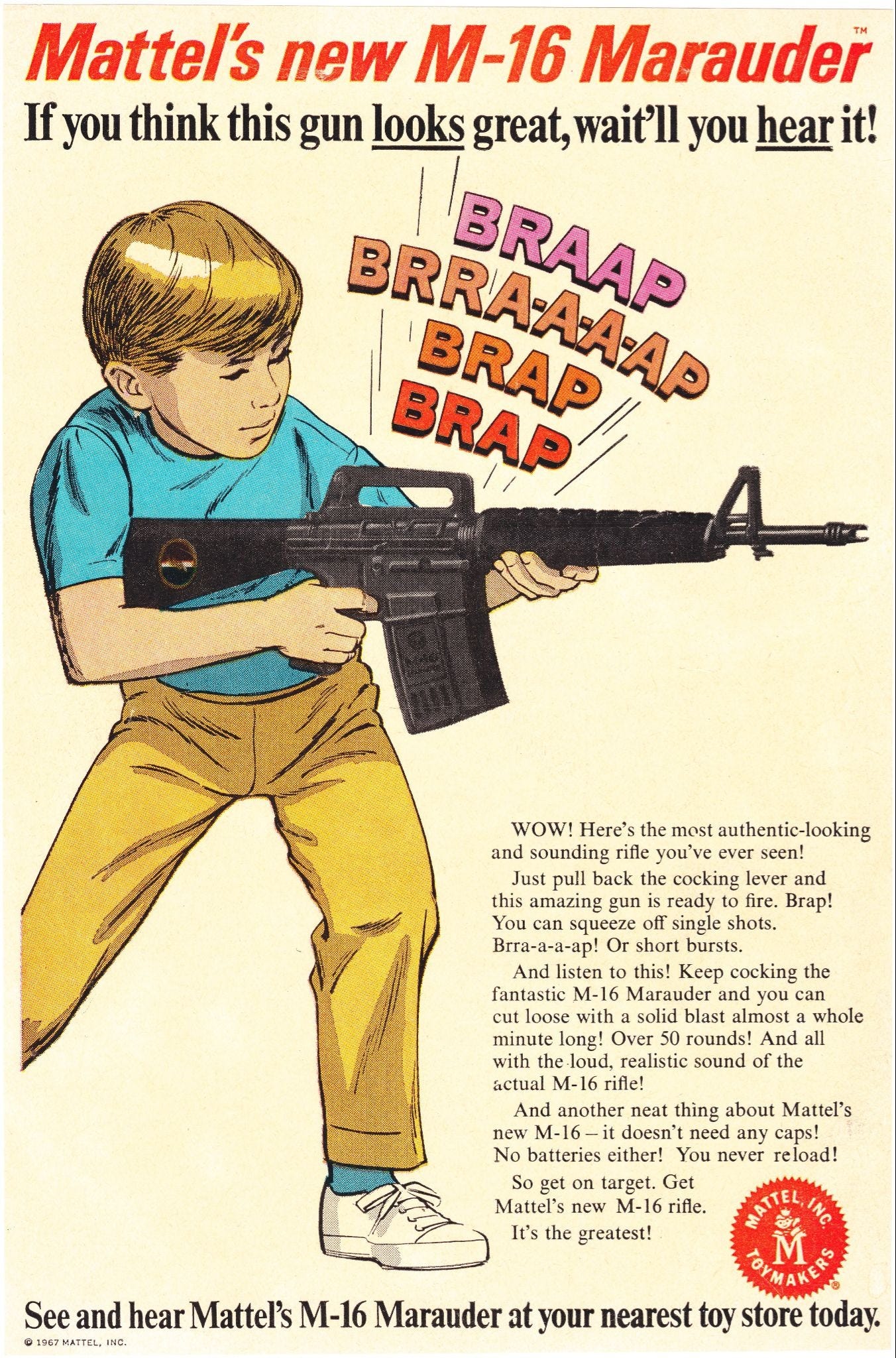
It looked remarkably close to the real thing. Hell, John Wayne even used one in 1968’s The Green Berets as a stand-in for the real thing when he smashed the rifle against a tree.
That proximity to the actual rifle in shape, in feel, and in the plastic materials used planted the first seeds of a story that would outlast the toy itself by decades.
When veterans say they saw “Mattel” stamped on their training rifles, they’re describing something they genuinely believe that they remember. That part isn’t in question. What they saw was likely a toy they’d seen as kids that left a surprisingly durable impression on memory.
I’ve done a couple marathons-worth of legwork trying to find the truth. FOIA requests to the Army and Marine Corps came back without a single record of Mattel manufacturing or supplying complete M16 or M16A1 rifles to the military. Nothing from Fort Polk. Nothing from Fort Leonard Wood. Nothing from Parris Island. Nothing from the entirety of the Department of Defense. I also contacted Mattel directly. Same result.
The locations and dates veterans cite span generations, across dozens of bases, multiple branches of service, and three decades of rifle variants. If Mattel had a genuine government contract to produce military rifles, that paper trail would exist. Documentation of government contracts on that large of a scale don’t just disappear. They don’t get quietly buried in a corporate vault because someone was worried about hippie PR.
This is the part I find genuinely fascinating.
The Mattel M16 myth persists because of a very human combination of factors: a real toy that looked like a real rifle and the natural fallibility of human memory under stress. There’s a reason why eye witness accounts aren’t considered reliable in court.
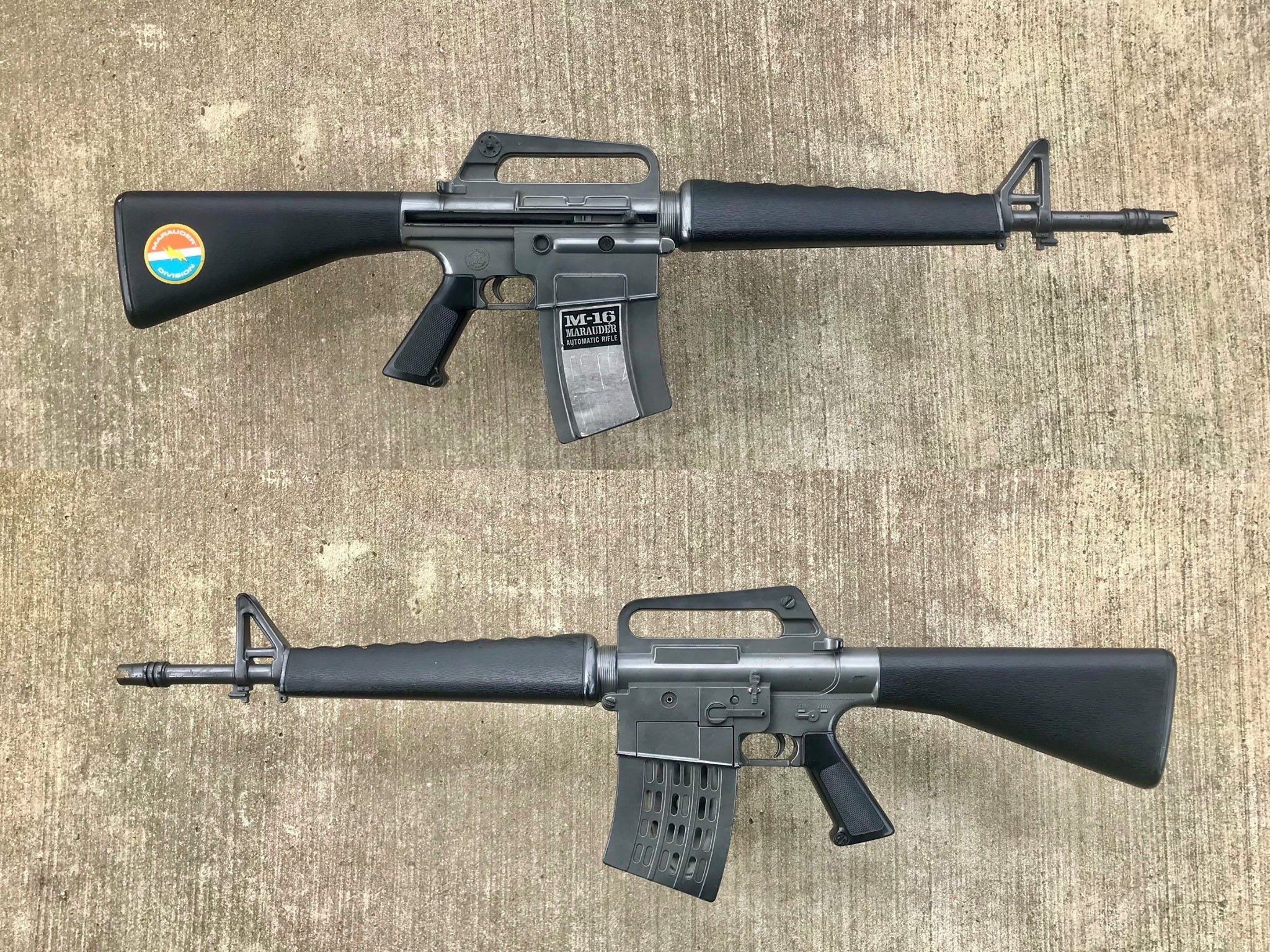
Basic training is one of the more cognitively overwhelming experiences a person can go through. Exhausted and anxious, you’re handed a rifle and expected to know it intimately. If you had the Mattel toy as a kid and the stock on your training rifle felt suspiciously light and plastic, your brain might connect those dots in a way that feels completely factual. That’s not a character flaw. That’s just how memory works.
Unfortunately, memory can indeed be a big problem. I had one vet tell me that the M16A1 he had in basic training in 1984 said Mattel on the plastic furniture and Colt on the lower receiver. He then went on to tell me others he saw had Winchester receivers. That’s a big problem because Winchester never made an M16 or any parts for M16s. So, in his attempt to prove me wrong, he actually proved his own memory to be wrong. Again, not a dig at that veteran; it’s just a fact that memories aren’t always reliable.
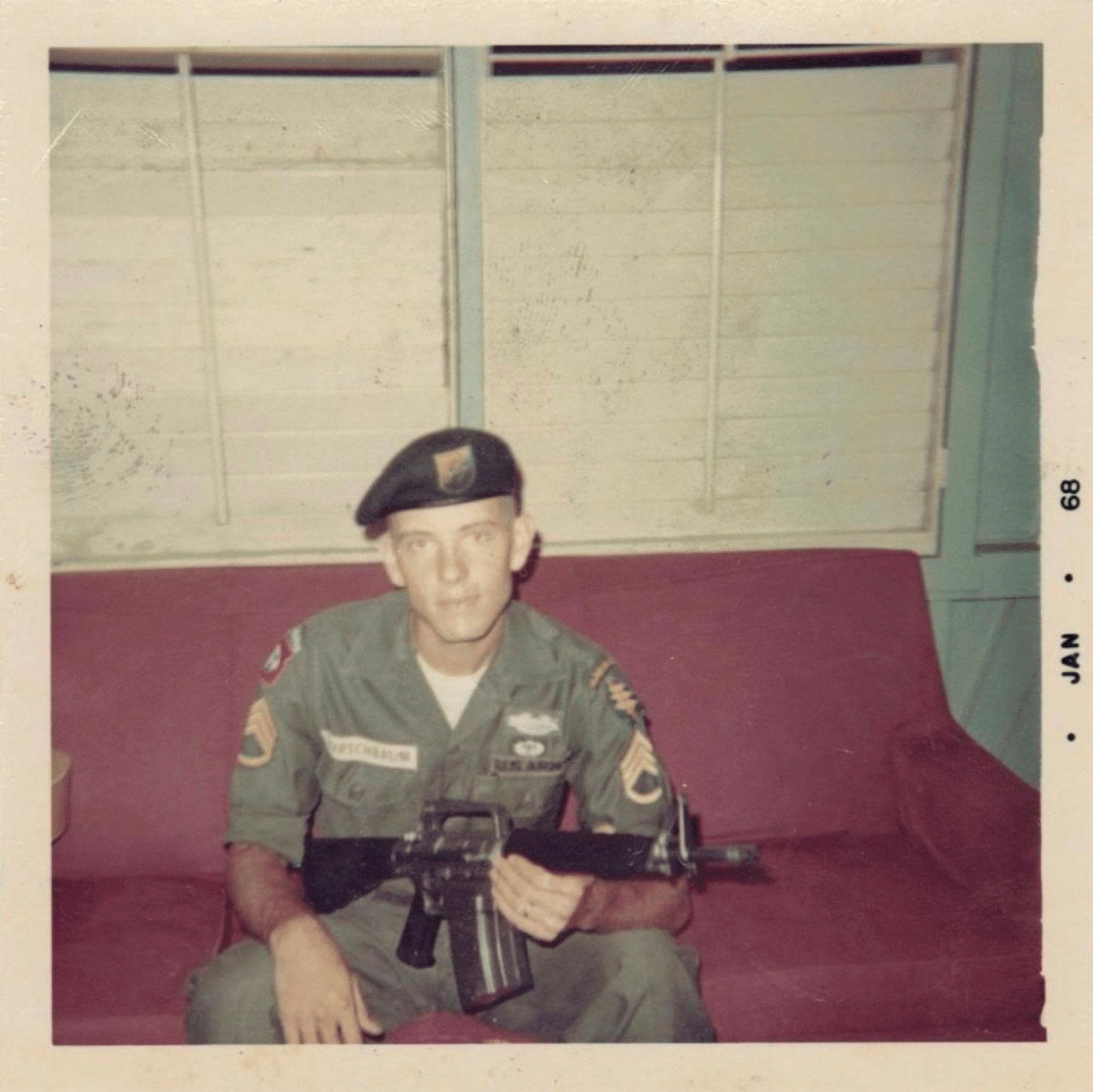
It also doesn’t help that there’s a single photo floating around the internet from January 1968 showing an American soldier in uniform holding a Mattel M-16 Marauder toy.
The problem compounds when the story gets passed down. One veteran tells another and over fifty-plus years, the locations multiply, the dates spread across decades, and the story takes on a weight that feels like it has to be true. At some point, people stop asking whether it’s true and start treating skepticism as an insult.
I’ve seen the online conversations. “We know what we saw.” “Your elevator doesn’t go all the way to the top floor.” “Who are you going to believe - veterans, or the government and a corporation?”
It’s a neat trick, actually. By framing any actual supporting documentation as inherently suspect, the myth becomes unfalsifiable. Any evidence against it becomes proof of the cover-up. That’s not history. That’s a closed loop.
In 2012, a prominent auction house offered a Colt SP1 (the civilian version of the M16) for sale with a bold claim in their physical catalog: “the stock on this rifle was made by Mattel.” They even included the red company logo in the listing (but not on the rifle) and cited further documentation from someone in the gun collecting industry who was sentenced to prison on felony fraud charges related to firearms.
The catalog listing can be found to this day on the auction company’s website. Interestingly enough, any mention of a Mattel connection has been scrubbed from both the text and the photos.
It’s important to note that I’m not knocking the auction house. They were going off of the information that they had at that time and believed to be true. Now that they know it isn’t, they’ve removed it to avoid further confusion.
Even so, the damage has been done. People still cite the physical catalog as proof and, unfortunately, the buyer paid dearly for something that simply isn’t. It sold for more than twice the pre-sale high estimate.
The Mattel M16 story is a useful case study for anyone who collects, studies, or writes about firearms history because it shows exactly how and where research can go sideways.
Primary source documentation matters more than anything else. Not because governments and corporations are upstanding examples of honesty, but because large-scale procurement contracts leave extensive paper trails in multiple locations across multiple agencies. The absence of that trail isn’t suspicious. It’s meaningful.
Physical evidence matters. What doesn’t exist is a complete M16A1 with a Mattel receiver, a government serial number, and an issuance record from any branch of service. There’s not even a handguard, grip, or buttstock with the Mattel logo that has ever been physically documented.
For close to a decade now, I’ve had a standing offer of $1,000 to any person who can show me any physical proof that Mattel made M16 parts or entire guns.
Not long ago, a commenter on YouTube told me that there’s a complete Mattel-marked M16A1 hanging in his local gun shop. I told him to take a picture, send it to me, and I’d give him $1,000. The money remains in my bank account.
Memory is not a primary source. This isn’t a knock on veterans. It applies to everyone, including me. I misremember things. You misremember things. The human brain is not a recording device, and high-stress environments don’t improve accuracy.
Despite what I see all the time, the goal of firearms history isn’t to win arguments in comment sections. It’s to follow the evidence wherever it actually goes, even when it means telling people that the story they’ve been telling for most of their life isn’t quite right.
That’s the job, and the real history is usually more interesting than the myth anyway.
Every firearm has a story. Every story deserves evidence. Whether you’re insuring a single heirloom or managing an entire collection, High Caliber History provides research-backed appraisals that help you make informed decisions with confidence.
Visit High Caliber History Appraisals for more information.
No posts
Comments
Nothing yet. Say the first thing.
Sign in to join the conversation.