
I’ve looked before at people that we owe so much for our knowledge of old Sheffield; mapmakers, photographers, writers - all leave us a legacy, and sometimes they give the only account of its kind. Before cameras there were another group of vital figures, and one that I haven’t gone into until now; artists. There are some panoramic views of Sheffield in the eighteenth century taken from surrounding hills, along with the many portraits of houses and rivers. I want to take a look at one interesting character from the early nineteenth century who painted many views of the old town, and some of the subject matters survive and are recognisable, but some of are long lost. His depictions are the some of the best evidence we have of them - an important figure in Sheffield history, and one of which we know almost nothing; W Botham.
It does seem unlikely that someone could leave many paintings of Sheffield and be so lost to history, and it may well be that more details are there to be discovered. It would be interesting to know his thinking or reasoning for the subject matter he chose - was Botham asked or commissioned to make his paintings, or did he just pick views he liked? He did record buildings that were soon demolished, and scenes that changed soon after - but also well-known and historic sites like Lady’s Bridge. Botham painted a few bridges on the River Don, but he seemed to paint mostly houses which he left us the descriptions of (so we can identify the present-day locations). We can at least study his work, if not the person.
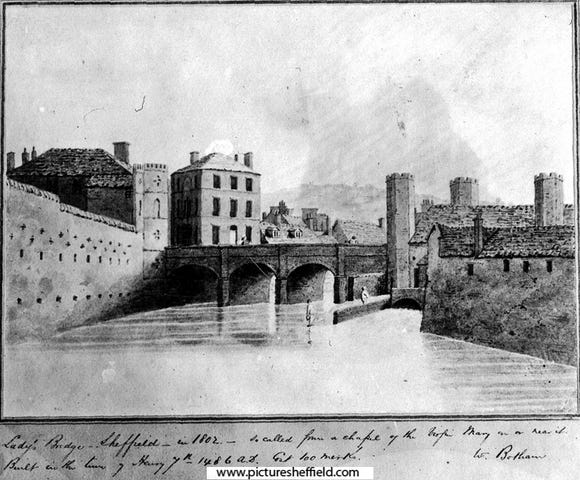
Lady’s Bridge on the River Don by W Botham, in 1802
We start then with a straight forward example of Botham’s work - a view of Lady’s Bridge. It is also interesting as along the bottom is a description which appears to be written by the artist, along with his signature in the corner. Unlike his work of back streets and cottages, and places soon to change, here we have a view that has been portrayed many times through history - maybe we can infer this to be an earlier (or even his first displayed or published) piece of work? The writing dates it as being from 1802, which is at the beginning of the years that we know Botham was actively painting. In the same year Botham depicted Hillfoot Bridge next to the Farfield Inn (both of which still stand), somewhere that would also have been quite a well known view. He then moved on in 1804 to a footbridge located between the two - and this is where Botham first came to my attention.
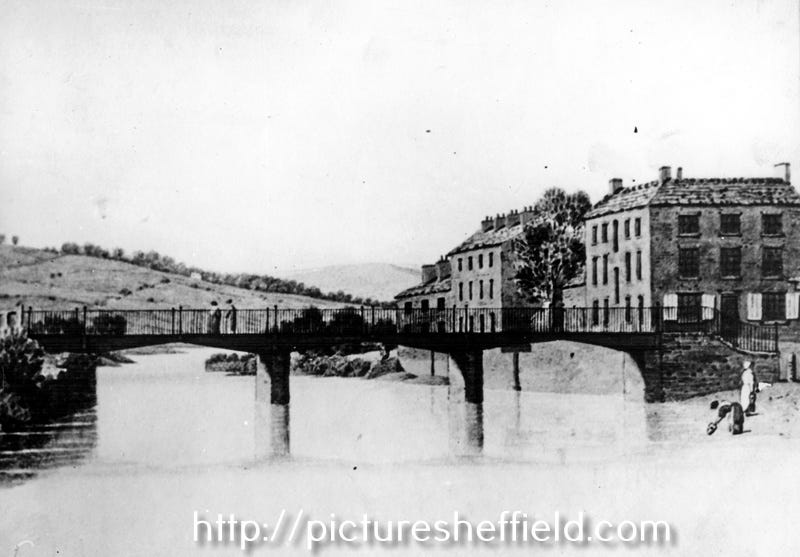
The historic Iron Bridge at Bridgehouses painted by W Botham in 1804
This was also a historic crossing, with a wooden bridge and stepping stones on the Bridgehouses site before the bridge painted by Botham. The footbridge above is very important, as it was the first iron bridge in the region, being built in 1795. In 1804 this was still a new structure standing in open space, only being joined by Borough Bridge at the bottom of Corporation Street when that road and bridge were built in the 1850s. The bridge was destroyed in the 1864 Great Flood, replaced the following year, and an updated version of that structure still survives isolated in the middle of Bridgehouses Roundabout. I have never found a photograph of the 1795-1864 bridge, so this is an important illustration of a piece of lost Sheffield heritage.
The houses that Botham recorded cover different parts of the town, and different sorts of housing too. He painted grand properties in Pitsmoor and Norton, but also workers cottages in the old town centre - the Norton house was demolished soon after his work. It may be interesting that an artist of the period concentrated on structures rather than nature and beauty, and depictions of lost houses are more useful to us now than paintings of woodlands (however nice those views are). Those town centre areas have changed beyond recognition, with one particularly interesting as the cottages on Balm Green (where City Hall now stands) which attracted Botham were photographed a century later, showing the cottages and the background almost unchanged.
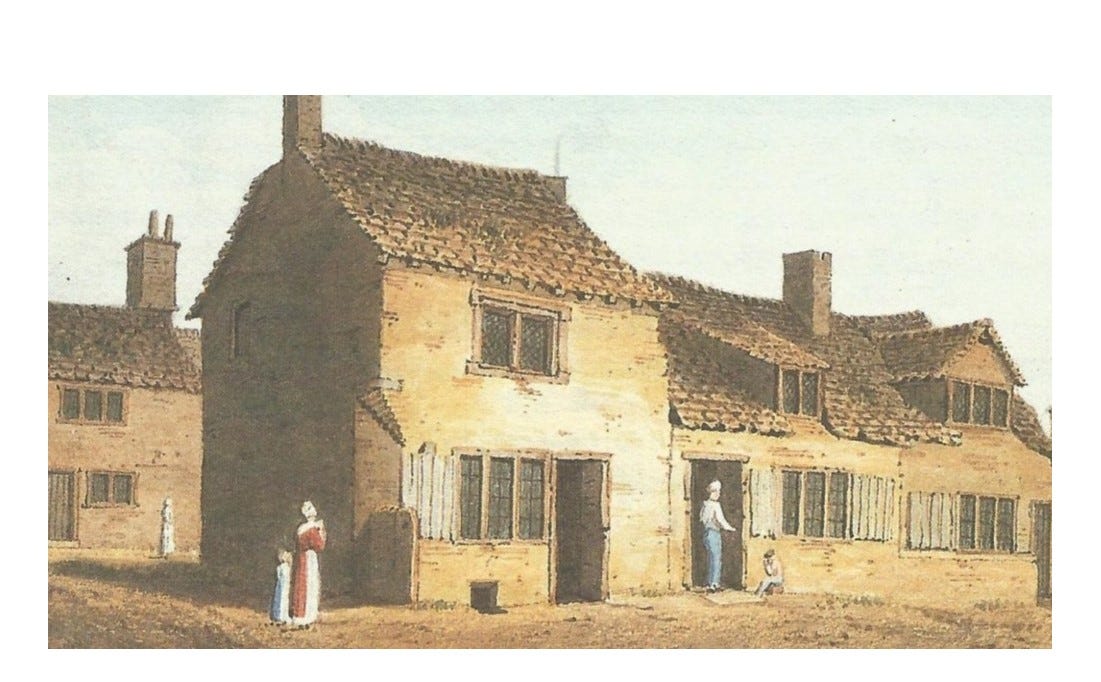
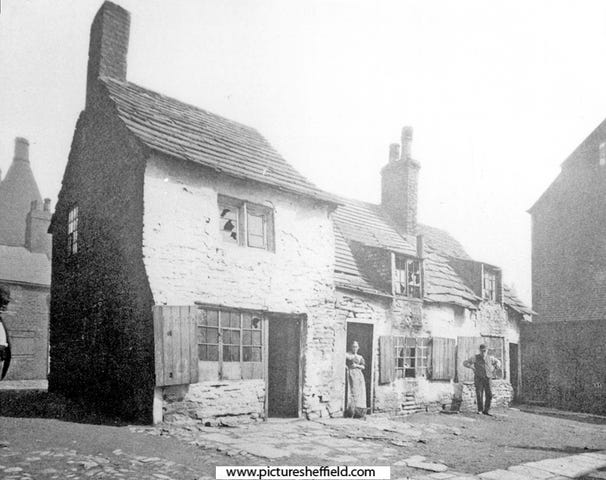
Cottages on Balm Green by Botham in 1802 (top) and photographed around 1900
Botham painted several similar views that were to be found close together in the old town centre. He recorded Pepper Alley and a house there said to have been the first brick dwelling in Sheffield - both the house and the road are long lost (Pepper Alley ran from Fargate to Norfolk Street near present-day Norfolk Row). On Castle Green he painted similar looking homes to those he found on Balm Green - it is hard to picture either of those areas looking like that today. Castle Green still exists and is very old indeed, featuring on the earliest town plan in 1736 - but not many people have reason to visit these days. It is the short road that runs from Castle Street down to behind the Old Town Hall - now cut-off, but until at least the 1970s it continued on to Bridge Street and the Exchange Brewery.
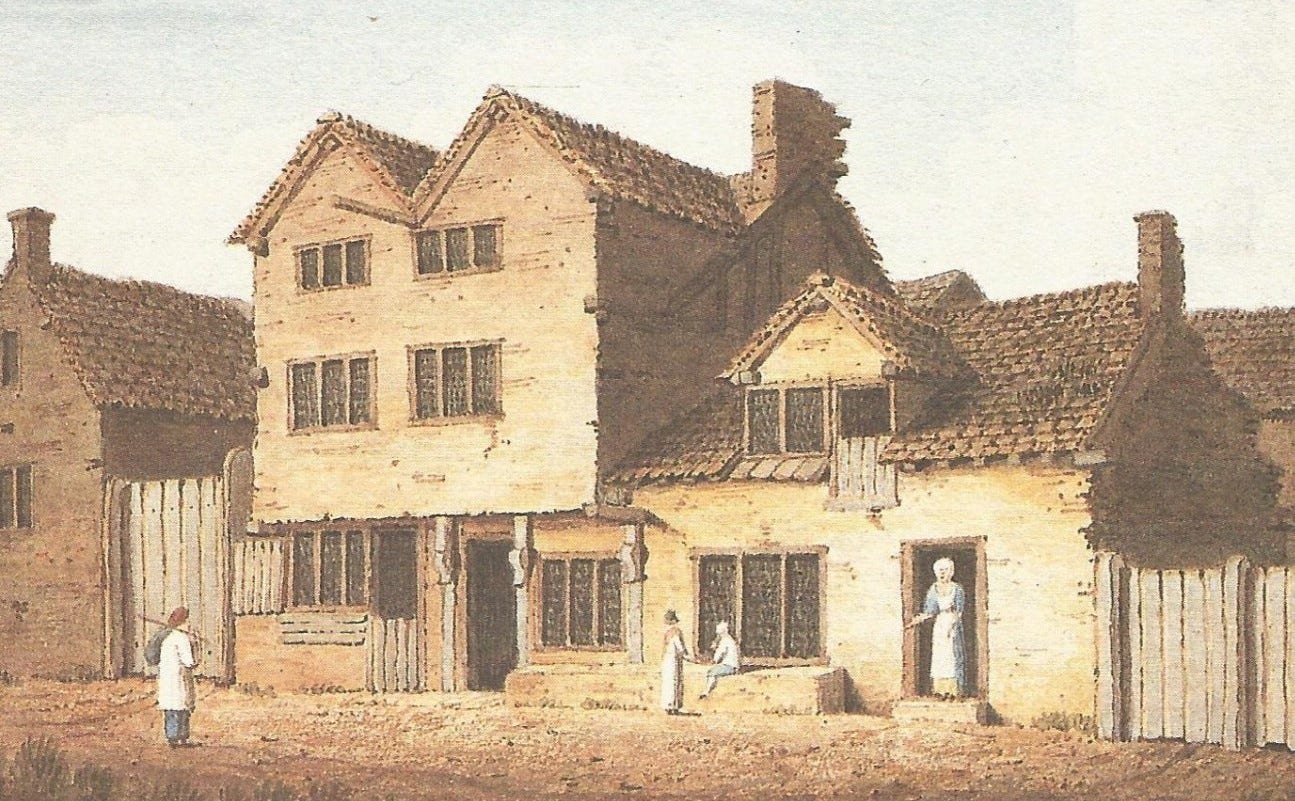
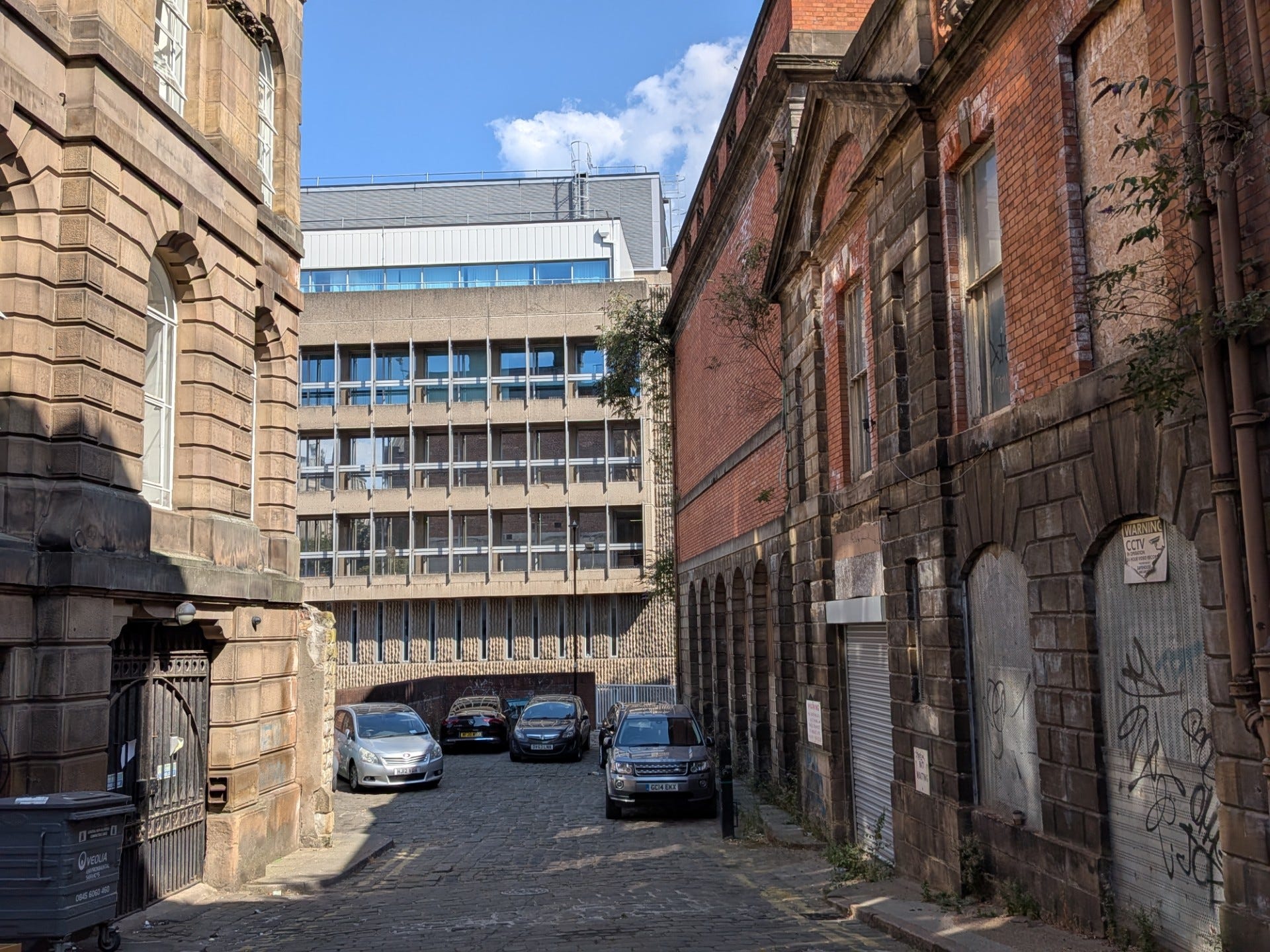
Housing on Castle Green by Botham in 1802 (top), and the approximate area today
The tantalising amount of detail about W Botham is sometimes found with reference to other artists of the time. He knew (and likely worked with) Francis Chantrey, who is an artist far better remembered today. From these passing references we can give Botham a first name; William - although his paintings are only signed with an initial. I am indebted to contributors to the Sheffield History forum for the information we have about Botham, and for the intriguing suggestion that he may have been creating these paintings as a teenager - there is a possible match with the details of a William Botham who was born in 1790. The archive does hold a work by Botham of Townhead Street said to be from after 1850, which would increase the possibility of him being a young man indeed in the first years of the nineteenth century.
https://www.sheffieldhistory.co.uk/forums/topic/18670-w-botham-watercolour-artist/
I had come across Botham Street in S4 and wondered if that might offer a clue about our artist. Peter Harvey says that one of the members of the Land Society that built the street in the 1860s was a W Botham, but this seems to be a coincidence as this namesake had a business on Haymarket in a different field. As I was looking deeper into a bit of a rabbit hole I started looking at archive photos of Botham Street (which only partly remains today), and saw an old photo of a pub on the corner. Given that I was pursuing a bit of a head-scratcher I smiled at the pub name; The ‘Who Can Tell’ -sometimes the archive records seem to be smiling back at me!
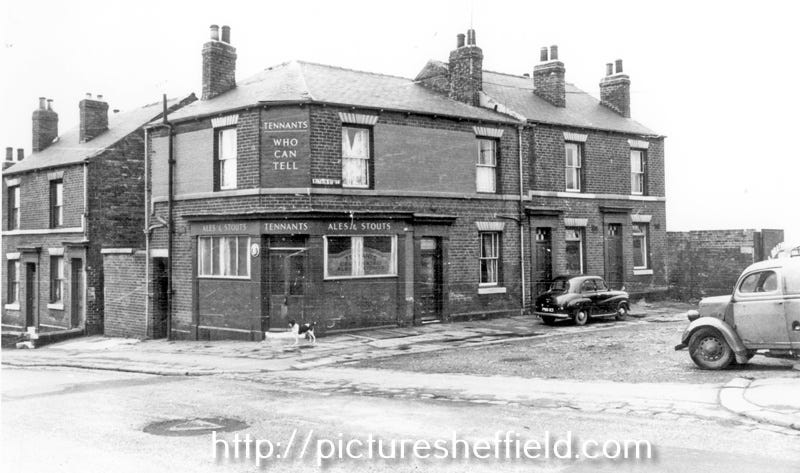
‘Who Can Tell’ indeed - no clues to our elusive artist here on Botham Street
This is an unusual subject, looking at somebody of which we know next to nothing. Taking his work itself we see a lost Sheffield, and those depictions are as important as any other such records; old maps or photos, both of which we all enjoy and appreciate. Botham includes the people in his work too, which gives the houses and public places a genuine feel of how he would have been seeing them at the time. It can be the case with artists or writers that freshly discovered work comes to light - in this case it’s detail about the artist himself that I’d love to find. Discovering just a little more about W Botham and his inspiration would be great, but for now we have some attractive and historically important views of Sheffield over two hundred years ago - even if Mr Botham himself remains elusive.
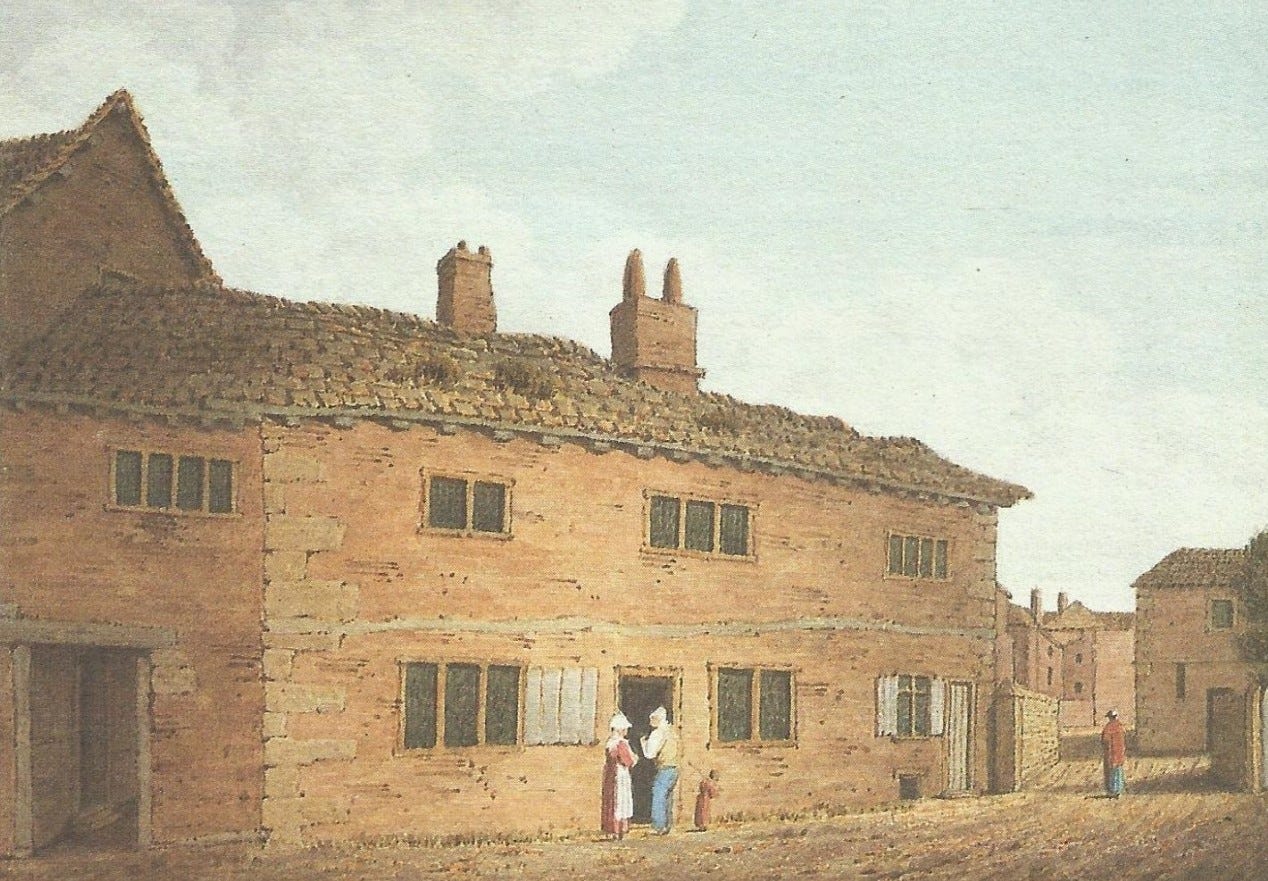
The brick house on Pepper Alley off Fargate by W Botham
No posts
Comments
Nothing yet. Say the first thing.
Sign in to join the conversation.