
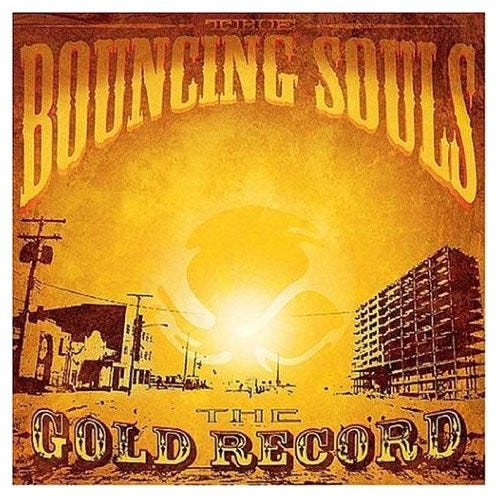
In June of 2006 I came back from Erasmus with a head full of things and a future that felt both close and impossibly far away. I had only my thesis left, but I had a clear sense that a chapter was closing: I had changed in those months, and everything back home in my small town seemed to have stayed exactly the same. Those evenings I remember I was listenening to the freshly released The Gold Record a lot (along with Decemberunderground from AFI, that was curiously released the same day as The Gold Record), while trying to figure out what direction to give to those last months as a student and whatever was going to come after.
It was also the summer of the soccer World Cup, which has never been a passion of mine. And yet I remember it vividly: the roar from houses and streets every time Italy scored, the collective noise crossing through open windows, and me in my room trying to figure out what the hell could my thesis could possibly deal with and holding the thread of a record that, at that moment, was speaking to me more than any patriotic enthusiasm. They took the trophy. I kept The Gold Record.
The album came out on June 6, 2006, a date the band reportedly called “the release of the beast”: 6/6/06, a very punk joke. But the title works on more than one level. The obvious one is self-awareness: after almost twenty years of a solid underground career, the Bouncing Souls had never certified a gold record in sales terms. Naming your most ambitious album The Gold Record is a very punk gesture: the prize you’ll never be given, turned into a title.
Behind the date and the humor there was something more serious. The Souls were coming off a difficult period following the Anchors Aweigh tour, which had left the band’s internal cohesion at a low point. Pete Steinkopf said it plainly in a 2016 interview:
“Greg wasn’t having a great time. At the end of that tour, we weren’t even sure we’d continue as a band. The Gold Record was the moment we got back together and said: let’s make a record and change how we do things.”
This is an album that survived itself before anyone ever heard it.
It’s also the most ambitious thing in their discography. Twelve tracks, forty-four minutes, no filler. Producer Ted Hutt brings every instrument into sharper focus, with Bryan Kienlen’s bass more defined than ever, and the arrangements expand into accordion, harmonica, piano, organ, trumpet. Rami Jaffee, already a Foo Fighters collaborator by then, later a full member, plays keys. None of it sounds like decoration: these elements are structural.
Greg Attonito’s voice in my opinion had never been used this well: more controlled, more expressive, a range the previous records hadn’t fully explored. And the songwriting has a structural signature that keeps returning across the record: both The Pizza Song and Midnight Mile shift register around the two-minute mark, a near-cinematic move that punk rarely attempts.
A few tracks deserve specific attention. The Gold Song opens the album as an anthem that establishes the tone immediately, with that line:
“There’s a love in all our souls and it shines like gold”
landing with the disarming conviction that has always been the band’s signature. So Jersey is the most autobiographical track, an explicit tribute to Asbury Park and its musical inheritance, Springsteen audible in the piano. Lean on Sheena is technically a cover of the Avoid One Thing, but it's been so completely absorbed into the Souls' identity that the question of origin stops mattering after about thirty seconds. One of my favorite songs they've ever recorded, full stop. Letter from Iraq is built on a poem by Garett Reppenhagen, a U.S. soldier in active service: an unusual angle on a theme that punk in those years had already overworked. And the closing For All the Unheard runs nearly seven minutes of organ, acoustic guitar, and slow build to an electric climax: unthinkable in anything they made ten years earlier.
Looking at what came before and after makes the record's position even clearer. The early albums, from Maniacal Laughter through How I Spent My Summer Vacation, lived on raw energy and short songs with no studio ambition. Anchors Aweigh (2003) had started to expand the palette, but the arrangements stayed lean and the record ran too long. The Gold Record is where all that tension resolved, just once, into something genuinely elaborate. Then Ghosts on the Boardwalk (2010) returned to a leaner sound; Comet (2012) pushed speed and clean production; Simplicity (2016) said it in the title. These were legitimate choices. But it's as if, after 2006, the band looked at that experiment and decided it wasn't their place. Which makes The Gold Record a genuine outlier: the peak of complexity in a career that chose not to build from it.
Critics were mostly enthusiastic. Big Takeover placed it among the year’s best records. PopMatters noted, accurately, that the Souls would never make revolutionary music but here they were twisting their own sound while staying true to themselves. Among fans the conversation has always been more divided: there’s a category that resisted it for years and eventually came around, and that category tends to call it the band’s masterpiece. The time it takes to earn the opinion seems to be part of the argument.
Initially, I didn’t like this record as much as I love it now. Or more precisely: I didn’t understand what it was saying and how to handle such sonic evolution, but this record grew in me year after year and I can sincerely say it has become one of my favorite punk records ever.
Italy took the golden World Cup home in the summer of 2006. The Bouncing Souls made a gold record. Twenty years later, one of those two golds is still in rotation.
Twenty years.
Comments
Nothing yet. Say the first thing.
Sign in to join the conversation.