
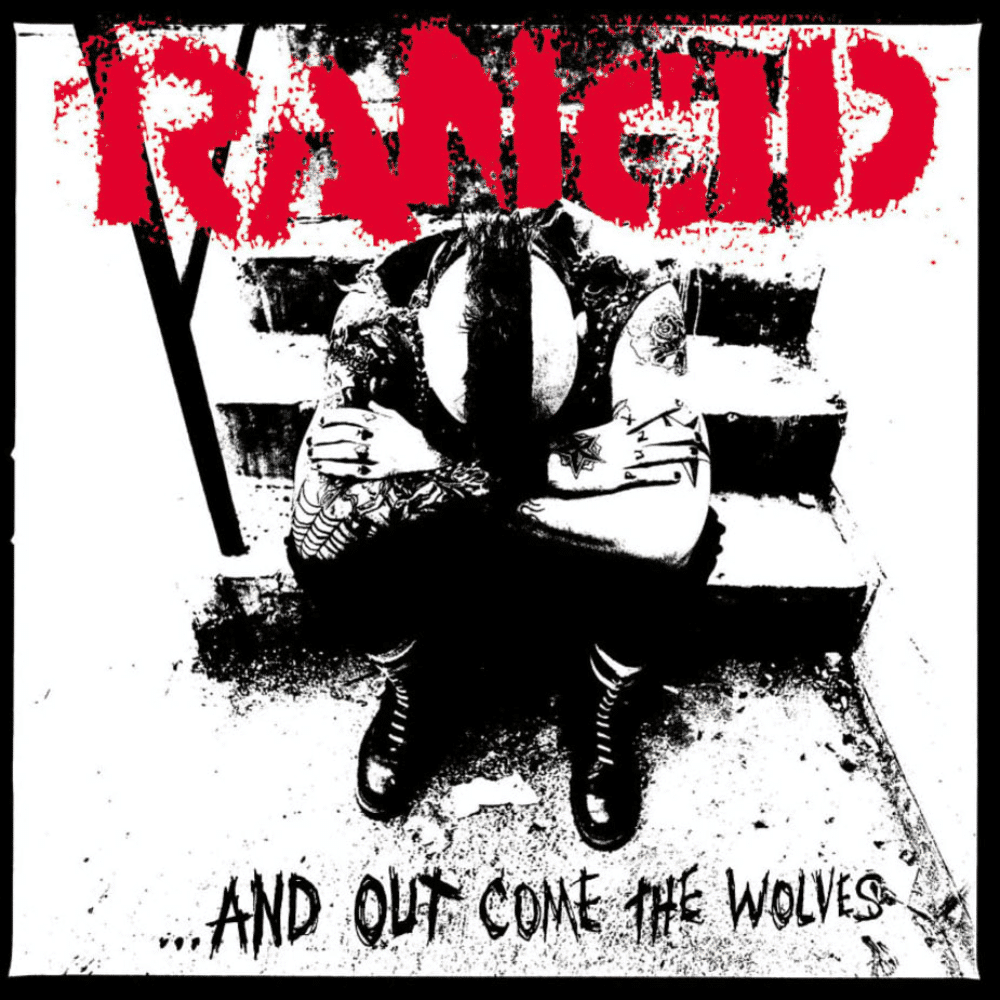
…And Out Come the Wolves came out yesterday, August 22, in 1995.
Sometimes I think I’ve been reading possibly every interview, review, forums focused on this record for 30 years, and I genuinely believe that everything could have already been said and written about this record. Nevertheless, I think I owe a small tribute to one of the greatest punk rock albums ever released in history - one that has constantly been with me for 3 decades and gives me something new at every listening - by highlighting some aspects that ultimately made me fall in love with this record instantly at its release, and more and more in the following years.
It’s Rancid’s third album, and from a pure stylistic point of view it’s a giant leap from their previous release, the 1993 Let’s Go. First of all, it’s a heavily ska-inflected album, with a clear Operation Ivy lineage (represented by Tim and Matt) doing a lot of work under the surface. The ska version of Tim Armstrong as author post-Op Ivy began to show clearly on this record and it was one destined to be more and more present in his production in various ways in the following years. It’s the version I prefer, for his undeniable ability of making ska sound fresh and new despite the rigid boundaries of the genre. It’s like two separate and very different versions of Tim – Tim Armstrong and Tim Timebomb – found their way to coexist starting from this record.
It’s Rancid’s third album, and it was still released on Epitaph. In 1994-1995 every major label with big money started flirting with bands from that scene, but Rancid chose to remain independent and stay with Brett Gurewitz’s label. The title itself comes from a Jim Carroll work called The Basketball Diaries (Carroll even reads part of his work on “Junky Man”), and it’s a real statement on the moment itself: while Green Day, The Offspring, Bad Religion were embracing the major labels experience (with very different trajectories, though), Rancid decided to stand their indie ground, and refuse any offer. Commercially, this record possibly overcame even the best expectations: #45 on the Billboard 200, gold within five months, platinum by 2004. Gold followed in Australia, Canada, the UK, and Japan. Its songs expanded beyond the underground scene and made their way into mainstream popularity: songs that even people not following punk could easily recognize. Three singles carried that reach: “Roots Radicals,” “Time Bomb” (which notably hit #8 on the Modern Rock chart), and “Ruby Soho,” all in MTV rotation. They even made a Saturday Night Live appearance in November 1995. It’s living proof that you don’t really need to leverage corporations to elevate your ceiling, provided that you have something real good to say.
It’s Rancid’s third album, and it’s where Tim Armstrong consolidates his incredible talent to introduce you to his stories like it’s a person or a situation you both know. He keeps doing this across this record and throughout all his later production: a city, a street, a train platform, a name, become something you could really feel part of. “Roots Radicals” starts, and you find yourself sitting on the 60 bus out of downtown Campbell, and Ben Zanotto is really there waiting for you. You are not there, but you feel like you are. It’s more of a narrator’s approach than a singer’s, and it’s a very distinctive trait of Rancid records, really maturing on this record: underneath the gravel and the punk patches on the jeans jacket there’s a genuine literate sensibility, a very rare ability to catch the situations and bringing you inside them instead of describing them to an external listener.
It’s Rancid third album, and the role of Lars Frederiksen shifts completely. In this record he becomes much more than the 4th Rancid he was on Let’s Go. Here, he is an essential second narrative voice in the band, with a raspy but melodic singing that balances Tim’s crooked delivery and also elevates it when the two are singing together. Such different vocal types, and working just fine together. Just listen to “Olimpya WA” chorus: the dynamic of the vocals brings new depth, it’s kind of a dialogue between two different ways of telling the same stories. This will remain a distinctive trait of Rancid production, but I really believe this record is where they almost reached perfection.
It’s Rancid’s third album, and it’s the one that cemented Matt Freeman’s place among the best bass players punk rock scene has ever produced. His bass is a real lead instrument, no more just the low end rhythmic frame of the songs. Take “Journey to the End of the East Bay” as example: the bassline basically carries the identity of a beautiful - but rather plain otherwise - punk song. Matt’s walking patterns are reminiscent of ska tradition, and bring a new perspective into straight punk songs that ultimately become a new platform for next generations of punk bassists. (I suggest you check out his YT channel, where he walks viewers through the details of his playing). And then there’s “Maxwell Murder,” where he steps fully into the spotlight, and what else can you say about that? That solo has become a rite of passage for punk bassists, something you learn to prove you really can play. What makes it so relevant to Matt’s style is that none of this feels like showing off for its own sake: he’s an incredibly gifted bass player, but he’s not a shredder at all. You have heard so many times that the technique should always be in service of the song, well, here’s your proof of concept.
It’s Rancid’s third album, and it’s probably evidence of why Brett Reed deserves to be remembered as the real Rancid’s drummer, full stop, the same role Bobby Schayer played for Bad Religion. He’s clearly not the most technical player, but he never pretended to be. What he had instead was fit: a clear understanding of what these songs needed, and not a single beat more than that. Brandon Steineckert had big shoes to fill when he stepped in, and he is an undeniably good drummer that has done real work to stay inside the pocket rather than impose his own style. But I’ve always felt he plays an impression of something, not the thing itself. Brett’s drumming on this record is the real blueprint of Rancid drumming, later refined even further on Life Won’t Wait, but it’s also very easy to overlook because it never called to attention to itself. That’s the job done right, and when you have 19 bangers full of hooks and riffs and choirs all compressed in songs shorter than 3 minutes it’s exactly what you need to do. Super underrated drummer.
It’s Rancid’s third album, and the album cover is its own piece of iconography: Lars Frederiksen on the steps, his head resting on his arms, a direct tribute to Minor Threat’s cover. The thing is, they were able to bring the same idea, the same steps, somewhere else entirely. It always sounded to me like this: we recognize where we come from and the impact of the greats that paved the road for us, but we’re also ready to take those roots somewhere new. Legendary, iconic picture.
A desert-island record for me, for what it’s worth, one of the very few I’d keep. My go-to song is “Old Friend,” the one that opens with a line about greeting heartache like a familiar visitor, waiting on the doorstep again.
What a realistic picture of my life, for many years.
Comments
Nothing yet. Say the first thing.
Sign in to join the conversation.