
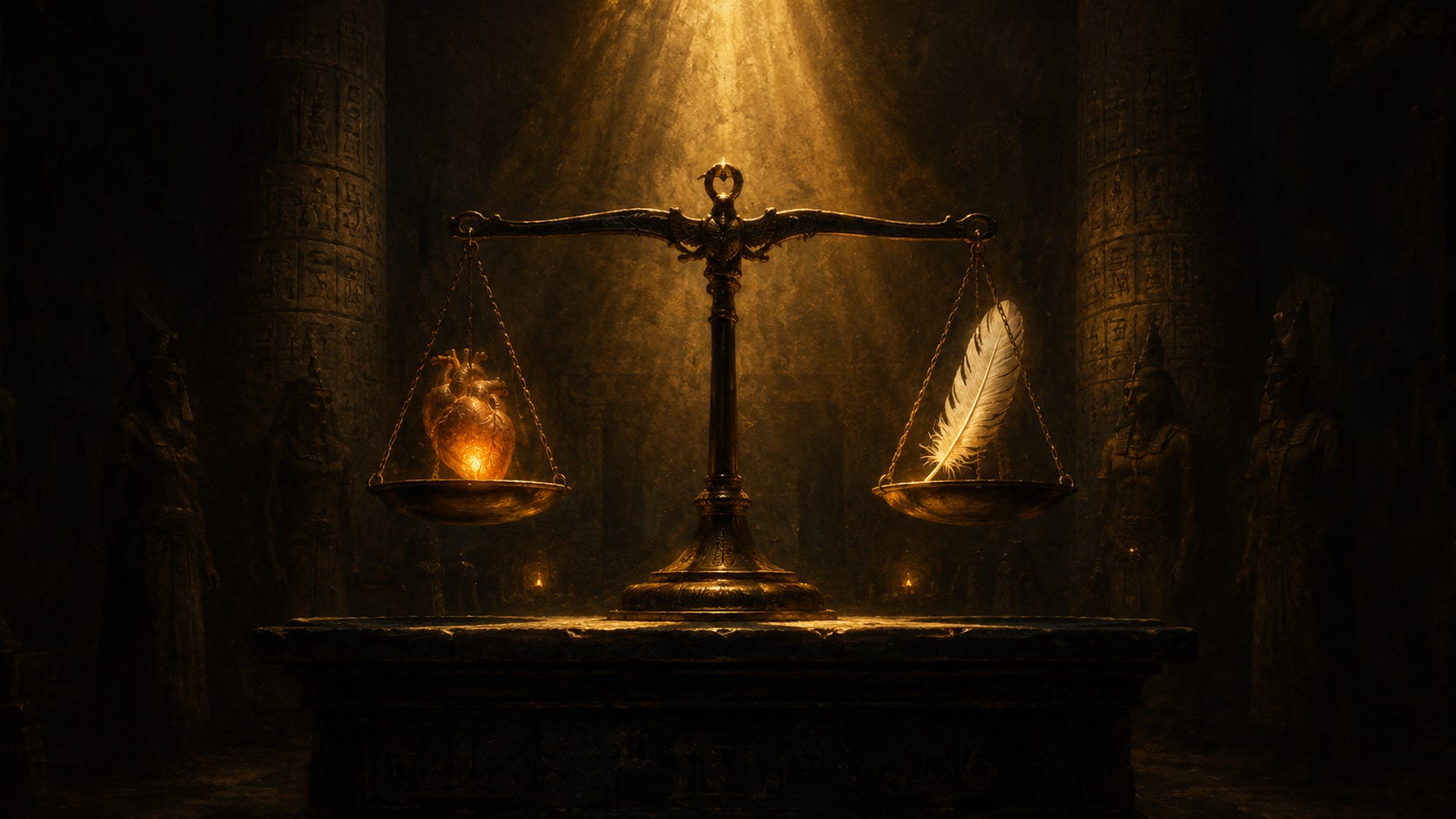
I want to start with the image itself.
You have seen it. Even if you have never studied Egyptian history or visited a museum or opened a book about ancient Egypt you have seen it. A scale. On one side a heart. On the other a feather. A figure with the head of a jackal supervising the weighing. A creature waiting at the edge of the frame with the head of a crocodile, the front legs of a lion, and the hindquarters of a hippopotamus, ready to devour the heart if it is found too heavy.
You have seen this image and you have probably assumed you understood it. A judgment. A moral reckoning. The good deeds on one side. The bad deeds on the other. The righteous soul passing. The wicked soul devoured.
That reading is almost entirely wrong.
What the Egyptians were actually describing in this image is something significantly more sophisticated and significantly more relevant to the inner life of the person reading this right now than a simple moral ledger.
This piece restores what the image was actually pointing at.
The weighing of the heart appears throughout the Egyptian Book of the Dead. A collection of spells, prayers, and navigational instructions compiled across more than a thousand years of Egyptian civilization. The oldest versions date to approximately 1550 BC. The most complete versions were produced during the New Kingdom period between 1550 and 1070 BC.
The Egyptians did not call it the Book of the Dead. They called it Reu Nu Pert Em Hru. The Book of Coming Forth by Day. Not a book about dying. A book about emergence. About the soul coming forth into the light after passing through the darkness.
The title the West gave it in the 19th century revealed more about the Western relationship to death than about what the Egyptians were actually describing. They were not writing about the end. They were writing about what becomes possible after the dissolution of what you thought you were.
The weighing of the heart is the central event in this emergence. Not the finale of a moral trial. The threshold of a transformation.
The Egyptian word for heart is Ib. In the Egyptian understanding the Ib was not the organ that pumps blood. It was the seat of consciousness. The center of intelligence, will, memory, and moral awareness. Everything a person had thought, felt, chosen, and experienced across an entire lifetime was stored in the Ib.
The Ib was the most important part of the human being in the Egyptian understanding. It was the part of you that persisted after death. The part that carried the full record of what you had been. Not your body. Not your possessions. Not your social status or your accomplishments or your religious observances. The Ib. The consciousness that had animated your life.
When the Egyptians placed the heart on the scale they were not placing a physical organ there. They were placing the entire accumulated inner life of a human being. Every thought. Every feeling. Every choice. Every moment of genuine love and every moment of genuine cruelty. Everything that had made the person who they were was contained in the Ib that was placed on the scale.
What the original was actually saying:
The heart being weighed is not a symbol of moral performance. It is the entire accumulated consciousness of a human being. What you had become across a lifetime. Not what you had done. What you had become in the doing of it.
The feather on the other side of the scale is the feather of Ma’at.
Ma’at is the Egyptian concept of cosmic order, truth, balance, and justice. It is the principle that holds the universe together. The Egyptians believed that the cosmos was structured by Ma’at. That truth and balance and right relationship were not human inventions but fundamental properties of reality itself. The universe was built on Ma’at the way a building is built on a foundation.
The feather of Ma’at was the lightest possible object. A single ostrich feather. The choice of a feather as the counterweight to the entire accumulated consciousness of a human being was not arbitrary. It was precise. And it points at the deepest teaching in the entire weighing of the heart tradition.
The heart that had lived in alignment with truth, with balance, with genuine love, with right relationship, was a light heart. Not in the sense of being unserious or trivial. Light in the sense of having released what was not real. Having shed the weight of the accumulated false self. The pretense. The performance. The resentment. The fear. The pride. The hardness that develops when a human being has spent years defending a constructed identity against the truth of what they actually are.
A light heart was not a heart that had performed the right rituals or believed the correct doctrines or accumulated enough good deeds to outweigh the bad ones. A light heart was a heart that had become what it was designed to be. Transparent. Open. Aligned with what is real.
The feather of Ma’at was not asking whether you had been good enough. It was asking whether you had become real enough.
What the original was actually saying:
The feather of Ma’at does not represent a moral standard to be met. It represents the natural weight of a consciousness in full alignment with what is real. The weighing is not a comparison of performance. It is a measurement of authenticity. Of how much of the false self had been shed and how much of the true self had been allowed to emerge.
The scale itself is significant. The Egyptians called it the Scales of Ma’at. And the scales appear in many ancient traditions as the symbol of divine judgment. The Hebrew Bible describes God as holding the nations in a balance. The Greek tradition gave Lady Justice her scales. The Christian tradition inherited the image.
But the Egyptian understanding of what the scales were measuring was more precise than any of the traditions that inherited the image.
The scales in the Egyptian tradition were not measuring quantity. They were not asking whether you had accumulated enough good deeds to outweigh the bad ones. They were measuring quality. The quality of what the heart had become.
A heart heavy with the accumulated weight of the constructed self, with pride, with fear, with the hardness that comes from years of living in defense of a false identity, was a heavy heart. Not because it contained more sins than another heart. Because it contained more of what was not real. More performance. More pretense. More weight that had been added to the original lightness of what the consciousness actually was before the world shaped it into something defended and defended and defended until it forgot what it was originally.
A heart light as the feather of Ma’at was a heart that had done the interior work. That had faced what was false in itself and released it. That had lived in honesty rather than performance. That had loved without needing the love returned. That had given without calculating the return. That had faced the truth about itself and remained open rather than closing down.
What the original was actually saying:
The scale is measuring the weight of the false self. The accumulated pretense. The defended identity. The heart that had shed most of this weight, that had become more like what it actually was rather than what the world required it to perform, was a light heart. A heart close to the weight of the feather of Ma’at.
The figure with the jackal head supervising the weighing is Anubis. The Egyptian god of embalming, death, and the transition between life and what comes after.
Anubis was not a figure of terror in the Egyptian tradition. He was a guide. A guardian of the transition. The one who accompanied the soul through the darkness between death and what lay beyond it.
The jackal was chosen because jackals were scavengers who frequented the edges of the desert and the borders of the burial grounds. They were creatures of the threshold. Beings who moved between the world of the living and the world of the dead without being destroyed by either.
In the weighing scene Anubis adjusts the scales and announces the result. He is not the judge. He is the facilitator. The one who makes the measurement visible. The judge in the Egyptian tradition is not Anubis. It is Osiris. Seated on his throne at the far end of the hall. Presiding over the judgment but not conducting it.
The presence of Anubis in the weighing scene speaks to something important about the Egyptian understanding of the threshold experience. The transition from life to what comes after is not a courtroom trial before an angry God. It is a supervised measurement conducted by a guide whose function is to make the truth visible. Not to condemn. To reveal.
What the original was actually saying:
Anubis is not an executioner. He is a guide of the threshold. His function is revelation not condemnation. The weighing of the heart in the Egyptian tradition is not a trial. It is a disclosure. The truth of what the heart has become being made visible.
The creature waiting at the edge of the frame is the Ammit. The Devourer. The Bone Eater. Described in the texts as having the head of a crocodile, the forequarters of a lion or leopard, and the hindquarters of a hippopotamus. The three most dangerous animals in ancient Egypt combined into a single form.
If the heart is found heavier than the feather of Ma’at the Ammit devours it. And the soul ceases to exist. Not to suffer eternally. To cease.
This is perhaps the most significant detail in the entire weighing of the heart scene that has been most consistently misread by the Western tradition.
The Ammit does not send the heavy heart to eternal torment. The Ammit devours it. The soul that is found too heavy experiences the second death. Cessation. Not eternal punishment. The end of the particular stream of consciousness that the heart contained.
The Egyptians did not invent eternal conscious torment. They invented the possibility of dissolution. Of a consciousness so weighted with what was false that it could not survive contact with the truth of what reality actually is.
The absence of eternal torment in the Egyptian afterlife is significant. The civilization that produced the most sophisticated afterlife theology in the ancient world did not produce a place of eternal conscious punishment. They produced a dissolution. A devourment. The end of what was too heavy to continue.
What the original was actually saying:
The consequence of a heart heavier than the feather of Ma’at is not eternal suffering. It is cessation. The ending of the particular stream of consciousness. Not a torture chamber. A dissolution. This is significantly different from the doctrine of eternal conscious torment that the Western tradition built from the four Hebrew and Greek words we decoded in the previous article.
Standing near the scales in the weighing scene is Thoth. The ibis-headed god of writing, wisdom, and record-keeping. He holds a stylus and a palette. He is recording the result of the weighing.
Thoth in the Egyptian tradition is the divine scribe. The one who records truth. The cosmic secretary of the divine council. His presence at the weighing of the heart is not incidental. He is there because the weighing produces a truth that must be recorded. Not for the purposes of judgment. For the purposes of cosmic record. The truth of what the heart has become is written into the fabric of reality by Thoth.
The Hermetic tradition that emerged from the synthesis of Egyptian and Greek wisdom identified Thoth with Hermes. The messenger of the gods. The guide of souls. The keeper of secret wisdom. The texts attributed to Hermes Trismegistus, Thrice-Greatest Hermes, became the foundation of Western alchemy, astrology, and the mystery school tradition.
The presence of Thoth at the weighing of the heart connects the Egyptian judgment scene to the entire Western esoteric tradition. What Thoth records at the weighing of the heart is the same truth that the Hermetic tradition has been preserving across three thousand years of secret transmission.
What the original was actually saying:
Thoth at the scales is not a bureaucrat recording sins for a divine prosecutor. He is the cosmic witness of truth. His recording of the weighing result is an act of acknowledgment. The universe recognizing what the heart has become. Writing it into the permanent record of what is real.
Before the heart is placed on the scale the soul must speak before 42 assessors. Each one representing a different nome or district of Egypt. Each one addressed with a specific declaration of innocence.
These declarations are called the Negative Confession. They are among the most misread texts in the entire Egyptian tradition. Most people read them as a list of sins to be denied. A moral checklist. I have not stolen. I have not lied. I have not caused suffering.
But the declarations are not primarily moral. They are ontological. They describe a quality of being rather than a record of behavior.
I have not been deaf to words of truth. I have not caused pain. I have not done harm to the image of God. I have not been hot-tempered. I have not stopped my ears against the words of right and truth.
These are not descriptions of actions avoided. They are descriptions of a quality of inner life maintained. A consciousness that remained open to truth. That did not close itself against what was real. That did not harden itself against the words of Ma’at even when those words were uncomfortable.
The 42 assessors are not prosecuting the soul. They are witnessing the quality of the consciousness that has come before them. The Negative Confession is not a denial of crimes. It is a declaration of what the soul has become.
What the original was actually saying:
The Negative Confession is a declaration of consciousness quality not moral performance. The 42 assessors are witnesses not prosecutors. The soul that can make these declarations honestly is the soul whose heart has been lightened by the interior work of becoming what it was designed to be.
Here is why the weighing of the heart matters for the person reading this right now.
The Egyptians were not describing a future event that happens after death. They were describing a present reality that happens continuously.
The heart is being weighed right now. Not by a divine tribunal. By the quality of attention you bring to your own inner life. The weight of the constructed self accumulates every time you choose performance over authenticity. Every time you choose defended identity over honest vulnerability. Every time you choose the comfort of what is false over the discomfort of what is real.
And the heart lightens every time you make the opposite choice. Every time you release what you have been carrying that was never actually yours. Every time you face the truth about yourself without turning away. Every time you love without calculating the return. Every time you choose Ma’at over the weight of the accumulated false self.
The feather of Ma’at is not waiting at the end of your life. It is the standard you are being measured against in every moment of every day. Not by a divine authority external to you. By the nature of what you actually are.
The Egyptians called this coming forth by day. The emergence of the true self from the darkness of everything that had been laid over it. The Book of Coming Forth by Day was not a death manual. It was a life manual. A guide to the interior work that lightens the heart while you are still alive to do the work.
The feather of Ma’at is the question the inner life asks in every moment of genuine choice. Is what I am about to do adding weight to what I carry or releasing it. Is what I am about to become more like what I actually am or less. Is the direction I am moving toward Ma’at or away from it.
The weighing happens now. In every choice. In every moment of honesty or dishonesty with yourself. In every act of genuine love or calculated performance.
The Devourer is not waiting at the end of your life. The dissolution of what is false begins the moment you stop feeding it with the energy of your attention and your belief.
And the emergence. The coming forth by day. The heart finally light enough to pass. That is not a future event either.
It is the present possibility available to whoever is willing to do the work of becoming what the heart was always designed to be.
If this piece opened something for you and you want to go deeper into the hidden knowledge every tradition has been preserving, from the Egyptian mystery schools to the suppressed gospels to the consciousness research the institution buried, The Mystery Schools Guide maps the complete tradition.
Get The Mystery Schools Guide here → https://stan.store/Earthmastery/p/the-mystery-schools-
Comments
Nothing yet. Say the first thing.
Sign in to join the conversation.