
💎 BGG rated 7.5/10 w. just 236 ratings 💎
💡 Designer: Chris Handy
🎨 Artist: Magdalena Markowska
🖨️ Publisher: Perplext
📅 Released: 2024
🧑🏻🤝🧑🏿 Players: 2
⚖️ Weight: 1.75/5
⏱️ Time: 15-25 minutes
Sometimes I wonder if the board game world has a size problem. Ever bigger boxes. Kallax units buckling under the strain of myriad elaborate components.
BOG is the anti-thesis of that. It takes a game and condenses it down to a box the size of a chewing gum packet. And, despite its diminutive size, there’s a surprising amount of game hidden away in there.
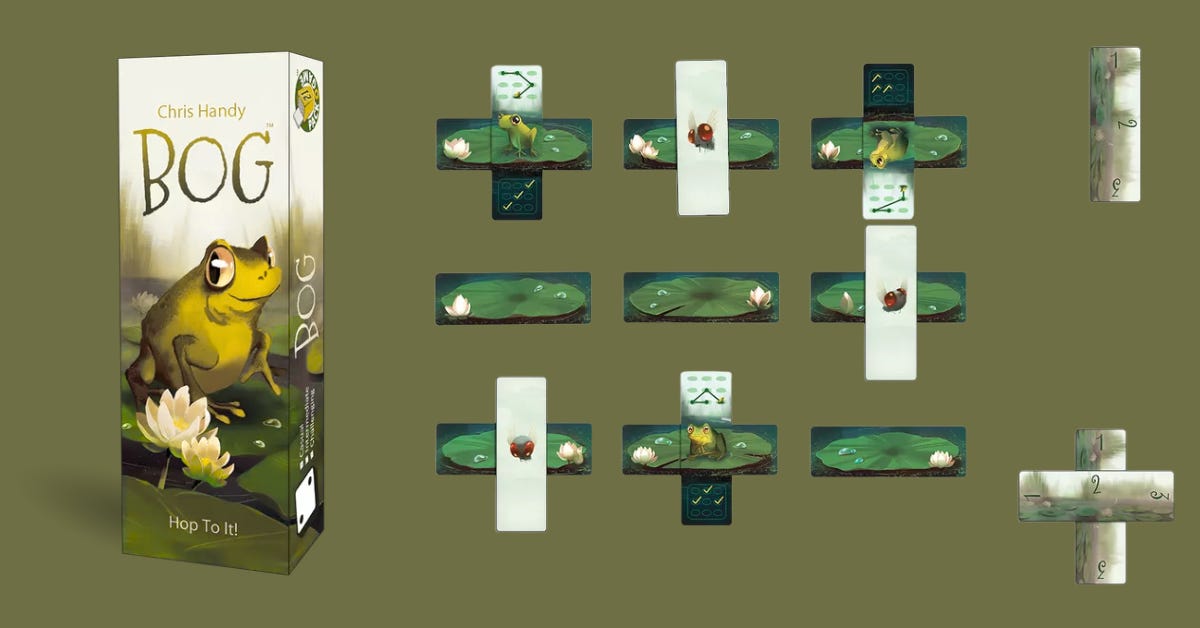
It’s a two player battle over a boggy swamp consisting of nine lily pad cards laid out in a 3 x 3 grid. You start the game with a couple of frog cards, which can be used in one of two ways.
The top of the card has a pre-determined route across the bog that this frog must follow. But, first you must play the card to your “shore”, which simply means on the table in front of you.
On your next turn you can then choose to move the frog to the start of its fated path. On subsequent turns you can move the frog to its next destination. If it makes it to the end, then on a future turn you can retire that frog and gain points.
Along the way, your frog might encounter one of your opponent’s. If so, it kicks them off the board, you get to keep the card as the spoils of froggy warfare and it’s worth 1 point at the end of the game.
At the start of the game there are also flies on the three cards in the middle row. Land on a fly and you get to move it to an unoccupied space (ideally somewhere you’re heading next and your opponent isn’t), then you get to take one new frog from a face-up market of three.
Instead of sending a frog out on a trek across the bog, you could instead consult the “formations” grid at the bottom of the frog card. It shows ticks in three of the nine grid spaces. If there are any frogs in those spaces, you can cash in the card on your turn for one, two or three points.
Play continues until someone cannot take an action. If there are still frogs in the market, the person who is unable to play automatically loses. If all the market cards are gone, points are tallied to decide the winner.
🎲 G - Gameplay
(pacing, downtime, intuitiveness)
Everything about this game clicks quickly. Setup is 30 seconds at most. Teaching the rules takes mere minutes.
Gameplay could slow down if you or your opponent are prone to analysis paralysis, but otherwise it’s lightning fast.
It definitely has layers to it. The more you play, the more you pick up on little nuances hiding in plain sight.
⭐ Score: 18/25
🎨 A - Art & Theme
(visual appeal, thematic coherence, component quality)
Bog is classic example of why I think art and theme really matter. At its heart, it’s an abstract game. A spatial, sometimes chess-like puzzle.
It could so easily have been done with squares and checkers pieces. But for me it wouldn’t have been anywhere near as appealing.
The frog artwork is completely charming.
A lot of thought has also gone into accommodating such a small box.
I love the way the back of the cards double as points counters, rotating them depending on the exact number of points. It’s such an elegant solution.
It results in a game that you can both take and play pretty much anywhere.
⭐ Score: 19/25
⚙️ M - Mechanics
(design elegance, balance, novelty)
Bog is essentially a programming game. You send your frogs out on pre-determined paths.
It means a lot of the game centres on timing. Can you get to the fly before your opponent? Can you avoid being caught?
There’s a couple of clever design choices that intensify this battle. One is the fact that you have to effectively declare your intentions by placing a frog on the table before you can add it to the bog.
The other is that even if your frog completes a route, you have to wait for your next turn to retire it for the points. This maximises your chances of derailing your opponent. Points always tend to be close, showing a well balanced design.
I’m a big fan of games specifically designed as 1 vs 1, as opposed to 2 player solitaire. Bog feels different to other card games I have in this genre, which is a real strength.
⭐ Score: 19/25
😄 E - Enjoyability
(fun factor, replayability, emotional response)
Like a lot of programming games, the real fun comes when the best laid plans go awry. Your opponent doesn’t make the choices you thought they were going to and everything falls apart.
Played well, there can be a lot of tension, particularly if you’ve got your frog to the end of its route and you’re anxiously waiting to see if your opponent kills it off before you can bank the points.
Every game I’ve played so far has turned out a little differently, so I’m happy with replayability.
⭐ Score: 17/25
For such a tiny game, Bog offers a lot. It’s highly portable, its table footprint is minimal, yet there are still juicy decisions to be made and real tension at times.
The theme and artwork turn what could have been a dull abstract game, into a fun yet strategic filler that is perfect for a quick 2 player game when you’re short on time.
We're always on the lookout for off-the-beaten-track board and card games that aren't getting the attention they deserve.
To be considered for Hidden Gem Board Games, titles must meet two simple criteria:
⭐ An average rating of 7.0 or higher on BoardGameGeek
👥 Fewer than 1,000 total ratings
Know a great game that’s flown under the radar?
Or maybe you're a designer or publisher interested in sending a review copy in exchange for an honest write-up? (We're based in the UK.)
We’d love to hear from you:
📧 hiddengemboardgames@gmail.com
Note: We only cover board and card games — no RPGs, miniatures or TTRPGs.
Please make sure to read our review policy before reaching out.
Comments
Nothing yet. Say the first thing.
Sign in to join the conversation.