
A horrible obsession gripped the minds of Cumbrians after the shattering destruction of the Cromwellian Civil War.
They felt compelled to accuse, persecute, try and execute large numbers of people, primarily women, for witchcraft. Pinpointing why this macabre witch-hunting mania erupted in the north of England is a challenge.
One explanation is that Cumbria always did indeed have a lot of witches. For hundreds if not thousands of years before Christianity, Cumbrians in common with Celts across Britain believed certain people, often women, could communicate with the gods, influence natural forces and bring about healing. These women were called “wicce” in Old English, which means witch. The men were called “wicca”. They were seen as beneficial for society and Celts did not see them as malign.
But during and after the English Civil War, Puritan authorities, which wanted to concentrate all religious authority in their own hands, increasingly viewed traditional Celtic healers and women practicing folk medicine not as benign helpers, but as witches suspected of making pacts with the devil. This marked a dramatic shift from earlier attitudes, where healers and wise women were often respected in their communities.
This harsh trend was accentuated by the nine-year nightmare of brutal sieges, pillage, robbery and the constant threat of violence by soldiers that the Civil War brought, followed by the impoverishment and famine that inflicted deep trauma, anxiety and a lasting sense of loss on Cumberland and Westmorland.
When the struggle ended in 1651 people looked for scapegoats for their suffering. Families were grief-stricken, bewildered and impoverished after an estimated 3,200 out of the 80,000 inhabitants of Cumbria died in the conflict between Charles I and Parliament.
That is 5.3 per cent of the local population, a significantly larger proportion than the 4 per cent killed in the whole of Britain during the Civil War and much higher than the death toll in the Second World War in which 1 per cent of Britain’s population died.
Although ordinary Cumbrians were not as consistently or enthusiastically Royalist as their local lords, the beheading of King Charles I and the collapse in authority of the mainstream churches left many feeling spiritually and socially rudderless. Widespread anxiety and related religious fervour fuelled a dramatic rise in witchcraft accusations. Henry VIII and James I had both affirmed that witches really existed and had issued laws making occult practices illegal.
But it seemed to many the bloody destruction of the monarchy had turned the normal class hierarchy upside down, dismantled the prevailing religious and cosmological order and violated the doctrine of the Divine Right of Kings. People felt this cosmic disturbance made supernatural events more likely. During the Civil War, reports of apparitions, omens, and ghost stories proliferated across Cumbria. For example, folklore tells that on the night before the battle of Marston Moor, people in Cumbria reportedly saw a ghostly army marching over Helvellyn which locals interpreted as an omen of the bloodshed to come. Ghostly soldiers who died or suffered during the conflict were reported walking on the battlements of Carlisle Castle.
Hundreds of ordinary Cumbrians started to nurture the utopian thoughts. Their ills, they imagined, could be solved by exploiting the crisis of authority to remake society on idealistic lines. They flocked to fringe sects that rose to fill the spiritual vacuum, particularly Quakerism which was deemed a particularly subversive organisation by the Government. It was led by the straggle-haired George Fox. He terrified the authorities by proposing a radical social and spiritual revolution, the reform of established religion and the abolition of all forms of hierarchy. And he singled out witches as part of the fundamental evil causing all society’s troubles.
Fox spoke to several large meetings in the region. Firstly at Firbank Fell (now known as Fox’s Pulpit) in Westmorland, located between Kendal and Sedbergh in 1652 and at least twice more at Pardshaw Crag, the historic Quaker site near Cockermouth, first in 1657, and again in 1663. Preachers inspired by Fox, such as John Audland and Edward Burrough, repeated his messages on other occasions.
Fox promised crowds of half-starved devotees universal equality and heaven on earth. He regularly blamed witches for causing the everyday misfortune and societal disorder that were preventing those good things from coming about.
Fox claimed to possess “a spirit of discernment” that enabled him to spot witches and expel them from Quaker meetings. He often publicly picked on individuals in the crowd and rebuked them for being “in the Spirit of witchcraft”.
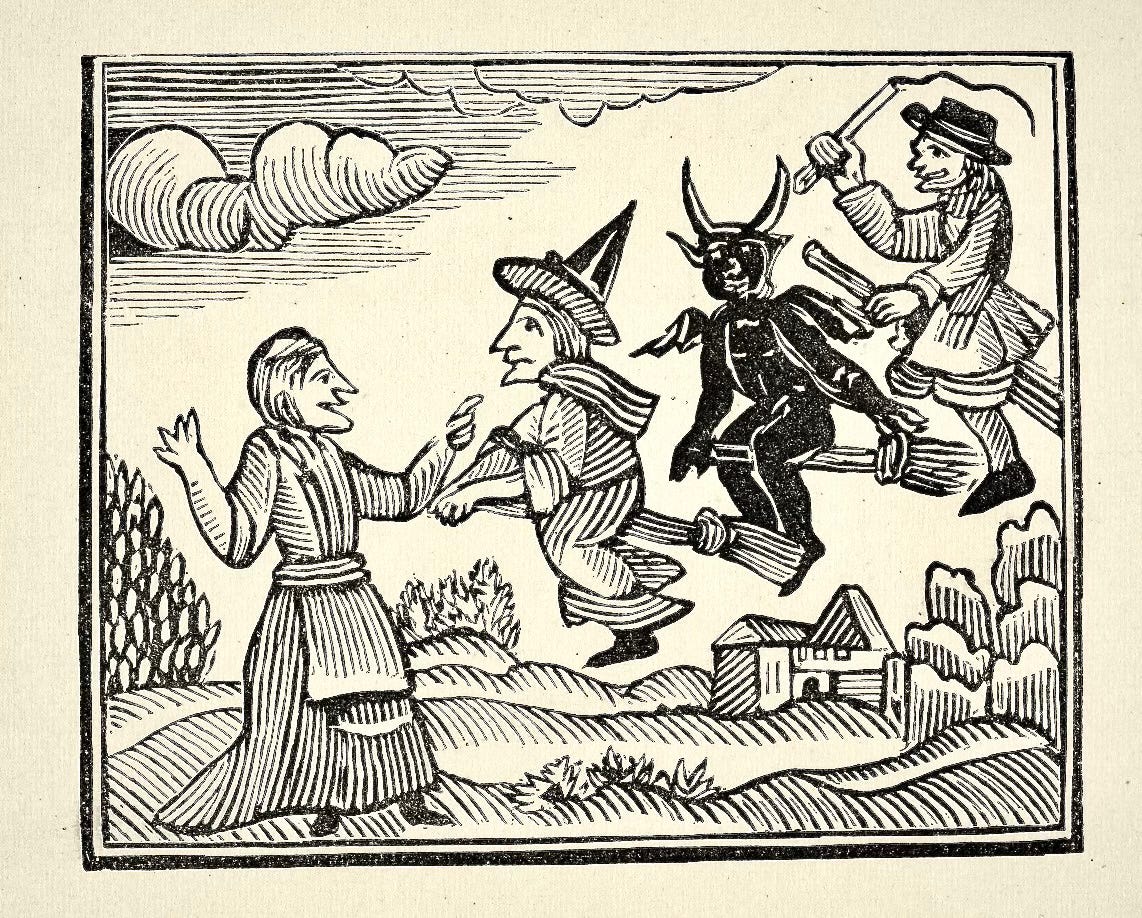
His words came as images of witches, mostly as woodcuts or illustrations in pamphlets, circulated in Cumbria. They often featured sensational pictures of accused women, animal “familiars,” and demonic scenes, reinforcing emerging stereotypes of witches as crones, frequently with regional settings. The classic propaganda image of the witch with the black pointed cap was taken by cartoonists from the conical “ale-wife” hats typically worn by women brewers who were common in Cumbria in the Civil War period.
Fox was only one of many demagogues who stoked the witch craze among northerners who we would today say were suffering post-traumatic stress disorder after the prolonged and bloody sieges at Carlisle and Cockermouth, the fighting at Clifton Moor and incessant border skirmishes. The merciless plundering of homes by the 20,000-strong Scottish Royalist army as it marched south to Preston meant few parishes escaped without suffering deaths or injuries.
The victorious Puritan Government dissolved the Anglican Church in retribution for supporting the King. Cromwell made Catholic worship illegal. Quakers, Anglicans, or dissenters of any stripe faced banishment, whipping, mutilation, imprisonment or even execution. Cromwell’s government ordered villagers to report moral or social deviants or anyone practicing mystical rites and folk magic. Naturally, the result was rampant fear, secrecy, and the breakdown of trust between neighbours.
In many small, stressed Cumbrian communities old grudges, jealousy and property disputes were reformulated into accusations that individuals were causing harm by magical or occult means. Thus, a witch hunt swept across Cumbria, egged on by hard-liners in the Puritan movement who believed in the reality of witchcraft, sorcery, divination, and related practices condemned in scripture.
Amid rising hardship, wealthier residents often refused charity or kindness to poor neighbours. When something bad happened on their property, many accused the desperate poor of witchcraft as a form of revenge or to assuage their own guilt. The victims of these allegations were overwhelmingly destitute, widowed, elderly, outspoken, independent and isolated women. Oddballs, loners, those who outraged traditional gender roles, or displayed knowledge of ancient Celtic herbal medicine or practised midwifery were the most typical victims.
Among the alleged perpetrators of Cumbrian Black Magic was Margaret Teasdale of Gisland. Her cupboard was found to contain a “Hand of Glory”, cut from the corpse of a murderer on the gallows. Arrayed with lit candles, such ghastly hands were used, most famously, to induce magic sleep so burglars could rob The Old Spital Inn, North Stainmore in 1797. Another alleged harpy, Elizabeth Howe of Thursby was said to have bewitched a valuable cow and calf to death and paralysed a farmer by putting her hand in his corn. The sorceress was only stopped by ritual “blooding” when her victims cut her forehead with a knife, it was claimed.
A mysterious phantom clad in green inflicted retribution when wealthy Westmorland landowner Gabriel Harding returned from visiting a prostitute and killed his wife with one blow to her chest. The apparition entered Gilbert’s house and broke his neck, his neighbours claimed.
A wizard called Dr William Farrar, of Orton, an “anti-conjurer” specialised in de-witching farmhouses using his “Book of Black Art” - in reality a treatise on astronomy with diagrams of the heavenly spheres - for a fancy fee. The Dentdale witch lurked in the Dee valley near Dent drowning drunks returning from the pub, it was said.
The flurry of allegations and prosecutions reached a frightening peak in April 1659, when the village of Winton in Westmorland became the centre of a notable witch trial. Margaret Bousefield, supported by neighbours, accused several women of bewitching her. The proceedings were heavily weighted against the defendants. If the accused cried or seemed afraid during the trial, that was taken as a sign she was a witch. An examiner would look for a diabolical mark on her body, like a birthmark or mole, which was a sure sign they were a witch. If he couldn’t find one, he was perfectly entitled to claim the mark had been made invisible by magic, and therefore the accused was a witch. The defendants were hanged at the Appleby General Sessions after a jury found them guilty.
The obsessive hunt for sorcery was a strange event. Carlisle had become a wealthy administrative town run by well-educated officials. It was also one of Britain’s earliest Christian centres. But its officials accused dozens of Cumbrian women of bewitching neighbours, sickening or killing livestock, damaging crops, summoning up harsh weather, causing physical ailments or other misfortunes.
Why did the witch craze flare up with such vicious intensity in Cumbria? The answer is that ordinary people believed witches existed. Families had passed knowledge of Celtic folk medicine, charms, spells and supernatural beliefs down the generations.
Prehistoric people credited members of their community with the ability to heal, ensure fertility, protect crops and livestock. In Old English such people were known as “conning” or “cunning” folk, meaning “learned, skilful, possessing knowledge.” Celts believed this positive role was symbolised by the Celtic mother goddess, Modron, who was associated with fertility, abundance, healing, and ancestral wisdom.
Evidence that Cumbrians believed in the literal reality of witches can still be seen. Visitors to Winton Hall in the village of Winton near Brough, where the alleged witches were apprehended, can see witch marks intended to ward off evil carved in 1665 on the fireplace in the snug.
Worshippers engraved witch marks in the form of daisy wheel shaped hexafoils on the window frames at St Mary’s in Dalton-in-Furness. Carvers in Carlisle Cathedral fashioned a former roof boss, dated to the early-fifteenth century, to ward off evil spirits. It depicts an evil-looking Green Man. He has a pronounced squint, a symbol hinting at the malevolence of a witch.
In 1637, James I’s son, Charles I, granted Carlisle its governing charter, which, among other things, appointed two aldermen of the city to act as justices of the peace. It gave the officials wide ranging powers to investigate witches and wizards or, as the king put it: “All manner of poisonings, enchantments, magic art, trespasses, forestallings, regratings and exortations whatsoever.”
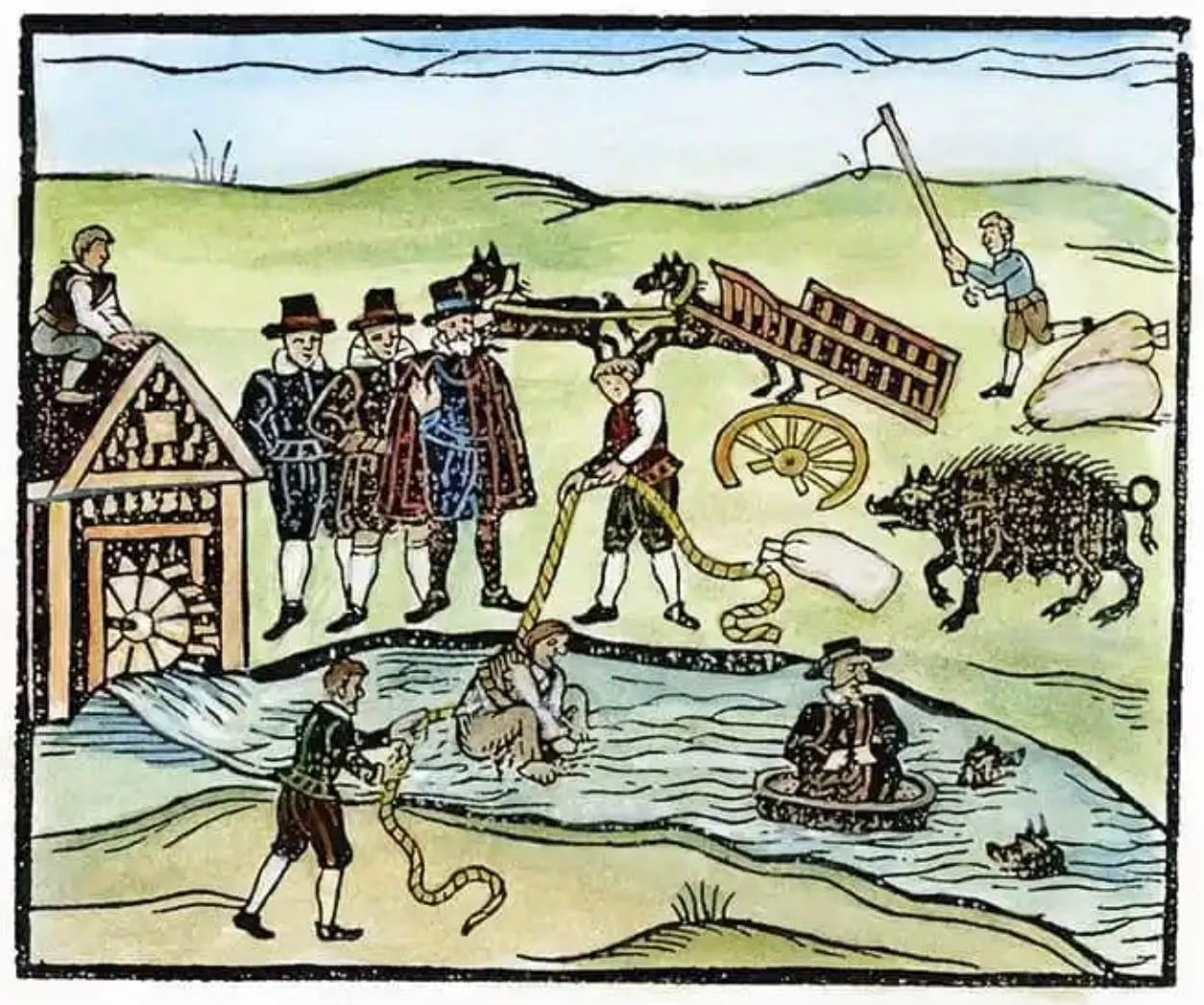
The nadir of the witch craze came when a man called Matthew Hopkins, a lawyer and son of a Puritan minister, in 1644 appointed himself “Witchfinder General.” He earned a fortune in fees from fearful town officials in return for ridding them of witches - extracting confessions by ruthless means. His most controversial technique for finding witches was the “swimming test.” He bound his suspects hand and foot and threw them into the river. If they floated, they were guilty. If they sank, they were innocent. Hopkins’ entirely bogus campaign led to the execution of up to 230 victims, overwhelmingly women.
Prosecuting witches became a formal duty of Cumbria’s governing classes. The Audit Book of Carlisle for 1649-50, the main record of the city’s policies and activities, has the following entry: “Item for ye witchfynder £6.10s.” This is the equivalent of £35,000 today, a hefty sum at a time when the average wage for a top-skilled craftsman was two shillings a day.
Town officials aggressively pursued witchcraft cases to gain favour with the Government and advance their careers. Frightened residents were also eager to administer rough justice. The parish register of Lamplugh covering the years between 1656 and 1663, records the deaths of seven people who were “bewitched,” as well as three women who residents accused of witchcraft and who they later drowned. The register records that the three victims were “frightened to death by fairies,” which seems to be code for how they were put to death by their neighbours, perhaps using the notorious swimming test.
This is an extract from a new book called Secrets of the Hidden People. You can buy it at Bookends in Carlisle or Keswick and the New Bookshop in Cockermouth or Sam Read in Grasmere.
Alternatively, you can order a copy online here:
https://www.fletcherchristianbooks.com/product/secrets-of-the-hidden-people
Comments
Nothing yet. Say the first thing.
Sign in to join the conversation.