
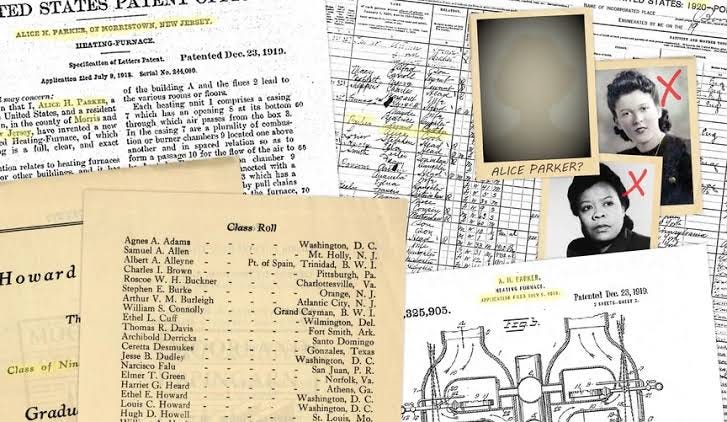
It’s 1919, and every winter morning across America starts the same way. Someone has to wake up before dawn, trudge down to a freezing basement, shovel coal into a furnace, and wait for warmth to slowly, unevenly creep through the house.
The person doing this backbreaking work was usually a woman, adding yet another exhausting task to her already endless list of household duties. Meanwhile, in Morristown, New Jersey, a Black woman named Alice Parker sat at her kitchen table, sketching out detailed engineering diagrams that would revolutionize how humanity heats its homes. Her invention would eventually free millions from the tyranny of coal shoveling and wood chopping, yet her name would disappear from history for nearly a century.
Alice Parker wasn’t supposed to be an inventor. Born in 1895, she entered a world that told Black women they had exactly two career options: domestic service or teaching in segregated schools. The fact that she would go on to patent a revolutionary heating system that forms the basis of modern central heating makes her story all the more extraordinary. What’s even more remarkable is that she did this without formal engineering training, without access to professional networks, and without any of the resources that her white male counterparts took for granted.
Alice H. Parker was born in Morristown, New Jersey, in 1895, right in the heart of the Jim Crow era. This wasn’t the Deep South with its explicit segregation laws, but Northern racism operated through different mechanisms—redlining, employment discrimination, and educational barriers that were just as effective at keeping Black Americans from opportunity. For a Black girl growing up in this environment, the path forward was supposed to be predetermined: limited education, marriage, and a lifetime of domestic work.
But Alice’s family had different ideas. Her parents, whose names have been lost to history thanks to the systematic erasure of Black family records, recognized their daughter’s exceptional intelligence. They scraped together enough money to send her to Howard University Academy, the prestigious high school affiliated with Howard University in Washington, D.C. This was no small feat—sending a Black daughter away for education required tremendous financial sacrifice and went against every societal expectation of the time.
At Howard Academy, Alice thrived. She graduated with honors in 1910, demonstrating particular aptitude in mathematics and science. This achievement alone was extraordinary—less than 1% of American women of any race earned high school diplomas at this time, and the percentage for Black women was virtually negligible. The fact that she graduated with honors from one of the most academically rigorous institutions available to Black students marked her as more than exceptional.
After graduation, census records show Alice working as a cook in Morristown, living with her husband who worked as a butler. This might seem like a step backward after her prestigious education, but it reflects the brutal reality of employment discrimination. No matter how educated or brilliant a Black woman was in 1910s America, white employers wouldn’t hire her for anything beyond domestic service. Alice Parker had the mind of an engineer trapped in the body of someone society insisted could only cook and clean for white families.
Working as a cook gave Alice intimate knowledge of exactly how miserable home heating was in early 20th century America. Every morning before she could even begin cooking, she had to deal with the heating system. This meant hauling coal from the basement, shoveling it into the furnace, managing the fire throughout the day, cleaning out ashes, and repeating this exhausting cycle endlessly through the winter months.
New Jersey winters are brutal. Temperatures regularly drop below freezing, and the wind chill can make it feel even colder. In Alice’s era, keeping a house warm meant someone—usually the woman of the house or a domestic worker like Alice—had to wake up hours before everyone else to start the furnace. The heat distribution was terrible; rooms near the furnace would be stifling while distant rooms remained frigid. At night, families faced an impossible choice: let the fire die and wake up to a freezing house, or keep it burning and risk a catastrophic fire.
Alice experienced these problems not as abstract inconveniences but as daily physical ordeals that dominated her winter life. The coal dust that covered everything, turning white linens gray and coating dishes with grime. The constant interruptions to her cooking duties to check and feed the furnace. The impossibility of keeping an even temperature throughout the house, leading to endless complaints from the family she served. The very real danger of carbon monoxide poisoning from improper ventilation, which killed dozens of people every winter.
But while others accepted these hardships as inevitable facts of life, Alice Parker saw them as engineering problems with engineering solutions. She began to envision a different way—a heating system that would run on cleaner-burning natural gas instead of coal, that would distribute heat evenly throughout a building, and most importantly, that would operate automatically without constant human intervention.
Comments
Nothing yet. Say the first thing.
Sign in to join the conversation.