
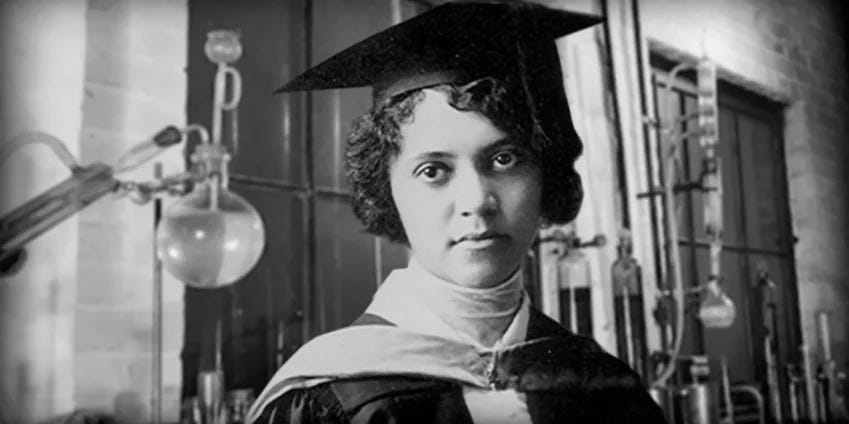
Most people die without making any real difference. Alice Ball died at 24 but not before she changed medicine forever. She solved a problem that had stumped doctors for centuries, saved thousands of people from permanent exile, and got zero credit for it during her lifetime. Her story reveals how racism and sexism in early 1900s academia nearly erased one of the most important medical breakthroughs of the 20th century.
Ball created the first effective treatment for leprosy that actually worked. Before her method, people diagnosed with Hansen’s disease were shipped to isolated islands to die. After her breakthrough, they could be treated and return home. The treatment remained the standard cure for over 30 years, until antibiotics were developed in the 1940s.
But here’s the part that makes her story different from other “forgotten women scientists” narratives. Ball wasn’t just overlooked because she was a woman or because she was Black. She was deliberately erased by her white male supervisor, who stole her work, published it under his own name, and spent years taking credit for her discovery. But that’s not it. The story has another, far more sickening twist to it.
Alice Augusta Ball was born on July 24, 1892, in Seattle, Washington. Her family background explains a lot about how she ended up breaking barriers that seemed impossible to cross. Her father, James Presley Ball, worked as a newspaper editor, photographer, and lawyer. Her mother, Laura Louise Howard Ball, was also a photographer. Her grandfather, James Ball Sr., was one of the first Black Americans to master daguerreotype photography.
This wasn’t a typical working-class Black family in 1890s America. The Balls were educated, professional, and refused to accept the limitations that white racist society tried to impose on them. They understood that technical skills and education could create opportunities that didn’t exist through traditional paths.
The family’s involvement in photography had an unexpected influence on Alice’s later career. Photography in the 1890s required working with mercury vapors and iodine-sensitized silver plates. The chemical processes involved in developing photographs exposed Alice to chemistry concepts from an early age. She watched her parents and grandfather manipulate chemical reactions to create permanent images on metal plates.
The Ball family made a decision that revealed their strategic thinking about race in America. Despite being prominent members of the African-American community, both of Alice’s parents are listed as “White” on her birth certificate. This wasn’t an accident or clerical error. It was a calculated attempt to help their daughter navigate a racist society by giving her the option to “pass” as white when necessary and possible.
This decision shows how the Ball family understood that talent and intelligence alone wouldn’t be enough for their daughter to succeed. They were willing to use every available advantage to create opportunities for her, even if it meant obscuring their own racial identity on official documents.
In 1902, when Alice was 10 years old, the Ball family moved from Seattle to Honolulu. The official reason was to help Alice’s grandfather’s arthritis with the warmer climate. But the move also represented the family’s willingness to take risks for potential opportunities. Hawaii in 1902 was still a territory, not a state. It was culturally different from the mainland United States and offered different possibilities for non-white families.
The grandfather died shortly after the move, and the family returned to Seattle in 1905. But those three years in Hawaii exposed Alice to a different kind of society. Hawaii had a more complex racial structure than the mainland United States. Native Hawaiians, Asian immigrants, and white settlers created a social environment where strict Black-white racial categories didn’t apply in the same way.
Back in Seattle, Alice attended Seattle High School and rose to excellence immediately. She participated in the drama club and was known for her quick wit and ambitious personality. These weren’t typical activities for young Black women in 1910s Seattle. The drama club would have required public speaking, memorization, and performance skills that built confidence and communication abilities, none of which were at the disposal of Black kids especially girls during that era.
Alice graduated from high school in 1910 with top grades in the sciences. This achievement positioned her for college admission at a time when very few women of any race attended university, and even fewer Black women had access to higher education in the sciences.
Alice enrolled at the University of Washington to study chemistry. This decision required enormous confidence and determination. In 1910, chemistry was considered a male field. The laboratory work was seen as too dangerous for women, and the mathematical requirements were supposedly “beyond female capabilities.” For a Black woman to enter this field was almost unthinkable.
But Alice had advantages that most other Black women lacked. Her family’s financial stability meant she could focus on studies without working to support herself. Her parents’ education and professional backgrounds meant she had examples of intellectual achievement and career success. Most importantly, her family expected her to succeed and provided the emotional support necessary to persist through inevitable discrimination.
In 1912, Alice graduated with a bachelor’s degree in pharmaceutical chemistry. Two years later, she earned a second bachelor’s degree in pharmacy. Having two degrees in related but distinct fields demonstrated her serious commitment to understanding both the theoretical and practical aspects of chemical science.
The most significant achievement during her undergraduate years was co-publishing a research article with her pharmacy instructor, William Dehn. The article, “Benzoylations in Ether Solution,” appeared in the Journal of the American Chemical Society in 1914. Publishing in a major scientific journal as an undergraduate was rare for anyone. For a Black woman in 1914, it was extraordinary.
This publication proved that Alice could conduct original research and communicate scientific findings effectively. It also established her credibility within the chemistry community and positioned her for graduate school opportunities.
After graduating, Alice received scholarship offers from multiple universities, including UC Berkeley and the College of Hawaii. She chose Hawaii, returning to the place where she had lived as a child. This decision may have been influenced by her positive memories of the islands, but it was also strategically smart.
The College of Hawaii was a small, new institution that needed talented students and faculty. Alice would have more opportunities to stand out and access research projects than she might at larger, more established universities. The smaller community also meant that her achievements would be more visible and harder to ignore. Or so she thought.
For her master’s thesis, Alice chose to study the chemical properties of the kava plant (Piper methysticum). This plant was endemic to Oceania and commonly used throughout Polynesia for treating anxiety, headaches, kidney disorders, and other conditions. By studying kava, Alice was investigating traditional Polynesian medicine using modern chemical analysis techniques.
This research approach demonstrated Alice’s understanding that traditional knowledge could be validated and improved through scientific methods. She wasn’t dismissing indigenous medicine as primitive or superstitious. Instead, she was using chemistry to understand why certain traditional treatments worked and how they might be improved.
The kava research also positioned Alice as an expert in plant chemistry and natural product analysis. These skills would prove crucial for her later work with chaulmoogra oil and leprosy treatment.
In 1915, Alice became the first woman and first African American to graduate with a master’s degree from the College of Hawaii. She was immediately hired as the university’s first female and African-American chemistry instructor. At age 23, she was building a career that seemed impossible just a few years earlier.
Comments
Nothing yet. Say the first thing.
Sign in to join the conversation.