
Since 2023, over a third (currently 38%) of the value of the top 500 publicly listed companies is in just 10 of them. To put it another way, the top 10 companies in the S&P 500 are worth more than the bottom 440 companies. Most financial experts would, and have, classify that as “over-concentration”.
I’ve only ever seen the ‘over-concentration’ term used in wealth management: people with vast, private portfolios of money, that they may invest in anything from their cousin’s mattress business, to fine art, to crypto, to high-yield hedge funds with a minimum $20m investment, to publicly traded stocks like those in the S&P 500. It’s easy to get wild on an idea and put too much money into similar things, which, in the event of a downturn in those things, could lead to an unexpectedly big loss. Over-concentration of investments.
You expect that risk in wealth management: private, non-expert people sloshing money around. Its why they have clever advisors. You don’t expect it in the institutional world of publicly listed shares, where the vast majority of people’s pensions live.
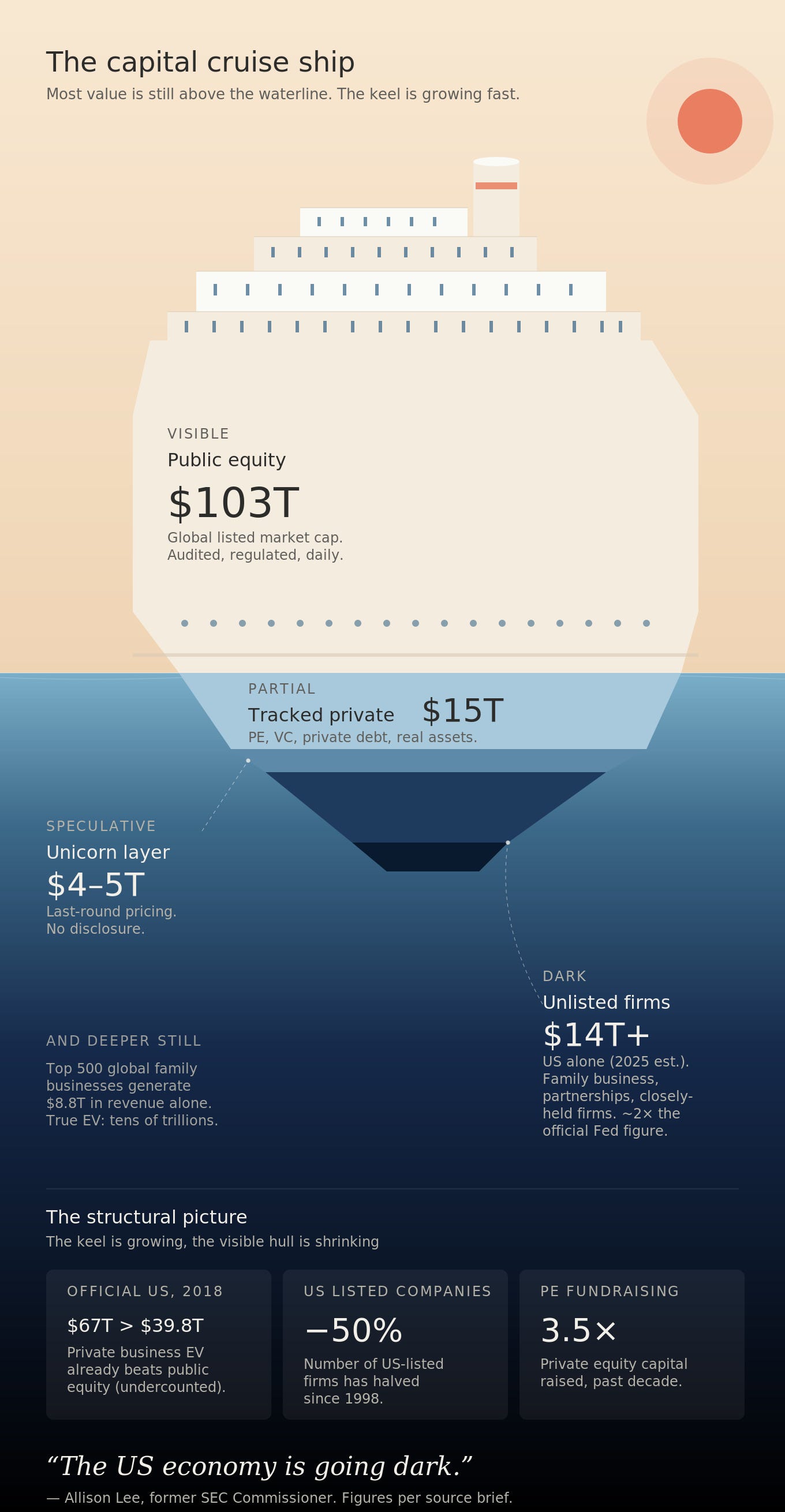
So if we have over-concentration in the S&P 500, what about all those non-public investment vehicles, that the majority of people don’t have access to? I’ve mentioned the high-yield funds with big entry fees: private equity and specialised funds. There’s also venture capital, SPACs (in the US) and other similar investment vehicles. More recently there are the ‘startup unicorns’: household name firms, like Anthropic, that are privately owned yet with valuations of hundreds of billions of dollars. The chart below illustrates the breakdown.
I remember when it was considered crazy that a privately owned firm could be worth more than a billion dollars - the original 39 unicorns of 2013. As of yesterday, 13 years later, there are 1,780 privately owned firms worth more than a billion dollars, according to Crunchbase. The unicorns have been breeding.
Now, the darker the money gets the harder it is to quantify: the difference between publicly listed stocks and private investments is the level of disclosure. Public stocks need to disclose their finances every quarter and there are a bunch of rules about how they do so and who checks them. As you go darker the disclosure requirements get smaller. That’s not to say people hide stuff: private equity firms keep a very close eye on where their money is invested, but it does not have to be disclosed publicly.
So, we can see that the vast majority of money is invested publicly, above the waterline, $103 trillion, versus 15+5+14+8.8 = 43.8 trillion under the water line, estimated. Roughly two thirds public, one third private. But here’s the catch: it is worsening.
Typically, private wealth gets better returns than public wealth. Where your pension may grow at 8-10% a year on a good year, private wealth can double that. Plus the fees are lower, so where the everyman pays, say, 2-3% in fees, the wealthy family pays 0.5-2.5% in fees. On that basis alone the private wealth would be growing 0.5-2.5% faster than public wealth per year.
As you can see from the chart, though, private wealth economic value (EV) already beats public equity. The number of publicly listed US firms has halved since 1998: some have delisted (gone privately owned), some just haven’t listed where you’d expect them to be at a size where it would be typical to do so. The trend, for the US anyway, is that as it gets wealthier, more of that wealth is concentrated among fewer people in more private ways.
Plutocracy is not just knocking on the door of democracy. It has moved in and is quietly refurbishing the place in its own image.
Comments
Nothing yet. Say the first thing.
Sign in to join the conversation.